Results by title
76 books match the query 'Representation' and 3 start with b
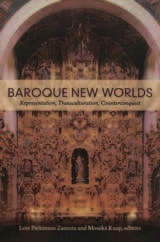
Baroque New Worlds
Representation, Transculturation, CounterconquestLois Parkinson Zamora and Monika Kaup, eds.
Duke University Press, 2010
Since Neobaroque reconstitutions necessarily reference the European Baroque, this volume begins with the reevaluation of the Baroque that evolved in Europe during the late nineteenth century and the early twentieth. Foundational essays by Friedrich Nietzsche, Heinrich Wölfflin, Walter Benjamin, Eugenio d’Ors, René Wellek, and Mario Praz recuperate and redefine the historical Baroque. Their essays lay the groundwork for the revisionist Latin American essays, many of which have not been translated into English until now. Authors including Alejo Carpentier, José Lezama Lima, Severo Sarduy, Édouard Glissant, Haroldo de Campos, and Carlos Fuentes understand the New World Baroque and Neobaroque as decolonizing strategies in Latin America and other postcolonial contexts. This collection moves between art history and literary criticism to provide a rich interdisciplinary discussion of the transcultural forms and functions of the Baroque.
Contributors. Dorothy Z. Baker, Walter Benjamin, Christine Buci-Glucksmann, José Pascual Buxó, Leo Cabranes-Grant, Haroldo de Campos, Alejo Carpentier, Irlemar Chiampi, William Childers, Gonzalo Celorio, Eugenio d’Ors, Jorge Ruedas de la Serna, Carlos Fuentes, Édouard Glissant, Roberto González Echevarría, Ángel Guido, Monika Kaup, José Lezama Lima, Friedrich Nietzsche, Mario Praz, Timothy J. Reiss, Alfonso Reyes, Severo Sarduy, Pedro Henríquez Ureña, Maarten van Delden, René Wellek, Christopher Winks, Heinrich Wölfflin, Lois Parkinson Zamora
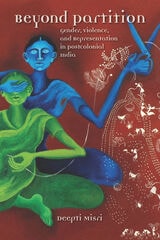
Beyond Partition
Gender, Violence and Representation in Postcolonial IndiaDeepti Misri
University of Illinois Press, 2014
Deepti Misri shows how Partition began a history of politicized animosity associated with the differing ideas of ""India"" held by communities and in regions on one hand, and by the political-military Indian state on the other. She moves beyond that formative national event, however, in order to examine other forms of gendered violence in the postcolonial life of the nation, including custodial rape, public stripping, deturbanning, and enforced disappearances. Assembling literary, historiographic, performative, and visual representations of gendered violence against women and men, Misri establishes that cultural expressions do not just follow violence but determine its very contours, and interrogates the gendered scripts underwriting the violence originating in the contested visions of what ""India"" means.
Ambitious and ranging across disciplines, Beyond Partition offers both an overview of and nuanced new perspectives on the ways caste, identity, and class complicate representations of violence, and how such representations shape our understandings of both violence and India.
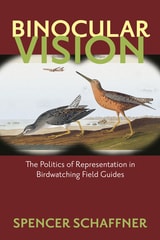
Binocular Vision
The Politics of Representation in Birdwatching Field GuidesSpencer Schaffner
University of Massachusetts Press, 2011
From meadows to marshlands, seashores to suburbs, field guides help us identify many of the things we find outdoors: plants, insects, mammals, birds. In these texts, nature is typically represented, both in words and images, as ordered, clean, and untouched by human technology and development. This preoccupation with species identification, however, has produced an increasingly narrow view of nature, a “binocular vision,” that separates the study of individual elements from a range of larger, interconnected environmental issues. In this book, Spencer Schaffner reconsiders this approach to nature study by focusing on how birds are presented in field guides.
Starting with popular books from the late nineteenth century and moving ultimately to the electronic guides of the current day, Binocular Vision contextualizes birdwatching field guides historically, culturally, and in terms of a wide range of important environmental issues. Schaffner questions the assumptions found in field guides to tease out their ideological workings. He argues that the sanitized world represented in these guides misleads readers by omitting industrial landscapes and so-called nuisance birds, leaving users of the guides disconnected from environmental degradation and its impact on bird populations.
By putting field guides into direct conversation with concerns about species conservation, environmental management, the human alteration of the environment, and the problem of toxic pollution, Binocular Vision is a field guide to field guides that takes a novel perspective on how we think about and interact with the world around us.