Results by title
60 books match the query 'Sculpture & Installation' and 3 start with b
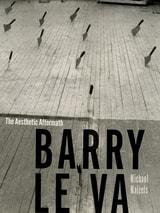
Barry Le Va
The Aesthetic AftermathMichael Maizels
University of Minnesota Press, 2015
Of the conceptual artists who began their careers in the 1960s and 1970s—Bruce Nauman, Chris Burden, Vito Acconci, and Mel Bochner among them—Barry Le Va may be the most elusive. As this first study of his work reveals, his rigorously planned art was instigated to mask its creator’s intentions and methods, presenting itself as an “aftermath” of modernism’s claim to permanency and civil society’s preferred mode of monumentalism.
For Michael Maizels, Le Va’s work constitutes a particularly productive subject of inquiry because it clearly articulates the interconnection between the avant-garde’s distrust of autonomous art objects, two decades of social unrest, the emergence of information theory, and lingering notions of scientific objectivity. Barry Le Va: The Aesthetic Aftermath explores how Le Va used such materials as shattered glass, spent bullets, sound recordings, scattered flour, and meat cleavers embedded in a floor to challenge the interlocking assumptions behind blind faith in lasting beauty, just government, and perfectible knowledge. Taking inspiration from popular crime novels as well as contemporary art theory, Le Va charged his viewers to attempt, like detectives at a crime scene, to decipher an order underlying the apparent chaos.
Le Va’s installations were designed to erode not simply the presumed autonomy of the art object but also the economic and political authority of the art establishment. In his concluding chapter, Maizels looks at the more fixed work of the past two decades in which Le Va turned to architectural themes and cast concrete to probe the limits of dynamism and the idea of permanence.
Boaz Vaadia
SculptureBoaz Vaadia
The Artist Book Foundation, 2016
Boaz Vaadia (1951–2017), the internationally acclaimed sculptor, amassed a prodigious body of work over his 40-year artistic career. With Boaz Vaadia: Sculpture, Grounds For Sculpture in Hamilton, New Jersey, presented the first retrospective exhibition of his indoor and outdoor works in 2016 in a comprehensive survey of the artist's journey from abstraction to figuration. Detailing 125 works installed in two buildings and throughout the 42-acre sculpture park, the exhibition's color catalogue presents Vaadia's ritualistic and highly personal early works, his later sculptures in stone, slate, and bronze, and his explorations of the ancient genre of bas-relief. With the global recognition his art has received, he continued working at the edge, discovering new possibilities in the constantly shifting grounds of his sculpture. Boaz Vaadia: Sculpture is a celebration of the artist's long and prolific career, and his unwavering advancement of his art.
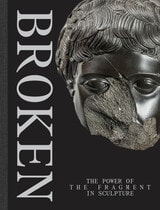
Broken
The Power of the Fragment in SculptureEdited by C. D. Dickerson III and Andrew Sears
University of Chicago Press, 2026
A compelling exploration of fragments in sculpture across time and cultures.
Some objects draw power from the way they have been broken. Becoming beautiful abstract shapes, they provoke consideration of how destruction can create something so aesthetically appealing. Beyond the visual, these fragments are compelling because they force us to confront the often unsettling stories of their breakage.
Published in conjunction with the National Gallery of Art and accompanying a traveling exhibition, this lavishly illustrated book explores our enduring fascination with broken statues through a range of interdisciplinary perspectives, featuring contributions by scholars and artists, along with examples of striking works from around the world spanning the third millennium BCE to the present.
Organized in three sections, Broken begins by investigating what makes fragments so intriguing and reveals the optical and neurological processes behind the strong emotions they evoke. It then moves to the act of breaking itself, exploring the forces—both natural and human—that shaped these objects, the power dynamics of iconoclastic dismantling and defacement, and how various cultures treat broken statues. The book concludes by considering one of the most powerful ways humans have responded to fragments over the course of history: by creating new works that are intentionally fractured.