Results by title
135 books match the query 'Self-help' and 4 start with b

Becoming Alcoholic
Alcoholics Anonymous and the Reality of AlcoholismDavid R. Rudy. Foreword by Norman K. Denzin
Southern Illinois University Press, 1986
Affiliation with Alcoholics Anonymous parallels religious conversion, according to David R. Rudy in this timely study of the most famous self-help organization in the world.
Drinkers who commit themselves to Alcoholics Anonymous embrace the radically different life-style, the altered world of the convert.
To understand this conversion and, more important, to get a grip on the even deeper mystery of alcoholism itself, Rudy sought to answer these three questions: What processes are involved in becoming alcoholic? How does the alcoholic affiliate with, and become committed to, A. A.’s belief system? What is the relationship between the world of A. A. members and that constructed by alcohologists?
Rudy establishes the history and structure of A. A. and examines the organization’s relationship to dominant sociological models, theories, and definitions of alcoholism.
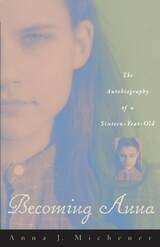
Becoming Anna
Anna J. Michener
University of Chicago Press, 1998
"A teen's raw, in-your-face chronicle of events almost as they were happening. As such, it's unforgettable. . . . Michener's story gives voice to the thousands of children and adolescents trapped in 'the system,' biding their time until their 18th birthdays. A candid and unstinting tell-all."—Kirkus Reviews
"Extraordinary. . . . Michener's expressive writing does justice to a topic that is clearly very disturbing to her personally and communicates a profoundly important message on behalf of all abused and neglected children."—Booklist
"An important book, painful to read, but essential if other children in similar situations are to be saved."—Library Journal
"An innocent child's account of 16 years in hell and of the terrible wrongs inflicted on children who are without rights or caring advocates."—Choice
"[Michener] emerges as a compelling and courageous advocate for children and their welfare—she's a young writer with an extraordinary voice."Feminist Bookstore News
"Quite simply one of the best, most compelling, well-written autobiographies published in years. . . . Remember the name. We have not heard the last of Anna Michener."—Myree Whitfield, Melbourne Herald-Sun, cover story

Becoming a Visually Reflective Practitioner
An Integrated Self-Study Model for Professional PracticeSheri R. Klein and Kathy Marzilli Miraglia
Intellect Books, 2024
Professional practice is increasingly becoming more complex, demanding, dynamic, and diverse, and the fluctuating nature of professional practice necessitates the pursuit of discernment and clarity through ongoing reflective practice. Ideal for visual arts practitioners of all levels, this book presents a self-study model grounded in compelling research that highlights arts-based methods for examining four areas of professional practice: professional identities, work cultures, change and transitions, and new pathways.
Each chapter focuses on a component of the self-study model and an area of professional practice. Additional chapters are devoted to artistic materials and research methods for interpreting self-study artifacts with the aim of goal setting. Throughout the text, charts and end-of-chapter prompts summarize key points, and images by visual arts practitioners represent a wide range of artistic media, methods, and approaches appropriate for self-study. The appendices provide additional resources for enhanced understanding of chapter concepts and key terms, guidelines, and rubrics for writing reflections, creating visual responses, and using a visual journal in the self-study process.

Body Story
Julia K. De Pree
Ohio University Press, 2004
For De Pree, between being a girl and being a woman, there was starvation. Body Story is her intimate account of girlhood, virginity, anorexia, and motherhood. De Pree's prose is spare and unguarded, revealing in vivid flashbacks and poignant vignettes the sources of her inner pain.
In high school, the five-foot-ten De Pree weighed as little as 114 pounds. She was too weak to raise her arms above her head. “In a paradoxical way, I starved my body in order to understand my life,” she writes. “I had to place my body in suspension before I could move physically into sexuality. Starving allowed me to create an interim space between innocence and experience.”
De Pree renders the starkness of anorexia along with the process of recovery, relapse, and, ultimately, redemption. She also tells the story of the physical landscape, from her origins in the Midwest to the American South, Paris, and the vast New Mexican desert, as well as the psychic landscape of her body as it encounters the joys and challenges of maturation, childbirth, and motherhood.
De Pree offers readers a new way of understanding women¿s bodily experience, as she writes about the mystery and the meaning of her illness. As many as eight million Americans suffer from eating disorders. Body Story, unlike clinical reports or news accounts, illuminates the complexity of anorexia as the narrative moves toward a subjective and deeply personal truth.
This evocative and often radiant vision is a unique window into womanhood and selfhood in middle-class, contemporary America.