Results by title
546 books match the query 'Semiotics & Theory' and 17 start with b
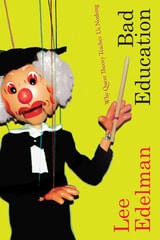
Bad Education
Why Queer Theory Teaches Us NothingLee Edelman
Duke University Press, 2022

Bakhtin’s Adventure
An Essay on Life without MeaningBenjamin Paloff
Northwestern University Press, 2025
A century after Mikhail Bakhtin first began formulating his now-canonical reflections on freedom and literary representation, we often seem as confused as ever about the relationship between narrative form and what it means to live ethically. Focusing on the throughline of adventure in Bakhtin’s thought, we find a peculiar, yet no less ethically urgent challenge: not to imagine the literary hero as if they were a real person but to recognize how we are always imagining real people as if they were literary characters. This is a provocation with far-reaching consequences for how we understand ourselves, each other, and our situatedness in space and time.
In Bakhtin’s Adventure: An Essay on Life without Meaning, Benjamin Paloff argues that the major aesthetic, ethical, and sociological threads of Bakhtin’s thought intersect in his concept of adventure. Reading across a wide variety of media, from classic literature to contemporary film, Paloff demonstrates how, for Bakhtin and his interlocutors, the test of human freedom is whether narrative means nothing beyond its own adventure. Reframed in this light, Bakhtin’s most influential ideas (eventness, chronotope, heteroglossia, polyphony, carnival) form a cohesive model for how to maintain ethical relations in a world where we can never really know each other the way we know ourselves.
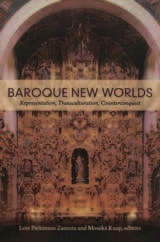
Baroque New Worlds
Representation, Transculturation, CounterconquestLois Parkinson Zamora and Monika Kaup, eds.
Duke University Press, 2010
Since Neobaroque reconstitutions necessarily reference the European Baroque, this volume begins with the reevaluation of the Baroque that evolved in Europe during the late nineteenth century and the early twentieth. Foundational essays by Friedrich Nietzsche, Heinrich Wölfflin, Walter Benjamin, Eugenio d’Ors, René Wellek, and Mario Praz recuperate and redefine the historical Baroque. Their essays lay the groundwork for the revisionist Latin American essays, many of which have not been translated into English until now. Authors including Alejo Carpentier, José Lezama Lima, Severo Sarduy, Édouard Glissant, Haroldo de Campos, and Carlos Fuentes understand the New World Baroque and Neobaroque as decolonizing strategies in Latin America and other postcolonial contexts. This collection moves between art history and literary criticism to provide a rich interdisciplinary discussion of the transcultural forms and functions of the Baroque.
Contributors. Dorothy Z. Baker, Walter Benjamin, Christine Buci-Glucksmann, José Pascual Buxó, Leo Cabranes-Grant, Haroldo de Campos, Alejo Carpentier, Irlemar Chiampi, William Childers, Gonzalo Celorio, Eugenio d’Ors, Jorge Ruedas de la Serna, Carlos Fuentes, Édouard Glissant, Roberto González Echevarría, Ángel Guido, Monika Kaup, José Lezama Lima, Friedrich Nietzsche, Mario Praz, Timothy J. Reiss, Alfonso Reyes, Severo Sarduy, Pedro Henríquez Ureña, Maarten van Delden, René Wellek, Christopher Winks, Heinrich Wölfflin, Lois Parkinson Zamora
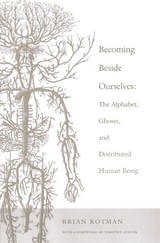
Becoming Beside Ourselves
The Alphabet, Ghosts, and Distributed Human BeingBrian Rotman
Duke University Press, 2008
Alphabetic texts do not convey the bodily gestures of human speech: the hesitations, silences, and changes of pitch that infuse spoken language with affect. Rotman suggests that by removing the body from communication, alphabetic texts enable belief in singular, disembodied, authoritative forms of being such as God and the psyche. He argues that while disembodied agencies are credible and real to “lettered selves,” they are increasingly incompatible with selves and subjectivities formed in relation to new virtual technologies and networked media. Digital motion-capture technologies are restoring gesture and even touch to a prominent role in communication. Parallel computing is challenging the linear thought patterns and ideas of singularity facilitated by alphabetic language. Barriers between self and other are breaking down as the networked self is traversed by other selves to become multiple and distributed, formed through many actions and perceptions at once. The digital self is going plural, becoming beside itself.
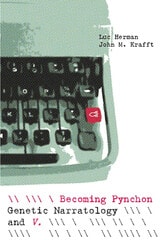
Becoming Pynchon
Genetic Narratology and V.Luc Herman and John M. Krafft
The Ohio State University Press, 2023
The 1963 publication of Thomas Pynchon’s V. changed the landscape of American fiction. Becoming Pynchon: Genetic Narratology and V. offers a detailed examination of the dramatic transformations that took place as Pynchon’s foundational novel went from typescript to published work. Luc Herman and John M. Krafft develop and deploy a rich theory of genetic narratology to examine the performance of genre in the novel. Pushing back against the current dominance of cognitive narratology, they discuss focalization, character construction, and evocation of consciousness as clues to Pynchon’s developing narratology of historical fiction. Their theoretical interventions offer an important and timely corrective to the field of narratology with a method that brings the author back into the analytical frame.
Herman and Krafft use as their guide the typescript of V. that surfaced in 2001, when it was acquired by the Harry Ransom Humanities Research Center, as well as Pynchon’s editorial correspondence with Corlies Smith, his first editor at J. B. Lippincott. Becoming Pynchon assembles a comprehensive and unequaled picture of Pynchon’s writing process that will appeal both to Pynchonians and to postmodernism scholars more broadly.
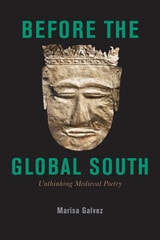
Before the Global South
Unthinking Medieval PoetryMarisa Galvez
University of Chicago Press, 2026
A bold approach to the work of contemporary, Indigenous, and other emergent artists as revisionist adaptations of medieval lyric poetry.
In this book, Marisa Galvez gathers an eclectic array of contemporary poets, artists, writers, and translators—from Brazilian poet Augusto de Campos and Irish painter Louis le Brocquy, to Occitanists Gérard Zuchetto and Jean-Louis Séverac, to Martinican writer Édouard Glissant, poet Rosanna Warren, and essayist Eliot Weinberg—to explore how they reimagine medieval European lyric forms. Galvez calls these adaptations unthought medievalism, and in Before the Global South, she argues that we should understand them as a mode of inquiry that is at once scholarly, critical, and creative. In these modern innovations, Galvez finds an expression of the medieval that challenges popular and scholarly dogmas alike, one she believes can inspire us to create a more shared, global world.
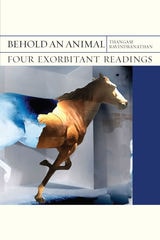
Behold an Animal
Four Exorbitant ReadingsThangam Ravindranathan
Northwestern University Press, 2019
As animals recede from our world, what tale is being told by literature’s creatures? Behold an Animal: Four Exorbitant Readings examines incongruous animals in the works of four major contemporary French writers: an airborne horse in a novel by Jean-Philippe Toussaint, extinct orangutans in Éric Chevillard, stray dogs in Marie NDiaye, vanishing (bits of) hedgehogs in Marie Darrieussecq. Resisting naturalist assumptions that an animal in a story is simply—literally or metaphorically—an animal, Thangam Ravindranathan understands it rather as the location of something missing. The animal is a lure: an unfinished figure fleeing the frame, crossing bounds of period, genre, even medium and language. Its flight traces an exorbitant (self-)portrait in which thinking admits to its commerce with life and flesh. It is in its animals, at the same time unbearably real and exquisitely unreal, that literature may today be closest to philosophy.
This book’s primary focus is the contemporary French novel and continental philosophy. In addition to Toussaint, Chevillard, NDiaye, and Darrieussecq, it engages the work of Jean de La Fontaine, Eadweard Muybridge, Edgar Allan Poe, Lewis Carroll, Samuel Beckett, and Francis Ponge.
Beside You in Time
Sense Methods and Queer Sociabilities in the American Nineteenth CenturyElizabeth Freeman
Duke University Press, 2019
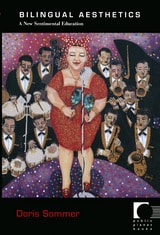
Bilingual Aesthetics
A New Sentimental EducationDoris Sommer
Duke University Press, 2004
Sommer encourages readers to entertain the creative possibilities inherent in multilingualism. With her characteristic wit and love of language, she focuses on humor—particularly bilingual jokes—as the place where tensions between and within cultures are played out. She draws on thinking about humor and language by a range of philosophers and others, including Sigmund Freud, Immanuel Kant, Ludwig Wittgenstein, Hannah Arendt, and Mikhail Bakhtin. In declaring the merits of allowing for crossed signals, Sommer sends a clear message: Making room for more than one language is about value added, not about remediation. It is an expression of love for a contingent and changing world.
Bioinsecurities
Disease Interventions, Empire, and the Government of SpeciesNeel Ahuja
Duke University Press, 2016
Black Aliveness, or A Poetics of Being
Kevin Quashie
Duke University Press, 2021
Black Queer Studies
A Critical AnthologyE. Patrick Johnson and Mae G. Henderson, eds.
Duke University Press, 2005
The contributors consider representations of the black queer body, black queer literature, the pedagogical implications of black queer studies, and the ways that gender and sexuality have been glossed over in black studies and race and class marginalized in queer studies. Whether exploring the closet as a racially loaded metaphor, arguing for the inclusion of diaspora studies in black queer studies, considering how the black lesbian voice that was so expressive in the 1970s and 1980s is all but inaudible today, or investigating how the social sciences have solidified racial and sexual exclusionary practices, these insightful essays signal an important and necessary expansion of queer studies.
Contributors. Bryant K. Alexander, Devon Carbado, Faedra Chatard Carpenter, Keith Clark, Cathy Cohen, Roderick A. Ferguson, Jewelle Gomez, Phillip Brian Harper, Mae G. Henderson, Sharon P. Holland, E. Patrick Johnson, Kara Keeling, Dwight A. McBride, Charles I. Nero, Marlon B. Ross, Rinaldo Walcott, Maurice O. Wallace
Blindness and Insight
Essays in the Rhetoric of Contemporary CriticismPaul De Man
University of Minnesota Press, 1983
Borderwaters
Amid the Archipelagic States of AmericaBrian Russell Roberts
Duke University Press, 2021

Borges
An IntroductionJulio Premat
Vanderbilt University Press, 2021
Originally published in French by an Argentine ex-pat living in Paris, Borges includes the Argentine specificities of Borges’s work—specificities that are often unrecognized or glossed over in Anglophone readings.
This book is a boon for university students of philosophy and literature, teachers and researchers in these fields who are looking to better understand this complex author, and anyone interested in the advanced study of literature. Somewhere between a guidebook and an exhaustive work of advanced research, Borges is the ultimate stepping-stone into the deeper Borgesian world.
Break Up the Anthropocene
Steve Mentz
University of Minnesota Press, 2019
Takes the singular eco-catastrophic “Age of Man” and redefines this epoch
We live in a new world: the Anthropocene. The Age of Man is defined in many ways, and most dramatically through climate change, mass extinction, and human marks in the geological record. Ideas of the Anthropocene spill out from the geophysical sciences into the humanities, social sciences, the arts, and mainstream debates—but it’s hard to know what the new coinage really means. Break Up the Anthropocene argues that this age should subvert imperial masculinity and industrial conquest by opening up the plural possibilities of Anthropocene debates of resilience, adaptation, and the struggle for environmental justice.
Forerunners: Ideas First
Short books of thought-in-process scholarship, where intense analysis, questioning, and speculation take the lead
Breathing Aesthetics
Jean-Thomas Tremblay
Duke University Press, 2022