Results by title
143 books match the query 'Sexuality' and 7 start with b

Bad Books
Rétif de la Bretonne, Sexuality, and PornographyAmy S. Wyngaard
University of Delaware Press, 2013
Published by University of Delaware Press. Distributed worldwide by Rutgers University Press.
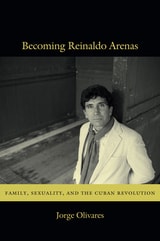
Becoming Reinaldo Arenas
Family, Sexuality, and The Cuban RevolutionJorge Olivares
Duke University Press, 2013
Through insightful close readings of a selection of Arenas's works, including unpublished manuscripts and correspondence, Olivares examines the writer's personal, political, and artistic trajectory, focusing on his portrayals of family, sexuality, exile, and nostalgia. He documents Arenas's critical engagement with cultural and political developments in revolutionary Cuba and investigates the ways in which Arenas challenged literary and national norms. Olivares's analysis shows how Arenas drew on his life experiences to offer revealing perspectives on the Cuban Revolution, the struggles of Cuban exiles, and the politics of sexuality.
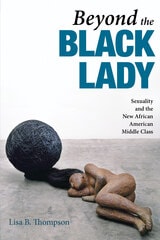
Beyond the Black Lady
Sexuality and the New African American Middle ClassLisa B. Thompson
University of Illinois Press, 2012

Bodies of Knowledge
Sexuality, Reproduction, and Women's Health in the Second WaveWendy Kline
University of Chicago Press, 2010
Throughout the 1970s and ’80s, women argued that unless they gained access to information about their own bodies, there would be no equality. In Bodies of Knowledge, Wendy Kline considers the ways in which ordinary women worked to position the female body at the center of women’s liberation.
As Kline shows, the struggle to attain this knowledge unified women but also divided them—according to race, class, sexuality, or level of professionalization. Each of the five chapters of Bodies of Knowledge examines a distinct moment or setting of the women’s movement in order to give life to the ideas, expectations, and pitfalls encountered by the advocates of women’s health: the making of Our Bodies, Ourselves (1973); the conflicts surrounding the training and practice of women’s pelvic exams; the emergence of abortion as a feminist issue; the battles over contraceptive regulation at the 1983 Depo-Provera FDA hearings; and the rise of the profession of midwifery. Including an epilogue that considers the experiences of the daughters of 1970s feminists, Bodies of Knowledge is an important contribution to the study of the bodies—that marked the lives—of feminism’s second wave.
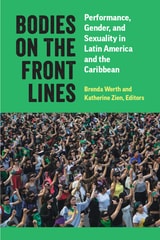
Bodies on the Front Lines
Performance, Gender, and Sexuality in Latin America and the CaribbeanBrenda Werth and Katherine Zien, Editors
University of Michigan Press, 2024
The volume’s contributors draw from rich legacies of theater, performance, and activism in the region, as well as decolonial and intersectional theorizing, to demonstrate the ways that performance practices enable activists to sustain their movements. The chapters engage diverse perspectives from Argentina, Brazil, Bolivia, Chile, Colombia, Cuba, the Dominican Republic, transnational Central America, Peru, Puerto Rico, and Mexico.
Rather than taking an approach that simplifies complexities among states, Bodies on the Front Lines takes seriously the geopolitical stakes of examining Latin America and the Caribbean as a heterogeneous site of nations and networks. In chapters covering this wide geographical area, leading scholars in the fields of theater and performance studies showcase the aesthetic, social, and political work of performance in generating and fortifying gender and sexual activism in the Americas.
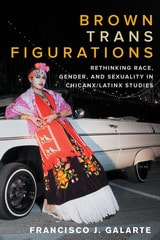
Brown Trans Figurations
Rethinking Race, Gender, and Sexuality in Chicanx/Latinx StudiesBy Francisco J. Galarte
University of Texas Press, 2021
Honorable Mention for the National Women’s Studies Association's 2021 Gloria E. Anzaldúa Book Prize
2021 Finalist Best LGBTQ+ Themed Book, International Latino Book Awards
2022 John Leo & Dana Heller Award for Best Single Work, Anthology, Multi-Authored, or Edited Book in LGBTQ Studies, Popular Culture Association
The Alan Bray Memorial Book Prize, GL/Q Caucus, Modern Language Association (MLA)
2022 AAHHE Book of the Year Award, American Association of Hispanics in Higher Education
Within queer, transgender, and Latinx and Chicanx cultural politics, brown transgender narratives are frequently silenced and erased. Brown trans subjects are treated as deceptive, unnatural, nonexistent, or impossible, their bodies, lives, and material circumstances represented through tropes and used as metaphors. Restoring personhood and agency to these subjects, Francisco J. Galarte advances “brown trans figuration” as a theoretical framework to describe how transness and brownness coexist within the larger queer, trans, and Latinx historical experiences.
Brown Trans Figurations presents a collection of representations that reveal the repression of brown trans narratives and make that repression visible and palpable. Galarte examines the violent deaths of two transgender Latinas and the corresponding narratives that emerged about their lives, analyzes the invisibility of brown transmasculinity in Chicana feminist works, and explores how issues such as transgender politics can be imagined as part of Chicanx and Latinx political movements. This book considers the contexts in which brown trans narratives appear, how they circulate, and how they are reproduced in politics, sexual cultures, and racialized economies.
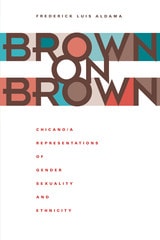
Brown on Brown
Chicano/a Representations of Gender, Sexuality, and EthnicityBy Frederick Luis Aldama
University of Texas Press, 2005
Common conceptions permeating U.S. ethnic queer theory tend to confuse aesthetics with real-world acts and politics. Often Chicano/a representations of gay and lesbian experiences in literature and film are analyzed simply as propaganda. The cognitive, emotional, and narrational ingredients (that is, the subject matter and the formal traits) of those representations are frequently reduced to a priori agendas that emphasize a politics of difference.
In this book, Frederick Luis Aldama follows an entirely different approach. He investigates the ways in which race and gay/lesbian sexuality intersect and operate in Chicano/a literature and film while taking into full account their imaginative nature and therefore the specific kind of work invested in them. Also, Aldama frames his analyses within today's larger (globalized) context of postcolonial literary and filmic canons that seek to normalize heterosexual identity and experience. Throughout the book, Aldama applies his innovative approach to throw new light on the work of authors Arturo Islas, Richard Rodriguez, John Rechy, Ana Castillo, and Sheila Ortiz Taylor, as well as that of film director Edward James Olmos. In doing so, Aldama aims to integrate and deepen Chicano literary and filmic studies within a comparative perspective. Aldama's unusual juxtapositions of narrative materials and cultural personae, and his premise that literature and film produce fictional examples of a social and historical reality concerned with ethnic and sexual issues largely unresolved, make this book relevant to a wide range of readers.