201 books match the query 'Social movements' and 6 start with b

cover of Bearing Witness against Sin: The Evangelical Birth of the American Social Movement

Bearing Witness against Sin

The Evangelical Birth of the American Social Movement

Michael P. Young

University of Chicago Press, 2007

During the 1830s the United States experienced a wave of movements for social change over temperance, the abolition of slavery, anti-vice activism, and a host of other moral reforms. Michael Young argues for the first time in Bearing Witness against Sin that together they represented a distinctive new style of mobilization—one that prefigured contemporary forms of social protest by underscoring the role of national religious structures and cultural schemas.

In this book, Young identifies a new strain of protest that challenged antebellum Americans to take personal responsibility for reforming social problems.In this period activists demanded that social problems like drinking and slaveholding be recognized as national sins unsurpassed in their evil and immorality. This newly awakened consciousness undergirded by a confessional style of protest, seized the American imagination and galvanized thousands of people. Such a phenomenon, Young argues, helps explain the lives of charismatic reformers such as William Lloyd Garrison and the Grimké sisters, among others.

Marshalling lively historical materials, including letters and life histories of reformers, Bearing Witness against Sin is a revelatory account of how religion lay at the heart of social reform.
[more]
cover of Beyond Civil Society: Activism, Participation, and Protest in Latin America

Beyond Civil Society

Activism, Participation, and Protest in Latin America

Sonia E. Alvarez, Jeffrey W. Rubin, Millie Thayer, Gianpaolo Baiocchi, and Agustín Laó-Montes, editors

Duke University Press, 2017

The contributors to Beyond Civil Society argue that the conventional distinction between civic and uncivic protest, and between activism in institutions and in the streets, does not accurately describe the complex interactions of forms and locations of activism characteristic of twenty-first-century Latin America. They show that most contemporary political activism in the region relies upon both confrontational collective action and civic participation at different moments. Operating within fluid, dynamic, and heterogeneous fields of contestation, activists have not been contained by governments or conventional political categories, but rather have overflowed their boundaries, opening new democratic spaces or extending existing ones in the process. These essays offer fresh insight into how the politics of activism, participation, and protest are manifest in Latin America today while providing a new conceptual language and an interpretive framework for examining issues that are critical for the future of the region and beyond.

Contributors. Sonia E. Alvarez, Kiran Asher, Leonardo Avritzer, Gianpaolo Baiocchi, Andrea Cornwall, Graciela DiMarco, Arturo Escobar, Raphael Hoetmer, Benjamin Junge, Luis E. Lander, Agustín Laó-Montes, Margarita López Maya, José Antonio Lucero, Graciela Monteagudo, Amalia Pallares, Jeffrey W. Rubin, Ana Claudia Teixeira, Millie Thayer
[more]
cover of Beyond Words: Story of Sensitivity Training and the Encounter Movement

Beyond Words

Story of Sensitivity Training and the Encounter Movement

Kurt W. Back

Russell Sage Foundation, 1972
Sensitivity training, T-Groups, and encounter groups have become a way of life. Beyond Words traces the history of this movement, the background of its successes, its varieties, and its failures. Dr. Back's approach is neither one of wide-eyed admiration nor hostility. Instead, he has written a book that provides the first long, hard look at sensitivity training as a social phenomenon. From its fortuitous beginnings the movement is followed through its developments at Bethel, its growth across the country, its new centers in California, its spread to Europe. The novelty of this movement, an almost religious exercise based on the scientific ethos, is related to the peculiar conditions of the last quarter century. The movement has acquired its own mythos. Dr. Back examines the interplay of the conflicting aims of self-expression and change, and shows how these contradictory aims have affected the ramifications of the movement in theory, in management, in recreation, and in education. Results emerging from studies on effects of sensitivity training indicate a recurrent pattern of great immediate emphasis followed by little permanent beneficial effect. Finally, Beyond Words assesses the overall impact of the movement, its relation to science, its possible changes, and its portent as a symptom of the state of society. Dr. Back examines the interplay of the conflicting aims of self-expression and change, and shows how these contradictory aims have affected the ramifications of the movement in theory, in management, in recreation, and in education.
[more]
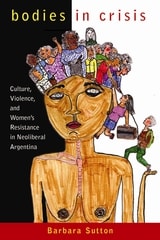
cover of Bodies in Crisis: Culture, Violence, and Women's Resistance in Neoliberal Argentina

Bodies in Crisis

Culture, Violence, and Women's Resistance in Neoliberal Argentina

Sutton, Barbara

Rutgers University Press, 2010

Born and raised in Argentina and still maintaining significant ties to the area, Barbara Sutton examines the complex, and often hidden, bodily worlds of diverse women in that country during a period of profound social upheaval. Based primarily on women's experiential narratives and set against the backdrop of a severe economic crisis and intensified social movement activism post-2001, Bodies in Crisis illuminates how multiple forms of injustice converge in and are contested through women's bodies. Sutton reveals the bodily scars of neoliberal globalization; women's negotiation of cultural norms of femininity and beauty; experiences with clandestine, illegal, and unsafe abortions; exposure to and resistance against interpersonal and structural violence; and the role of bodies as tools and vehicles of political action.

Through the lens of women's body consciousness in a Global South country, and drawing on multifaceted stories and a politically embedded approach, Bodies in Crisis suggests that social policy, economic systems, cultural ideologies, and political resistance are ultimately fleshly matters.
[more]
cover of Brazil's Long Revolution: Radical Achievements of the Landless Workers Movement

Brazil's Long Revolution

Radical Achievements of the Landless Workers Movement

Anthony Pahnke

University of Arizona Press, 2018

Economic crises in the Global North and South are forcing activists to think about alternatives. Neoliberal economic policies and austerity measures have been debated and implemented around the globe. Author Anthony Pahnke argues that activists should look to the Global South and Brazil for inspiration.

Brazil’s Long Revolution shows how the Movimento dos Trabalhadores Rurais Sem Terra (the Brazilian Landless Workers Movement, or MST) positioned itself to take advantage of challenging economic times to improve its members’ lives. Pahnke analyzes the origins and development of the movement, one of the largest and most innovative social movements currently active. Over the last three decades, the MST has mobilized more than a million Brazilians through grassroots initiatives, addressing political and economic inequalities.

The MST and its allies—together known as the Landless Movement—confront inequality by constructing democratic ways of governing economic, political, and social life in collectivized production cooperatives, movement-run schools, and decentralized agrarian reform encampments and settlements. Their strategies for organizing political, economic, and social life challenge the current neoliberal orthodoxy that privileges individualized, market-oriented practices.

Based on research conducted over five years, Pahnke’s book places the Landless Movement squarely within the tradition of Latin American revolutionary struggles, while at the same time showing the potential for similar forms of radical resistance to develop in the United States and elsewhere in the Global North.

[more]
cover of Bridging Scholarship and Activism: Reflections from the Frontlines of Collaborative Research

Bridging Scholarship and Activism

Reflections from the Frontlines of Collaborative Research

Bernd Reiter

Michigan State University Press, 2015

This timely book brings together activist scholars from a number of disciplines (political science, geography, sociology, anthropology, and communications) to provide new insights into a growing trend in publicly engaged research and scholarship. Bridging Scholarship and Activism creatively redefines what constitutes activism without limiting it to a narrow range of practices. Acknowledging that the current conjuncture of neoliberal globalization has created constraints on as well as possibilities for activist scholarly engagement, the book argues that racism and its intersections with gender and class oppression are salient forces to be interrogated and confronted in the predicaments and struggles activist scholarship targets. The book’s ultimate goal is to create a decolonized and democratized forum in which activist scholars from the Global South converse and cross-fertilize ideas and projects with their counterparts from the United States and other North Atlantic metropolitan-based academy. The coeditors and contributors attempt to decenter hegemonic knowledge and to create some of the necessary (if not sufficient) conditions for a more pluriversal (rather than orthodox “universal”) context for producing enabling knowledge, without the naiveté and romanticism that has characterized earlier projects in critical and radical social science.

CONTENTS:
Introduction, Ulrich Oslender and Bernd Reiter
Part One. The Promises and Pitfalls of Collaborative Research
  • Of Academic Embeddedness: Communities of Choice and How to Make Sense of Activism and Research Abroad, Bernd Reiter
  • New Shapes of Revolution, Gustavo Esteva
  • The Accidental Activist Scholar: A Memoir on Reactive Boundary and Identity Work for Social Change within the Academy, Rob Benford
  • Leaving the Field: How to Write about Disappointment and Frustration in Collaborative Research, Ulrich Oslender
  • Invisible Heroes, Eshe Lewis
Part Two. Negotiating Racialized and Gendered Positionalities
  • El Muntuen America, Manuel Zapata Olivella
  • Activism as History Making: The Collective and the Personal in Collaborative Research with the Process of Black Communities in Colombia, Arturo Escobar
  • Out of Bounds: Negotiating Researcher Positionality in Brazil, Elizabeth Hordge-Freeman
  • Between Soapboxes and Shadows: Activism, Theory, and the Politics of Life and Death in Salvador, Bahia, Brazil, Christen A. Smith
  • State Violence and the Ethnographic Encounter: Feminist Research and Racial Embodiment, Keisha-Khan Y. Perry
  • The Challenges Resulting from Combining Scientific Production and Social-Political Activism in the Brazilian Academy, Fernando Conceição
  • The Challenge of Doing Applied/Activist Anti-Racist Anthropology in Revolutionary Cuba, Gayle L. McGarrity
  • Conclusion, Ulrich Oslender and Bernd Reiter
  • About the Authors
[more]