Results by title
150 books match the query 'Social psychology' and 4 start with b

Black Undertow
Hugo ka Canham
Duke University Press, 2026
Meditative and theoretical, Black Undertow reorients the thinking of blackness away from the Atlantic to the African shorelines of the Indian Ocean, places where queerness and black life frequently brush up against one another. Hugo ka Canham listens for what he names the buzz of the undertow, the traces of African ancestors who linger in water, sand, coastal forts, corals, ritual practices, and unruly imaginations along the shore. In tracking these elusive figures, he develops an approach that honors a queer right to opacity. Canham reconstitutes the siloed disciplinarity that imagines African studies, Black studies, Queer African studies, and Queer studies as necessarily different. When read as coconstitutive instead, Canham demonstrates that they better allow for explicating local life, history, poetics, and theory. In so doing, he forges methods of studying black life that think beyond the limits of traditional, textual archives.
[more]
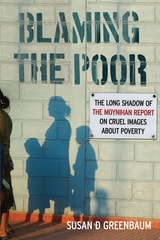
Blaming the Poor
The Long Shadow of the Moynihan Report on Cruel Images about PovertyGreenbaum, Susan D
Rutgers University Press, 2015
In 1965, the late Senator Daniel Patrick Moynihan—then a high-ranking official in the Department of Labor—sparked a firestorm when he released his report “The Negro Family,” which came to be regarded by both supporters and detractors as an indictment of African American culture. Blaming the Poor examines the regrettably durable impact of the Moynihan Report for race relations and social policy in America, challenging the humiliating image the report cast on poor black families and its misleading explanation of the causes of poverty.
A leading authority on poverty and racism in the United States, Susan D. Greenbaum dismantles Moynihan’s main thesis—that the so called matriarchal structure of the African American family “feminized” black men, making them inadequate workers and absent fathers, and resulting in what he called a tangle of pathology that led to a host of ills, from teen pregnancy to adult crime. Drawing on extensive scholarship, Greenbaum highlights the flaws in Moynihan’s analysis. She reveals how his questionable ideas have been used to redirect blame for substandard schools, low wages, and the scarcity of jobs away from the societal forces that cause these problems, while simultaneously reinforcing stereotypes about African Americans. Greenbaum also critiques current policy issues that are directly affected by the tangle of pathology mindset—the demonization and destruction of public housing; the criminalization of black youth; and the continued humiliation of the poor by entrepreneurs who become rich consulting to teachers, non-profits, and social service personnel.
A half century later, Moynihan’s thesis remains for many a convenient justification for punitive measures and stingy indifference to the poor. Blaming the Poor debunks this infamous thesis, proposing instead more productive and humane policies to address the enormous problems facing us today.
[more]

Blush
Faces of ShameElspeth Probyn
University of Minnesota Press, 2005
With the rise of pride - national pride, gay pride, black pride, fat pride - shame, the "sickness of the soul," has acquired a bad reputation. While the repudiation of some forms and consequences of societal shame are undoubtedly necessary, Elspeth Probyn contends that this emotion is a powerful resource in rethinking who we are and who we want to be. When we blush, we are driven to question what we value about ourselves and why. Blush argues that we are all born with a capacity for shame, much as we are born with the capacity for anger or pride, and that shame, like these other emotions, can be good for us and reveal the good in us. Painfully introspective, shame demands that we question our actions and our relationship to others. Shame's physical manifestation - the blush - gives us away, connecting us to our humanity. What shames us says a great deal about our character as individuals and as a society, about our past and our desires for the future. Written in an engaging and personal style, Blush combines psychology and cultural criticism, sociology and popular science, to present a unique perspective on debates about the ethics and emotion of identity.
[more]
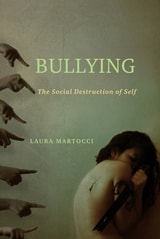
Bullying
The Social Destruction of SelfLaura Martocci
Temple University Press, 2015
In her forceful social history, Bullying, Laura Martocci explores the “bully culture” that has claimed national attention since the late 1990s.
Moving beyond the identification of aggressive behaviors to an analysis of how and why we have arrived at a culture that thrives on humiliation, she critiques the social forces that gave rise to, and help maintain, bullying. Martocci’s analysis of gossip, laughter, stereotyping, and competition—dynamics that foment bullying and prompt responses of shame, violence, and depression—is positioned within a larger social narrative: the means by which we negotiate damaged social bonds and the role that bystanders play in the possibility of atonement, forgiveness, and redemption.
Martocci’s fresh perspective on bullying positions shame as pivotal. She urges us to acknowledge the pain and confusion caused by social disgrace; to understand its social, psychological, and neurological nature; and to address it through narratives of loss, grief, and redemption—cultural supports that are already in place.
[more]