Results by title
72 books match the query 'Social structure' and 5 start with b
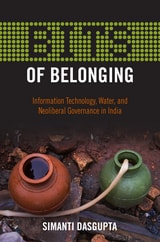
BITS of Belonging
Information Technology, Water, and Neoliberal Governance in IndiaSimanti Dasgupta
Temple University Press, 2015
India’s global success in the Information Technology industry has also prompted the growth of neoliberalism and the re-emergence of the middle class in contemporary urban areas, such as Bangalore. In her significant study, BITS of Belonging, Simanti Dasgupta shows that this economic shift produces new forms of social inequality while reinforcing older ones. She investigates this economic disparity by looking at IT and water privatization to explain how these otherwise unrelated domains correspond to our thinking about citizenship, governance, and belonging.
Dasgupta’s ethnographic study shows how work and human processes in the IT industry intertwine to meet the market stipulations of the global economy. Meanwhile, in the recasting of water from a public good to a commodity, the middle class insists on a governance and citizenship model based upon market participation. Dasgupta provides a critical analysis of the grassroots activism involved in a contested water project where different classes lay their divergent claims to the city.
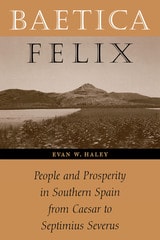
Baetica Felix
People and Prosperity in Southern Spain from Caesar to Septimius SeverusBy Evan W. Haley
University of Texas Press, 2003
Baetica, the present-day region of Andalusia in southern Spain, was the wealthiest province of the Roman Empire. Its society was dynamic and marked by upward social and economic mobility, as the imperial peace allowed the emergence of a substantial middle social and economic stratum. Indeed, so mutually beneficial was the imposition of Roman rule on the local population of Baetica that it demands a new understanding of the relationship between Imperial Rome and its provinces.
Baetica Felix builds a new model of Roman-provincial relations through a socio-economic history of the province from Julius Caesar to the end of the second century A.D. Describing and analyzing the impact of Roman rule on a core province, Evan Haley addresses two broad questions: what effect did Roman rule have on patterns of settlement and production in Baetica, and how did it contribute to wealth generation and social mobility? His findings conclusively demonstrate that meeting the multiple demands of the Roman state created a substantial freeborn and ex-slave "middle stratum" of the population that outnumbered both the super-rich elite and the destitute poor.
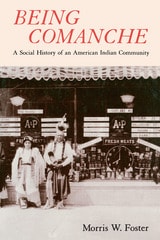
Being Comanche
The Social History of an American Indian CommunityMorris W. Foster
University of Arizona Press, 1991
Comanches have engaged Euro-Americans' curiosity for three centuries. Their relations with Spanish, French, and Anglo-Americans on the southern Plains have become a highly resonant part of the mythology of the American West. Yet we know relatively little about the community that Comanches have shared and continue to construct in southwestern Oklahoma. Morris W. Foster has written the first study of Comanches' history that identifies continuities in their intracommunity organization from the initial period of European contact to the present day. Those continuities are based on shared participation in public social occasions such as powwows, peyote gatherings, and church meetings Foster explains how these occasions are used to regulate social organization and how they have been modified by Comanches to adapt them to changing political and economic relations with Euro-Americans. Using a model of community derived from sociolinguistics, Foster argues that Comanches have remained a distinctive people by organizing their face-to-face relations with one another in ways that maintain Comanche-Comanche lines of communication and regulate a shared sense of appropriate behavior. His book offers readers a significant reinterpretation of traditional anthropological and historical views of Comanche social organization.
Between Us
Healing Ourselves and Changing the World Through SociologyEdited by Marika Lindholm and Elizabeth Anne Wood
University of Chicago Press, 2024
The world is a tough place right now. Climate change, income inequality, racist violence, and the erosion of democracy have exposed the vulnerability of our individual and collective futures. But as the sociologists gathered here by Marika Lindholm and Elizabeth Wood show, no matter how helpless we might feel, it’s vital that we discover new paths toward healing and change. The short, accessible, emotionally and intellectually powerful essays in Between Us offer a transformative new way to think about sociology and its ability to fuel personal and social change. These forty-five essays reflect a diverse range of experiences. Whether taking an adult son with autism grocery shopping or fighting fires in Barcelona, contending with sexism at the beach or facing racism at a fertility clinic, celebrating one’s immigrant heritage, or acknowledging one’s KKK ancestors, this book shows students that sociology is deeply rooted in everyday life and can be used to help us process and understand it. A perfect introduction to the discipline and why it matters, Between Us will resonate with students from all backgrounds as they embark on their academic journey.
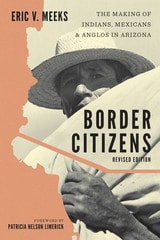
Border Citizens
The Making of Indians, Mexicans, and Anglos in ArizonaBy Eric V. Meeks; foreword by Patricia Nelson Limerick
University of Texas Press, 2007
In Border Citizens, historian Eric V. Meeks explores how the racial classification and identities of the diverse indigenous, mestizo, and Euro-American residents of Arizona’s borderlands evolved as the region was politically and economically incorporated into the United States. First published in 2007, the book examines the complex relationship between racial subordination and resistance over the course of a century. On the one hand, Meeks links the construction of multiple racial categories to the process of nation-state building and capitalist integration. On the other, he explores how the region’s diverse communities altered the blueprint drawn up by government officials and members of the Anglo majority for their assimilation or exclusion while redefining citizenship and national belonging.
The revised edition of this highly praised and influential study features dozens of new images, an introductory essay by historian Patricia Nelson Limerick, and a chapter-length afterword by the author. In his afterword, Meeks details and contextualizes Arizona’s aggressive response to undocumented immigration and ethnic studies in the decade after Border Citizens was first published, demonstrating that the broad-based movement against these measures had ramifications well beyond Arizona. He also revisits the Yaqui and Tohono O’odham nations on both sides of the Sonora-Arizona border, focusing on their efforts to retain, extend, and enrich their connections to one another in the face of increasingly stringent border enforcement.