Results by title
86 books match the query 'Soul' and 6 start with b

Battle for the Soul
Mètis Children Encounter Evangelical Protestants at Mackinaw Mission, 1823-1837Keith R. Widder
Michigan State University Press, 1999
In 1823 William and Amanda Ferry opened a boarding school for Métis children on Mackinac Island, Michigan Territory, setting in motion an intense spiritual battle to win the souls and change the lives of the children, their parents, and all others living at Mackinac. Battle for the Soul demonstrates how a group of enthusiastic missionaries, empowered by an uncompromising religious motivation, served as agents of Americanization. The Ferrys' high hopes crumbled, however, as they watched their work bring about a revival of Catholicism and their students refuse to abandon the fur trade as a way of life. The story of the Mackinaw Mission is that of people who held differing world views negotiating to create a "middle-ground," a society with room for all.
Widder's study is a welcome addition to the literature on American frontier missions. Using Richard White's "middle ground" paradigm, it focuses on the cultural interaction between French, British, American, and various native groups at the Mackinac mission in Michigan during the early 19th century. The author draws on materials from the American Board of Commissioners for Foreign Missions archives, as well as other manuscript sources, to trace not only the missionaries' efforts to Christianize and Americanize the native peoples, but the religious, social, and cultural conflicts between Protestant missionaries and Catholic priests in the region. Much attention has been given to the missionaries to the Indians in other areas of the US, but little to this region.

Become Like the Angels
Benjamin P. Blosser
Catholic University of America Press, 2012
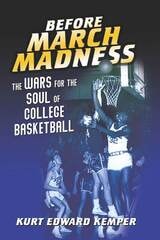
Before March Madness
The Wars for the Soul of College BasketballKurt Edward Kemper
University of Illinois Press, 2020
Kurt Edward Kemper tells the dramatic story of the clashes that shook college basketball at mid-century—and how the repercussions continue to influence college sports to the present day. Taking readers inside the competing factions, he details why historically black colleges and regional schools came to embrace commercialization. As he shows, the NCAA's strategy of co-opting its opponents gave each group just enough just enough to play along—while the victory of the big-time athletics model handed the organization the power to seize control of college sports.
An innovative history of an overlooked era, Before March Madness looks at how promises, power, and money laid the groundwork for an American sports institution.

Black Lawyers, White Courts
The Soul of South African LawKenneth S. Broun
Ohio University Press, 2000
In the struggle against apartheid, one often overlooked group of crusaders was the coterie of black lawyers who overcame the Byzantine system that the government established oftentimes explicitly to block the paths of its black citizens from achieving justice.
Now, in their own voices, we have the narratives of many of those lawyers as recounted in a series of oral interviews. Black Lawyers, White Courts is their story and the anti-apartheid story that has before now gone untold.
Professor Kenneth Broun conducted interviews with twenty-seven black South African lawyers. They were asked to tell about their lives, including their family backgrounds, education, careers, and their visions for the future. In many instances they also discussed their years in prison or exile, or under house arrest. Most told of both education and careers interrupted because of the ongoing struggle.
The story of the professional achievements of black lawyers in South Africa—indeed their very survival—provides an example of the triumph of individuals and, ultimately, of the law. Black Lawyers, White Courts is about South Africa, and about black professionals in that country, but the lessons its protagonists teach extend far beyond circumstances, geography, or race.

Body and Soul
Essays on PoetryMark Jarman
University of Michigan Press, 2002
The essays "Where Poems Take Place" and "A Shared Humanity" consider the relation between setting or situation and representation. The psychological roots of narrative are considered in "The Primal Storyteller." But the main interest of these essays is how and why narrative is used as a form. The influence of Robinson Jeffers's style of narrative is argued in "Slip, Shift, and Speed Up: The Influence of Robinson Jeffers's Narrative Syntax." In "The Trace of a Story Line" an argument is made that the poets Philip Levine and Charles Wright employ narration or storytelling in their poetry as a mode of meaning. Other essays consider Donald Davie, Philip Larkin, Herbert Lomas, Louis Simpson, Lyn Hejinian, Tess Gallagher, and Ellen Bryant Voigt.
Mark Jarman's poetry has appeared in many publications, including the American Poetry Review and the New Yorker. He has won the Lenore Marshall/Nation Prize of the Academy of American Poets, a Guggenheim fellowship, and multiple grants from the National Endowment for the Arts. He is Professor of English, Vanderbilt University.
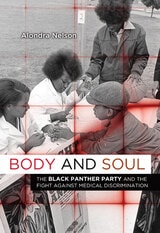
Body and Soul
The Black Panther Party and the Fight against Medical DiscriminationAlondra Nelson
University of Minnesota Press, 2013
Between its founding in 1966 and its formal end in 1980, the Black Panther Party blazed a distinctive trail in American political culture. The Black Panthers are most often remembered for their revolutionary rhetoric and militant action. Here Alondra Nelson deftly recovers an indispensable but lesser-known aspect of the organization’s broader struggle for social justice: health care. The Black Panther Party’s health activism—its network of free health clinics, its campaign to raise awareness about genetic disease, and its challenges to medical discrimination—was an expression of its founding political philosophy and also a recognition that poor blacks were both underserved by mainstream medicine and overexposed to its harms.
Drawing on extensive historical research as well as interviews with former members of the Black Panther Party, Nelson argues that the Party’s focus on health care was both practical and ideological. Building on a long tradition of medical self-sufficiency among African Americans, the Panthers’ People’s Free Medical Clinics administered basic preventive care, tested for lead poisoning and hypertension, and helped with housing, employment, and social services. In 1971, the party launched a campaign to address sickle-cell anemia. In addition to establishing screening programs and educational outreach efforts, it exposed the racial biases of the medical system that had largely ignored sickle-cell anemia, a disease that predominantly affected people of African descent.
The Black Panther Party’s understanding of health as a basic human right and its engagement with the social implications of genetics anticipated current debates about the politics of health and race. That legacy—and that struggle—continues today in the commitment of health activists and the fight for universal health care.