Results by title
501 books match the query 'South' and 23 start with b

Back Home
Journeys through MobileRoy Hoffman
University of Alabama Press, 2007
After twenty years in New York City, a prize-winning writer takes a "long look back" at his hometown of Mobile, Alabama.
In Back Home: Journeys through Mobile, Roy Hoffman tells stories—through essays, feature articles, and memoir—of one of the South's oldest and most colorful port cities. Many of the pieces here grew out of Hoffman's work as Writer-in-Residence for his hometown newspaper, the Mobile Register, a position he took after working in New York City for twenty years as a journalist, fiction writer, book critic, teacher, and speech writer. Other pieces were first published in the New York Times, Southern Living, Preservation, and other publications. Together, this collection comprises a long, second look at the Mobile of Hoffman's childhood and the city it has since become.
Like a photo album, Back Home presents close-up portraits of everyday places and ordinary people. There are meditations on downtown Mobile, where Hoffman's grandparents arrived as immigrants a century ago; the waterfront where longshoremen labor and shrimpers work their nets; the back roads leading to obscure but intriguing destinations. Hoffman records local people telling their own tales of race relations, sports, agriculture, and Mardi Gras celebrations. Fishermen, baseball players, bakers, authors, political figures--a strikingly diverse population walks across the stage of Back Home.
Throughout, Hoffman is concerned with stories and their enduring nature. As he writes, "When buildings are leveled, when land is developed, when money is spent, when our loved ones pass on, when we take our places a little farther back every year on the historical time-line, what we have still are stories."
Bactria
The History of a Forgotten EmpireHugh George Rawlinson
Westholme Publishing, 2013
“If through the Bactrian Empire European ideas were transmitted to the Far East, through that and similar channels Asiatic ideas found their way to Europe.”—Intellectual Development of Europe
Following the Macedonian invasion of Persian in the fourth century B.C., an independent Greek-ruled empire emerged over an area encompassing modern Afghanistan, eastern Iran, and northern Pakistan. This ancient empire, called Bactria, is recorded in texts, both Asian and European, as well as through coins, inscriptions, and architectural remnants. Bactria served as a contact point between Europe, South Asia, and the Far East for more than two hundred years before disappearing under the pressure of a resurgent Persia to the west and Indian states to the east. In Bactria: The History of a Forgotten Empire, historian Hugh G. Rawlinson begins with the early history of Bactria and its subjugation by Persia, and then describes the conquest of Iran by Alexander the Great and the establishment of an independent Bactria ruled by Greeks. The Bactrians adopted Buddhism early on and helped establish the religion throughout the area. The author then follows the history of the empire through its rulers, including Menander, until Greek rule was extinguished around 135 B.C. Finally, the author discusses the effects of Greek occupation on the region. Based on meticulous research in ancient texts from Greece, Persia, and India, and using material evidence of the time, this history, which won the Hare University Prize at Cambridge in 1909, remains relevant today, providing a fascinating portrait of a little-known connection between East and West.
Becoming Imperial Citizens
Indians in the Late-Victorian EmpireSukanya Banerjee
Duke University Press, 2010
Interpreting autobiography, fiction, election speeches, economic analyses, parliamentary documents, and government correspondence, Banerjee foregrounds the narrative logic sustaining the unprecedented claims to citizenship advanced by racialized colonial subjects. She focuses on the writings of figures such as Dadabhai Naoroji, known as the first Asian to be elected to the British Parliament; Surendranath Banerjea, among the earliest Indians admitted into the Indian Civil Service; Cornelia Sorabji, the first woman to study law in Oxford and the first woman lawyer in India; and Mohandas K. Gandhi, who lived in South Africa for nearly twenty-one years prior to his involvement in Indian nationalist politics. In her analysis of the unexpected registers through which they carved out a language of formal equality, Banerjee draws extensively from discussions in both late-colonial India and Victorian Britain on political economy, indentured labor, female professionalism, and bureaucratic modernity. Signaling the centrality of these discussions to the formulations of citizenship, Becoming Imperial Citizens discloses a vibrant transnational space of political action and subjecthood, and it sheds new light on the complex mutations of the category of citizenship.
Beneath the Surface
A Transnational History of Skin LightenersLynn M. Thomas
Duke University Press, 2020
Bengal in Global Concept History
Culturalism in the Age of CapitalAndrew Sartori
University of Chicago Press, 2008
Sartori weaves the narrative of Bengal’s embrace of culturalism into a worldwide history of the concept, from its origins in eighteenth-century Germany, through its adoption in England in the early 1800s, to its appearance in distinct local guises across the non-Western world. The impetus for the concept’s dissemination was capitalism, Sartori argues, as its spread across the globe initiated the need to celebrate the local and the communal. Therefore, Sartori concludes, the use of the culture concept in non-Western sites was driven not by slavish imitation of colonizing powers, but by the same problems that repeatedly followed the advance of modern capitalism. This remarkable interdisciplinary study will be of significant interest to historians and anthropologists, as well as scholars of South Asia and colonialism.
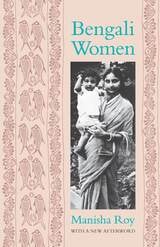
Bengali Women
Manisha Roy
University of Chicago Press, 1992
In a new Afterword, Roy discusses changes in Bengali society and culture over the last two decades which have direct bearings on women's lives: divorce and the breakup of the joint family, education, increasing Westernization via television and women's magazines, and the erosion of traditional religious practices.
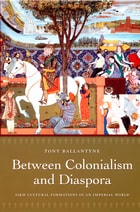
Between Colonialism and Diaspora
Sikh Cultural Formations in an Imperial WorldTony Ballantyne
Duke University Press, 2006
Constructing an expansive historical archive, Ballantyne draws on film, sculpture, fiction, and Web sites, as well as private papers, government records, journalism, and travel narratives. He proceeds from a critique of recent historiography on the development of Sikhism to an analysis of how Sikh identity changed over the course of the long nineteenth century. Ballantyne goes on to offer a reading of the contested interpretations of the life of Dalip Singh, the last Maharaja of Punjab. He concludes with an exploration of bhangra, a traditional form of Punjabi dance that diasporic artists have transformed into a globally popular music style. Much of bhangra’s recent evolution stems from encounters of the Sikh and Afro-Caribbean communities, particularly in the United Kingdom. Ballantyne contends that such cross-cultural encounters are central in defining Sikh identity both in Punjab and the diaspora.

Beverley Ditsie's Fearless Speech
A Dialogue on the Pitfalls of Queer StruggleSharad Chari with Beverley Palesa Ditsie
Temple University Press, 2027
Beverley Palesa Ditsie is a key South African Black lesbian activist, part of a world of queer activism during South Africa’s decade of transition from apartheid, when sexuality was crucial to recircuiting post-apartheid power and possibility. Part of the Gay and Lesbian Organization of the Witwatersrand (GLOW) which organized the continent’s first Pride March, she has stood steadfastly for Black lesbian self-determination and African queer representation.
Beverley Ditsie’s Fearless Speech enters this recent history of sexuality politics through an activist and a critical theorist in conversation. This book bends an account of Ditsie’s life and work in the critique of racial and sexual capitalism. Grounded in South Africa, the conversation is cut through with radical queer, materialist, and feminist critique in an internationalist frame.
Through this dialogic form, Beverley Ditsie emerges alongside other figures of fearless speech willing to stand for Black and African queer liberation, yet aware of pitfalls in these struggles that point to work that remains to be done. Beverley Ditsie’s Fearless Speech is a cautionary tale of hope for radical change in a world of deepening injustice and political homophobia.
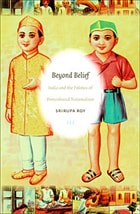
Beyond Belief
India and the Politics of Postcolonial NationalismSrirupa Roy
Duke University Press, 2007
Roy considers several different ways that identification with the Indian nation-state was produced and consolidated during the 1950s and 1960s. She looks at how the Films Division of India, a state-owned documentary and newsreel production agency, allowed national audiences to “see the state”; how the “unity in diversity” formation of nationhood was reinforced in commemorations of India’s annual Republic Day; and how the government produced a policy discourse claiming that scientific development was the ultimate national need and the most pressing priority for the state to address. She also analyzes the fate of the steel towns—industrial townships built to house the workers of nationalized steel plants—which were upheld as the exemplary national spaces of the new India. By prioritizing the role of actual manifestations of and encounters with the state, Roy moves beyond theories of nationalism and state formation based on collective belief.
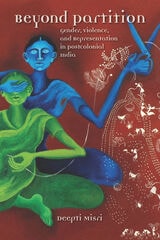
Beyond Partition
Gender, Violence and Representation in Postcolonial IndiaDeepti Misri
University of Illinois Press, 2014
Deepti Misri shows how Partition began a history of politicized animosity associated with the differing ideas of ""India"" held by communities and in regions on one hand, and by the political-military Indian state on the other. She moves beyond that formative national event, however, in order to examine other forms of gendered violence in the postcolonial life of the nation, including custodial rape, public stripping, deturbanning, and enforced disappearances. Assembling literary, historiographic, performative, and visual representations of gendered violence against women and men, Misri establishes that cultural expressions do not just follow violence but determine its very contours, and interrogates the gendered scripts underwriting the violence originating in the contested visions of what ""India"" means.
Ambitious and ranging across disciplines, Beyond Partition offers both an overview of and nuanced new perspectives on the ways caste, identity, and class complicate representations of violence, and how such representations shape our understandings of both violence and India.
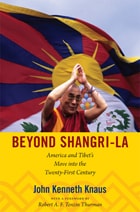
Beyond Shangri-La
America and Tibet's Move into the Twenty-First CenturyJohn Kenneth Knaus
Duke University Press, 2012
Since the late 1950s, the rugged resolve of the Dalai Lama and his people and the growing respect for their efforts to free their homeland from Chinese occupation have made Tibet's political and cultural status a pressing issue in international affairs. So has the realization by nations, including the United States, that their geopolitical interests would best be served by the defeat of the Chinese and the achievement of Tibetan self-determination. Beyond Shangri-La provides unique insight into the efforts of the U.S. government and committed U.S. citizens to support a free Tibet.
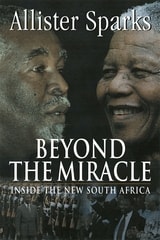
Beyond the Miracle
Inside the New South AfricaAllister Sparks
University of Chicago Press, 2003
Sparks sees South Africa as facing many of the same challenges as the rest of the world, especially a widening gap between rich and poor, exacerbated by the forces of globalization. While the transition government has done much to establish democracy and racial equality in a short time, as well as bring basic services such as clean water to millions who did not have them before, many blacks feel it has not done enough to redress the continuing imbalance of wealth in the country. Many whites, meanwhile, feel disempowered and confused about what role they have to play as a racial minority in a country they used to rule and regard as theirs by divine right. Sparks also covers other burning issues, such as the HIV/AIDS epidemic, high crime rates, the diamond wars, the Congo conflict, and the Zimbabwean land crisis.
Writing vividly and often quite movingly, Sparks draws on his decades of journalistic experience and his recent insider access to key figures in the liberation government to take stock of where South Africa has been, where it's going, and why the rest of the world should not turn away from this country where the First and Third Worlds meet. As Sparks persuasively argues, the success of Mandela's vision of a peaceful "rainbow nation" is crucial not just for the salvation of Africa, but also for the world.
“It is as good a guide to the new South Africa as any.”—Economist
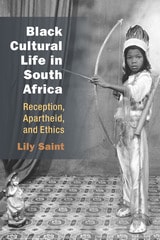
Black Cultural Life in South Africa
Reception, Apartheid, and EthicsLily Saint
University of Michigan Press, 2018
This study provocatively posits that states of oppression, including colonial and postcolonial rule, can elicit ethical responses to imaginative identification through encounters with popular culture, and it asks whether and how they carry over into ethical action. Its consideration of how globalized popular culture “travels” not just in material form, but also through the circuits of the imaginary, opens a new window for exploring the ethical and liberatory stakes of popular culture. Each chapter focuses on a separate genre, yet the overall interdisciplinary approach to the study of genre and argument for an expansion of ethical theory that draws on texts beyond the Western canon speak to growing concerns about studying genres and disciplines in isolation. Freed from oversimplified treatments of popular forms—common to cultural studies and ethical theory alike—this book demonstrates that people can do things with mass culture that reinvigorate ethical life.
Lily Saint’s new volume will interest Africanists across the humanities and the social sciences, and scholars of Anglophone literary, globalization, and cultural studies; race; ethical theories and philosophies; film studies; book history and material cultures; and the burgeoning field of comics and graphic novels.

Black Lawyers, White Courts
The Soul of South African LawKenneth S. Broun
Ohio University Press, 2000
In the struggle against apartheid, one often overlooked group of crusaders was the coterie of black lawyers who overcame the Byzantine system that the government established oftentimes explicitly to block the paths of its black citizens from achieving justice.
Now, in their own voices, we have the narratives of many of those lawyers as recounted in a series of oral interviews. Black Lawyers, White Courts is their story and the anti-apartheid story that has before now gone untold.
Professor Kenneth Broun conducted interviews with twenty-seven black South African lawyers. They were asked to tell about their lives, including their family backgrounds, education, careers, and their visions for the future. In many instances they also discussed their years in prison or exile, or under house arrest. Most told of both education and careers interrupted because of the ongoing struggle.
The story of the professional achievements of black lawyers in South Africa—indeed their very survival—provides an example of the triumph of individuals and, ultimately, of the law. Black Lawyers, White Courts is about South Africa, and about black professionals in that country, but the lessons its protagonists teach extend far beyond circumstances, geography, or race.

Black Property Owners in the South, 1790-1915
Loren Schweninger
University of Illinois Press, 1990
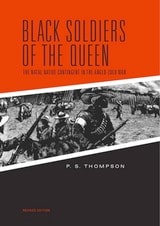
Black Soldiers of the Queen
The Natal Native Contingent in the Anglo-Zulu WarP. S. Thompson
University of Alabama Press, 2006
Africans who fought alongside the British against the Zulu king
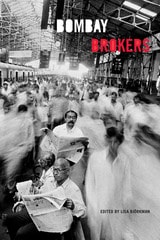
Bombay Brokers
Lisa Björkman, editor
Duke University Press, 2021
Contributors. Anjali Arondekar, Sarthak Bagchi, Tobias Baitsch, Sangeeta Banerji, Srimati Basu, Tarini Bedi, Amita Bhide, Lisa Björkman, Uday Chandra, Simon Chauchard, Ka-Kin Cheuk, Michael Collins, Daisy Deomampo, Maura Finkelstein, Ajay Gandhi, Rupali Gupte, Kathryn C. Hardy, Lalitha Kamath, Prasad Khanolkar, Bhushan Korgaonkar, Ratoola Kundu, Ken Kuroda, Annelies Kusters, Lisa Mitchell, Shailaja Paik, Gautam Pemmaraju, Lubaina Rangwala, Llerena Guiu Searle, Atreyee Sen, Prasad Shetty, Rohan Shivkumar, Edward Simpson, David Strohl, Rachel Sturman, R. Swaminathan, Aneri Taskar, Yaffa Truelove, Sahana Udupa, Lalit Vachani, Leilah Vevaina
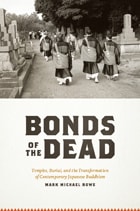
Bonds of the Dead
Temples, Burial, and the Transformation of Contemporary Japanese BuddhismMark Michael Rowe
University of Chicago Press, 2011
Despite popular images of priests seeking enlightenment in snow-covered mountain temples, the central concern of Japanese Buddhism is death. For that reason, Japanese Buddhism’s social and economic base has long been in mortuary services—a base now threatened by public debate over the status, treatment, and location of the dead. Bonds of the Dead explores the crisis brought on by this debate and investigates what changing burial forms reveal about the ways temple Buddhism is perceived and propagated in contemporary Japan.
Boundaries of the Text
Epic Performances in South and Southeast AsiaJoyce Burkhalter Flueckiger and Laurie Sears, Editors
University of Michigan Press, 1991
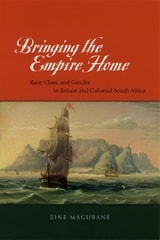
Bringing the Empire Home
Race, Class, and Gender in Britain and Colonial South AfricaZine Magubane
University of Chicago Press, 2003
Bringing the Empire Home tracks colonial images of blackness from South Africa to England and back again to answer questions such as these. Before the mid-1800s, black Africans were considered savage to the extent that their plight mirrored England's internal Others—women, the poor, and the Irish. By the 1900s, England's minority groups were being defined in relation to stereotypes of black South Africans. These stereotypes, in turn, were used to justify both new capitalist class and gender hierarchies in England and the subhuman treatment of blacks in South Africa. Bearing this in mind, Zine Magubane considers how marginalized groups in both countries responded to these racialized representations.
Revealing the often overlooked links among ideologies of race, class, and gender, Bringing the Empire Home demonstrates how much black Africans taught the English about what it meant to be white, poor, or female.
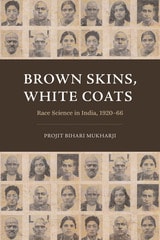
Brown Skins, White Coats
Race Science in India, 1920–66Projit Bihari Mukharji
University of Chicago Press, 2022
There has been a recent explosion in studies of race science in the twentieth and twenty-first centuries, but most have focused either on Europe or on North America and Australia. In this stirring history, Projit Bihari Mukharji illustrates how India appropriated and repurposed race science to its own ends and argues that these appropriations need to be understood within the national and regional contexts of postcolonial nation-making—not merely as footnotes to a Western history of “normal science.”
The book comprises seven factual chapters operating at distinct levels—conceptual, practical, and cosmological—and eight fictive interchapters, a series of epistolary exchanges between the Bengali author Hemendrakumar Ray (1888–1963) and the protagonist of his dystopian science fiction novel about race, race science, racial improvement, and dehumanization. In this way, Mukharji fills out the historical moment in which the factual narrative unfolded, vividly revealing its moral, affective, political, and intellectual fissures.
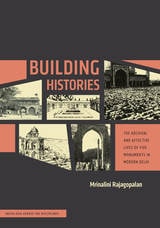
Building Histories
The Archival and Affective Lives of Five Monuments in Modern DelhiMrinalini Rajagopalan
University of Chicago Press, 2016
Mrinalini Rajagopalan argues that the modern construction of the history of these monuments entailed the careful selection, manipulation, and regulation of the past by both the colonial and later postcolonial states. Although framed as objective “archival” truths, these histories were meant to erase or marginalize the powerful and persistent affective appropriations of the monuments by groups who often existed outside the center of power. By analyzing these archival and affective histories together, Rajagopalan works to redefine the historic monument—far from a symbol of a specific past, the monument is shown in Building Histories to be a culturally mutable object with multiple stories to tell.
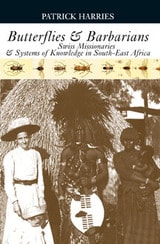
Butterflies & Barbarians
Swiss Missionaries and Systems of Knowledge in South-East AfricaPatrick Harries
Ohio University Press, 2007
Central to this group was Junod, who became a pioneering collector in the fields of entomology and botany. He would later examine African society with the methodology, theories, and confidence of the natural sciences. On the way he came to depend on the skills of African observers and collectors. Out of this work emerged, in three stages between 1898 and 1927, an influential classic in the field of South African anthropology, Life of a South African Tribe.