Results by title
149 books match the query 'Spanish & Portuguese' and 5 start with b
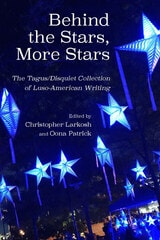
Behind the Stars, More Stars
The Tagus/Disquiet Collection of New Luso-American WritingEdited by Christopher Larkosh and Oona Patrick
Tagus Press, 2019
Presenting experimental and boundary-breaking prose from women, people of color, and LGBTQ writers, Behind the Stars, More Stars imagines a more diverse and inclusive Luso-American and Portuguese-American literary scene, which has traditionally been dominated by male voices. Since its first “Writing the Luso Experience” workshops were held in 2011, Dzanc Books's Disquiet International Literary Program in Lisbon has aimed to break silences within today's Luso-American communities. Disquiet faculty Katherine Vaz and Frank X. Gaspar appear alongside up-and-coming writers from the workshops, such as Traci Brimhall, Megan Fernandes, Hugo Dos Santos, and previously unpublished women writers.

Benito Perez Galdos and the Creative Process
Walter T. Pattison
University of Minnesota Press, 1954
Benito Perez Galdos and the Creative Process was first published in 1954. Minnesota Archive Editions uses digital technology to make long-unavailable books once again accessible, and are published unaltered from the original University of Minnesota Press editions.
Most critics would rank Benito Perez Galdos second only to Cervantes among the great novelists of Spain. However, in spite of the esteem in which he is generally held, Galdos has been the subject of relatively few scholarly studies. Professor Pattison, by an analysis of two of Galdos' novels, attempts to reconstruct the creative processes that were involved in the writing of these novels. This is the first time that such a critical approach has been used in the field of Spanish fiction and the resulting study is significant not only to Spanish scholars but to all students of literature seeking further insights into the fascinating and still elusive creative process.
Professor Pattison analyzes the novels Gloria, published in 1877, and Marianela,which was published the following year. Both are stories of contemporary life, the former having as its theme the conflict between noble religion and the fanaticism of individual religious sects, and the latter presenting a story of tragic love interwoven with the social problem of the responsibilities of the rich toward the poor.
In tracking down the sources of ideas, characters, plots, and viewpoints that emerge in these novels, Professor Pattison worked first-hand in Galdos' personal library in Madrid. From the notes and markings in the books and from other intimate observations, the scholar-detective put his finger on many of the original sources that contributed to Galdos' artistic creations and identified the prototypes for fictional characters among persons Galdos knew.
Between Market and Myth
The Spanish Artist Novel in the Post-Transition, 1992-2014Katie J. Vater
Bucknell University Press, 2020
Published by Bucknell University Press. Distributed worldwide by Rutgers University Press.
Beyond Human
Vital Materialisms in the Andean Avant-GardesDaly, Tara
Bucknell University Press, 2019
Published by Bucknell University Press. Distributed worldwide by Rutgers University Press.
Beyond Tordesillas
New Approaches to Comparative Luso-Hispanic StudiesEdited by Robert Patrick Newcomb and Richard A. Gordon
The Ohio State University Press, 2017
The jumping-off point for Beyond Tordesillas is the critic Jorge Schwartz’s evocative call to arms, “Down with Tordesillas!” In this groundbreaking essay, Schwartz looks to the imaginary line created by the Treaty of Tordesillas (1494), which divided the known world into Spanish and Portuguese spheres of influence, to stand in for generations of literary and cultural noncommunication between the Spanish- and Portuguese-speaking spheres, and their attendant academic disciplines. This volume’s contributions range topically across continents, from the Iberian Peninsula to Latin American countries. They also range across genres, with studies that analyze fictional narrative, music, performance, and visual culture. Beyond Tordesillas forcefully challenges the disciplinary—and indeed, arbitrary—boundaries that for too long have separated Hispanic and Luso-Brazilian studies.