Results by title
84 books match the query 'Special education' and 3 start with b
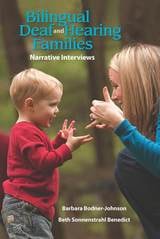
Bilingual Deaf and Hearing Families
Narrative InterviewsBarbara Bodner-Johnson
Gallaudet University Press, 2012
This study emphasizes the importance of family support for deaf members, particularly through the use of both American Sign Language (ASL) and spoken and/or written English. Research has shown how these factors influence such areas as a child’s development, performance in school, and relationships with brothers and sisters. In this volume, authors Barbara Bodner-Johnson and Beth S. Benedict concentrate on the vital, positive effects of bilingualism and how families that share their experiences with other families can enhance all of their children’s achievement and enrichment.
Bilingual Deaf and Hearing Families: Narrative Interviews describes the experiences of ten families who have at least one deaf family member. In five of the families, the parents are hearing and they have a deaf child; two of the children in these families have cochlear implants. In three families, both the parents and children are deaf. In one family, the parents are deaf and their daughter is hearing; and in one family, the parents and one child are deaf and they all have cochlear implants, and the deaf child’s twin is hearing.
The interviews were conducted in the families’ homes using set topics and questions. The family discussions cover a wide range of subjects: cochlear implants, where they live, their thoughts about family relationships, how they participate in the Deaf community, how they arrive at certain decisions, their children’s friendships, and the goals and resiliencies they have as a family.
Black Deaf Students
A Model for Educational SuccessCarolyn E. Williamson
Gallaudet University Press, 2007
Contemporary research has identified resilience — the ability to rebound and learn despite obstacles and adversities — as a key element to success in school. Black Deaf Students: A Model for Educational Success searches out ways to develop, reinforce, and alter the factors that encourage resilience in African American deaf and hard of hearing students. To find the individual characteristics and outside influences that foster educational achievement, author Carolyn E. Williamson conducted extensive interviews with nine African American deaf and hard of hearing adults who succeeded in high school and postsecondary programs.
Until now, the majority of studies of African American deaf and hard of hearing students concentrated upon their underachievement. The only success stories available involved high-achieving African American hearing students. To create an effective model in Black Deaf Students, Williamson focuses on the factors that contributed to her subjects’ successes in postsecondary programs, what they viewed as obstacles and how they overcame them, and their recommendations for facilitating graduation from postsecondary programs. Her work gives “voice” to a group rarely heard in research, which enables readers to view them as a heterogeneous rather than homogeneous group. Their stories provide vital information for parents, school personnel, community stakeholders, and those enrolled in education and mental health preparation programs. In addition, the insights about how these adults succeeded can be useful in facilitating positive outcomes for students who are going into two-year colleges, vocational training, and work settings.

Building Bridges, Crossing Borders
One Young Deaf Woman’s EducationAnn Darby Getty
Gallaudet University Press, 2014
As soon as they realized that their daughter was deaf, Kyler’s parents, who were hearing, immediately began to learn sign language. They also engaged Darby, a parent/infant educator employed by the state school for the deaf, to work with Kyler. From the age of 13 months until Kyler’s college graduation 22 years later, Darby was involved in her education and development.
Despite living in a rural area, Kyler enjoyed an array of services, including parent/infant education, sign language interaction/modeling, speech and language therapy, and also a cochlear implant. At the same time that she developed her speech skills, sign language continued to be a critically important facet of her communication. In grade school, she learned with other deaf students, while in high school, she worked successfully in mainstream classrooms with interpreters and notetakers. As a college graduate, gifted artist, and veterinarian’s assistant today, Kyler exemplifies how a balanced approach to deaf education, using all resources at hand, can achieve remarkable results. Her story serves as a model for parents of other deaf children and the professionals who work with them.