Results by title
105 books match the query 'Sustainable development' and 6 start with b

Banking for a Better World
Nanno Kleiterp in Conversation with Marijn WiersmaNanno Kleiterp
Amsterdam University Press, 2017
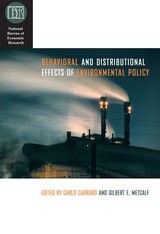
Behavioral and Distributional Effects of Environmental Policy
Edited by Carlo Carraro and Gilbert E. Metcalf
University of Chicago Press, 2001

Betting the Earth
How We Can Still Win the Biggest Gamble of all TimeJohn Charles Kunich
Parkhurst Brothers, Inc., 2010
"Betting the Earth explores the uneasy parallels between our contemporary environmental challenges and our national fascination with gambling. How much should we bet on preserving biodiversity? Should we bet more on responding to climate change? where should we place each bet: on federal or state laws, on acquiring public or private preserves, on preventing environmental harms or saving places of special environmental significance? Like it or not, we must make such choices every day, and Betting the Earth helps us to understand how we do so."
Professor John Copeland Nagle, John N. Matthews Chair in Law, University of Notre Dame Law School
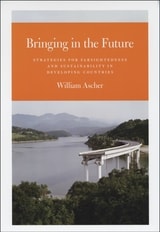
Bringing in the Future
Strategies for Farsightedness and Sustainability in Developing CountriesWilliam Ascher
University of Chicago Press, 2009
Humans are plagued by shortsighted thinking, preferring to put off work on complex, deep-seated, or difficult problems in favor of quick-fix solutions to immediate needs. When short-term thinking is applied to economic development, especially in fragile nations, the results—corruption, waste, and faulty planning—are often disastrous. In Bringing in the Future, William Ascher draws on the latest research from psychology, economics, institutional design, and legal theory to suggest strategies to overcome powerful obstacles to long-term planning in developing countries.
Drawing on cases from Africa, Asia, and Latin America, Ascher applies strategies such as the creation and scheduling of tangible and intangible rewards, cognitive exercises to increase the understanding of longer-term consequences, self-restraint mechanisms to protect long-term commitments and enhance credibility, and restructuring policy-making processes to permit greater influence of long-term considerations. Featuring theoretically informed research findings and sound policy examples, this volume will assist policy makers, activists, and scholars seeking to understand how the vagaries of human behavior affect international development.
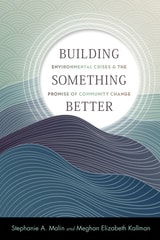
Building Something Better
Environmental Crises and the Promise of Community ChangeStephanie A. Malin
Rutgers University Press, 2022
Sociologists Stephanie A. Malin and Meghan Elizbeth Kallman offer a clear, accessible volume that demonstrates the ways that communities adapt in the face of crises and explains that sociology can help us understand how and why they do this challenging work. Tackling neoliberalism head-on, these communities are making big changes by crafting distributive and regenerative systems that depart from capitalist approaches. The vivid case studies presented range from activist water protectors to hemp farmers to renewable energy cooperatives led by Indigenous peoples and nations. Alongside these studies, Malin and Kallman present incisive critiques of colonialism, extractive capitalism, and neoliberalism, while demonstrating how sociology’s own disciplinary traditions have been complicit with those ideologies—and must expand beyond them.
Showing that it is possible to challenge social inequality and environmental degradation by refusing to continue business-as-usual, Building Something Better offers both a call to action and a dose of hope in a time of crises.
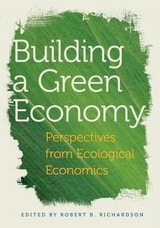
Building a Green Economy
Perspectives from Ecological EconomicsRobert B. Richardson
Michigan State University Press, 2013
The first decade of the twenty-first century has been characterized by a growing global awareness of the tremendous strains that human economic activity place on natural resources and the environment. As the world’s population increases, so does the demand for energy, food, and other resources, which adds to existing stresses on ecosystems, with potentially disastrous consequences. Humanity is at a crossroads in our pathway to future prosperity, and our next steps will impact our long-term sustainability immensely. In this timely volume, leading ecological economics scholars offer a variety of perspectives on building a green economy. Grounded in a critique of conventional thinking about unrestrained economic expansion and the costs of environmental degradation, this book presents a roadmap for an economy that prioritizes human welfare over consumerism and growth. As the authors represented here demonstrate, the objective of ecological economics is to address contemporary problems and achieve long-term socioeconomic well-being without undermining the capacity of the ecosphere. The volume is organized around three sections: “Perspectives on a Green Economy,” “Historical and Theoretical Perspectives,” and “Applications and Practice.” A rich resource in its own right, Building a Green Economy contains the most innovative thinking in ecological economics at a critical time in the reexamination of the human relationship with the natural world.