Results by title
270 books match the query 'Technology' and 10 start with b
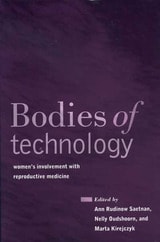
BODIES OF TECHNOLOGY
Women’s Involvement with Reproductive MedicineEdited by Ann R. Saetnan, Nelly Oudshoorn, and Marta Kirejczyk
The Ohio State University Press, 2000
Bodies of Technology is based on the premise that technology and society mutually shape one another, and on a concern for women’s health and autonomy. A basic question is one of cultural appropriation: Do technologies take on different shapes, different practices, and have different impacts as they spread from one place to another? By juxtaposing a number of culturally and historically contextualized studies of similar technologies, the editors demonstrate that although technologies globalize by spreading among cultures, they are also localized by the cultures they encounter.
The first part of the book investigates how potential users of hormone-based contraceptives are represented as these technologies are developed in laboratories and field tests. The next section explores the political and economic processes that regulate access to and practices of assisted fertilization. The final section focuses on individual users engaging with fetal diagnostic technologies in clinical practice. Taken as a whole, the book points out the need and the possibilities for women to become directly involved in the shaping of technologies that so strongly affect their health and their daily lives.
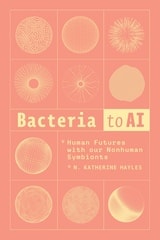
Bacteria to AI
Human Futures with Our Nonhuman SymbiontsN. Katherine Hayles
University of Chicago Press, 2025
A new theory of mind that includes nonhuman and artificial intelligences.
The much-lauded superiority of human intelligence has not prevented us from driving the planet into ecological disaster. For N. Katherine Hayles, the climate crisis demands that we rethink basic assumptions about human and nonhuman intelligences. In Bacteria to AI, Hayles develops a new theory of mind—what she calls an integrated cognitive framework (ICF)—that includes the meaning-making practices of lifeforms from bacteria to plants, animals, humans, and some forms of artificial intelligence. Through a sweeping survey of evolutionary biology, computer science, and contemporary literature, Hayles insists that another way of life, with ICF at its core, is not only possible but necessary to safeguard our planet’s future.

Beyond the Dance Floor
Female DJs, Technology and Electronic Dance Music CultureRebekah Farrugia
Intellect Books, 2012
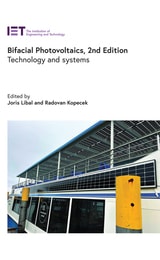
Bifacial Photovoltaics
Technology and systemsJoris Libal
The Institution of Engineering and Technology, 2026
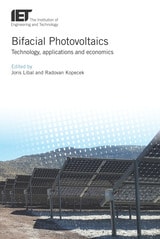
Bifacial Photovoltaics
Technology, applications and economicsJoris Libal
The Institution of Engineering and Technology, 2019
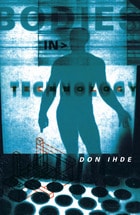
Bodies In Technology
Don Ihde
University of Minnesota Press, 2001
An original exploration of the ways cyberspace affects human experience.
New technologies suggest new ideas about embodiment: our "reach" extends to global sites through the Internet; we enter cyberspace through the engines of virtual reality. In this book, a leading philosopher of technology explores the meaning of bodies in technology-how the sense of our bodies and of our orientation in the world is affected by the various information technologies.
Bodies in Technology begins with an analysis of embodiment in cyberspace, then moves on to consider ways in which social theorists have interpreted or overlooked these conditions. An astute and sensible judge of these theories, Don Ihde is a uniquely provocative and helpful guide through contemporary thinking about technology and embodiment, drawing on sources and examples as various as video games, popular films, the workings of e-mail, and virtual reality techniques.Charting the historical, philosophical, and practical territory between virtual reality and real life, this work is an important contribution to the national conversation on the impact technology-and information technology in particular-has on our lives in a wired, global age.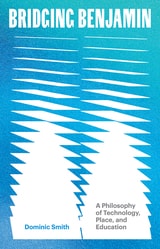
Bridging Benjamin
A Philosophy of Technology, Place, and EducationDominic Smith
University of Minnesota Press, 2026
Walter Benjamin reimagined through the forgotten power of radio
Philosopher and cultural critic Walter Benjamin (1892–1940) has long been recognized for his influence on the fields of literature, film, media studies, critical legal theory, and philosophy. Bringing fresh attention to an often-overlooked aspect of his oeuvre, Bridging Benjamin examines the dozens of radio broadcasts he produced, primarily for children, between 1927 and 1933. Delivered after the academic rejection of his notoriously complex Trauerspiel, these shows became a testing ground for Benjamin’s developing ideas and experimental pedagogy. Though they were cast off as inconsequential by both Benjamin and his contemporaries, Dominic Smith reveals the broadcasts to be a fruitful site for a novel, “derailed” interpretation of Benjamin’s larger body of work.
Reading Benjamin’s radio production as a dynamic site of philosophical experimentation, Smith uses it as a channel and amplifier for three integral but underappreciated aspects of Benjamin’s work: his philosophies of technology, place, and education. Showing how he used broadcast media to explore the increasing “virtualization” of place in networked society, Bridging Benjamin encourages an embrace of Benjamin in contrast to his divisive historical counterparts in the philosophy of technology, such as Martin Heidegger and Carl Schmitt.
Interpreting Benjamin’s broadcasts as a form of peripatetic thinking—deeply embedded in place, yet mobile and mediated—Bridging Benjamin offers a compelling model for reassessing attachments to the technologies and practices shaping our contemporary worlds.
Retail e-book files for this title are screen-reader friendly.
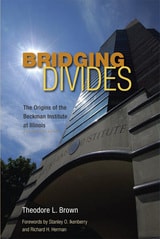
Bridging Divides
The Origins of the Beckman Institute at IllinoisTheodore L. Brown. Forewords by Stanley O. Ikenberry and Richard H. Herman.
University of Illinois Press, 2009
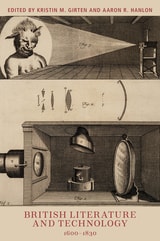
British Literature and Technology, 1600-1830
Kristin M. Girten
Bucknell University Press, 2023
Enlightenment-era writers had not yet come to take technology for granted, but nonetheless were—as we are today—both attracted to and repelled by its potential. This volume registers the deep history of such ambivalence, examining technology’s influence on Enlightenment British literature, as well as the impact of literature on conceptions of, attitudes toward, and implementations of technology. Offering a counterbalance to the abundance of studies on literature and science in seventeenth- and eighteenth-century Britain, this volume’s focus encompasses approaches to literary history that help us understand technologies like the steam engine and the telegraph along with representations of technology in literature such as the “political machine.” Contributors ultimately show how literature across genres provided important sites for Enlightenment readers to recognize themselves as “chimeras”—“hybrids of machine and organism”—and to explore the modern self as “a creature of social reality as well as a creature of fiction.”
Building Materials and Technology in Hong Kong, Expanded Second Edition
Wah Sang Wong, Wing Yan, Alice Chan, Chui Chi, Rosman Wai, Yee Chun, Tris Kee, Kam Lung, Franky Choi, Jingxuan, and Lila Xie
Hong Kong University Press, 2026
This book is a thorough documentation of tectonics in the Hong Kong construction industry. It looks at how buildings have been designed and built in a high-density city in a subtropical climate. Written in both Chinese and English, it covers almost all aspects of building materials and technology in Hong Kong with a succinct sequence that follows the construction process of a building project. The case studies in Chapter 3 brings together 16 local projects, which embrace a wide range of building types: from single-storey buildings to high-rise towers, from private development to public institutional construction, from office to residence, and provide invaluable information on the application of building materials and technology.
While it is intended primarily for students in architecture, surveying, and construction, Building Materials and Technology in Hong Kong is an indispensable reference for professionals and practitioners who are dealing with building design and construction. Those with a general interest in building construction will also find this highly illustrated book an interesting and engaging read.