Results by title
64 books match the query 'Text' and 2 start with b
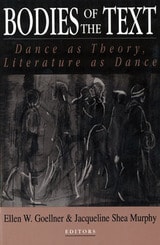
Bodies of the Text
Dance as Theory, Literature as DanceEdited by Ellen W Goellner
Rutgers University Press, 1995
Dance and literary studies have traditionally been at odds: dancers and dance critics have understood academic analysis to be overly invested in the mind at the expense of body signification; literary critics and theorists have seen dance studies as anti-theoretical, even anti-intellectual. Bodies of the Text is the first book-length study of the interconnections between the two arts and the body of writing about them. The essays, by scholar-critics of dance and literature, explore dances actual and fictional to offer powerful new insights into issues of gender, race, ethnicity, popular culture, feminist aesthetics, historical "embodiment," identity politics, and narrativity. The general introduction traces the genealogy of dance studies in the academy to suggest why critical and theoretical attention to dance--and dance's challenges to writing--is both compelling and overdue. A milestone in interdisciplinary studies, Bodies of the Text opens both its fields to new inquiry, new theoretical precision, and to new readers and writers.
[more]
Boundaries of the Text
Epic Performances in South and Southeast AsiaJoyce Burkhalter Flueckiger and Laurie Sears, Editors
University of Michigan Press, 1991
When the Mahabharata and Ramayana are performed in South and Southeast Asia, audiences may witness a variety of styles. A single performer may deliver a two-hour recitation, women may meet in informal singing groups, shaddow puppets may host an all-night play, or professional theaters may put on productions lasting thirty nights. Performances often celebrate ritual passages: births, deaths, marriages, and religious observances. The stories live and are transmitted through performance; their characters are well known and well loved.
Yet written versions of the Mahabharata and Ramayana have existed in both South and Southeast Asia for hundreds of years. Rarely have these texts been intended for private reading. What is the relationship between written text and oral performance? What do performers and audiences mean when they identify something as “Ramayana” or “Mahabharata”? How do they conceive of texts? What are the boundaries of the texts?
By analyzing specific performance traditions, Boundaries of the Text addresses questions of what happens to written texts when they are preformed and how performance traditions are affected when they interact with written texts. The dynamics of this interaction are of particular interest in South and Southeast Asia where oral performance and written traditions share a long, interwoven history. The contributors to Boundaries of the Text show the difficulty of maintaining sharp distinctions between oral and written patterns, as the traditions they consider defy a unidirectional movement from oral to written. The boundaries of epic traditions are in a state of flux, contracting or expanding as South and Southeast Asian societies respond to increasing access to modern education, print technology, and electronic media.
[more]