Results by title
303 books match the query 'Time' and 7 start with b
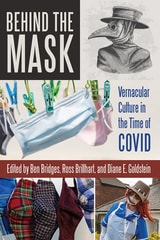
Behind the Mask
Vernacular Culture in the Time of COVIDBen Bridges
Utah State University Press, 2023
Despite vernacular’s potential nod to dominant or external culture, it is the strong connection to the local that grounds the vernacular within the experiential context that it occupies. Exploring the nature and shape of vernacular responses to the ongoing public health crisis, Behind the Mask documents processes that are otherwise likely to be forgotten. Including different ethnographic presents, contributors capture moments during the pandemic rather than upon reflection, making the work important to students and scholars of folklore and ethnology, as well as general readers interested in the COVID pandemic.
Beside You in Time
Sense Methods and Queer Sociabilities in the American Nineteenth CenturyElizabeth Freeman
Duke University Press, 2019
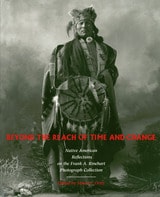
Beyond the Reach of Time and Change
Native American Reflections on the Frank A. Rinehart Photograph CollectionEdited by Simon J. Ortiz
University of Arizona Press, 2004
This book provides an unusual perspective on the Rinehart collection. It features one hundred outstanding images printed from the original negatives made by Rinehart and Muhr at the Congress and over the course of the next two years. It also includes 14 essays by modern Native American writers, artists, and educators—some of them descendants of the individuals photographed—reflecting on the place of these images in their heritage.
Beyond the Reach of Time and Change is not another coffee-table book of historical Indian photographs but rather a conversation between Indian people of a century ago and today. Just as the Rinehart collection offers today's Native Americans a unique connection to the past, this book offers all readers a positive understanding of continuity and endurance within the American Indian community.

Black Epic
Poetics in the Time of Black Lives MatterDavid M. de León
Duke University Press, 2027
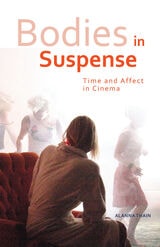
Bodies in Suspense
Time and Affect in CinemaAlanna Thain
University of Minnesota Press, 2017
Bodies in Suspense presents a powerful new way to think through postdigital cinema and the affective turn in critical theory. According to Alanna Thain, suspense films allow us to experience the relation between two bodies: that of the film and that of the viewer. Through the “time machine” of suspense, film form, gender, genre, and spectatorship are revealed in innovative and different ways. These films not only engage us directly in ethical concerns, but also provide a key for understanding corporeal power in the digital era.
Offering a new framework for understanding cinematic suspense, Bodies in Suspense argues that the “body in time” enables us to experience the temporal dimension of the body directly. This is the first book to link two contemporary frames of analysis: questions of cinematic temporality and contemporary affect theory. Thain conducts close readings of influential suspense films by Alfred Hitchcock, David Lynch, Christian Marclay, Rian Johnson, and Lou Ye, and sets forth a compelling new theory of cinema, reading for the productivity of the “crime of time” that stages the duplicity of cinematic bodies. Through these films that foreground doubled characters and looping, Thain explores Gilles Deleuze’s claim that “the direct time-image is the phantom which has always haunted cinema.”
A vital new addition to film theory, corporeality and affect theory, feminist theory, and the philosophy of time—and one of the first books to explore David Lynch’s Hollywood trilogy—Bodies in Suspense asks us to pay attention, above all, to the ways in which the condition of spectatorship creates a doubling sensation with important philosophical repercussions.
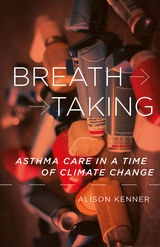
Breathtaking
Asthma Care in a Time of Climate ChangeAlison Kenner
University of Minnesota Press, 2018
Analyzing asthma care in the twenty-first century
Asthma is not a new problem, but today the disease is being reshaped by changing ecologies, healthcare systems, medical sciences, and built environments. A global epidemic, asthma (and our efforts to control it) demands an analysis attentive to its complexity, its contextual nature, and the care practices that emerge from both. At once clearly written and theoretically insightful, Breathtaking provides a sweeping ethnographic account of asthma’s many dimensions through the lived experiences of people who suffer from disordered breathing, as well as by considering their support networks, from secondary school teachers and coaches, to breathing educators and new smartphone applications designed for asthma control.
Against the backdrop of unbreathable environments, Alison Kenner describes five modes of care that illustrate how asthma is addressed across different sociocultural scales. These modes of care often work in combination, building from or preceding one another. Tensions also exist between them, a point reflected by Kenner’s description of the structural conditions and material rhythms that shape everyday breathing, chronic disease, and our surrounding environments. She argues that new modes of distributed, collective care practices are needed to address asthma as a critical public health issue in the time of climate change.
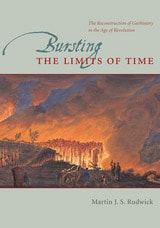
Bursting the Limits of Time
The Reconstruction of Geohistory in the Age of RevolutionMartin J. S. Rudwick
University of Chicago Press, 2005
In 1650, Archbishop James Ussher of Armagh joined the long-running theological debate on the age of the earth by famously announcing that creation had occurred on October 23, 4004 B.C. Although widely challenged during the Enlightenment, this belief in a six-thousand-year-old planet was only laid to rest during a revolution of discovery in the late eighteenth and early nineteenth centuries. In this relatively brief period, geologists reconstructed the immensely long history of the earth-and the relatively recent arrival of human life. Highlighting a discovery that radically altered existing perceptions of a human's place in the universe as much as the theories of Copernicus, Darwin, and Freud did, Bursting the Limits of Time is a herculean effort by one of the world's foremost experts on the history of geology and paleontology to sketch this historicization of the natural world in the age of revolution.
Addressing this intellectual revolution for the first time, Rudwick examines the ideas and practices of earth scientists throughout the Western world to show how the story of what we now call "deep time" was pieced together. He explores who was responsible for the discovery of the earth's history, refutes the concept of a rift between science and religion in dating the earth, and details how the study of the history of the earth helped define a new branch of science called geology. Rooting his analysis in a detailed study of primary sources, Rudwick emphasizes the lasting importance of field- and museum-based research of the eighteenth and nineteenth centuries.
Bursting the Limits of Time, the culmination of more than three decades of research, is the first detailed account of this monumental phase in the history of science.