Results by title
265 books match the query 'To 1500' and 10 start with b
Baetica Felix
People and Prosperity in Southern Spain from Caesar to Septimius SeverusBy Evan W. Haley
University of Texas Press, 2003
Baetica, the present-day region of Andalusia in southern Spain, was the wealthiest province of the Roman Empire. Its society was dynamic and marked by upward social and economic mobility, as the imperial peace allowed the emergence of a substantial middle social and economic stratum. Indeed, so mutually beneficial was the imposition of Roman rule on the local population of Baetica that it demands a new understanding of the relationship between Imperial Rome and its provinces.
Baetica Felix builds a new model of Roman-provincial relations through a socio-economic history of the province from Julius Caesar to the end of the second century A.D. Describing and analyzing the impact of Roman rule on a core province, Evan Haley addresses two broad questions: what effect did Roman rule have on patterns of settlement and production in Baetica, and how did it contribute to wealth generation and social mobility? His findings conclusively demonstrate that meeting the multiple demands of the Roman state created a substantial freeborn and ex-slave "middle stratum" of the population that outnumbered both the super-rich elite and the destitute poor.
Beauty and the Good
Recovering the Classical Tradition from Plato to Duns ScotusAlice M. Ramos
Catholic University of America Press, 2021
Becoming Villagers
Comparing Early Village SocietiesEdited by Matthew S. Bandy and Jake R. Fox
University of Arizona Press, 2010
Based on a Society for American Archaeology symposium and subsequent Amerind Advanced Seminar in 2006, Becoming Villagers examines this transformation at various places and times across the globe by focusing not on the origins of agriculture and village life but rather on their consequences. The goal of the volume is to identify regularities in the ways that societies developed in the centuries and millennia following a transition to village life. Using cases that range from China to Bolivia and from the Near East to the American Southwest, leading archaeologists situate their specific areas of specialization in a broad comparative context.
They consider the forces acting to divide and fragment early villages and the social technologies and practices by which those obstacles were, in some cases, overcome. Finally, the volume examines the long-term historical trajectories of these early village societies.
This transformative collection makes a powerful case for a renewed and invigorated archaeological focus on large-scale comparative studies. It will be an essential read for anyone interested not only in early village societies but also in the ways in which archaeology relates to anthropology, other social sciences, and history.
CONTENTS:
- “Becoming Villagers: The Evolution of Early Village Societies,” Matthew S. Bandy and Jake R. Fox
- “Population Growth, Village Fissioning, and Alternative Early Village Trajectories,” Matthew S. Bandy
- “A Scale Model of Seven Hundred Years of Farming Settlements in Southwestern Colorado,” Timothy A. Kohler and Mark D. Varien
- “‘Great Expectations,’ or the Inevitable Collapse of the Early Neolithic in the Near East,” Nigel Goring-Morris and Anna Belfer-Cohen
- “‘Ritualization’ in Early Village Society: The Case of the Lake Titicaca Basin Formative,” Amanda B. Cohen
- “The Sacred and the Secular Revisited: The Essential Tensions of Early Village Society in the Southeastern United States,” Thomas Pluckhahn
- “Substantial Structures, Few People, and the Question of Early Villages in the Mimbres Region of the North American Southwest,” Patricia A. Gilman
- “Sea Changes in Stable Communities: What Do Small Changes in Practices at Catalhoyuk and Chiripa Imply about Community Making?” Christine A. Hastorf
- “The Emergence of Early Villages in the American Southwest: Cultural Issues and Historical Perspectives,” Richard H. Wilshusen and James M. Potter
- “A Persistent Early Village Settlement System on the Bolivian Southern Altiplano,” Jake R. Fox
- “First Towns in the Americas: Searching for Agriculture, Population Growth, and Other Enabling Conditions,” John E. Clark, Jon L. Gibson, and James Zeidler
- “The Evolution of Early Yangshao Period Village Organization in the Middle Reaches of Northern China's Yellow River Valley,” Christian E. Peterson and Gideon Shelach
Beowulf and the Grendel-Kin
Politics and Poetry in Eleventh-Century EnglandHelen Damico
West Virginia University Press, 2014
In Beowulf and the Grendel-kin: Politics and Poetry in Eleventh-Century England, Helen Damico presents the first concentrated discussion of the initiatory two-thirds of Beowulf’s 3,182 lines in the context of the sociopolitically turbulent years that composed the first half of the eleventh century in Anglo-Danish England.
Damico offers incisive arguments that major historical events and personages pertaining to the reign of Cnut and those of his sons recorded in the Anglo-Saxon Chronicle, the Encomium Emmae Reginae, and major continental and Scandinavian historical texts, hold striking parallels with events and personages found in at least eight vexing narrative units, as recorded by Scribe A in BL, Cotton Vitellius A.xv, that make up the poem’s quasi sixth-century narrative concerning the fall of the legendary Scyldings.
Given the poet’s compositional skill—widely relational and eclectic at its core—and his affinity with the practicing skalds, these strings of parallelisms could scarcely have been coincidental. Rather, Damico argues that examined within the context of other eleventh-century texts that either bemoaned or darkly satirized or obversely celebrated the rise of the Anglo-Danish realm, the Beowulfian units may bring forth a deeper understanding of the complexity of the poet’s compositional process.
Damico illustrates the poet’s use of the tools of his trade—compression, substitution, skillful encoding of character—to reinterpret and transform grave sociopolitical “facts” of history, to produce what may be characterized as a type of historical allegory, whereby two parallel narratives, one literal and another veiled are simultaneously operative.
Beowulf and the Grendel-Kin lays out the story of Beowulf, not as a monster narrative nor a folklorish nor solely a legendary tale, but rather as a poem of its time, a historical allegory coping with and reconfiguring sociopolitical events of the first half of eleventh-century Anglo-Saxon England.
Bishops, Councils, and Consensus in the Visigothic Kingdom, 589-633
Rachel L. Stocking
University of Michigan Press, 2001
This eloquently presented, exhaustive study concludes that legislation, however persistently enacted, was unequal to the task of remedying a lack of unity and other social and political ills. Notions of consensus are explored as a way of maintaining community cohesion and order in the absence of strong central authorities. Other issues the author confronts are Catholic tolerance and intolerance toward heterodox and non-Christian "others;" the transformation and transmission of ancient ideals and social structures from the Roman to the later medieval worlds; and the position of medieval Spain in relation to the mainstream of western European history.
This nuanced study is a must-read for anyone interested in medieval life, politics, religion, and the precarious nature of the medieval state.
Rachel Stocking is Professor of History, Southern Illinois University at Carbondale.

Blessed Mary and the Monks of England, 1000-1215
Matthew J. Mills
Catholic University of America Press, 2024
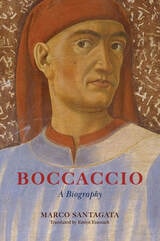
Boccaccio
A BiographyMarco Santagata
University of Chicago Press, 2025
Boccaccio (1313–75) stands with Dante and Petrarch as one of the “Three Crowns” of Italian letters, a trio of writers who shaped the history of humanism, literature, and poetry. In this book, Dante’s award-winning biographer, Marco Santagata, takes up the moving life and legacy of Boccaccio—whose unflinching story of a pandemic-era community (the Decameron) created new possibilities for vernacular Italian prose.
This landmark biography sheds new light on Boccaccio’s life—his family, friends, and foes, his aspirations, fears, and frustrations—and it shows how he was affected by transformations in Italian society. It also charts the influences that shaped Boccaccio’s understanding of literature: what kinds of stories it could tell and what kinds of characters it could depict; and, perhaps most importantly, what role art could play in a changing world. An insightful portrait of one of literature’s most important figures, this book promises to be the definitive biography of Boccaccio for many years to come.
Bodily Arts
Rhetoric and Athletics in Ancient GreeceBy Debra Hawhee
University of Texas Press, 2005
The role of athletics in ancient Greece extended well beyond the realms of kinesiology, competition, and entertainment. In teaching and philosophy, athletic practices overlapped with rhetorical ones and formed a shared mode of knowledge production. Bodily Arts examines this intriguing intersection, offering an important context for understanding the attitudes of ancient Greeks toward themselves and their environment.
In classical society, rhetoric was an activity, one that was in essence "performed." Detailing how athletics came to be rhetoric's "twin art" in the bodily aspects of learning and performance, Bodily Arts draws on diverse orators and philosophers such as Isocrates, Demosthenes, and Plato, as well as medical treatises and a wealth of artifacts from the time, including statues and vases.
Debra Hawhee's insightful study spotlights the notion of a classical gymnasium as the location for a habitual "mingling" of athletic and rhetorical performances, and the use of ancient athletic instruction to create rhetorical training based on rhythm, repetition, and response. Presenting her data against the backdrop of a broad cultural perspective rather than a narrow disciplinary one, Hawhee presents a pioneering interpretation of Greek civilization from the sixth, fifth, and fourth centuries BCE by observing its citizens in action.

Book and Verse
A Guide to Middle English Biblical LiteratureJames H. Morey
University of Illinois Press, 2000
Book and Verse is an indispensable guide to the variety and extent of biblical literature in England, exclusive of drama and the Wycliffite Bible that appeared between the twelfth and the fifteenth centuries. Entries provide detailed information on how much of what parts of the Bible appear in Middle English and where this biblical material can be found. Comprehensive indexing by name, keyword, and biblical verse allows a researcher to find, for example, all the occurrences of the Flood Story or of the encounter between Elijah and the Widow of Sarephta. An invaluable resource, Book and Verse provides the first easy access to the "popular Bible" assembled before and after John Wyclif's translation of the Vulgate into English.
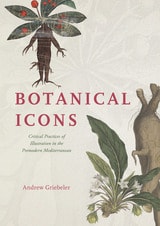
Botanical Icons
Critical Practices of Illustration in the Premodern MediterraneanAndrew Griebeler
University of Chicago Press, 2024
This book traces the history of botanical illustration in the Mediterranean from antiquity to the early modern period. By examining Greek, Latin, and Arabic botanical inquiry in this early era, Andrew Griebeler shows how diverse and sophisticated modes of plant depiction emerged and ultimately gave rise to practices now recognized as central to modern botanical illustration. The author draws on centuries of remarkable and varied documentation from across Europe and the Mediterranean.
Lavishly illustrated, Botanical Icons marshals ample evidence for a dynamic and critical tradition of botanical inquiry and nature observation in the late antique and medieval Mediterranean. The author reveals that many of the critical practices characteristic of modern botanical illustrations began in premodern manuscript culture. Consequently, he demonstrates that the distinctions between pre- and early modern botanical illustration center more on the advent of print, the expansion of collections and documentation, and the narrowing of the range of accepted forms of illustration than on the invention of critical and observational practices exclusive to modernity.
Griebeler’s emphasis on continuity, intercultural collaboration, and the gradual transformation of Mediterranean traditions of critical botanical illustration persuasively counters previously prevalent narratives of rupture and Western European exceptionalism in the histories of art and science.