155 books match the query 'Toward' and 5 start with b
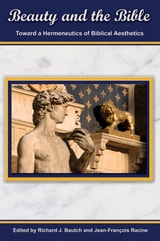
cover of Beauty and the Bible: Toward a Hermeneutics of Biblical Aesthetics

Beauty and the Bible

Toward a Hermeneutics of Biblical Aesthetics

Richard J. Bautch

SBL Press, 2013

These seven essays offer fresh perspectives on beauty’s role in revelation. Each essay features a hermeneutical approach informed by the contemporary study of aesthetics. Covering a series of texts in the Hebrew Bible and New Testament, from Adam and Eve in the garden to Jesus on trial in the Fourth Gospel, the authors engage beauty from three overarching perspectives: modern philosophy, contextual criticism, and the postcritical return to beauty’s primary qualities. The three perspectives are not harmonized but rather explored concurrently to create a volume with intriguing methodological tensions. As this collection highlights beauty in the narratives of scripture, it opens readers to a largely unexplored dimension of the Bible. The contributors are Richard J. Bautch, Jo-Ann A. Brant, Mark Brummitt, David Penchansky, Antonio Portalatín, Jean-François Racine, and Peter Spitaler.
[more]
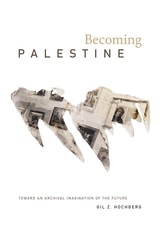
cover of Becoming Palestine: Toward an Archival Imagination of the Future

Becoming Palestine

Toward an Archival Imagination of the Future

Gil Z. Hochberg

Duke University Press, 2021
In Becoming Palestine, Gil Z. Hochberg examines how contemporary Palestinian artists, filmmakers, dancers, and activists use the archive in order to radically imagine Palestine's future. She shows how artists such as Jumana Manna, Kamal Aljafari, Larissa Sansour, Farah Saleh, Basel Abbas, and Ruanne Abou-Rahme reimagine the archive, approaching it not through the desire to unearth hidden knowledge, but to sever the identification of the archive with the past. In their use of archaeology, musical traditions, and archival film and cinematic footage, these artists imagine a Palestinian future unbounded from colonial space and time. By urging readers to think about archives as a break from history rather than as history's repository, Hochberg presents a fundamental reconceptualization of the archive's liberatory potential.
[more]
cover of Between Politics and Ethics: Toward a Vocative History of English Studies

Between Politics and Ethics

Toward a Vocative History of English Studies

James N. Comas

Southern Illinois University Press, 2006

For nearly twenty-five years, English studies has been focused on two terms: politics and ethics. However, the institutional emergence, development, and relationship of these two concepts have yet to be examined. Between Politics and Ethics: Toward a Vocative History of English Studies traces the development of politics and ethics in contemporary English studies, questions the current political orientation of the discipline, and proposes a rethinking of the history of English studies based on a “vocative” dimension of writing—the idea that writers form a virtual community by “calling to” and listening to other writers.

In a series of interrelated discussions, James Comas examines the historical trends leading to recent confusion regarding ethics and its relation to the politics of English studies. Through close, rhetorical readings of texts by Judith Butler, Stephen Greenblatt, Edward Said, and others, Comas argues that this confusion is largely the result of a “political turn” that resists theorizing itself. In addition, he argues that work on ethics by Wayne Booth, Geoffrey Harpham, and J. Hillis Miller reflects an uneasy dialectic between the ethics and politics of reading and writing. In response to this discord, Comas turns to the theories of Emmanuel Levinas and Maurice Blanchot, as well as to the examples of Georges Bataille and Kenneth Burke, and proposes a vocative approach to assessing English studies and its history. In doing so, this volume offers a thoughtful reassessment of English studies that affects our understanding of the rhetoric of disciplinary histories.
[more]
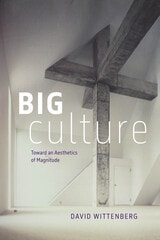
cover of Big Culture: Toward an Aesthetics of Magnitude

Big Culture

Toward an Aesthetics of Magnitude

David Wittenberg

University of Chicago Press, 2025

A philosophical exploration of our relationship to large objects and their outsized psychological effects.
 

Big Culture asks a simple question: why do big things give us big feelings? Skyscrapers, disasters, and other large phenomena can elicit fear, attraction, and awe. David Wittenberg argues that these feelings cannot be explained through objects’ size alone. Instead, he contends that an encounter with bigness is a primal, even violent sensation like little else that we experience in our well-proportioned adult lives.

Drawing on examples as commonplace and as singular as atomic bombs, cinematic effects, pornographic “macrophilia,” monstrous creatures, and more, Wittenberg demonstrates how big things tap into our earliest experiences of the world, reigniting our most fundamental feelings about reality. In doing so, Wittenberg offers a new aesthetics of magnitude and of the special role that bigness plays in our everyday perception of objects and images.
[more]
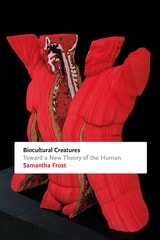
cover of Biocultural Creatures: Toward a New Theory of the Human

Biocultural Creatures

Toward a New Theory of the Human

Samantha Frost

Duke University Press, 2016

In Biocultural Creatures, Samantha Frost brings feminist and political theory together with findings in the life sciences to recuperate the category of the human for politics. Challenging the idea of human exceptionalism as well as other theories of subjectivity that rest on a distinction between biology and culture, Frost proposes that humans are biocultural creatures who quite literally are cultured within the material, social, and symbolic worlds they inhabit. Through discussions about carbon, the functions of cell membranes, the activity of genes and proteins, the work of oxygen, and the passage of time, Frost recasts questions about the nature of matter, identity, and embodiment.  In doing so, she elucidates the imbrication of the biological and cultural within the corporeal self.  In remapping the relation of humans to their habitats and arriving at the idea that humans are biocultural creatures, Frost provides new theoretical resources for responding to political and environmental crises and for thinking about how to transform the ways we live. 
[more]