Results by title
86 books match the query 'Translating & Interpreting' and 3 start with b

Becoming an Interpreter
Rachel E. Herring
Gallaudet University Press, 2026
How does one become an interpreter, and what knowledge and skills are developed along the way? What does developing an identity as an interpreter involve? Becoming an Interpreter bridges the gap between theory and practice, weaving together personal narratives and research insights to explore questions like these.
Becoming an Interpreter is structured around five dimensions of becoming that connect foundational concepts to lived experience: community, social aspects, acquisition of interpreting skills, ethical reasoning and decision-making, and coping with emotion and stress. Together, these varied perspectives and experiences show that there is no one single breakthrough moment for becoming an interpreter; there are many. At the end of each chapter, there are interactive prompts that invite readers to pause and reflect.
Designed for students, developing interpreters, and individuals considering interpreting as a career, Becoming an Interpreter is an introduction to the field and an essential resource for professional reflection and growth.
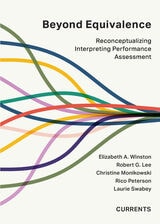
Beyond Equivalence
Reconceptualizing Interpreting Performance AssessmentElizabeth A. Winston
Gallaudet University Press, 2023
There is a longstanding need for valid, reliable measurements of interpreting competence. Although rubrics and checklists are commonly used in both academic and employment settings, a review of available rubrics indicates that many do not focus on interpreting performance. Traditional metrics for sign language interpreting often conflate language proficiency with interpreting proficiency. Conflating fundamental aspects of language in use—vocabulary, grammar, and prosody— with fundamental aspects of interpretation—content, intent, and monitoring—compromises the valid assessment of interpreting proficiency. Beyond Equivalence: Reconceptualizing Interpreting Performance Assessment argues for a shift toward more nuanced and evidence-based conceptualizations of interpreting, communication, and meaning to improve the creation and use of rubrics for assessment in interpreter education, certification, and professional development.
This inaugural volume in the Currents series introduces a rubric and accompanying scale, which can be used to assess both simultaneous and consecutive interpreting performance in terms of both process and product, in both signed and spoken language interpreting, and in a variety of settings. Beyond Equivalence offers an appreciation of the multivarious nature of meaning in the interpreting process and presents a new paradigm for the measurement of interpreting proficiency.
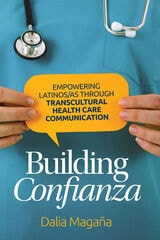
Building Confianza
Empowering Latinos/as Through Transcultural Health Care CommunicationDalia Magaña
The Ohio State University Press, 2021