Results by title
141 books match the query 'Turkey' and 3 start with b
Borders of Belief
Religious Nationalism and the Formation of Identity in Ireland and TurkeyGregory J. Goalwin
Rutgers University Press, 2022
Bound Together
The Secularization of Turkey’s Literary Fields and the Western Promise of FreedomBaris Büyükokutan
University of Michigan Press, 2021
Bound Together takes a new look at twentieth-century Turkey, asking what it will take for Turkish women and men to regain their lost freedoms, and what the Turkish case means for the prospects of freedom and democracy elsewhere. Contrasting the country’s field of poetry, where secularization was the joint work of pious and nonpious people, with that of the novel, this book inquires into the nature of western-nonwestern difference.
Turkey’s poets were more fortunate than its novelists for two reasons. Poets were slightly better at developing the idea of the autonomy of art from politics. While piety was a marker of political identity everywhere, poets were better able than novelists to bracket political differences when assessing their peers as the country was bitterly polarized politically and as the century wore on. Second, and more important, poets of all stripes were more connected to each other than were novelists. Their greater ability to find and keep one another in coffeehouses and literary journals made it less likely for prospective cross-aisle partnerships to remain untested propositions.
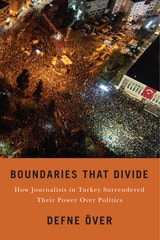
Boundaries That Divide
How Journalists in Turkey Surrendered Their Power over PoliticsDefne Över
Rutgers University Press, 2026
Turkey presents a striking example of the most recent wave of global authoritarian turns. The two-decade-long transition in the country’s political system also transformed its media environment. As mainstream journalists gradually yielded their places to sycophants, much more willing to praise the government in their news, the mainstream media that once oversaw—however imperfectly—political decisions started devoting its full service to cheerleading the government. Simultaneously, a new sphere of critical journalism began to emerge, with mainstream media journalists joining their fellows in the peripheries of the media. Considering the transformation of Turkey’s news media as the decay of a democratic institution, this book asks, How does the media break down under the rule of an elected government?
Drawing on fieldwork and in-depth interviews, the book traces the ruling AKP’s manipulation of social divides to consolidate power and journalists’ navigation of the resulting climate of fear, hope, doubt, and anger. The book shows how Turkey’s news media surrendered its power over politics as some journalists embraced disinformation as a path to heightened status, others turned to self-censorship for protection, and still others resisted capture through continuous but fragmented efforts.
The book portrays journalists as central actors in media decay, while also revealing that resilience to decay emerges where rising demand for “news” meets the contentious mobilization of journalists. Although focused on Turkey, the book’s insights extend far beyond, offering urgent lessons about the future of journalism in an age of populism, polarization, and institutional erosion.