Results by title
63 books match the query 'Turkey & Ottoman Empire' and 6 start with b
Battling over the Balkans
Historiographical Questions and ControversiesJohn R. Lampe
Central European University Press, 2020
Between Jaffa and Tel Aviv, 1870–1930
A MemoirYosef Eliyahu Chelouche
Brandeis University Press, 2025
Born in Jaffa in 1870, Yosef Eliyahu Chelouche grew up within a notable Sephardi family in the local Jewish community. He went on to become a prominent entrepreneur; a founder of Tel Aviv; and a fierce critic of the Ashkenazi Zionist leadership, Arab nationalism, and British colonial sectarianism; before emerging, in the last decade of his life, as an anguished public figure struggling to repair Arab-Jewish relations.
His memoir paints an intimate portrait of life in Palestine at the turn of the twentieth century, told from the perspective of a Middle Eastern Jew deeply embedded in local society. By centering on the world and experiences of a native Jew who was an eyewitness to and participant in the unfolding conflict in Palestine, this book shows how the course of Zionist politics and Jewish-Arab relations in pre-state Palestine might have taken alternative pathways. A comprehensive introduction sets the scene in late nineteenth- and early twentieth-century Jaffa and thoughtful annotations contextualize Chelouche’s story within the modern history of Palestine and Israel. Between Jaffa and Tel Aviv, 1870–1930 tells the fascinating story of a civic leader—and offers a complex view of the various cultural, social, and political forces that forged multilayered Jewish identities in the Middle East. The book includes a family tree and is illustrated with photographs of the family and scenes of Jaffa and early Tel Aviv.
Borders of Belief
Religious Nationalism and the Formation of Identity in Ireland and TurkeyGregory J. Goalwin
Rutgers University Press, 2022
Boys Abducted
The Homoerotics of Empire and Race in Early ModernityAbdulhamit Arvas
Duke University Press, 2025
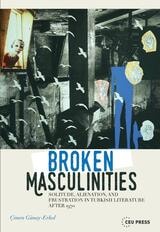
Broken Masculinities
Solitude, Alienation, and Frustration in Turkish Literature after 1970Cimen Günay-Erkol
Central European University Press, 2016
Broken Masculinities portrays the post-dictatorial novel of the 1970s in all its complexity, and introduces the reader to a 1968-era Turkey, a period which challenges Turkey’s now reinforced Islamic image by portraying the quest for sexual liberation and critical student uprisings. Günay-Erkol argues that the literature written after the 1971 coup in Turkey constitutes a coherent sub-genre and needs to be considered together. These novels share a common ground which is rich in images of men and women craving for power: general isolation, sexual-emotional frustration, and a traumatic sense of solitude and alienation.
This book is an original and significant contribution to two major fields of study: (1) gender and sexuality with respect to formation of subjectivity through literature, and (2) modern literature and history through the study of Turkish literature. The chief concern in this book is not only literature’s response to a particular period in Turkey, but also the role of literature in bearing witness to trauma and drastic political acts of violence—and coming to terms with them.B
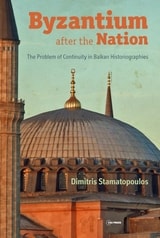
Byzantium after the Nation
The Problem of Continuity in Balkan HistoriographiesDimitris Stamatopoulos
Central European University Press, 2023
Stamatopoulos undertakes the first systematic comparison of the dominant ethnic historiographic models and divergences elaborated by Greek, Bulgarian, Serbian, Albanian, Romanian, Turkish, and Russian intellectuals with reference to the ambiguous inheritance of Byzantium. The title alludes to the seminal work of Nicolae Iorga in the 1930s, Byzantium after Byzantium, that argued for the continuity between the Byzantine and the Ottoman empires. Rival Balkan nationalisms engaged in a “war of interpretation” as to the nature of Byzantium, assuming different positions of adoption or rejection of its imperial model and leading to various schemes of continuity in each national historiographic canon.
Stamatopoulos discusses what Byzantium represented for nineteenth-, and twentieth-century scholars and how their perceptions related to their treatment of the imperial model: whether a different perception of the medieval Byzantine period prevailed in the Greek national center as opposed to Constantinople; how nineteenth-century Balkan nationalists and Russian scholars used Byzantium to invent their own medieval period (and, by extension, their own antiquity); and finally, whether there exist continuities or discontinuities in these modes of making ideological use of the past.