Results by title
147 books match the query 'Urban & Land Use Planning' and 7 start with b
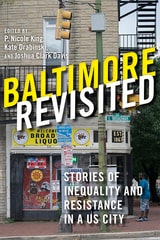
Baltimore Revisited
Stories of Inequality and Resistance in a U.S. CityEdited by P. Nicole King, Kate Drabinski, and Joshua Clark Davis
Rutgers University Press, 2019
To help untangle these apparent paradoxes, the editors of Baltimore Revisited have assembled a collection of over thirty experts from inside and outside academia. Together, they reveal that Baltimore has been ground zero for a slew of neoliberal policies, a place where inequality has increased as corporate interests have eagerly privatized public goods and services to maximize profits. But they also uncover how community members resist and reveal a long tradition of Baltimoreans who have fought for social justice.
The essays in this collection take readers on a tour through the city’s diverse neighborhoods, from the Lumbee Indian community in East Baltimore to the crusade for environmental justice in South Baltimore. Baltimore Revisited examines the city’s past, reflects upon the city’s present, and envisions the city’s future.
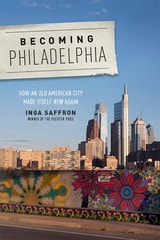
Becoming Philadelphia
How an Old American City Made Itself New AgainInga Saffron
Rutgers University Press, 2020
Becoming Philadelphia collects the best of Saffron’s work, plus a new introduction reflecting on the stunning changes the city has undergone. A fearless crusader who is also a seasoned reporter, Saffron ranges beyond the usual boundaries of architectural criticism to explore how big money and politics intersect with design, profoundly shaping our everyday experience of city life. Even as she celebrates Philadelphia’s resurgence, she considers how it finds itself grappling with the problems of success: gentrification, poverty, privatization, and the unequal distribution of public services.
What emerges in these 80 pieces is a remarkable narrative of a remarkable time. The proverbial first draft of history, these columns tell the story of how a great city shape-shifted before our very eyes.
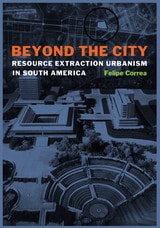
Beyond the City
Resource Extraction Urbanism in South AmericaBy Felipe Correa
University of Texas Press, 2016
During the last decade, the South American continent has seen a strong push for transnational integration, initiated by the former Brazilian president Fernando Henrique Cardoso, who (with the endorsement of eleven other nations) spearheaded the Initiative for the Integration of Regional Infrastructure in South America (IIRSA), a comprehensive energy, transport, and communications network. The most aggressive transcontinental integration project ever planned for South America, the initiative systematically deploys ten east-west infrastructural corridors, enhancing economic development but raising important questions about the polarizing effect of pitting regional needs against the colossal processes of resource extraction. Providing much-needed historical contextualization to IIRSA’s agenda, Beyond the City ties together a series of spatial models and offers a survey of regional strategies in five case studies of often overlooked sites built outside the traditional South American urban constructs.
Implementing the term “resource extraction urbanism,” the architect and urbanist Felipe Correa takes us from Brazil’s nineteenth-century regional capital city of Belo Horizonte to the experimental, circular, “temporary” city of Vila Piloto in Três Lagoas. In Chile, he surveys the mining town of María Elena. In Venezuela, he explores petrochemical encampments at Judibana and El Tablazo, as well as new industrial frontiers at Ciudad Guayana. The result is both a cautionary tale, bringing to light a history of societies that were “inscribed” and administered, and a perceptive examination of the agency of architecture and urban planning in shaping South American lives.
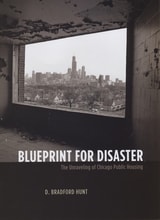
Blueprint for Disaster
The Unraveling of Chicago Public HousingD. Bradford Hunt
University of Chicago Press, 2009
Now considered a dysfunctional mess, Chicago’s public housing projects once had long waiting lists of would-be residents hoping to leave the slums behind. So what went wrong? To answer this complicated question, D. Bradford Hunt traces public housing’s history in Chicago from its New Deal roots through current mayor Richard M. Daley’s Plan for Transformation. In the process, he chronicles the Chicago Housing Authority’s own transformation from the city’s most progressive government agency to its largest slumlord.
Challenging explanations that attribute the projects’ decline primarily to racial discrimination and real estate interests, Hunt argues that well-intentioned but misguided policy decisions—ranging from design choices to maintenance contracts—also paved the road to failure. Moreover, administrators who fully understood the potential drawbacks did not try to halt such deeply flawed projects as Cabrini-Green and the Robert Taylor Homes. These massive high-rise complexes housed unprecedented numbers of children but relatively few adults, engendering disorder that pushed out the working class and, consequently, the rents needed to maintain the buildings. The resulting combination of fiscal crisis, managerial incompetence, and social unrest plunged the CHA into a quagmire from which it is still struggling to emerge.
Blueprint for Disaster, then,is an urgent reminder of the havoc poorly conceived policy can wreak on our most vulnerable citizens.
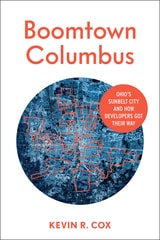
Boomtown Columbus
Ohio’s Sunbelt City and How Developers Got Their WayKevin R. Cox
The Ohio State University Press, 2021
How have development interests become entwined with government? How has a policy of annexation reformed the city’s map? Why have airline service and major league prestige lagged behind its status as a regional center? And what, if anything, makes this city with a reputation for being average stand apart? In Boomtown Columbus, Cox applies both scholarly expertise and his personal experience as a long-time resident of the city to look at the real-life costs of policy. The resulting narrative will fascinate not only locals but anyone with a stake in understanding American cities and a path toward urban livability for all.
Building Globalization
Transnational Architecture Production in Urban ChinaXuefei Ren
University of Chicago Press, 2011
From the years 2004 to 2008, Beijing and Shanghai witnessed the construction of an extraordinary number of new buildings, many of which were designed by architectural firms overseas. Combining ethnographic fieldwork, historical research, and network analysis, Building Globalization closely scrutinizes the growing phenomenon of transnational architecture and its profound effect on the development of urban space.
Roaming from construction sites in Shanghai to architects’ offices in Paris, Xuefei Ren interviews hundreds of architects, developers, politicians, residents, and activists to explore this issue. She finds that in the rapidly transforming cities of modern China, iconic designs from prestigious international architects help private developers to distinguish their projects, government officials to advance their careers, and the Chinese state to announce the arrival of modern China on the world stage.
China leads the way in the globalization of architecture, a process whose ramifications can be felt from Beijing to Dubai to Basel. Connecting the dots between real estate speculation, megaproject construction, residential displacement, historical preservation, housing rights, and urban activism, Building Globalization reveals the contradictions and consequences of this new, global urban frontier.
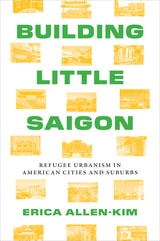
Building Little Saigon
Refugee Urbanism in American Cities and SuburbsErica Allen-Kim
University of Texas Press, 2024
2026 Spiro Kostof Book Award, Society of Architectural Historians
An in-depth look at the diverging paths of Vietnamese American communities, or “Little Saigons,” in America’s built environment.
In the final days before the fall of Saigon in 1975, 125,000 Vietnamese who were evacuated or who made their own way out of the country resettled in the United States. Finding themselves in unfamiliar places yet still connected in exile, these refugees began building their own communities as memorials to a lost homeland. Known both officially and unofficially as Little Saigons, these built landscapes offer space for everyday activities as well as the staging of cultural heritage and political events.
Building Little Saigon examines nearly fifty years of city building by Vietnamese Americans—who number over 2.2 million today. Author Erica Allen-Kim highlights architecture and planning ideas adapted by the Vietnamese communities who, in turn, have influenced planning policies and mainstream practices. Allen-Kim traveled to ten Little Saigons in the United States to visit archives, buildings, and public art and to converse with developers, community planners, artists, business owners, and Vietnam veterans. By examining everyday buildings—who made them and what they mean for those who know them—Building Little Saigon shows us the complexities of migration unfolding across lifetimes and generations.