Results by title
73 books match the query 'Urban policy' and 4 start with b
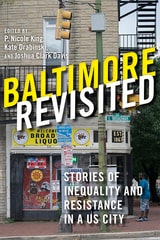
Baltimore Revisited
Stories of Inequality and Resistance in a U.S. CityEdited by P. Nicole King, Kate Drabinski, and Joshua Clark Davis
Rutgers University Press, 2019
To help untangle these apparent paradoxes, the editors of Baltimore Revisited have assembled a collection of over thirty experts from inside and outside academia. Together, they reveal that Baltimore has been ground zero for a slew of neoliberal policies, a place where inequality has increased as corporate interests have eagerly privatized public goods and services to maximize profits. But they also uncover how community members resist and reveal a long tradition of Baltimoreans who have fought for social justice.
The essays in this collection take readers on a tour through the city’s diverse neighborhoods, from the Lumbee Indian community in East Baltimore to the crusade for environmental justice in South Baltimore. Baltimore Revisited examines the city’s past, reflects upon the city’s present, and envisions the city’s future.
Beyond the City Limits
Urban Policy and Economics Restructuring in Comparative Perspectiveedited by John R. Logan and Todd Swanstrom
Temple University Press, 1991
This book challenges the notion that there is a single, global process of economic restructuring to which cities must submit. The studies in this volume compare urban development in the United States, Western Europe, and Japan, demonstrating that there is significant variety in urban economic restructuring. The contributors emphasize that the economic forces transforming cities from industrial concentrations to postindustrial service centers do not exist apart from politics: all nation-states are heavily involved in the restructuring process.
Contributors: Pierre Clavel, Susan Fainstein, Richard Child Hill, Nancy Kleniewski, Harvey L. Molotch, Michael Parkinson, Edmond Preteceille, Saskia Sassen, H. V. Savitch, John Walton, and the editors.
In the series Conflicts in Urban and Regional Development, edited by John R. Logan and Todd Swanstrom.

Black Representation and Urban Policy
Albert Karnig and Susan Welch
University of Chicago Press, 1981
In exploring the factors that underlie the election of blacks to public office, the authors found that the resources of the black community itself—the size as well as the education and income of the black population—are the best predictors of blacks' winning political office. The authors' assessment of the impact of black elected officials on urban policy constitutes perhaps their most profoundly important finding. Cities with black mayors have had greater increases in social welfare expenditures than have similar communities without black mayors. The authors point out that election of blacks to mayoral posts, then, can have more than symbolic consequences for public policy.
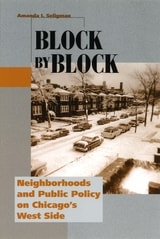
Block by Block
Neighborhoods and Public Policy on Chicago's West SideAmanda I. Seligman
University of Chicago Press, 2005
Seligman's study reveals that the responses of white West Siders to racial changes occurring in their neighborhoods were both multifaceted and extensive. She shows that, despite rehabilitation efforts, deterioration in these areas began long before the color of their inhabitants changed from white to black. And ultimately, the riots that erupted on Chicago's West Side and across the country in the mid-1960s stemmed not only from the tribulations specific to blacks in urban centers but also from the legacy of accumulated neglect after decades of white occupancy. Seligman's careful and evenhanded account will be essential to understanding that the "flight" of whites to the suburbs was the eventual result of a series of responses to transformations in Chicago's physical and social landscape, occurring one block at a time.