Results by title
60 books match the query 'Visions' and 4 start with b
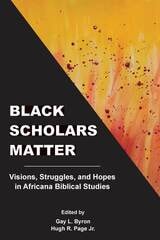
Black Scholars Matter
Visions, Struggles, and Hopes in Africana Biblical StudiesGay L. Byron
SBL Press, 2022
Distinctive, Powerful, Transformational
This book collects the presentations of twelve leading Africana scholars who participated in the groundbreaking #Black Scholars Matter virtual symposium held in August 2020 that was organized by the Society of Biblical Literature's Black Scholars Matter Task Force in coordination with the SBL’s Committee on Underrepresented Racial and Ethnic Minorities in the Profession. These scholars share their perspectives on biblical studies and their experiences in the discipline on a range of topics, including blatant and subtle forms of bias and racism; mentoring; lessons of struggle, sacrifice, and lack of support; reflections on the obstacles of national tragedies, geographical locations, and academic disciplines; and the challenges of creating a more welcoming environment for the next generation of Black biblical scholars. Eight additional contributors and stakeholders that have administrative and decision-making responsibilities within theological and other settings address the need for institutional and personal accountability. Contributors include Efraín Agosto, Cheryl B. Anderson, Randall C. Bailey, Gay L. Byron, Ronald Charles, Stephanie Buckhanon Crowder, Steed Vernyl Davidson, Sharon Watson Fluker, John F. Kutsko, Vanessa Lovelace, Madipoane Masenya (Ngwan'a Mphahlele), Raj Nadella, Hugh R. Page Jr., Adele Reinhartz, Kimberly D. Russaw, Abraham Smith, Shively T. J. Smith, Mai-Anh Le Tran, Renita J. Weems, and Vincent L. Wimbush.
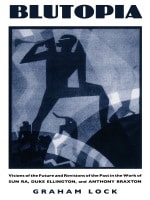
Blutopia
Visions of the Future and Revisions of the Past in the Work of Sun Ra, Duke Ellington, and Anthony BraxtonGraham Lock
Duke University Press, 2000
A century after Ellington’s birth, Lock reassesses his use of music as a form of black history and compares the different approaches of Ra, a band leader who focused on the future and cosmology, and Braxton, a contemporary composer whose work creates its own elaborate mythology. Arguing that the majority of writing on black music and musicians has—even if inadvertently—incorporated racial stereotypes, he explains how each artist reacted to criticism and sought to break free of categorical confines. Drawing on social history, musicology, biography, cultural theory, and, most of all, statements by the musicians themselves, Lock writes of their influential work.
Blutopia will be a welcome contribution to the literature on twentieth-century African American music and creativity. It will interest students of jazz, American music, African American studies, American culture, and cultural studies.
Boston
Voices and VisionsShaun O'Connell
University of Massachusetts Press, 2010
“New England was founded consciously, and in no fit of absence of mind,” observed historian Samuel Eliot Morison on the establishment of the Bay Colony in 1630 on the narrow, mountainous Shawmut peninsula of what became Massachusetts. That self-conscious presence of mind has endured for four centuries. Boston has been shaped and sustained by observation, imagination, and interpretation. As a result, the evolving vision of Boston has yielded a compelling literary record.
In this wide-ranging anthology, Shaun O'Connell includes a generous sampling of those who have recorded, revised, and redefined the vision of Boston. Anne Bradstreet, Nathaniel Hawthorne, Henry James, W. E. B. Du Bois, Mary Antin, Edwin O'Connor, John Updike, and many others eloquently evoke and explain Boston in these pages.
From John Winthrop's “city upon a hill” sermon, delivered aboard the Arbella before his followers landed in 1630 in the place they would call Boston, to Robert Lowell's “For the Union Dead,” a poem delivered in Boston's Public Garden in 1960, writers have continued to invoke the high purposes for which the city was founded, sometimes in praise of the city, but often in what Robert Frost named a “lover's quarrel,” in works that called attention to the city's failures to fulfill its promises. In the twenty-first century some writers continue to celebrate or to castigate the city, while others look back to Boston's origins to reassess its founders and renew its covenant of high purpose.
This is an interpretive anthology—one that includes commentary as well as writings. Section introductions provide historical and biographical context, offer analysis that stresses the thematic relevance of each selection, and explore the pattern of their relations. Rather than present a random array of writers who happen to have been Greater Bostonians, O'Connell focuses on those authors who possessed a commitment to the sense of place, those who addressed Boston not only as a geographical, social, and political entity but as an image, idea, and site of symbolic values.
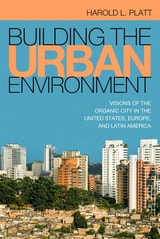
Building the Urban Environment
Visions of the Organic City in the United States, Europe, and Latin AmericaHarold L Platt
Temple University Press, 2015
Building the Urban Environment is a comparative study of the contestation among planners, policymakers, and the grassroots over the production and meaning of urban space. Award-winning historian Harold Platt presents case studies of seven cities, including Rotterdam, Chicago, and Sao Paulo, to show how, over time, urban life created hybrid spaces that transformed people, culture, and their environments.
As Platt explains, during the post-1945 race to technological modernization, policymakers gave urban planners of the International Style extraordinary influence to build their utopian vision of a self-sustaining “organic city.” However, in the 1960s, they faced a revolt of the grassroots. Building the Urban Environment traces the rise and fall of the Modernist planners during an era of Cold War, urban crisis, unnatural disasters, and global restructuring in the wake of the oil-energy embargo of the ’70s.
Ultimately, Platt provides a way to measure different visions of the postwar city against actual results in terms of the built environment, contrasting how each city created a unique urban space.