Results by title
71 books match the query 'Voice' and 6 start with b
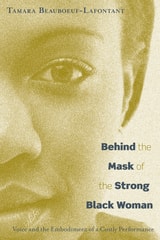
Behind the Mask of the Strong Black Woman
Voice and the Embodiment of a Costly PerformanceTamara Beauboeuf-Lafontant
Temple University Press, 2009
The defining quality of Black womanhood is strength, states Tamara Beauboeuf-Lafontant in Behind the Mask of the Strong Black Woman. But, she argues, the idea of strength undermines its real function: to defend and maintain a stratified social order by obscuring Black women’s experiences of suffering, acts of desperation, and anger. This provocative book lays bare the common perception that strength is an exemplary or defining quality of “authentic” Black womanhood.
The author, a noted sociologist, interviews 58 Black women about being strong and proud, to illustrate their “performance” of invulnerability. Beauboeuf-Lafontant explains how such behavior leads to serious symptoms for these women, many of whom suffer from eating disorders and depression.
Drawing on Black feminist scholarship, cultural studies, and women’s history, Behind the Mask of the Strong Black Woman traces the historical and social influences of normative Black femininity, looking at how notions of self-image and strength create a distraction from broader forces of discrimination and power.
[more]
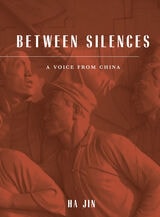
Between Silences
A Voice from ChinaHa Jin
University of Chicago Press, 1990
"Mixing autobiography with invented other voices, this book is an extraordinary meditation on what it means to have lived the history of China in the second half of the twentieth century. At its best, Ha Jin's language is as accessible, penetrating, and mysterious as Pound's Cathay. This is a profound book, an event."—Frank Bidart
"In these poems Ha Jin gives voice to the millions whose lives were altered and whose tongues were silenced by the Cultural Revolution. . . .If Ha Jin speaks in tongues in these poems, we feel him behind those voices—the hidden director behind the scenes—never as a presence filled with stridency and self-congratulation; he brings a great empathy and compassion to his depiction of the fallible men and women whose acts and attitudes together make up history."—Roger Gilbert, Hungry Mind Review
"In these poems Ha Jin gives voice to the millions whose lives were altered and whose tongues were silenced by the Cultural Revolution. . . .If Ha Jin speaks in tongues in these poems, we feel him behind those voices—the hidden director behind the scenes—never as a presence filled with stridency and self-congratulation; he brings a great empathy and compassion to his depiction of the fallible men and women whose acts and attitudes together make up history."—Roger Gilbert, Hungry Mind Review
[more]
Beyond Betrayal
The Priest Sex Abuse Crisis, the Voice of the Faithful, and the Process of Collective IdentityPatricia Ewick and Marc W. Steinberg
University of Chicago Press, 2019
In 2002, the national spotlight fell on Boston’s archdiocese, where decades of rampant sexual misconduct from priests—and the church’s systematic cover-ups—were exposed by reporters from the Boston Globe. The sordid and tragic stories of abuse and secrecy led many to leave the church outright and others to rekindle their faith and deny any suggestions of institutional wrongdoing. But a number of Catholics vowed to find a middle ground between these two extremes: keeping their faith while simultaneously working to change the church for the better.
Beyond Betrayal charts a nationwide identity shift through the story of one chapter of Voice of the Faithful (VOTF), an organization founded in the scandal’s aftermath. VOTF had three goals: helping survivors of abuse; supporting priests who were either innocent or took risky public stands against the wrongdoers; and pursuing a broad set of structural changes in the church. Patricia Ewick and Marc W. Steinberg follow two years in the life of one of the longest-lived and most active chapters of VOTF, whose thwarted early efforts at ecclesiastical reform led them to realize that before they could change the Catholic Church, they had to change themselves. The shaping of their collective identity is at the heart of Beyond Betrayal, an ethnographic portrait of how one group reimagined their place within an institutional order and forged new ideas of faith in the wake of widespread distrust.
Beyond Betrayal charts a nationwide identity shift through the story of one chapter of Voice of the Faithful (VOTF), an organization founded in the scandal’s aftermath. VOTF had three goals: helping survivors of abuse; supporting priests who were either innocent or took risky public stands against the wrongdoers; and pursuing a broad set of structural changes in the church. Patricia Ewick and Marc W. Steinberg follow two years in the life of one of the longest-lived and most active chapters of VOTF, whose thwarted early efforts at ecclesiastical reform led them to realize that before they could change the Catholic Church, they had to change themselves. The shaping of their collective identity is at the heart of Beyond Betrayal, an ethnographic portrait of how one group reimagined their place within an institutional order and forged new ideas of faith in the wake of widespread distrust.
[more]
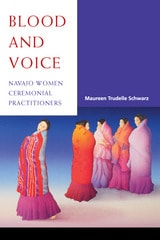
Blood and Voice
Navajo Women Ceremonial PractitionersMaureen Trudelle Schwarz
University of Arizona Press, 2003
Adulthood in the Navajo world is marked by the onset of menstruation in females and by the deepening of the voice in males. Accordingly, young adults must accept responsibility over the powers manifest in blood and voice: for women, the forces that control reproduction and growth; for men, the powers of protection and restoration of order that come through maintaining Navajo oral tradition.
The maintenance of the latter tradition has long been held to be the function of the Navajo singer, a role usually viewed as male. But despite this longstanding assumption, women can and do fill this role. Drawing on interviews with seventeen Navajo women practitioners and five apprentices, Maureen Trudelle Schwarz explicates women's role as ceremonial practitioners and shows that it is more complex than has previously been thought. She examines gender differences dictated by the Navajo origin story, details how women came to be practitioners, and reveals their experiences and the strategies they use to negotiate being both woman and singer.
Women who choose careers as singers face complex challenges, since some rules prohibit menstruating women from conducting ceremonies and others regarding sexual continence can strain marital relationships. Additionally, oral history places men in charge of all ceremonial matters. Schwarz focuses on how the reproductive life courses of Navajo women influence their apprenticeships and practices to demonstrate how they navigate these issues to preserve time-honored traditions. Through the words of actual practitioners, she shows how each woman brings her own unique life experience to the role. While differing among individuals, these experiences represent a commitment to shared cultural symbols and result in a consensus that sustains social cohesion.
By showing the differences and similarities between the apprenticeship, initiation, and practice of men and women singers, Blood and Voice offers a better understanding of the role of Navajo women in a profession usually viewed as a male activity—and of the symbolic construction of the self in Navajo culture. It also addresses classic questions concerning the sexual division of labor, menstrual taboos, gender stereotypes, and the tension between tradition and change that will enlighten students of other cultures.
[more]
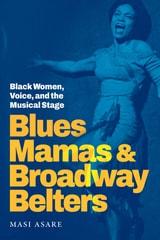
Blues Mamas and Broadway Belters
Black Women, Voice, and the Musical StageMasi Asare
Duke University Press, 2024
In Blues Mamas and Broadway Belters, songwriter, scholar, and dramatist Masi Asare explores the singing practice of black women singers in US musical theatre between 1900 and 1970. Asare shows how a vanguard of black women singers including Gertrude “Ma” Rainey, Bessie Smith, Ethel Waters, Pearl Bailey, Juanita Hall, Lena Horne, Eartha Kitt, Diahann Carroll, and Leslie Uggams created a lineage of highly trained and effective voice teachers whose sound and vocal techniques continue to be heard today. Challenging pervasive narratives that these and other black women possessed “untrained” voices, Asare theorizes singing as a form of sonic citational practice—how the sound of the teacher’s voice lives on in the student’s singing. From vaudeville-blues shouters, black torch singers, and character actresses to nightclub vocalists and Broadway glamour girls, Asare locates black women of the musical stage in the context of historical voice pedagogy. She invites readers not only to study these singers, but to study with them—taking seriously what they and their contemporaries have taught about the voice. Ultimately, Asare speaks to the need to feel and hear the racial history in contemporary musical theatre.
[more]
Broadcasting, Voice, and Accountability
A Public Interest Approach to Policy, Law, and RegulationSteve Buckley, Kreszentia Duer, Toby Mendel, and Seán Ó Siochrú
University of Michigan Press, 2008
Participatory development and government accountability depend in part on the existence of media that provide broad access to information from varied sources and that equip and encourage people to raise and debate issues and develop public opinion. Conducive policies, laws, and regulations are essential for media to develop that are independent and widely accessible and that enable the expression of diverse perspectives and sources of information. Broadcasting, Voice, and Accountability presents a framework to inform analysis of existing policies and support the development of a vigorous media sector, with a particular emphasis on broadcasting. It focuses on broadcasting because that is the medium with the greatest potential to reach and involve society at large, including the most disadvantaged and illiterate segments of society in developing countries. Information on good practices in broadcasting policy is in demand in countries of every region—particularly in countries that are opening their economies, democratizing, and decentralizing public service delivery.
This book provides development practitioners with a wide overview of the key policy and regulatory issues involved in supporting freedom of information and expression and enabling development of a pluralistic, independent, and robust broadcasting sector. Policy, regulation, capacity, and institutional development are important development levers that shape the ownership, content, and social impacts of broadcasting systems. The guide shows the importance of enabling a mix of ownership and uses, commonly classified in terms of commercial, public service, and community broadcasting, that serves the public interest. With the guidance of this book, broadcasting policy and regulation can be tackled as a mainstream development topic, with important consequences for government transparency, government accountability, and enabling disadvantaged constituencies to voice their concerns and press for action.
This book is the World Bank's first publication presenting good practices from around the world in media and broadcasting policy and regulation and complements existing work in governance, public sector reform, and access to information. It is a useful tool for policymakers, reform managers, development practitioners, and students alike.
"Most books on the state of broadcasting in the third world tend either to lament the lack of governance, accountability and competence, or to speak down to their readers. This book is part of a new generation that acknowledges ability and a willingness to move forward into the twenty-first century with integrity and imagination. It is not patronizing, and it is certainly not boring. It focuses on really useful approaches to setting up, sustaining, and governing broadcasting systems across the world. This is an excellent book whose combination of sound scholarship and intelligent advice will be welcomed by policymakers and broadcasters alike. It is relevant, interesting, and a jolly good read."
---Ruth Teer-Tomaselli, UNESCO Chair in Communication for Southern Africa, Culture, Communication and Media Studies, University of KwaZulu-Natal
---Ruth Teer-Tomaselli, UNESCO Chair in Communication for Southern Africa, Culture, Communication and Media Studies, University of KwaZulu-Natal
digitalculturebooks is an imprint of the University of Michigan Press and the Scholarly Publishing Office of the University of Michigan Library dedicated to publishing innovative and accessible work exploring new media and their impact on society, culture, and scholarly communication. Visit the website at www.digitalculture.org.
[more]