53 books match the query 'Voting' and 4 start with b
cover of Ballots of Tumult: A Portrait of Volatility in American Voting

Ballots of Tumult

A Portrait of Volatility in American Voting

Courtney Brown

University of Michigan Press, 1991
Ballots of Tumult examines the dynamics of explosive and large-scale electoral change in the United States throughout the twentieth century. The case is made that electoral volatility, often overlooked, is nonetheless common to American politics. This conclusion runs counter to much of the conventional wisdom regarding stability in American politics.Four types of electoral events are brought together to demonstrate the massbased structure of electoral volatility: electoral realignments, the emergence of third parties, extensions of the franchise, and recurrent shocks to congressional mobilization. Among the historical episodes studied under these categories are the 1928-36 Roosevelt realignment, the Bull Moose and Populist parties, George Wallace’s and John Anderson's presidential bids, the bizarre effects of doubling the electorate in 1920, and changes in African-American and white voting in the 1980s.As well as testing formal theories of mass behavior, Ballots of Tumult also resolves such longstanding debates as whether new voters or partisan switchers voted for Roosevelt in the 1930s. It also shows that African-Americans have “long memories” with regard to voting against the Republican party, and that changes in the national economy affect congressional voting among separate subgroups in the population in dramatically different ways. To support this unconventional and provocative thesis Courtney Brown has used a large and newly organized set of electoral and census data. As well, new and sophisticated analyses of dynamic data using numerically intensive techniques are used to support Ballots of Tumult’s claim of volatility. These pioneering methods of data analysis were recognized by IBM in the 1989 Supercomputing Competition. This unique analytical sophistication has allowed Courtney Brown to examine his subject from a broad and general perspective and so create new and challenging conclusions.
[more]
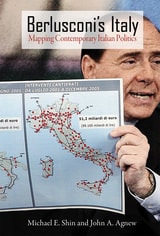
cover of Berlusconi's Italy: Mapping Contemporary Italian Politics

Berlusconi's Italy

Mapping Contemporary Italian Politics

Michael E. Shin and John A. Agnew

Temple University Press, 2008
Berlusconi's Italy provides a fresh, thoroughly-informed account of how Italy's richest man came to be its political leader. Without dismissing the importance of personalities and political parties, it emphasizes the significance of changes in voting behaviors that led to the rise-and eventual fall-of Silvio Berlusconi, the millionaire media baron who became Prime Minister. Armed with new data and new analytic tools, Michael Shin and John Agnew use recently developed methods of spatial analysis, to offer a compelling new argument about contextual re-creation and mutation. They reveal that regional politics and shifting geographical voting patterns were far more important to Berlusconi's successes than the widely-credited role of the mass media, and conclude that Berlusconi's success (and later defeat) can be best understood in geographic terms.
[more]
cover of Broken Ballots: Will Your Vote Count?

Broken Ballots

Will Your Vote Count?

Douglas E. Jones and Barbara Simons

CSLI, 2012

For many of us, the presidential election of 2000 was a wake-up call. The controversy following the vote count led to demands for election reform. But the new voting systems that were subsequently introduced to the market have serious security flaws, and many are confusing and difficult to use. Moreover, legislation has not kept up with the constantly evolving voting technology, leaving little to no legal recourse when votes are improperly counted. How did we come to acquire the complex technology we now depend on to count votes?  Douglas Jones and Barbara Simons probe this question, along with public policy and regulatory issues raised by our voting technologies.  Broken Ballots is a thorough and incisive analysis of the current voting climate that approaches American elections from technological, legal, and historical perspectives.  The authors examine the ways in which Americans vote today, gauging how inaccurate, unreliable, and insecure our voting systems are. An important book for election administrators, political scientists, and students of government and technology policy, Broken Ballots is also a vital tool for any voting American.
[more]
cover of Broken Record: The Origins and Evolution of Recorded Voting in the U.S. Congress

Broken Record

The Origins and Evolution of Recorded Voting in the U.S. Congress

Michael S. Lynch & Anthony J. Madonna

University of Michigan Press, 2025

Since the 1920s, the roll call voting record has influenced American politics. Using recorded votes, candidates attack electoral opponents, interest groups attempt to drum up financial or electoral support for their preferred candidates, scholars test theories of legislative behavior, and the media characterizes the ideological leanings of Congress. Despite this, there has not been a systematic attempt to document the changing usage of the roll call record. Michael S. Lynch and Anthony J. Madonna have undertaken a massive, multiyear data collection effort that culminated in four new datasets covering from 1905 to the contemporary period. Using data on approximately 120,000 amendments, 60,000 roll call votes, 2,000 important enactments, and 8,000 special rules from 1905 to 2015, the authors demonstrate how the roll call recording system has evolved. 

Consistent with the Founders’ skepticism of the impact of recorded voting in Congress, Broken Record shows that the contemporary roll call voting record includes far more meaningless position-taking and procedural roll call votes than it did during earlier congresses. The book argues that the removal of practical barriers to roll calls, internal changes to legislative procedures, and increased electoral competitiveness have led to more roll call votes on proposals sponsored by more extreme members. In addition to policy making being more difficult, increased roll call voting has played a substantial role in artificially increasing observed levels of polarization. This book argues that solving polarization requires a more nuanced set of solutions than simply replacing legislators; it will require increased public education about how Congress operates and specific procedural reforms.
[more]