Results by title
139 books match the query 'World War, 1914-1918' and 2 start with b
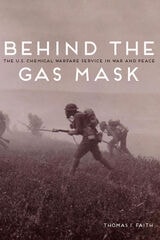
Behind the Gas Mask
The U.S. Chemical Warfare Service in War and PeaceThomas Faith
University of Illinois Press, 2014
In Behind the Gas Mask, Thomas Faith offers an institutional history of the Chemical Warfare Service, the department tasked with improving the Army's ability to use and defend against chemical weapons during and after World War One. Taking the CWS's story from the trenches to peacetime, he explores how the CWS's work on chemical warfare continued through the 1920s despite deep opposition to the weapons in both military and civilian circles.
As Faith shows, the believers in chemical weapons staffing the CWS allied with supporters in the military, government, and private industry to lobby to add chemical warfare to the country's permanent arsenal. Their argument: poison gas represented an advanced and even humane tool in modern war, while its applications for pest control and crowd control made a chemical capacity relevant in peacetime. But conflict with those aligned against chemical warfare forced the CWS to fight for its institutional life--and ultimately led to the U.S. military's rejection of battlefield chemical weapons.
As Faith shows, the believers in chemical weapons staffing the CWS allied with supporters in the military, government, and private industry to lobby to add chemical warfare to the country's permanent arsenal. Their argument: poison gas represented an advanced and even humane tool in modern war, while its applications for pest control and crowd control made a chemical capacity relevant in peacetime. But conflict with those aligned against chemical warfare forced the CWS to fight for its institutional life--and ultimately led to the U.S. military's rejection of battlefield chemical weapons.
[more]
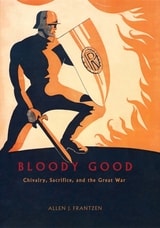
Bloody Good
Chivalry, Sacrifice, and the Great WarAllen J. Frantzen
University of Chicago Press, 2003
In the popular imagination, World War I stands for the horror of all wars. The unprecedented scale of the war and the mechanized weaponry it introduced to battle brought an abrupt end to the romantic idea that soldiers were somehow knights in shining armor who always vanquished their foes and saved the day. Yet the concept of chivalry still played a crucial role in how soldiers saw themselves in the conflict.
Here for the first time, Allen J. Frantzen traces these chivalric ideals from the Great War back to their origins in the Middle Ages and shows how they resulted in highly influential models of behavior for men in combat. Drawing on a wide selection of literature and images from the medieval period, along with photographs, memorials, postcards, war posters, and film from both sides of the front, Frantzen shows how such media shaped a chivalric ideal of male sacrifice based on the Passion of Jesus Christ. He demonstrates, for instance, how the wounded body of Christ became the inspiration for heroic male suffering in battle. For some men, the Crucifixion inspired a culture of revenge, one in which Christ's bleeding wounds were venerated as badges of valor and honor. For others, Christ's sacrifice inspired action more in line with his teachings—a daring stay of hands or reason not to visit death upon one's enemies.
Lavishly illustrated and eloquently written, Bloody Good will be must reading for anyone interested in World War I and the influence of Christian ideas on modern life.
[more]