384 books match the query 'Black Studies (Global)' and 56 start with b

cover of Bloodflowers: Rotimi Fani-Kayode, Photography, and the 1980s

Bloodflowers

Rotimi Fani-Kayode, Photography, and the 1980s

W. Ian Bourland

Duke University Press, 2019

In Bloodflowers W. Ian Bourland examines the photography of Rotimi Fani-Kayode (1955–1989), whose art is a touchstone for cultural debates surrounding questions of gender and queerness, race and diaspora, aesthetics and politics, and the enduring legacy of slavery and colonialism. Born in Nigeria, Fani-Kayode moved between artistic and cultural worlds in Washington, DC, New York, and London, where he produced the bulk of his provocative and often surrealist and homoerotic photographs of black men. Bourland situates Fani-Kayode's work in a time of global transition and traces how it exemplified and responded to profound social, cultural, and political change. In addition to his formal analyses of Fani-Kayode's portraiture, Bourland outlines the important influence that surrealism, neo-Romanticism, Yoruban religion, the AIDS crisis, experimental film, loft culture, and house and punk music had on Fani-Kayode's work. In so doing, Bourland offers new perspectives on a pivotal artist whose brief career continues to resonate with deep aesthetic and social meaning.
[more]
cover of Bordering Blackness: Migration and Dispossession in the Afro-Mediterranean

Bordering Blackness

Migration and Dispossession in the Afro-Mediterranean

Leslie Gross-Wyrtzen

Duke University Press, 2027

Bordering Blackness is an ethnography of the EurAfrican border told through the experiences of African migrants as they travel through the Sahara Desert into Morocco and across the Mediterranean Sea. Leslie Gross-Wyrtzen sheds light on the racial and economic logics that organize the transnational border regime across various sites and actors, historicizing them within the longue durée of African captivity, commodification, and racial othering. In contrast to Euro-American theories of blackness originating in the Middle Passage and western Atlantic slavery, she traces how West and Central Africans become black through present-day desert and maritime passages, which are entangled in earlier pathways across Atlantic and Mediterranean worlds. By historicizing and spatializing blackness, Gross-Wyrtzen forwards a relational understanding of contemporary borders, not as manifestations of an unchanging colonial or racial past but as contingent, if durable, ensembles ripe for reworking and resistance.
[more]
cover of Borders, Human Itineraries, and All Our Relation

Borders, Human Itineraries, and All Our Relation

Dele Adeyemo, Natalie Diaz, Nadia Yala Kisukidi, and Rinaldo Walcott. With a Foreword by Christina Sharpe

Duke University Press, 2024
The first annual Alchemy Lecture brings four deep and agile writers from different geographies and disciplines into vibrant conversation on a topic of urgent relevance: humans and borders. Borders, Human Itineraries, and All Our Relation captures and expands those conversations in insightful, passionate ways. Architect, artist, and urban theorist Dele Adeyemo (UK/Nigeria) calls attention to the complexity of Black infrastructures, questioning how “the environments that surround us condition the possibility of our being.” Poet Natalie Diaz (US/Mojave/Akimel O’otham) writes, “Like story, migration is the sensual movement of knowledge,” and asks, “What is the language we need to live right now?” Philosopher Nadia Yala Kisukidi (France) suggests there is no diasporic life “without the dynamics of fabulation, where we pass down, from generation to generation, the stories of our ancestors who walked barefoot for many months.” And cultural theorist Rinaldo Walcott (Canada) asks us to consider inheritances beyond white supremacist logics: “What might it mean to live a life, if we can’t risk desiring and working towards utopia?” As each alchemist considers the legacies of anticolonial struggle, the future of the planet, and the textures of Black and Indigenous life, their essays speak to each other in multiple ways, creating something startling and revelatory: a vision of the world as it is, and as it could be.
[more]
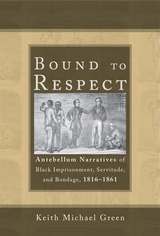
cover of Bound to Respect: Antebellum Narratives of Black Imprisonment, Servitude, and Bondage, 1816–1861

Bound to Respect

Antebellum Narratives of Black Imprisonment, Servitude, and Bondage, 1816–1861

Keith Michael Green

University of Alabama Press, 2015

WINNER OF THE ELIZABETH AGEE PRIZE IN AMERICAN LITERATURE

Challenges the commonplace narrative that the African American experience of captivity in the United States is reducible to the legal institution of slavery, a status remedied through emancipation
 
In Bound to Respect: Antebellum Narratives of Black Imprisonment, Servitude, and Bondage, 1816–1861, Keith Michael Green examines key texts that illuminate forms of black bondage and captivity that existed within and alongside slavery. In doing so, he restores to antebellum African American autobiographical writing the fascinating heterogeneity lost if the historical experiences of African Americans are attributed to slavery alone.
 
The book’s title is taken from the assertion by US Supreme Court chief justice Roger B. Taney in his 1857 Dred Scott decision that blacks had no rights that whites were “bound to respect.” This allusion highlights Green’s critical assertion that the dehumanizing absurdities to which defenders of slavery resorted to justify slavery only brought into more stark relief the humanity of African Americans.
 
A gifted storyteller, Green examines four forms of captivity: incarceration, enslavement to Native Americans, child indentured servitude, and maritime capture. By illuminating this dense penumbra of captivity beyond the strict definitions of slavery, he presents a fluid and holistic network of images, vocabulary, narratives, and history. By demonstrating how these additional forms of confinement flourished in the era of slavery, Green shows how they persisted beyond emancipation, in such a way that freed slaves did not in fact partake of “freedom” as white Americans understood it. This gap in understanding continues to bedevil contemporary American society, and Green deftly draws persuasive connections between past and present.
 
A vital and convincing offering to readers of literary criticism, African American studies, and American history, Green’s Bound to Respect brings fresh and nuanced insights to this fundamental chapter in the American story.
[more]
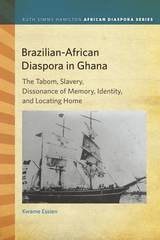
cover of Brazilian-African Diaspora in Ghana: The Tabom, Slavery, Dissonance of Memory, Identity, and Locating Home

Brazilian-African Diaspora in Ghana

The Tabom, Slavery, Dissonance of Memory, Identity, and Locating Home

Kwame Essien

Michigan State University Press, 2016
Brazilian-African Diaspora in Ghana is a fresh approach, challenging both pre-existing and established notions of the African Diaspora by engaging new regions, conceptualizations, and articulations that move the field forward. This book examines the untold story of freed slaves from Brazil who thrived socially, culturally, and economically despite the challenges they encountered after they settled in Ghana. Kwame Essien goes beyond the one-dimensional approach that only focuses on British abolitionists’ funding of freed slaves’ resettlements in Africa. The new interpretation of reverse migrations examines the paradox of freedom in discussing how emancipated Brazilian-Africans came under threat from British colonial officials who introduced stringent land ordinances that deprived the freed Brazilian- Africans from owning land, particularly “Brazilian land.” Essien considers anew contention between the returnees and other entities that were simultaneously vying for control over social, political, commercial, and religious spaces in Accra and tackles the fluidity of memory and how it continues to shape Ghana’s history. The ongoing search for lost connections with the support of the Brazilian government—inspiring multiple generations of Tabom (offspring of the returnees) to travel across the Atlantic and back, especially in the last decade—illustrates the unending nature of the transatlantic diaspora journey and its impacts.
 
[more]
cover of Brutalism

Brutalism

Achille Mbembe

Duke University Press, 2024

In Brutalism, eminent social and critical theorist Achille Mbembe invokes the architectural aesthetic of brutalism to describe our moment, caught up in the pathos of demolition and production on a planetary scale. Just as brutalist architecture creates an affect of overwhelming weight and destruction, Mbembe contends that contemporary capitalism crushes and dominates all spheres of existence. In our digital, technologically focused era, capitalism has produced a becoming-artificial of humanity and the becoming-human of machines. This blurring of the natural and artificial presents a planetary existential threat in which contemporary society’s goal is to precipitate the mutation of the human species into a condition that is at once plastic and synthetic. Mbembe argues that Afro-diasporic thought presents the only solution for breaking the totalizing logic of contemporary capitalism: repairing that which is broken, developing a new planetary consciousness, and reforming a community of humans in solidarity with all living things.
[more]