Results by title
3388 books match the query 'Fiction' and 126 start with b
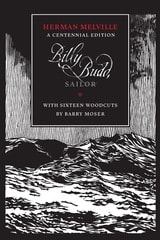
Billy Budd, Sailor (An Inside Narrative)
Herman Melville, Illustrated by Barry Moser
University of Chicago Press, 2025
An illustrated edition of Billy Budd featuring woodcuts by celebrated artist Barry Moser.
This edition of Billy Budd, Sailor presents Herman Melville’s iconic tale of the high seas alongside illustrations by renowned artist, publisher, and printmaker Barry Moser.
Throughout his fifty-year career, Moser has illustrated more than three hundred books ranging from novels to children’s stories to the Bible. Through his Pennyroyal Press, Moser designs and prints fine-press, illustrated, and occasionally oversized books in very limited editions, which are beloved by collectors and bibliophiles. To coincide with the centenary of the novella’s posthumous publication, Moser created sixteen original woodcuts illustrating the scenes and characters of Billy Budd, Sailor, and this trade edition now makes these exquisite illustrations accessible to a wide audience.
This illustrated edition adapts the text of the critical edition of the novella prepared for the Melville Electronic Library by John Bryant, Wyn Kelley, and Christopher Ohge.
Billy Budd, Sailor and Other Uncompleted Writings
The Writings of Herman Melville, Volume 13Herman Melville; Historical Note by Hershel Parker
Northwestern University Press, 2017
These unfinished writings include, besides Billy Budd, two projected volumes containing poems and prose pieces, Weeds and Wildings and Parthenope; three prose pieces, “Rammon,” “Story of Daniel Orme,” and “Under the Rose”; and some three dozen poems of varying lengths. Some of these pieces were surely composed late in Melville’s career, during his retirement, but others may date to as early as the 1850s. Except for Billy Budd, many of these works have not been readily available in reliable texts, when available at all.
This volume, the result of the editors’ meticulous study of the manuscripts, offers new reading texts, with significant corrections of words, phrases, and titles, the inclusion of heretofore unpublished lines of verse, and the return to their original locations of the two poems, “The Enviable Isles” and “Pausilippo,” that Melville had extracted for use in John Marr (1888) and Timoleon (1891). Hershel Parker’s Historical Note traces how these writings fit into the trajectory of Melville’s career, and the rest of the Editorial Appendix presents the scholarly evidence and decisions made in creating the reading texts. As a whole, the Northwestern-Newberry Edition of The Writings of Herman Melville, now complete in fifteen volumes, offers for the first time the total body of Melville’s extant writings in a critical text, faithful to his intentions.
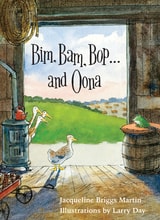
Bim, Bam, Bop . . . and Oona
Jacqueline Briggs Martin
University of Minnesota Press, 2019
An irresistible read-aloud picture book, in which a little odd-duck-out discovers her unique strengths
When these ducks go to the pond, it is Bim, Bam, Bop . . . and Oona, always last. They’re all ducks, but Bim, Bam, and Bop are runners, and Oona’s a waddler. “Last is a blot on my life,” she says to her frog friend, Roy. “I don’t feel as big as a duck should feel.” But she’s good with gizmos, Roy reminds her. So Oona tinkers with things, scraps, and strings, and eventually creates just the right gadget to get her to the pond first.
Spunky Oona will inspire and delight all who see her final triumphant creation. With its fun read-aloud words (from Brrrrrring to OOO-hoolie-hoo!), her story is wonderful to hear. Its charming illustrations invite readers to imagine our own new gizmos, and her victory reminds us to look for our own special gifts. A tale about being true to yourself, building confidence, and finding friendship, Bim, Bam, Bop . . . and Oona is sure to bring smiles to readers and listeners of all ages.
Birds without a Nest
A Novel: A Story of Indian Life and Priestly Oppression in PeruBy Clorinda Matto de Turner
University of Texas Press, 1996
"I love the native race with a tender love, and so I have observed its customs closely, enchanted by their simplicity, and, as well, the abjection into which this race is plunged by small-town despots, who, while their names may change, never fail to live up to the epithet of tyrants. They are no other than, in general, the priests, governors, caciques, and mayors." So wrote Clorinda Matto de Turner in Aves sin nido, the first major Spanish American novel to protest the plight of native peoples.
First published in 1889, Birds without a Nest drew fiery protests for its unsparing expose of small town officials, judicial authorities, and priests who oppressed the native peoples of Peru. Matto de Turner was excommunicated by the Catholic Church and burned in effigy. Yet her novel was strongly influential; indeed, Peruvian President Andres Avelino Caceres credited it with stimulating him to pursue needed reforms.
In 1904, the novel was published in a bowdlerized English translation with a modified ending. This edition restores the original ending and the translator's omissions. It will be important reading for all students of the indigenous cultures of South America.
Bisbee '17
Robert Houston
University of Arizona Press, 1999
Bkejwanong Dbaajmowinan/Stories of Where the Waters Divide
McGahey, Monty
Michigan State University Press, 2021
Black Diamond
Zakes Mda
Seagull Books, 2014
Kristin receives menacing phone calls and her home is invaded and vandalized—even her cat isn’t spared the threats—and the chief magistrate has no choice but to assign a bodyguard to protect her. To Kristin’s consternation, security guard Don Mateza moves into her home and trails her everywhere. This new arrangement doesn’t suit Don’s longtime girlfriend Tumi, a former model and successful businesswoman, who is intent on turning Don into a Black Diamond—a member of the wealthy new black South African middle class. And Don soon finds that his new assignment has unexpected complications that Tumi simply does not understand.
In Black Diamond, Mda tackles every conceivable South African stereotype, skillfully turning them upside down and exposing their ironies—often hilariously. This is a clever, quirky novel, in which Mda captures the essence of contemporary life in a fast-changing urban world.
Black Eagle Child
The Facepaint NarrativesRay A. Young Bear
University of Iowa Press, 1992
A candid, poetic account of childhood and young manhood through the eyes of a Native American, this vivid narrative is destined to become a central moral text for our time. Through the persona of Edgar Bearchild—a member of the Black Eagle Child Settlement—Ray A. Young Bear takes readers on an unforgettable “journey of words” as he documents grief and anguish countered by an abundance of humor, pride, and insight.
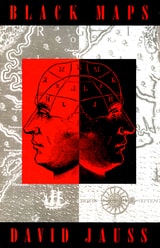
Black Maps
David Jauss
University of Massachusetts Press, 1996
As the epigraph from Milan Kundera suggests, the secret of life is that "the border beyond which everything loses meaning . . . is not miles away, but a fraction of an inch." With an unerring eye for human frailty, Jauss maps this ever-shifting boundary.
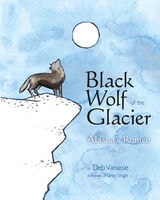
Black Wolf of the Glacier
Alaska's RomeoDeb Vanasse
University of Alaska Press, 2013
Black Wolf of the Glacier tells the story of this beloved legend through the eyes of Shawna, whose dog becomes best friends with Romeo. While initially afraid, Shawna ultimately learns to love the benevolent wolf. When Romeo goes missing, Shawna begins a determined search to find him, bringing readers along for the adventure.
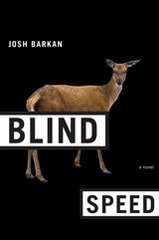
Blind Speed
A NovelJosh Barkan
Northwestern University Press, 2008
Not since Don DeLillo and George Saunders has a writer caught the humor and irreverent seriousness of our time like Barkan has through his protagonist Paul Berger, a flawed hero whose so-called fate drives him toward enlightenment just as surely as it propels him to destruction. Berger is stunned when he receives an ominous palm reading from a savvy guru at a health retreat in Iowa, of all places. And now it seems the prophecy is coming true. His fiancée, who is about to leave him, is shot at a historic reenactment of the Revolutionary War in Concord. One of his brothers, an astronaut, dies on 9/11 in the Pentagon. And his more famous brother, a lawyer and politician, kidnaps him in a media campaign to win an election. But is Paul’s life really controlled by fate? Or is the prophecy a lie he has latched onto ever since his band went under, leaving him almost famous yet unknown—a teacher at a community college, struggling to keep his job?
Blind Speed is a wildly entertaining exploration of intersecting lives in which what happens is never solely by chance or choice. Barkan has built a uniquely American satirical novel, a thoroughly twisted journey of discovery that pops and fires from its first shot in Concord to its last rifle blast, which echoes across the heartland. With global warming, 9/11, government and corporate deceit, and ecoterrorism, the novel dives into epic ideas, capturing America in all its dangerous myths.
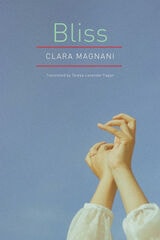
Bliss
Clara Magnani
Seagull Books, 2021
Rome, 2014, late summer. While he is reading on his sun-drenched terrace, Giangiacomo’s heart stops. A quick, painless death—something he had always hoped for, his daughter, Elvira, remembers. A few days later, Elvira comes across an unfinished manuscript in her father’s flat. In it, she discovers a love story between Giangiacomo—Gigi, to his loved ones—and a Belgian journalist, Clara, which had been going on for over four years. Gigi’s manuscript tells of how their “mature love,” an expression that became code between Gigi and Clara, blossomed unexpectedly and of the happiness of their meetings, the abandon of their bodies, their laughter, the films they watched and rewatched together. As she struggles to cope with the loss of Gigi, Clara writes her own version of their story. Her “journal of absence” is first addressed to Gigi, then, gradually, to Elvira. She confides in the young woman on the threshold of adult life, with discretion and tenderness, describing the fullness of the hidden love she shared with her father.
Blood Of Requited Love
Manuel Puig
University of Minnesota Press, 1999
Blood Pact and Other Stories
Mario Benedetti
Northwestern University Press, 1997
Blood of Mugwump
A Tiresian Tale of IncestDoug Rice
University of Alabama Press, 1996
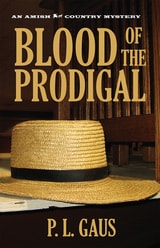
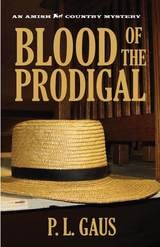
Blood of the Prodigal
An Amish Country MysteryP. L. Gaus
Ohio University Press, 1999
P. L. Gaus’s Blood of the Prodigal, a mystery in the tradition of Tony Hillerman, is back in a new edition, including an exclusive interview with the author, discussion questions for reading groups, and a detailed map and driving guide to Holmes County, Ohio, with everything one needs to visit the iconic scenes depicted in the story.
In Holmes County, Ohio—home to the largest Amish and Mennonite settlements in the world—mystery and foreboding lurk in the quiet Old Order Amish community led by Bishop Eli Miller.
The illusion of peace is shattered one early morning when a young Amish boy goes missing—abducted from his home and from Bishop Miller’s care. At first, the bishop suspects the child’s father, who was exiled from the Old Order ten years ago, but a murder soon casts doubt on the bishop’s theory. With a strong distrust of law enforcement and the modern “English” ways, the bishop must put his faith in an unlikely partnership with Professor Michael Branden before it’s too late.With the help of the peaceful pastor Cal Troyer and the reckless Sheriff Bruce Robertson, Branden plunges headlong into the closed culture to unravel the mystery of the missing child and uncover truths many would prefer to leave undisturbed.
Blood of the Prodigal
An Amish Country MysteryP. L. Gaus
Ohio University Press, 1999
P. L. Gaus’s Blood of the Prodigal, a mystery in the tradition of Tony Hillerman, is back in a new edition, including an exclusive interview with the author, discussion questions for reading groups, and a detailed map and driving guide to Holmes County, Ohio, with everything one needs to visit the iconic scenes depicted in the story.
In Holmes County, Ohio—home to the largest Amish and Mennonite settlements in the world—mystery and foreboding lurk in the quiet Old Order Amish community led by Bishop Eli Miller.
The illusion of peace is shattered one early morning when a young Amish boy goes missing—abducted from his home and from Bishop Miller’s care. At first, the bishop suspects the child’s father, who was exiled from the Old Order ten years ago, but a murder soon casts doubt on the bishop’s theory. With a strong distrust of law enforcement and the modern “English” ways, the bishop must put his faith in an unlikely partnership with Professor Michael Branden before it’s too late.With the help of the peaceful pastor Cal Troyer and the reckless Sheriff Bruce Robertson, Branden plunges headlong into the closed culture to unravel the mystery of the missing child and uncover truths many would prefer to leave undisturbed.
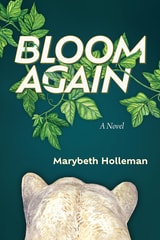
Bloom Again
A NovelMarybeth Holleman
University of Alaska Press, 2025
As the ground beneath them stirs, both women begin to recall their shared childhoods. Each must ignore the rumblings and fight for their comfortable existence—or leap. Before long, Elyse is following a Yup’ik marine mammal hunter along the windswept Siberian coast, and Astrid is risking her entire career to plant trees in India. As they navigate upheaval, they also confront the reminders of their past—a past whose full truth carries in it the promise of their future.
Bloom Again weaves together sophisticated narrative and characters, evocative travel and nature writing, and effective and reliable depictions of the climate change crisis in parts of the world underrepresented in mainstream literary fiction. A realistic work of ecoclimate fiction, it considers how people confront and respond to an amorphous yet unavoidable event like climate change in their everyday lives, as well as how women find new inspiration in their “second spring”—a time in life when career and family needs are fulfilled. It’s a book about waking up and finding our way, together.
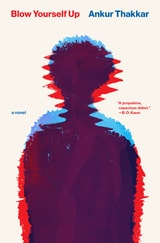
Blow Yourself Up
A NovelAnkur Thakkar
Northwestern University Press, 2026
A story of first love across cities spanning the decade that transformed the internet
In the halls of an elite East Coast high school, Arjun and Payal fall in love as the world begins to tilt toward the digital. Over the next eight years, their trajectories diverge as sharply as the fractured internet itself. Payal ascends to the dizzying, dopamine-fueled heights of New York’s influencer economy, finding fame on Boost, a looping video app that is as rewarding as it is demanding. Meanwhile, in a cavernous office in Chicago, Arjun, a musician whose dreams have quieted, now cleans up the same platform’s debris, moderating the internet’s darkest videos. When a brutal act of political violence against a beloved musician goes viral, this rip in reality forces the pair to confront the motivations of the platforms they inhabit. A sharp exploration of creative ambition and the multifarious nature of identity, this is a story of love in the time of infinite scroll and a look at what we sacrifice to be seen.
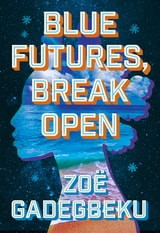
Blue Futures, Break Open
A NovelZoë Gadegbeku
West Virginia University Press, 2025
2026 IPPY Awards Gold Medal Winner, Visionary/New Age Fiction
Blue Basin Island is the final resting spot of formerly enslaved Africans whose souls have flown from Earth—not to heaven or purgatory but toward freedom and a new life. Lucille, the island’s seamstress, takes two forms. She lives among the inhabitants in human form and, along with the evil-repelling blue of the houses, her divine form protects people from the violence of the their former lives. Yet, even there, outside of time, the souls are not totally insulated from the world in which they were enslaved. Each time a Black person anywhere is harmed, a piece of Blue Basin disintegrates: an earthquake leaves hundreds of thousands dead, and bricks crumble on the island; when police kill a Black child asleep in her bed, the blue paint on homes throughout the island drips and then runs from the walls. Lucille must hold the island together, but she struggles to juggle the responsibility of ensuring everyone’s safety while also seeking and losing her own private love. Grounding the story in African folklore and dipping into the rich literary tradition around African people with the power of flight, Zoë Gadegbeku visualizes the destination at the end of the flight and the new life that awaits them.
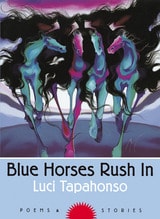
Blue Horses Rush In
Poems and StoriesLuci Tapahonso
University of Arizona Press, 1997
Blue Horses Rush In takes its title from a poem about the birth of her granddaughter Chamisa, whose heart "pounded quickly and we recognized / the sound of horses running: / the thundering of hooves on the desert floor." Through such personal insights, this collection follows the cycle of a woman's life and underlines what it means to be Navajo in the late twentieth century. The book marks a major accomplishment in American literature for its successful blending of Navajo cultural values and forms with the English language, while at the same time retaining the Navajo character. Here, Luci Tapahonso walks slowly through an ancient Hohokam village, recalling stories passed down from generation to generation. Later in the book, she may tell a funny story about a friend, then, within a few pages, describe family rituals like roasting green chiles or baking bread in an outside oven. Throughout, Tapahonso shares with readers her belief in the power of pollen and prayer feathers and sacred songs.
Many of these stories were originally told in Navajo, taking no longer than ten minutes in the telling. "Yet, in recreating them, it is necessary to describe the land, the sky, the light, and other details of time and place," writes Tapahonso. "In this way, I attempt to create and convey the setting for the oral text. In writing, I revisit the place or places concerned and try to bring the reader to them, thereby enabling myself and other Navajos to sojourn mentally and emotionally in our home, Dinétah."
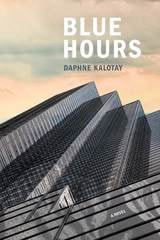
Blue Hours
A NovelDaphne Kalotay
Northwestern University Press, 2019
A mystery linking Manhattan circa 1991 to eastern Afghanistan in 2012, Blue Hours tells of a life-changing friendship between two memorable heroines. When we first meet Mim, she is a recent college graduate who has disavowed her lower middle class roots to befriend Kyra, a dancer and daughter of privilege, until calamity causes their estrangement. Twenty years later, Kyra has gone missing from her NGO’s headquarters in Jalalabad, and Mim—now a recluse in rural New England—embarks on a journey to find her. In its nuance, originality, and moral complexity, Blue Hours becomes an unexpected page-turner.
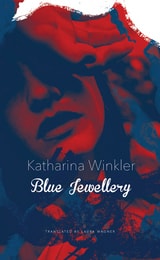
Blue Jewellery
Katharina Winkler
Seagull Books, 2018
Blue jewelry is private property. Not to be seen. Not to be talked about. It is worn like a bracelet around the wrists, on ribs, legs, arms. Blue jewelry is another name for the marks left on women’s bodies, inflicted by the men around them.
This novel tells the story of Filiz and Yunus. When Filiz meets Yunus, he is young and beautiful, and Filiz is proud that he wants her. Against her father’s wishes, they marry when she is thirteen. Yunus is her entire universe, all encompassing, all powerful. Soon after the wedding, Filiz’s dream of living in the West with her husband, of escaping their small village in Anatolia for freedom and autonomy, comes crashing down around her. Yunus, only a few years older than his bride, turns their marriage into a prison of dependency and violence. Trapped in her mother-in-law’s house, Filiz is subjected to physical and mental abuse, forced to veil herself, and treated as a house slave. When she becomes pregnant, Filiz seems to have reached her breaking point. But she endures. When Yunus moves his young family first to Istanbul and then to Austria, the life he had once promised her seems to be within reach. But there is no escaping the spiral of violence and love, which, to Filiz, have become inseparable.
Katharina Winkler’s powerful story of a marriage dominated by violence gives voice to a tenacious young woman whose will to survive is never broken.
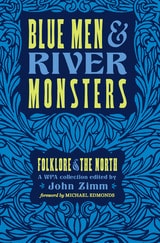
Blue Men and River Monsters
Folklore of the NorthJohn Zimm
Wisconsin Historical Society Press, 2014
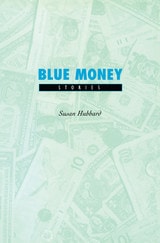
Blue Money
StoriesStories by Susan Hubbard
University of Missouri Press, 1999
A union organizer returns to her hometown and her high school sweetheart, only to discover unexpected peril. A middle-aged man walks to meet his wife at work one day and loses her forever. A young writer's stage fright destroys her work and her marriage but offers her a new life. In Blue Money, Susan Hubbard creates a world in which the most ordinary things can be magical, and the most ordinary people can be extraordinary.
"Selling the House" is the enchanting story of Marianne, a young housewife whose life is altered forever by a mysterious stranger. He suddenly appears on her doorstep one morning, offers to buy her home, quotes poetry, and just as suddenly disappears. Marianne soon discovers, however, that the stranger wants more than her house—he wants her. Although she does not accept the man's proposition, Marianne has been changed by it. His words echo throughout her life. "If she sometimes had trouble sleeping, if she spent more time reading poetry or staring out the window . . . well, those were small aberrations in an otherwise quite satisfactory life."
Strangers appear and disappear in Blue Money. Shoes charm and cure. A soiled shirt conjures conscience, and a clean one promises new identity. Hubbard brilliantly weaves these fantastic elements into the fabric of her fiction.
Women's relationships with men—whether they be fathers, lovers, or strangers—are a prominent theme of Hubbard's collection. "What Friends Are For" captures this theme at its most humorous and bizarre in the strange mishaps of two young girls trying to rid their lives of the stepfathers they despise. When their plan fails miserably, the girls are forced to accept the unwanted men, but not without finding brief comfort in the humor of their failure. "Then I start laughing too--a laugh I've never laughed before, like some exotic bird, high and shrill and free—and now [we're] laughing so hard that the voices outside fade away entirely."
Praised by Ploughshares as "an assured storyteller and a complex narrative stylist," Hubbard excels at writing spare yet powerfully evocative prose. Haunting in its suspense and subtle grace, Blue Money celebrates Hubbard's marvelous ability to explore the power of imagination.
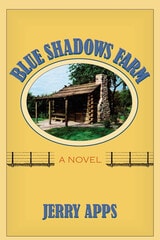
Blue Shadows Farm
A NovelJerry Apps
University of Wisconsin Press, 2009
Silas Starkweather, a Civil War veteran, is drawn to Wisconsin and homesteads 160 acres in Ames County, where he is known as the mysterious farmer forever digging holes. After years of hardship and toil, however, Silas develops a commitment to farming his land and respect for his new community. When Silas’s son Abe inherits Blue Shadows Farm he chooses to keep the land out of reluctant necessity, distilling and distributing “purified corn water” throughout Prohibition and the Great Depression in order to stay solvent. Abe’s daughter, Emma, willingly takes over the farm after her mother’s death. Emma’s love for this place inspires her to open the farm to school-children and families who share her respect for it. As she considers selling the land, Emma is confronted with a difficult question—who, through thick and thin, will care for Blue Shadows Farm as her family has done for over a century? In the midst of a controversy that disrupts the entire community, Emma looks into her family’s past to help her make crucial decisions about the future of its land.
Through the story of the Starkweather family’s changing fortunes, and each generation’s very different relationship with the farm and the land, Blue Shadows Farm is in some ways the narrative of all farmers and the increasingly difficult challenges they face as committed stewards of the land.
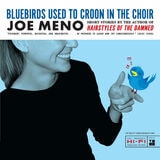
Bluebirds Used to Croon in the Choir
StoriesJoe Meno
Northwestern University Press, 2007
Children who anesthetize—and dress up—small wild animals in an ill-fated attempt to cheer their grieving mother; childhood friends who ritually return every year to the site of their near-kidnapping; an awkward teen trying to find his place among the cultural ruins of Greek Mythology Camp; brothers brought together, if not by mutual understanding, by a strange need to steal airport baggage: these are some of the characters who inhabit—and invariably tell—the stories in Joe Meno's Bluebirds Used to Croon in the Choir. Oddballs and charmers and would-be lovers, they are souls not so much lost as wandering, looking for something better, almost getting laid, trying to explain or, if all else fails, to entertain—and this they unfailingly do. Rarely has fiction so understated produced such hilarity and heartbreak.
Novelist, music journalist, and playwright Meno writes squarely in the American tradition of wringing large effects from small change, revealing the subtlety in the broad stroke, and conveying complexity with seeming simplicity. Celebrated for its "unflinching honesty" (Entertainment Weekly) and for its "poetic and visceral style" (Booklist), his work resonates with the unmistakable magic and curious mystery of modern life.
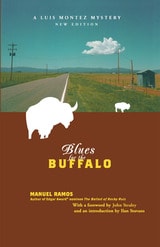
Blues for the Buffalo
Manuel Ramos
Northwestern University Press, 2004
The sun, the sand, a young beauty named Rachel in a white bikini—there's no better way to recover from the aches and pains of your latest case. At least that's what attorney and part-time detective Luis Montez thinks until the woman gives him the manuscript of her novel and vanishes.
Montez just wants to rebuild his Denåver practice, but an aggressive young P.I. with an emotional attachment to Rachel draws him in. With the woman's powerful adopted family on one side and unexplained death of a writer friend on the other, Montez digs up a series of long-told lies and long-hidden ugly truths. He also finds himself confronting one of the great unsolved mysteries of recent Chicano history. What happened to Oscar "Zeta" Acosta, the iconic activist-writer presumed dead since 1974? More to the point, what made Rachel insist the legendary Brown Buffalo was alive-and that he was her real father?

Blues in the Blood
Julien Delmaire
Seagull Books, 2023
Blues in the Blood is an ode to the spring of 1932 in the Mississippi delta, when stifling heat crushed the countryside and threatened the harvest, pervasive injustice ruled the day, and ghostly riders of the Ku Klux Klan spread terror. A panoramic historical and musical portrait, Blues in the Blood follows a poor young Black couple who believe their love for each other will save them from this devastation. Julien Delmaire introduces us to a gallery of figures: Blacks, Whites, Native Americans, mulattos, landowners, itinerant bluesmen, preachers, witches, corrupt politicians, prisoners, bootleggers, and Legba, the voodoo god, “master of crossroads,” who, like an otherworldly detective, watches over people’s destinies. As the story unfolds, a world is reborn: the delta, the birthplace of the blues, in which oppressed women and men rediscover the voices and rhythms of their humanity.
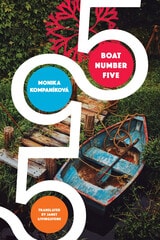
Boat Number Five
Monika Kompaníková
Seagull Books, 2021
A fierce, unapologetic eye captures the universal quest for connection in post-communist Eastern Europe.
Emotionally neglected by her immature, promiscuous mother and forced to care for her cantankerous dying grandmother, twelve-year-old Jarka is left to fend for herself in the social vacuum of a post-communist concrete jungle in Bratislava. She spends her days roaming the streets and daydreaming in the only place she feels truly safe: a small garden inherited from her grandfather. One day, stopping at a suburban railway station, she impulsively abducts twin babies.
Teetering on the edge of disaster, Jarka struggles to care for the children, and in the process, begins to discover herself. Boat Number Five—which was adapted into an award-winning Slovak film—brilliantly captures the ache and emptiness of a fractured society.

Body Blows
Six PerformancesTim Miller
University of Wisconsin Press, 2002
Hailed for his humor and passion, the internationally acclaimed performance artist Tim Miller has delighted, shocked, and emboldened audiences all over the world. Body Blows gathers six of Miller’s best-known performances that chart the sexual, spiritual, and political topography of his identity as a gay man: Some Golden States, Stretch Marks, My Queer Body, Naked Breath, Fruit Cocktail, and Glory Box. In Body Blows, Tim Miller leaps from the stage to the page, as each performance script is illustrated with striking photographs and accompanied by Miller’s notes and comment.
This book explores the tangible body blows—taken and given—of Miller’s life and times as explored in his performances: the queer-basher’s blow, the sweet blowing breath of a lover, the below-the-belt blow of HIV/AIDS, the psychic blows from a society that disrespects the humanity of lesbian and gay relationships. Miller’s performances are full of the put-up-your-dukes and stand-your-ground of such day-to-day blows that make up being gay in America
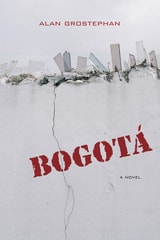
Bogotá
A NovelAlan Grostephan
Northwestern University Press, 2013
In Bogotá, a taut, moving novel set in present-day Colombia, Wilfredo decides to uproot his family from their small town, where his ferry service on the river subjects him to the gruesome errands demanded by the local paramilitary. Moving in with relatives in a slum in Bogotá, the family tries desperately to achieve the smallest measure of comfort and hope in a world of almost total ruin, wracked by deprivation, fear, and ceaseless violence.
Alan Grostephan depicts with startling immediacy an urban landscape of extreme harshness and oppressive instability. The tension between the desperate conditions surrounding his characters and their efforts to hold on to their humanity gives Bogotá a ferocious energy. As Wilfredo and his family fight to stay alive and stay together, their plight emerges as equally enraging and uplifting, constituting a portrait of a society always on the verge of disintegration.
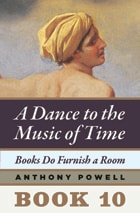
Books Do Furnish a Room
Book 10 of A Dance to the Music of TimeAnthony Powell
University of Chicago Press, 1995
Anthony Powell’s universally acclaimed epic A Dance to the Music of Time offers a matchless panorama of twentieth-century London. Now, for the first time in decades, readers in the United States can read the books of Dance as they were originally published—as twelve individual novels—but with a twenty-first-century twist: they’re available only as e-books.
The tenth volume, Books Do Furnish a Room (1971), finds Nick Jenkins and his circle beginning to re-establish their lives and careers in the wake of the war. Nick dives into work on a study of Robert Burton; Widmerpool grapples with the increasingly difficult and cruel Pamela Flitton—now his wife; and we are introduced to the series’ next great character, the dissolute Bohemian novelist X. Trapnel, a man who exudes in equal measure mystery, talent, and an air of self-destruction.
"Anthony Powell is the best living English novelist by far. His admirers are addicts, let us face it, held in thrall by a magician."--Chicago Tribune
"A book which creates a world and explores it in depth, which ponders changing relationships and values, which creates brilliantly living and diverse characters and then watches them grow and change in their milieu. . . . Powell's world is as large and as complex as Proust's."--Elizabeth Janeway, New York Times
"One of the most important works of fiction since the Second World War. . . . The novel looked, as it began, something like a comedy of manners; then, for a while, like a tragedy of manners; now like a vastly entertaining, deeply melancholy, yet somehow courageous statement about human experience."--Naomi Bliven, New Yorker
“The most brilliant and penetrating novelist we have.”--Kingsley Amis

Books, Readers and Libraries in Fiction
Edited by Karen Attar and Andrew Nash
University of London Press, 2024
Books and libraries appear in fiction from the earliest times onwards, in works for all age groups, in canonical literature, and in books that form part of popular culture. Fiction enables writers to teach readers how to read, but it can also portray subversive acts of reading that engage with contemporary cultural anxieties or moral debates. The reading material of fictional personae is part of their characterization; we are often reading readers.
Drawing on approaches from literary studies, book history, library history, and theories and histories of reading, Books, Readers and Libraries in Fiction examines what fictional representations of reading tell us about changing cultural attitudes to different reading practices, and the use (and abuse) of books beyond actual reading, both in the context of specific works and about the reception of books more widely. Through detailed case studies from primarily British fiction that address common themes such as gender, genre, and the relation between reading and writing itself, this collection catalogs the ways in which authors of fiction mediate and interpret books, libraries, and the act of reading to their own readers.

Border Beagles
A Tale of MississippiWilliam Gilmore Simms
University of Arkansas Press, 1996
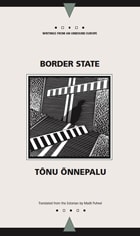
Border State
Tonu Onnepalu
Northwestern University Press, 2000
An immediate sensation upon its 1993 publication in Europe, already translated into more than a dozen languages, Border State is a brilliantly realized account of a man in the grip of Western excess, emotionally crippled by a world that is subsuming his own and inhabiting a West in which "all countries have become imaginary deserts of ruins where crowds of nomads roam from one attraction to the other." His tale, in which disillusion and murder become inextricably linked, is a compelling exploration of scarcity, longing, and madness.
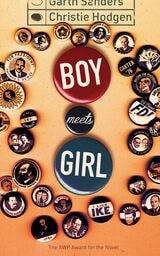
Boy Meets Girl
Christie Hodgen
New Issues Poetry and Prose, 2022
Boy Meets Girl is the story of a twenty-five-year friendship between Sammy Browne (young, idealistic, and broke) and Ben Eisenberg (older, jaded, and almost unimaginably rich)—two characters drawn together, and ultimately torn apart, by their differences. This novel tells the story of their relationship over the decades—from youthful flirtation to unrequited love, to long-term friendship that flourishes in middle age, to estrangement and then reunion. The novel unfolds in alternating chapters, toggling back and forth between Ben and Sammy as young people and in middle age, showing everything the characters hoped to become and how things turned out for them. Boy Meets Girl unfolds against the political and social backdrop of the last three decades, with Bill Clinton’s election, the events of September 11, the wars in Iraq and Afghanistan, and even the Trump era providing context and contrast for the personal stories of the main characters.
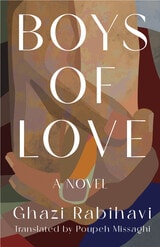
Boys of Love
Ghazi Rabihavi
University of Wisconsin Press, 2024
In Boys of Love, Ghazi Rabihavi offers both a universal story about the ups and downs of all relationships and a clear-eyed portrait of same-sex desire in Iran, where homosexuality remains punishable by death. Banned in Iran, the novel was initially published in Farsi in the UK, then translated into French and shortlisted for the Prix Médicis étranger. Rabihavi avoids both lasciviousness and exoticism in depicting a deep love between male characters living through the Iranian Cultural Revolution. Ultimately, this story challenges preconceived notions about marginalized communities in the Middle East.
Brain Fever
A NovelValerie Sayers
Northwestern University Press, 2013
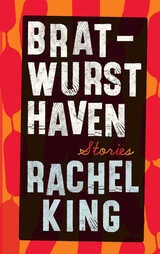
Bratwurst Haven
StoriesRachel King
West Virginia University Press, 2022
“An excellent collection that’s likely to appeal to fans of Alice Munro and Tobias Wolff.” —Kirkus Reviews
It’s almost a decade after the Great Recession, and in Colorado, St. Anthony Sausage has not recovered. Neither have its employees: a laid-off railway engineer, an exiled computer whiz, a young woman estranged from her infant daughter, an older man with cancer who lacks health care. As these low-wage workers interact under the supervision of the factory’s owner and his quietly rebellious daughter, they come to understand that in America’s postindustrial landscape, although they may help or comfort each other, they also have to do what’s best for themselves.
Over the course of these twelve interrelated stories, Rachel King gives life to diverse, complex, and authentic characters who are linked through the sausage factory and through their daily lives in a vividly rendered small town in Boulder County. The internal and external struggles of Bratwurst Haven’s population are immediately and intimately relatable and resonant: these people seek answers within the world they inhabit while questioning what it means to want more from their lives.
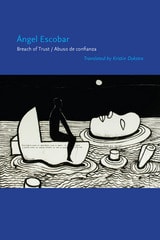
Breach of Trust/Abuso de confianza
Ángel Escobar with Translation by Kristin Dykstra
University of Alabama Press, 2016
The best-known work by acclaimed Cuban poet Ángel Escobar
Ángel Escobar’s Breach of Trust / Abuso de confianza is known by many as the most devastating book of his poetic generation. It is his first to be offered to an English-speaking audience. Merging personal and collective meditations, these twenty-three poems perform an indictment of violence. Escobar’s poetry delineates lacerations etched on bodies and minds by the sanguinary twentieth century, which unfolded out of a longer modernity spanning the Americas.
Breach of Trust / Abuso de confianza outlived its author, who took his own life in 1997. Brief and implicit appeals for justice and love offset the book’s abject theatricality. Escobar’s tragic masterpiece deftly interweaves themes into a striking synthesis offered in the spirit of survival.
Award-winning translator Kristin Dykstra introduces this collection with a comprehensive examination of Escobar’s life, work, and the times within which he wrote. Dykstra situates Escobar’s poetic abjection as his drive to confront thingification face to (non)face.
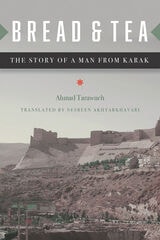
Bread and Tea
The Story of a Man from KarakAhmad Tarawneh
Michigan State University Press, 2017
Bread for the Departed
Bogdan Wojdowski
Northwestern University Press, 1997
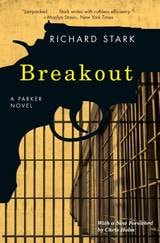
Breakout
A Parker NovelRichard Stark
University of Chicago Press, 2017
Richard Stark's Parker novels are the hardest of hard-boiled, classic crime novels where the heists are huge, the body counts are high, and the bad guys usually win.
The Parker novels have been a huge influence on countless writers and filmmakers, including Quentin Tarantino, Stephen King, George Pelecanos, Colson Whitehead, Lucy Sante, John Banville, and many more. Their stripped-down language and hard-as-nails amorality create an unforgettable world where the next score could be the big one, but your next mistake could also be your last. There's nothing else like them.
With Parker locked up and about to be unmasked, Breakout follows his Houdini-like escape from prison with a team of convicts. But when a new heist and new dangers—con artists, snitches, busybodies, eccentrics, and cops—loom among the dark alleys and old stone buildings of the big city to which they’ve fled, Parker soon learns that not all prisons have bars.
The Parker novels are pure artistry, adrenaline, and logic both brutal and brilliant. Join Parker on his jobs and read them all again or for the first time. Just don’t talk to the law.

Brezhat
A NovellaMichael Holt
University of Alabama Press, 2027
Three Sams, one impossible building, and a mystery echoing across worlds, lifetimes, and dreams.
Brezhat is a thrilling, puzzle-like novella that unfolds across three overlapping worlds, all occurring within the same haunted building. In one timeline, the building is a school where children's dreams are recorded. In another, an orphanage tied to a glass factory. In the third, a postapocalyptic ruin inhabited by a community of eccentric survivors.
Within its shifting halls live three versions of the same person, all named Sam. Though separated by time and circumstance, the Sams share dreams, sensations, and fleeting encounters that bind their lives together in unsettling ways. As they wander through forgotten corridors and forbidden rooms, the Sams undertake tasks both ordinary and uncanny. They deliver life-saving serum, reassemble the body of a broken friend, talk with the dead, and bury dead mice. Along the way, they are guided, taught, and sometimes misled by an unforgettable cast of adults: teachers, nuns, scientists, artists, a librarian, and the inscrutable Mr. Jones, a janitor who seems to exist outside of time altogether. Threaded through each timeline is the shadow of a former friend whose acts of violence echo across worlds, causing old wounds to recur in new forms. Blending speculative fiction, psychological insight, and gothic atmosphere, Brezhat is a mesmerizing novella steeped in mystery, unraveling the stories we inherit, the selves we might have been, and the strange ways pain reverberates across a lifetime.
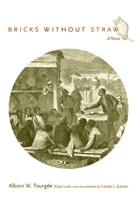
Bricks Without Straw
A NovelAlbion W. Tourgée
Duke University Press, 2009
Bricks Without Straw is Tourgée’s fictionalized account of how Reconstruction was sabotaged. It is a chilling picture of violence against African Americans condoned, civil rights abrogated, constitutional amendments subverted, and electoral fraud institutionalized. Its plot revolves around a group of North Carolina freedpeople who strive to build new lives for themselves by buying land, marketing their own crops, setting up a church and school, and voting for politicians sympathetic to their interests, until Klan terrorism and the ascendancy of a white supremacist government reduce them to neo-slavery. This edition of Bricks Without Straw is enhanced by Carolyn L. Karcher’s introduction, which sets the novel in historical context and provides an overview of Albion W. Tourgée’s career, a chronology of the significant events of both the Reconstruction era and Tourgée’s life, and explanatory notes identifying actual events fictionalized in the novel.
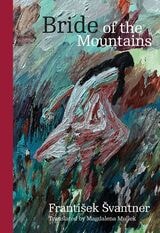
Bride of the Mountains
František Švantner
Karolinum Press, 2026
A classic work of twentieth-century Slovak literature that blends naturalism and depictions of rural life with the supernatural.
After many years, Libor returns to his native village, where he has been appointed gamekeeper. His childhood sweetheart, Zuna, is waiting for him there. But his homecoming is far from idyllic. He has “tasted city life” and soon becomes an outsider to the villagers. According to them, Zuna has become a local prostitute who sleeps with anyone who pays her. Zuna’s father, an old miller, has gone blind because he made a pact with the devil. The mill where Libor and Zuna used to play as children has fallen into disrepair and ruin. The more Libor gets to know the world that he has returned to, the more confused he becomes. The village is full of superstitions, secrets, and hostility. He meets the charcoal burner Tavo, who lives high in the mountains, and learns from him the mysterious and bloody story of Zuna’s birth. He also learns what matters most to him: Zuna is pure and innocent. Libor starts a relationship with her from scratch. But just when their forgotten love might finally come to fruition, He appears—a vagabond who can transform into a wolf—and Libor discovers that Zuna is meeting with him. Is it a monster that gouges people’s eyes out? The devil, or our immaterial, dark alter ego? Reality, dreams, and fantasy blend in Libor’s mind as his hopes seem crushed beyond redemption.
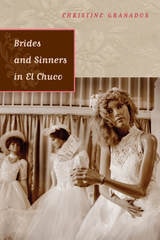
Brides and Sinners in El Chuco
Christine Granados
University of Arizona Press, 2006
In the border town of El Paso—better known to its Mexican American residents as El Chuco—dramas unfold in humdrum households every day as working-class men come home from their jobs and as their wives and children do their best to cope with life. Christine Granados now plumbs the heart of this community in fourteen startling stories, uncovering the dreams and secrets in which ordinary people sometimes lose themselves. Many fictional accounts of barrio life play up tradition and nostalgia; Brides and Sinners in El Chuco is a trip to the darker side. Here are memories of growing up in a place where innocence is always tempered by reality—true-to-life stories, told in authentic language, of young women, from preteens to twenty-somethings, learning to negotiate their way through troubled times and troubled families. In the award-winning story “The Bride,” a young girl recalls her sister as a perennial bride on Halloween, planning for her eventual big day in a pink notebook with lists of potential husbands, only to see her dream thwarted at the junior prom. In another, we meet Bobbi, the class slut, whose D-cup chest astounds the other girls and entices everyone—even those who shouldn’t be tempted.
Granados’ tales boldly portray women’s struggle for solidarity in the face of male abuse, and as these characters come to grips with self-discovery, sibling rivalry, and dysfunctional relationships, she shows what it means for Chicanas to grow up in protective families while learning to survive in the steamy border environment. Brides and Sinners in El Chuco is an uncompromising look at life with all its hard edges—told with enough softness to make readers come back for more.
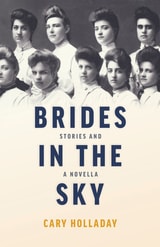
Brides in the Sky
Stories and a NovellaCary Holladay
Ohio University Press, 2019
Each of the crystalline worlds Cary Holladay brings us in the short stories and novella that make up Brides in the Sky has sisterhood, in all its urgency and peril, at its heart. In the title story, two women in 1850s Virginia marry brothers who promptly uproot them to follow the Oregon Trail west, until an unexpected shift of allegiance separates the sisters forever. Elsewhere in the book, a young boy’s kidnapping ignites tensions in a sorority house; frontier figure Cynthia Ann Parker struggles upon her return to her birth community from the Comanche people with whom she’s lived a full life; and in a metafictional twist, a gothic tale resonates in the present. In the novella, “A Thousand Stings,” three sisters come of age in the 1960s over a long summer of small-town scandal and universal stakes. These are just some of the lives, shaped by migrations, yearning, and the long shadows of myth, that Holladay creates. She crafts them with subtle humor, a stunning sense of place, and an unerring eye for character.
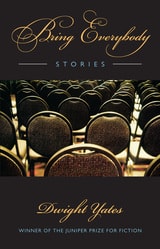
Bring Everybody
StoriesDwight Alan Yates
University of Massachusetts Press, 2006
Self-delusion courts self-destruction in these stories, but not without relief, since revelation is always possible and redemption just might come tumbling after. Though the stakes are sometimes low and the circumstances more rueful than tragic, Yates illuminates the gulf between expectation and reality with humor and compassion.
Seduction does not inevitably lead to abandonment in these tales, although that is certainly one outcome. A disastrous young marriage is another. In one case, a seducer comes to see that a chance encounter with an old flame has not closed an incomplete narrative from the past, but most likely has opened a perilous new chapter.
Other stories investigate dormant dread awakened by the hiccup of circumstance. A family man's decision to stop and assist a stalled motorist does not imperil his family as his wife fears. Yet the encounter reveals a burden of faith and guilt that continues to haunt this Samaritan and prompts his irrational, yet perhaps admirable, behavior. In another family tale, a father struggles with the imminent independence of his daughter, a struggle that, like much in his life, is distorted by his curious infatuation with the insomnia afflicting him. The collection's final piece concerns an aging, retired accountant who, stricken with intimations of mortality, hastily attempts to become well loved and eventually handsomely eulogized by undertaking good works, an undertaking he persists in pursuing against mounting odds.
Men and women tell many of their own stories here. In other outings, the telling rests with bemused and attentive narrators, crowding in close, better to witness the charm and folly of the memorable characters assembled in this prize-winning collection.