Results by title
1917 books match the query 'Law' and 62 start with b
Broken Contract
A Memoir of Harvard Law SchoolRichard D. Kahlenberg
University of Massachusetts Press, 1999
In 1986, 70 percent of the first-year class of Harvard Law School wanted to pursue careers in public-interest law. Ten years later, the same percentage of this class was pursuing careers in private corporate firms. How is it that these students began their careers interested in using law as a vehicle for social change, but ended up in those very law firms most resistant to change? How are law students able to reconcile liberal politics with careers in corporate law?
Richard D. Kahlenberg's Broken Contract serves to warn prospective law students on the transformation that happens during the second and third years. His memoir explores the intense competitiveness and insidious pressure leading to jobs that are lucrative, prestigious, and challenging, but ultimately unsatisfying.
Though Broken Contract doesn't seek to convince every law student to go into public service, Kahlenberg means to challenge and restructure our social institutions to make it easier to follow our impulses toward good instead of toward the goods.
Broken Worlds, Disabled Kin
Strategies for Collective SurvivalKelly Fritsch
University of Minnesota Press, 2026
A call to remake our world through a new politics of disabled kin-making
We live in a world broken by design: a web of systems that debilitate and kill through racist and ableist infrastructural neglect, socioeconomic abandonment, and ecological negligence. Fixes for these forms of breakage often conceal and amplify harm—but what happens if we refuse to rehabilitate this inhospitable world? In Broken Worlds, Disabled Kin, Kelly Fritsch and Anne McGuire urge an alternative response through abolition, access, care, and interdependence.
Bringing a much-needed disability studies lens to discussions of public policy, legal reform, and social change, Fritsch and McGuire show how hostile social and economic structures such as racial capitalism, neoliberalism, and settler colonialism unevenly target certain populations and environments. As they trace how everyday encounters with broken infrastructures like inaccessible transit, fragmented mental health care, and crumbling educational institutions reflect broader patterns of structural abandonment and slow violence, they pose a radical means of response: the making of disabled kin. Ranging from mundane disruptions to global crises like pandemics, wars, genocides, and climate collapse, they demonstrate how disabled kin-making nurtures connection and support between people, ecologies, infrastructures, and objects, cultivating a collective “we” that can contest systems broken by design.
Urgent and passionate, Broken Worlds, Disabled Kin asks readers to reexamine conceptions of breakage, maintenance, and repair, viewing them as tools of abolition and justice. Against relentless fragmentation and atomization, this book equips us with a politics of solidarity and collectivity with which to begin making a more life-supporting world.
Retail e-book files for this title are screen-reader friendly with images accompanied by short alt text and/or extended descriptions.
Brokered Subjects
Sex, Trafficking, and the Politics of FreedomElizabeth Bernstein
University of Chicago Press, 2018
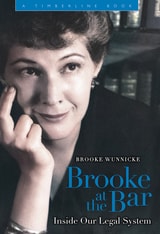
Brooke at the Bar
Inside Our Legal SystemBrooke Wunnicke
University Press of Colorado, 2023
Brooke shares vignettes of her early life—California in the Great Depression, college at Stanford, law school in Colorado during World War II, and the 1946 opening of her Cheyenne law office, a precedent for women in law. She vividly describes memorable and amusing experiences with clients, witnesses, lawyers, juries, and judges and explains some significant cases. She recounts important and dynamic events from her twelve years as Denver’s chief appellate deputy district attorney, an era during which she was an inestimable mentor to many young lawyers who became prominent in the private and public sectors.
Brooke passionately believed “the law has been and will continue to be civilization’s hope.” In her book’s final part, she demystifies many legal terms and procedures and describes the parts of a civil jury trial—including information for jurors and witnesses—and provides an enthusiastic and clear refresher on the US Constitution and Bill of Rights.
Brooke at the Bar is a unique and historically important contribution that will be of interest to general readers, scholars, and students interested in US law, political science, government, women’s history, twentieth-century western history, civil rights, and legal communities, including those in Wyoming and Colorado, where Brooke was “at the Bar.”
Brotherly Love
Murder and the Politics of Prejudice in Nineteenth-Century Rhode IslandCharles Hoffmann
University of Massachusetts Press, 1993
Brotherly Love is a graphic reconstruction of the crime, its social and economic background, and the subsequent trials. The story reveals the antagonism between native-born Yankees, who commanded great power, and the growing number of Irish Catholic immigrants, most of whom worked in the textile mills. Indeed, the economic, political, and religious dimensions of the conflict are all evident in the trials.
The authors argue persuasively that the Gordons were victims of bigotry and circumstantial evidence, serving as convenient scapegoats to appease a community outraged over the murder of its wealthiest citizen. In telling the story of this notorious case, Brotherly Love reveals the politics of prejudice in nineteenth-century New England as played out in community and courtroom.
Building a Legislative-Centered Public Administration
Congress and the Administrative State, 1946-1999David Rosenbloom
University of Alabama Press, 2002
2001 Louis Brownlow Award from the National Academy of Public Administration
Reimagining public administration through the lens of constitutional governance and legislative intent.
Before 1946 the congressional role in public administration had been limited to authorization, funding, and review of federal administrative operations, which had grown rapidly as a result of the New Deal and the Second World War. But in passing the Administrative Procedure Act and the Legislative Reorganization Act that pivotal year, Congress self-consciously created for itself a comprehensive role in public administration. Reluctant to delegate legislative authority to federal agencies, Congress decided to treat the agencies as extensions of itself and established a framework for comprehensive regulation of the agencies' procedures. Additionally, Congress reorganized itself so it could provide continuous supervision of federal agencies.
Rosenbloom shows how these 1946 changes in the congressional role in public administration laid the groundwork for future major legislative acts, including the Freedom of Information Act (1966), Privacy Act (1974), Government in the Sunshine Act (1976), Paperwork Reduction Acts (1980, 1995), Chief Financial Officers Act (1990), and Small Business Regulatory Fairness Enforcement Act (1996). Each of these acts, and many others, has contributed to the legislative-centered public administration that Congress has formed over the past 50 years.
This first book-length study of the subject provides a comprehensive explanation of the institutional interests, values, and logic behind the contemporary role of Congress in federal administration and attempts to move the public administration field beyond condemning legislative "micromanagement" to understanding why Congress values it.

Building a New Legal Order for the Oceans
Tommy Koh
National University of Singapore Press, 2019
In this book, Koh fully explains the many new concepts of international law that arose from UNCLOS III, such as the Exclusive Economic Zone, Archipelagic State, Straits Used for International Navigation, Transit Passage, Archipelagic Sealane Passage, and the Common Heritage of Mankind. He also discusses current threats to maritime security and explains the intricacies of the disputes in the South China Sea. Koh asks What can be learned from the success of UNCLOS? How can we build on that success and manage the new tensions that arise in the Law of the Sea? There is no better guide to this aspect of international law than Koh.
Building a Revolutionary State
The Legal Transformation of New York, 1776-1783Howard Pashman
University of Chicago Press, 2018
Building a Revolutionary State looks closely at one state, New York, to understand the broader question of how legal structures emerged from an insurgency. By examining law as New Yorkers experienced it in daily life during the war, Pashman reconstructs a world of revolutionary law that prevailed during America’s transition to independence. In doing so, Pashman explores a central paradox of the revolutionary era: aggressive enforcement of partisan property rules actually had stabilizing effects that allowed insurgents to build legal institutions that enjoyed popular support. Tracing the transformation from revolutionary disorder to legal order, Building a New Revolutionary State gives us a radically fresh way to understand the emergence of new states.
Building the Prison State
Race and the Politics of Mass IncarcerationHeather Schoenfeld
University of Chicago Press, 2018
Reframing the story of mass incarceration, Heather Schoenfeld illustrates how the unfinished task of full equality for African Americans led to a series of policy choices that expanded the government’s power to punish, even as they were designed to protect individuals from arbitrary state violence. Examining civil rights protests, prison condition lawsuits, sentencing reforms, the War on Drugs, and the rise of conservative Tea Party politics, Schoenfeld explains why politicians veered from skepticism of prisons to an embrace of incarceration as the appropriate response to crime. To reduce the number of people behind bars, Schoenfeld argues that we must transform the political incentives for imprisonment and develop a new ideological basis for punishment.
Butterfly, the Bride
Essays on Law, Narrative, and the FamilyCarol Weisbrod
University of Michigan Press, 2004
Butterfly, the Bride looks at law from the outside, using narrative to provide a fresh perspective on the issues of law and social structure---and individual responses to law. This book thoroughly explores relationships between inner and public lives by examining what is ordinarily classified as the sphere of private life---the world of family relationships.
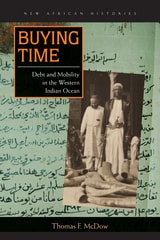
Buying Time
Debt and Mobility in the Western Indian OceanThomas F. McDow
Ohio University Press, 2018
In Buying Time, Thomas F. McDow synthesizes Indian Ocean, Middle Eastern, and East African studies as well as economic and social history to explain how, in the nineteenth century, credit, mobility, and kinship knit together a vast interconnected Indian Ocean region. That vibrant and enormously influential swath extended from the desert fringes of Arabia to Zanzibar and the Swahili coast and on to the Congo River watershed.
In the half century before European colonization, Africans and Arabs from coasts and hinterlands used newfound sources of credit to seek out opportunities, establish new outposts in distant places, and maintain families in a rapidly changing economy. They used temporizing strategies to escape drought in Oman, join ivory caravans in the African interior, and build new settlements.
The key to McDow’s analysis is a previously unstudied trove of Arabic business deeds that show complex variations on the financial transactions that underwrote the trade economy across the region. The documents list names, genealogies, statuses, and clan names of a wide variety of people—Africans, Indians, and Arabs; men and women; free and slave—who bought, sold, and mortgaged property. Through unprecedented use of these sources, McDow moves the historical analysis of the Indian Ocean beyond connected port cities to reveal the roles of previously invisible people.

By Their Fruits
Eugenics, Population Control, and the Abortion CampaignAnn FARMER
Catholic University of America Press, 2008