Results by title
1488 books match the query 'Media Studies' and 65 start with b

British TV and Film Culture in the 1950s
Coming to a TV Near YouSu Holmes
Intellect Books, 1995
Britpop Cinema
From Trainspotting to This is EnglandMatt Glasby
Intellect Books, 2019
Broadcasters and Citizens in Europe
Trends in Media Accountability and Viewer ParticipationEdited by Paolo Baldi and Uwe Hasebrink
Intellect Books, 2007
European media is experiencing a paradoxical form of growth: as media outlets surge and new technologies develop, major broadcasting companies are consolidating like never before. In Broadcasters and Citizens in Europe, an esteemed group of contributors look at what this paradox might mean for the European community. Are broadcasting audiences better informed than they were twenty years ago? And how has the advent of the European Union changed media practices? This essential volume explores a new media world in the context of a continent in flux.
Broadcasting Diversity
Migrant Representation in Irish RadioKatie Moylan
Intellect Books, 2013

Broadcasting Hollywood
The Struggle over Feature Films on Early TVJennifer Porst
Rutgers University Press, 2021
Broadcasting Modernity
Cuban Commercial Television, 1950-1960Yeidy M. Rivero
Duke University Press, 2015
Broadcasting and National Imagination in Post-Communist Latvia
Defining the Nation, Defining Public TelevisionJanis Juzefovics
Intellect Books, 2017
Broadcasting, Voice, and Accountability
A Public Interest Approach to Policy, Law, and RegulationSteve Buckley, Kreszentia Duer, Toby Mendel, and Seán Ó Siochrú
University of Michigan Press, 2008
---Ruth Teer-Tomaselli, UNESCO Chair in Communication for Southern Africa, Culture, Communication and Media Studies, University of KwaZulu-Natal
digitalculturebooks is an imprint of the University of Michigan Press and the Scholarly Publishing Office of the University of Michigan Library dedicated to publishing innovative and accessible work exploring new media and their impact on society, culture, and scholarly communication. Visit the website at www.digitalculture.org.
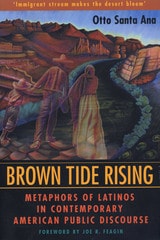
Brown Tide Rising
Metaphors of Latinos in Contemporary American Public DiscourseBy Otto Santa Ana
University of Texas Press, 2002
2002 – Best Book on Ethnic and Racial Political Ideology and/or Political Theory – Organized Section on Race, Ethnicity, and Politics of the American Political Science Association
"...awash under a brown tide...the relentless flow of immigrants..like waves on a beach, these human flows are remaking the face of America...." Since 1993, metaphorical language such as this has permeated mainstream media reporting on the United States' growing Latino population. In this groundbreaking book, Otto Santa Ana argues that far from being mere figures of speech, such metaphors produce and sustain negative public perceptions of the Latino community and its place in American society, precluding the view that Latinos are vested with the same rights and privileges as other citizens.
Applying the insights of cognitive metaphor theory to an extensive natural language data set drawn from hundreds of articles in the Los Angeles Times and other media, Santa Ana reveals how metaphorical language portrays Latinos as invaders, outsiders, burdens, parasites, diseases, animals, and weeds. He convincingly demonstrates that three anti-Latino referenda passed in California because of such imagery, particularly the infamous anti-immigrant measure, Proposition 187. Santa Ana illustrates how Proposition 209 organizers broadcast compelling new metaphors about racism to persuade an electorate that had previously supported affirmative action to ban it. He also shows how Proposition 227 supporters used antiquated metaphors for learning, school, and language to blame Latino children's speech—rather than gross structural inequity—for their schools' failure to educate them. Santa Ana concludes by calling for the creation of insurgent metaphors to contest oppressive U.S. public discourse about minority communities.

Brushed in Light
Calligraphy in East Asian CinemaMarkus Nornes
University of Michigan Press, 2021
Drawing on a millennia of calligraphy theory and history, Brushed in Light examines how the brushed word appears in films and in film cultures of Korea, Japan, Taiwan, Hong Kong, and PRC cinemas. This includes silent era intertitles, subtitles, title frames, letters, graffiti, end titles, and props. Markus Nornes also looks at the role of calligraphy in film culture at large, from gifts to correspondence to advertising. The book begins with a historical dimension, tracking how calligraphy is initially used in early cinema and how it is continually rearticulated by transforming conventions and the integration of new technologies. These chapters ask how calligraphy creates new meaning in cinema and demonstrate how calligraphy, cinematography, and acting work together in a single film. The last part of the book moves to other regions of theory. Nornes explores the cinematization of the handwritten word and explores how calligraphers understand their own work.
Bubbles and Machines
Gender, Information and Financial CrisesMicky Lee
University of Westminster Press, 2019
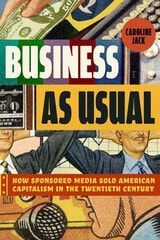
Business as Usual
How Sponsored Media Sold American Capitalism in the Twentieth CenturyCaroline Jack
University of Chicago Press, 2024
Business as Usual reveals how American capitalism has been promoted in the most ephemeral of materials: public service announcements, pamphlets, educational films, and games—what Caroline Jack calls “sponsored economic education media.” These items, which were funded by corporations and trade groups who aimed to “sell America to Americans,” found their way into communities, classrooms, and workplaces, and onto the airwaves, where they promoted ideals of “free enterprise” under the cloaks of public service and civic education. They offered an idealized vision of US industrial development as a source of patriotic optimism, framed business management imperatives as economic principles, and conflated the privileges granted to corporations by the law with foundational political rights held by individuals. This rhetoric remains dominant—a harbinger of the power of disinformation that so besets us today. Jack reveals the funding, production, and distribution that together entrenched a particular vision of corporate responsibility—and, in the process, shut out other hierarchies of value and common care.
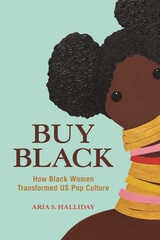
Buy Black
How Black Women Transformed US Pop CultureAria S. Halliday
University of Illinois Press, 2022
Far-ranging and bold, Buy Black reveals what attitudes inform a contemporary Black sensibility based in representation and consumerism. It also traces the parameters of Black symbolic power, mapping the sites where intraracial ideals of blackness, womanhood, beauty, play, and sexuality meet and mix in consumer and popular culture.
By Their Work
Indigenous Women's Digital Media in North AmericaJoanna Hearne
University of Minnesota Press, 2025
A first-of-its-kind collection to transform our understanding of digital media from Indigenous women creators
Indigenous women form a vital force in digital media production now and have over the past several decades—in fact, nearly three quarters of the projects at the 2017 imagineNATIVE Film and Media Arts Festival were created by women. By Their Work highlights the prismatic nature of Indigenous women’s digital media, connecting the digital arts with their creative labor and adaptive activism.
Joanna Hearne and Karrmen Crey bring together a collection of essays and interviews to highlight the voices of powerful and important media makers, from Indigenous video game creators to animators to social media influencers and from theorists of early Indigenous digital media to current practitioners, including trans and nonbinary creators often left out of public narratives about the digital. Creating a space to hear critical voices on Indigenous media history, theory, and production, the contributors share stories, genealogies, and practices behind Indigenous women’s power and presence in the digital world.
Focusing on the history of digital media as a whole, this collection presents a compelling case for Indigenous women’s crucial roles across the history of digital forms and platforms. In doing so, By Their Work transforms digital Indigenous studies in the twenty-first century.
Contributors: Nanobah Becker; Reilley Bishop-Stall, McGill U; Meagan Byrne; Tawny Trottier Cale; Dana Claxton; Crystal Harrison Collin; Elizabeth Day; Kristin L. Dowell, Florida State U; Miranda Due; Heid E. Erdrich; Marcella Ernest, U of New Mexico; Marisa Erven; David Gaertner, U of British Columbia; Carol Geddes; Faye Ginsburg, New York U; Patuk N. Glenn; Lisa Jackson; Jacqueline Land, William Jewell College; Jason Edward Lewis, Concordia University, Montreal; Joshua D. Miner, U of Kansas; Salma Monani, Gettysburg College; Jas M. Morgan, Simon Fraser U; Archer Pechawis, York U; Mikhel Proulx, Queen’s U Canada; Ryan Rice; Jolene Rickard, Cornell U; Channette Romero, U of Georgia; Wendi Sierra, Texas Christian U; Skawennati.
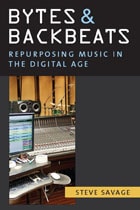
Bytes and Backbeats
Repurposing Music in the Digital AgeSteve Savage
University of Michigan Press, 2013
From Attali's "cold social silence" to Baudrillard's hallucinatory reality, reproduced music has long been the target of critical attack. In Bytes and Backbeats, however, Steve Savage deploys an innovative combination of designed recording projects, ethnographic studies of contemporary music practice, and critical analysis to challenge many of these traditional attitudes about the creation and reception of music. Savage adopts the notion of "repurposing" as central to understanding how every aspect of musical activity, from creation to reception, has been transformed, arguing that the tension within production between a naturalizing "art" and a self-conscious "artifice" reflects and feeds into our evolving notions of creativity, authenticity, and community.
At the core of the book are three original audio projects, drawing from rock & roll, jazz, and traditional African music, through which Savage is able to target areas of contemporary practice that are particularly significant in the cultural evolution of the musical experience. Each audio project includes a studio study providing context for the social and cultural analysis that follows. This work stems from Savage's experience as a professional recording engineer and record producer.