Results by title
4917 books match the query 'Philosophy' and 154 start with b
Being is Better Than Not Being
The Metaphysics of Goodness and Beauty in AristotleChristopher V. Mirus
Catholic University of America Press, 2022
Believable Impossibilities
Race, Testimony, and the Horror FilmChristopher Bracken
University of Chicago Press, 2026
A gripping exploration of belief in the impossible through horror film, informed by philosophy, history, and anthropology.
What if aliens crash-landed at an old mine? What if you discovered your spouse is protecting you from witchcraft? What if you received messages from the dead? You wouldn’t believe it, of course—but you might investigate. As Christopher Bracken shows through this gripping exploration of the horror film, this is the first step toward believing the impossible.
In Believable Impossibilities, Bracken examines the genre in which we are most frequently called on to believe something seemingly impossible has unsettled our ordinary lives—the horror story. Whether on the page or on screen, horror draws us into narratives in which a community of nonbelievers are suddenly confronted with the challenge of believing in events and experiences that radically break with expectation. As Bracken argues, questions of belief often intersect with issues of race and Indigeneity because, historically, belief in the impossible has been racially coded as a trait of “primitive” thought. Drawing on philosophy, anthropology, and psychoanalysis, Bracken explores the fictional spaces in which the paranormal and supernatural challenge and defy our social bonds.
Bending Archaeology toward Social Justice
Transformational Action for Positive PeaceBarbara J. Little
University of Alabama Press, 2023
Introduces an analytic model for how archaeologists can work toward social justice
In this time of Black Lives Matter, the demands of NAGPRA, and climate crises, the field of American archaeology needs a radical transformation. It has been largely a white, male, privileged domain that replicates an entrenched patriarchal, colonial, and capitalist system. In Bending Archaeology toward Social Justice, Barbara J. Little explores the concepts and actions required for such a change, looking to peace studies, anthropology, sociology, social justice activism, and the achievements of community-based archaeology for helpful approaches in keeping with the UN Sustainable Development Goals. She introduces an analytic model that uses the strengths of archaeology to destabilize violence and build peace.
As Little explains, the Diachronic Transformational Action model and the peace/violence triad of interconnected personal, cultural, and structural domains of power can help disrupt the injustice of all forms of violence. Diachronic connects the past to the present to understand how power worked in the past and works now. Transformational influences power now by disrupting the stability of the violence triad. Action refers to collaborative work to diagnose power relations and transform toward social justice.
Using this framework, Little confronts the country’s founding and myth of liberty and justice for all, as well as the American Dream. She also examines whiteness, antiracism, privilege, and intergenerational trauma, and offers white archaeologists concepts to grapple with their own racialized identities and to consider how to relinquish white supremacy. Archaeological case studies examine cultural violence and violent direct actions against women, Indigenous peoples, African Americans, and Japanese Americans, while archaeologies of poverty, precarity, and labor are used to show how archaeologists have helped expose the roots of these injustices. Because climate justice is integral to social justice, Little showcases insights that archaeology can bring to bear on the climate crisis and how lessons from the past can inform direct actions today. Finally, Little invites archaeologists to embrace inquiry and imagination so that they can both imagine and achieve the positive peace of social justice.

Beneath the Veil of the Strange Verses
Reading Scandalous TextsJeremiah L. Alberg
Michigan State University Press, 2013
Benjamin
Philosophy, Aesthetics, HistoryEdited by Gary Smith
University of Chicago Press, 1989
A balance of original work by Benjamin and important commentary on his works, this volume includes the crucial chapter from Benjamin's magnum opus The Arcades Project, his "Program of the Coming Philosophy," and "Central Park," as well as essays by leading scholars (including Theodor W. Adorno, Leo Lowenthal, and Rolf Tiedemann) that treat single philosophical themes and relate his ideas to those of other thinkers such as Gadamer, Goodmann, and Rosenzweig. Gary Smith's introduction to the volume provides an extremely useful and sophisticated entrée for readers unaccustomed to the breadth of Benjamin's philosophical allusions, as well as an informative summation of the contents of the volume. This book will be of interest to philosophers, literary theorists, art historians, anthropologists, and other social scientists.
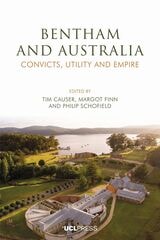
Bentham and Australia
Convicts, Utility and EmpireEdited by Tim Causer, Margot Finn, and Philip Schofield
University College London, 2022
This volume considers Jeremy Bentham’s Australian writings. In the first part of the volume, Bentham’s works are placed in their historical contexts, while the second part provides a critical assessment of the historical accuracy and plausibility of Bentham’s arguments against transportation from the British Isles. In the third part, attention turns to Bentham’s claim that New South Wales was founded illegally and to the imperial and colonial constitutional ramifications of that claim. The authors also discuss Bentham’s work of 1831 in which he supports the establishment of a free colony on the southern coast of Australia. In the final part, the authors shed light on the history of Bentham’s panopticon penitentiary scheme, his views on the punishment and reform of criminals and what role, if any, religion had to play in that regard, and discuss apparently panopticon-inspired institutions built in the Australian colonies.
This collection will appeal to readers interested in Bentham’s life and thought, the history of transportation from the British Isles and of British penal policy more generally, colonial and imperial history, Indigenous history, legal and constitutional history, and religious history.
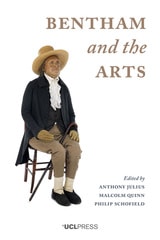
Bentham and the Arts
Edited by Anthony Julius, Malcolm Quinn, and Philip Schofield
University College London, 2020
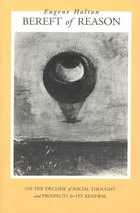
Bereft of Reason
On the Decline of Social Thought and Prospects for Its RenewalEugene Halton
University of Chicago Press, 1995
Claiming that human beings should be understood as far more than simply a form of knowledge, social construction, or contingent difference, Halton argues that contemporary thought has lost touch with the spontaneous passions—or enchantment—of life. Exploring neglected works in twentieth century social thought and philosophy—particularly the writings of Lewis Mumford and Charles Peirce—as well as the work of contemporary writers such as Vaclav Havel, Maya Angelou, Milan Kundera, Doris Lessing, and Victor Turner, Halton argues that reason is dependent upon nonrational forces—including sentiment, instinct, conjecture, imagination, and experience. We must, he argues, frame our questions in a way which encompasses both enchantment and critical reason, and he offers an outline here for doing so.
A passionate plea for a fundamental reexamination of the entrenched assumptions of the modern era, this book deals with issues of vital concern to modern societies and should be read by scholars across disciplines.
"Bereft of Reason is a thoughtful critique informed by a passionate commitment to the renewal of critical concerns. For this reason alone it should be widely read and inform current debates."—Lauren Langman, Sociological Inquiry
"Halton takes the 'ghost in the machine' as a dominant defining metaphor for modern thought and life, and criticizes it with gusto, wit, wide reading, and philosophical acumen."—Robert J. Mulvaney, Review of Metaphysics
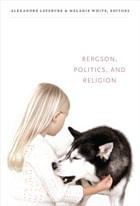
Bergson, Politics, and Religion
Alexandre Lefebvre and Melanie White, eds.
Duke University Press, 2012
Contributors. Keith Ansell-Pearson, G. William Barnard, Claire Colebrook, Hisashi Fujita, Suzanne Guerlac, Vladimir Jankélévitch, Frédéric Keck, Leonard Lawlor, Alexandre Lefebvre, Paola Marrati, John Mullarkey, Paulina Ochoa Espejo, Carl Power, Philippe Soulez, Jim Urpeth, Melanie White, Frédéric Worms
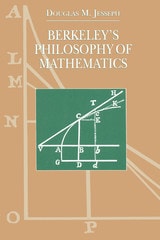
Berkeley's Philosophy of Mathematics
Douglas M. Jesseph
University of Chicago Press, 1993
Jesseph begins with Berkeley's radical opposition to the received view of mathematics in the philosophy of the late seventeenth and early eighteenth centuries, when mathematics was considered a "science of abstractions." Since this view seriously conflicted with Berkeley's critique of abstract ideas, Jesseph contends that he was forced to come up with a nonabstract philosophy of mathematics. Jesseph examines Berkeley's unique treatments of geometry and arithmetic and his famous critique of the calculus in The Analyst.
By putting Berkeley's mathematical writings in the perspective of his larger philosophical project and examining their impact on eighteenth-century British mathematics, Jesseph makes a major contribution to philosophy and to the history and philosophy of science.

Berkeley
Critical and Interpretive EssaysColin Turbayne, Editor
University of Minnesota Press, 1982
Berkeley was first published in 1982. Minnesota Archive Editions uses digital technology to make long-unavailable books once again accessible, and are published unaltered from the original University of Minnesota Press editions.
In contemporary philosophy the works of George Berkeley are considered models of argumentative discourse; his paradoxes have a further value to teachers because, like Zeno's, they challenge a beginning student to find the submerged fallacy. And as a final, triumphant perversion of Berkeley's intent, his central contribution is still commonly viewed as an argument for skepticism - the very position he tried to refute. This limited approach to Berkeley has obscured his accomplishments in other areas of thought - his account of language, his theories of meaning and reference, his philosophy of science. These subjects and others are taken up in a collection of twenty essays, most of them given at a conference in Newport, Rhode Island, commemorating the 250th anniversary of Berkeley's American sojourn of 1728–31. The essays constitute a broad survey of problems tackled by Berkeley and still of interest to philosophers, as well as topics of historical interest less familiar to modern readers. Its comprehensive scope will make this book appropriate for text use.

Bernhard Lang
Critical Guides to Contemporary ComposersChristine Dysers
Intellect Books, 2026
This introduction to a challenging contemporary composer delves into the theory and philosophy of repetition.
The work of Austrian composer Bernhard Lang eludes easy categorization. While rooted simultaneously in DJ culture, free jazz, pop culture, and the Austro-European new music scene, his oeuvre explicitly foregrounds repetition. He is, in his own words, a “repeat offender.”
Bernhard Lang serves as a critical guide to the composer’s music and traces the phenomenon of repetition throughout his oeuvre. To examine Lang’s repetitive aesthetics, Christine Dysers employs various philosophical methods, such as Gilles Deleuze’s differential ontology. Fusing critical musicology, aesthetic theory, poststructuralist thought, and music analysis, Bernhard Lang brings fresh insight to the work of an award-winning contemporary composer.
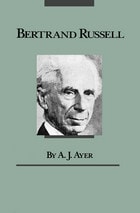
Bertrand Russell
A. J. Ayer
University of Chicago Press, 1988
"I am sure [this] is the best introduction of any length to Russell, and I suspect that it might serve as one of the best introductions to modern philosophy. . . . Ayer begins with a brief, austere, and balanced account of Russell's life: as in Russell's autobiography this means his thought, books, women, and politics. Tacitus (and Russell) would have found the account exemplary. Ayer ends with a sympathetic and surprisingly detailed survey of Russell's social philosophy. But the bulk of this book consists of a chapter on Russell's work in logic and the foundations of mathematics, followed by a chapter on his epistemological views and one on metaphysics. . . . I find it impossible to imagine that this book will not remain indefinitely the very best book of its sort."—Review of Metaphysics
"The confrontation or conjunction of Ayer and Russell is a notable event and has produced a remarkable book—brilliantly argued and written."—Martin Lebowitz, The Nation
Bettering Humanomics
A New, and Old, Approach to Economic ScienceDeirdre Nansen McCloskey
University of Chicago Press, 2021
Economic historian Deirdre Nansen McCloskey has distinguished herself through her writing on the Great Enrichment and the betterment of the poor—not just materially but spiritually. In Bettering Humanomics she continues her intellectually playful yet rigorous analysis with a focus on humans rather than the institutions. Going against the grain of contemporary neo-institutional and behavioral economics which privilege observation over understanding, she asserts her vision of “humanomics,” which draws on the work of Bart Wilson, Vernon Smith, and most prominently, Adam Smith. She argues for an economics that uses a comprehensive understanding of human action beyond behaviorism.
McCloskey clearly articulates her points of contention with believers in “imperfections,” from Samuelson to Stiglitz, claiming that they have neglected scientific analysis in their haste to diagnose the ills of the system. In an engaging and erudite manner, she reaffirms the global successes of market-tested betterment and calls for empirical investigation that advances from material incentives to an awareness of the human within historical and ethical frameworks. Bettering Humanomics offers a critique of contemporary economics and a proposal for an economics as a better human science.
Between / Beyond / Hybrid
New Essays on TransdisciplinarityEdited by Hartmut von Sass
Diaphanes, 2019
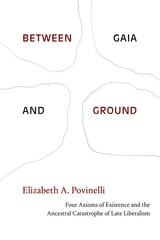
Between Gaia and Ground
Four Axioms of Existence and the Ancestral Catastrophe of Late LiberalismElizabeth A. Povinelli
Duke University Press, 2021
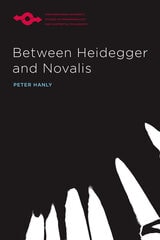
Between Heidegger and Novalis
Peter Hanly
Northwestern University Press, 2021
An entirely new approach to both Novalis and Heidegger, this book will interest scholars and students engaged with continental philosophy and the legacy of German Romanticism.
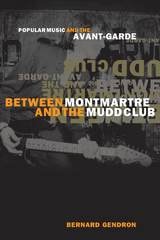
Between Montmartre and the Mudd Club
Popular Music and the Avant-GardeBernard Gendron
University of Chicago Press, 2002
When and how did popular music earn so much cultural capital? To find out, Bernard Gendron investigates five key historical moments when popular music and avant-garde art transgressed the rigid boundaries separating high and low culture to form friendly alliances. He begins at the end of the nineteenth century in Paris's Montmartre district, where cabarets showcased popular music alongside poetry readings in spaces decorated with modernist art works. Two decades later, Parisian poets and musicians "slumming" in jazz clubs assimilated jazz's aesthetics in their performances and compositions. In the bebop revolution in mid-1940s America, jazz returned the compliment by absorbing modernist devices and postures, in effect transforming itself into an avant-garde art form. Mid-1960s rock music, under the leadership of the Beatles, went from being reviled as vulgar music to being acclaimed as a cutting-edge art form. Finally, Gendron takes us to the Mudd Club in the late 1970s, where New York punk and new wave rockers were setting the aesthetic agenda for a new generation of artists.
Between Montmartre and the Mudd Club should be on the shelves of anyone interested in the intersections between high and low culture, art and music, or history and aesthetics.
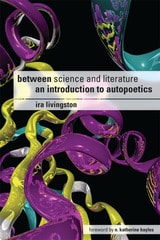
Between Science and Literature
AN INTRODUCTION TO AUTOPOETICSIra Livingston
University of Illinois Press, 2005
The main movement of the book is through a series of model explications and analyses, operational definitions of concepts and terms, more extended case studies, vignettes and thought experiments designed to give the reader a feel for the concepts and how to use them, while working to expand the autopoetic internee by putting cultural self-reference in dialogue with the self-organizing systems of the sciences. Along the way the reader is introduced to self-reference in epistemology (Foucault), sociology (Luhmann), biology (Maturana/Varela/Kauffman), and physics and cosmology (Smolin). Livingston works through the fundamentals of cultural, literary, and science studies and makes them comprehensible to a non-specialist audience.
Between Two Pines
Ushering in a Sustainable Future Through an Art-Science PracticeEdgar Cardenas
Michigan Publishing Services, 2019
“I am truly thankful that Dr. Edgar Cardenas’s thoughtful research is now available in this beautiful book. I have recommended his work to more people, both in my personal and professional spheres of my life, than I can count, and I’m glad to have this provocative and elegant publication to put into people’s hands. Cardenas shows us how each of us really can make a difference.”
“Between Two Pines anticipates and leads the discussion of scholarship around questions of land and landscape. This work brilliantly and ethically refocuses our vision, from distanced scrutiny to connection and proximity, rooted in daily care-taking and ecological efforts. Thoughtfully imaged, the photographs offer an aesthetic that is based in balanced, enduring reflection, rather than on the grand view. These beautiful images reveal discoveries that bridge the arts, ecology, and sociology, and will serve to reconnect every reader with the world in their backyard and beyond.”
“Drawing from a long photographic tradition of examining the relationship between humans and their environment, Edgar Cardenas has found a voice that is as compassionate as it is poignant. Yet he is not content for his photographs to be mere observations, recording the relationship. Between Two Pines is a call to action – a platform by which we might imagine together, with all of the tools in our tool kit, a sustainable future.”
Between You and I
Dialogical PhenomenologyBeata Stawarska
Ohio University Press, 2009
Classical phenomenology has suffered from an individualist bias and a neglect of the communicative structure of experience, especially the phenomenological importance of the addressee, the inseparability of I and You, and the nature of the alternation between them. Beata Stawarska remedies this neglect by bringing relevant contributions from cognate empirical disciplines—such as sociolinguistics and developmental psychology, as well as the dialogic tradition in philosophy—to bear on phenomenological inquiry. Taken together, these contributions substantiate an alternative view of primary I-You connectedness and help foreground the dialogic dimension of both prediscursive and discursive experience. Between You and I suggests that phenomenology is best practiced in a dialogical engagement with other disciplines.
Beyond Being
Gadamer's Post-Platonic Hermeneutic OntologyBrice R. Wachterhauser
Northwestern University Press, 1999
In Beyond Being, Brice R. Wachterhauser contends that this perceived bifurcation in Gadamer's work oversimplifies and distorts important parts of Gadamer's thought. Wachterhauser argues that only by viewing Gadamer's contribution to philosophy as an integrated whole and by reading Gadamer's hermeneutical studies in light of his Plato studies are we able to avoid certain key misunderstandings of Gadamer, as well as to comprehend more clearly the radical implications of Gadamer's thought.
Beyond Cheering and Bashing
New Perspectives on The Closing of the American MindWilliam K. Buckley
University of Wisconsin Press, 1992
The debate over the central issue confronted in The Closing of the American Mind—the role of the university and the liberal arts in the United States—has become increasingly urgent and contentious. The goal of this collection of essays is to see what we can learn about the dilemmas confronting American culture through consideration of both The Closing of the American Mind and the debate it aroused.
Beyond Constraint
Middle/Passages of Blackness and Indigeneity in the Radical TraditionShona N. Jackson
Duke University Press, 2024
Beyond Man
Race, Coloniality, and Philosophy of ReligionYountae An and Eleanor Craig, editors
Duke University Press, 2021
Contributors. An Yountae, Ellen Armour, J. Kameron Carter, Eleanor Craig, Amy Hollywood, Vincent Lloyd, Filipe Maia, Mayra Rivera, Devin Singh, Joseph R. Winters
Beyond Matter
Why Science Needs MetaphysicsRoger Trigg
Templeton Press, 2016
Does science have all the answers? Can it even deal with abstract reasoning beyond the world we experience? How can we ensure that the physical world is sufficiently ordered to be intelligible to humans? How can mathematics, a product of human minds, unlock the secrets of the physical universe? Should all such questions be considered inadmissible if science cannot settle them?
Metaphysics has traditionally been understood as reasoning beyond the reach of science, sometimes even claiming realities beyond its grasp. Because of this, metaphysics is often contemptuously dismissed by scientists and philosophers who wish to remain within the bounds of what can be scientifically proven. Yet scientists at the frontiers of physics unwittingly engage in metaphysics, as they are now happy to contemplate whole universes that are, in principle, beyond human reach.
Roger Trigg challenges those who deny that science needs philosophical assumptions. Trigg claims that the foundations of science themselves have to lie beyond science. It takes reasoning apart from experience to discover what is not yet known and this metaphysical reasoning to imagine realities beyond what can be accessed.
“In Beyond Matter, Roger Trigg advances a powerful, persuasive, fair-minded argument that the sciences require a philosophical, metaphysical foundation. This is a brilliant book for newcomers to the philosophy of science and experts alike.” —Charles Taliaferro, professor of philosophy, St. Olaf College
Beyond Method
Philosophical Conversations in Healthcare Research and ScholarshipEdited by Pamela M. Ironside
University of Wisconsin Press, 2005
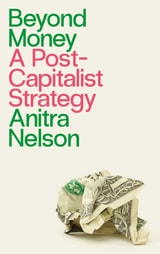
Beyond Money
A Postcapitalist StrategyAnitra Nelson
Pluto Press, 2022
What would a world without money look like? This book is a lively thought experiment that deepens our understanding of how money is the driver of political power, environmental destruction and social inequality today, arguing that it has to be abolished rather than repurposed to achieve a postcapitalist future.
Grounded in historical debates about money, Anitra Nelson draws on a spectrum of political and economic thought and activism, including feminism, ecoanarchism, degrowth, permaculture, autonomism, Marxism and ecosocialism. Looking to Indigenous rights activism and the defense of commons, an international network of activists engaged in a fight for a money-free society emerges.
Beyond Money shows that, by organizing around post-money versions of the future, activists have a hope of creating a world that embodies their radical values and visions.

Beyond Money
A Postcapitalist StrategyAnitra Nelson
Pluto Press, 2022
'A fascinating portal into arguments about why we need to get beyond money' - Harry Cleaver
What would a world without money look like? This book is a lively thought experiment that deepens our understanding of how money is the driver of political power, environmental destruction and social inequality today, arguing that it has to be abolished rather than repurposed to achieve a postcapitalist future.
Grounded in historical debates about money, Anitra Nelson draws on a spectrum of political and economic thought and activism, including feminism, ecoanarchism, degrowth, permaculture, autonomism, Marxism and ecosocialism. Looking to Indigenous rights activism and the defense of commons, an international network of activists engaged in a fight for a money-free society emerges.
Beyond Money shows that, by organizing around post-money versions of the future, activists have a hope of creating a world that embodies their radical values and visions.
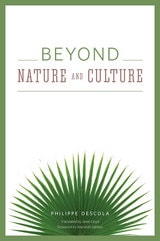
Beyond Nature and Culture
Philippe Descola
University of Chicago Press, 2013
Culture—as a collective human making, of art, language, and so forth—is often seen as essentially different from nature, which is portrayed as a collective of the nonhuman world, of plants, animals, geology, and natural forces. Descola shows this essential difference to be, however, not only a specifically Western notion, but also a very recent one. Drawing on ethnographic examples from around the world and theoretical understandings from cognitive science, structural analysis, and phenomenology, he formulates a sophisticated new framework, the “four ontologies”— animism, totemism, naturalism, and analogism—to account for all the ways we relate ourselves to nature. By thinking beyond nature and culture as a simple dichotomy, Descola offers nothing short of a fundamental reformulation by which anthropologists and philosophers can see the world afresh.
Beyond Nihilism
Nietzsche without MasksOfelia Schutte
University of Chicago Press, 1984
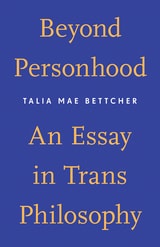
Beyond Personhood
An Essay in Trans PhilosophyTalia Mae Bettcher
University of Minnesota Press, 2025
A bold intervention in the philosophical concepts of gender, sex, and self
Beyond Personhood provides an entirely new philosophical approach to trans experience, trans oppression, gender dysphoria, and the relationship between gender and identity. Until now, trans experience has overwhelmingly been understood in terms of two reductive frameworks: trans people are either “trapped in the wrong body” or they are oppressed by the gender binary. Both accounts misgender large trans constituencies while distorting their experience, and neither can explain the presentation of trans people as make-believers and deceivers or the serious consequences thereof. In Beyond Personhood, Talia Mae Bettcher demonstrates how taking this phenomenon seriously affords a new perspective on trans oppression and trans dysphoria—one involving liminal states of “make-believe” that bear positive possibilities for self-recognition and resistance.
Undergirding this account is Bettcher’s groundbreaking theory of interpersonal spatiality—a theory of intimacy and distance that requires rejection of the philosophical concepts of person, self, and subject. She argues that only interpersonal spatiality theory can successfully explain trans oppression and gender dysphoria, thus creating new possibilities for thinking about connection and relatedness.
An essential contribution to the burgeoning field of trans philosophy, Beyond Personhood offers an intersectional trans feminism that illuminates transphobic, sexist, heterosexist, and racist oppressions, situating trans oppression and resistance within a much larger decolonial struggle. By refusing to separate theory from its application, Bettcher shows how a philosophy of depth can emerge from the everyday experiences of trans people, pointing the way to a reinvigoration of philosophy.
Beyond Positivism, Behaviorism, and Neoinstitutionalism in Economics
Deirdre Nansen McCloskey
University of Chicago Press, 2022
In Beyond Positivism, Behaviorism, and Neoinstitutionalism in Economics, Deirdre Nansen McCloskey zeroes in on the authoritarian cast of recent economics, arguing for a re-focusing on the liberated human. The behaviorist positivism fashionable in the field since the 1930s treats people from the outside. It yielded in Williamson and North a manipulative neo-institutionalism. McCloskey argues that institutions as causes are mainly temporary and intermediate, not ultimate. They are human-made, depending on words, myth, ethics, ideology, history, identity, professionalism, gossip, movies, what your mother taught you. Humans create conversations as they go, in the economy as in the rest of life.
In engaging and erudite prose, McCloskey exhibits in detail the scientific failures of neo-institutionalism. She proposes a “humanomics,” an economics with the humans left in. Humanomics keeps theory, quantification, experiment, mathematics, econometrics, though insisting on more true rigor than is usual. It adds what can be learned about the economy from history, philosophy, literature, and all the sciences of humans. McCloskey reaffirms the durability of “market-tested innovation” against the imagined imperfections to be corrected by a perfect government. With her trademark zeal and incisive wit, she rebuilds the foundations of economics.
Beyond Potentialities?
Politics between the Possible and the ImpossibleEdited by Mark Potocnik, Frank Ruda, and Jan Völker
Diaphanes, 2011
The question of possibility is raised in philosophy itself in different terms: as a question of potentiality and potentials but also as a question of the impossibilities of changing political order. In recent political discussions this question is more present than ever and is newly posed in fundamental ways by thinkers such as Agamben, Badiou, and Deleuze, or Lacan and Žižek. The present volume assembles articles that investigate this question and the new guise it took from different perspectives and highlight its relevance for contemporary political thought.
Beyond Practical Virtue
A Defense of Liberal Democracy through LiteratureJoel A. Johnson
University of Missouri Press, 2007
Why hasn’t democracy been embraced worldwide as the best form of government?
Aesthetic critics of democracy such as Carlyle and Nietzsche have argued that modern democracy, by removing the hierarchical institutions that once elevated society’s character, turns citizens into bland, mediocre souls. Joel A. Johnson now offers a rebuttal to these critics, drawing surprising inspiration from American literary classics.
Addressing the question from a new perspective, Johnson takes a fresh look at the worth of liberal democracy in these uncertain times and tackles head-on the thorny question of cultural development. Examining the novels of James Fenimore Cooper, Mark Twain, and William Dean Howells, he shows that through their fiction we can gain a better appreciation of the rich detail of everyday life, making the debate relevant to contemporary discussions of liberal democracy.
Johnson focuses on an issue that liberals have inadequately addressed: whether people tend to develop fully as individuals under liberal democracy when such a regime does little formally to encourage their development. He argues that, though the liberal fear of state-guided culture is well founded, it should not prevent us from evaluating liberalism’s effect on individual flourishing. By extending the debate over the worthiness of liberal democracy to include democracy’s effect on individual development, he contends that the democratic experience is much fuller than the aristocratic one and thus expands the faculties of its citizens.
Critics of American democracy such as John Rawls have sought to transform it into a social or egalitarian democracy in the European style. Johnson shows that neither the debate between Rawls and his communitarian critics nor the ongoing discussion of the globalization of American values adequately addresses the fundamental critique of democratic culture advanced by the aesthetic critics. Johnson’s cogent analysis reaches out to those readers who are ready for a more comprehensive evaluation of liberal democracy, offering new insight into the relationship between the state and the individual while blazing new trails in the intersection of politics and literature.
Beyond Prejudice
The Moral Significance of Human and Nonhuman AnimalsEvelyn B. Pluhar
Duke University Press, 1995
Exposing the traditional view—which restricts the moral realm to autonomous, fully fledged "persons"—as having horrific implications for the treatment of many humans, Pluhar goes on to argue positively that sentient individuals of any species are no less morally significant than the most automomous human. Her position provides the ultimate justification that is missing from previous defenses of the moral status of nonhuman animals. In the process of advancing her position, Pluhar discusses the implications of determining moral significance for children and "abnormal" humans as well as its relevance to population policies, the raising of animals for food or product testing, decisions on hunting and euthanasia, and the treatment of companion animals. In addition, the author scrutinizes recent assertions by environmental ethicists that all living things or that natural objects and ecosystems be considered highly morally significant. This powerful book of moral theory challenges all defenders of the moral status quo—which decrees that animals decidedly do not count—to reevaluate their convictions.
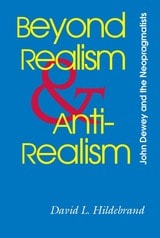
Beyond Realism and Antirealism
John Dewey and the NeopragmatistsDavid L. Hildebrand
Vanderbilt University Press, 2003
In Beyond Realism and Antirealism: John Dewey and the Neopragmatists, David L. Hildebrand asks two important questions: first, how faithful are the Neopragmatists' reformulations of Classical Pragmatism (particularly Deweyan Pragmatism)? Second, and more significantly, can their Neopragmatisms work?
In assessing Neopragmatism, Hildebrand advances a number of historical and critical points:
• Current debates between realists and antirealists (as well as objectivists and relativists) are similar to early twentieth-century debates between realists and idealists that Pragmatism addressed extensively.
• Despite their debts to Dewey, the Neopragmatists are reenacting realist and idealist stands in their debate over realism, thus giving life to something shown fruitless by earlier Pragmatists.
• What is absent from the Neopragmatist's position is precisely what makes Pragmatism enduring: namely, its metaphysical conception of experience and a practical starting point for philosophical inquiry that such experience dictates.
• Pragmatism cannot take the "linguistic turn" insofar as that turn mandates a theoretical starting point.
• While Pragmatism's view of truth is perspectival, it is nevertheless not a relativism.
• Pace Rorty, Pragmatism need not be hostile to metaphysics; indeed, it demonstrates how pragmatic instrumentalism and metaphysics are complementary.
In examining these and other difficulties in Neopragmatism, Hildebrand is able to propose some distinct directions for Pragmatism. Beyond Realism and Antirealism will provoke specialists and non-specialists alike to rethink not only the definition of Pragmatism, but its very purpose.
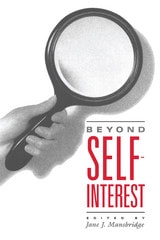
Beyond Self-Interest
Edited by Jane J. Mansbridge
University of Chicago Press, 1990
In Beyond Self-Interest, leading social scientists argue for a view of individuals behavior and social organization that takes into account the powerful motivations of duty, love, and malevolence. Economists who go beyond "economic man," psychologists who go beyond stimulus-response, evolutionary biologists who go beyond the "selfish gene," and political scientists who go beyond the quest for power come together in this provocative and important manifesto.
The essays trace, from the ancient Greeks to the present, the use of self-interest to explain political life. They investigate the differences between self-interest and the motivations of duty and love, showing how these motivations affect behavior in "prisoners' dilemma" interactions. They generate evolutionary models that explain how altruistic motivations escape extinction.
They suggest ways to model within one individual the separate motivations of public spirit and self-interest, investigate public spirit and self-interest, investigate public spirit in citizen and legislative behavior, and demonstrate that the view of democracy in existing Constitutional interpretations is not based on self-interest. They advance both human evil and mothering as alternatives to self-interest, this last in a penetrating feminist critique of the "contract" model of human interaction.
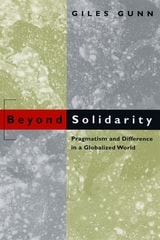
Beyond Solidarity
Pragmatism and Difference in a Globalized WorldGiles Gunn
University of Chicago Press, 2001
He finds the terms for answering these questions in a more inclusive, cosmopolitan pragmatism—one willing to explore fundamental values without recourse to absolutist arguments. Drawing on the work of William and Henry James, John Dewey, Primo Levi, Richard Rorty, and many others, as well as postcolonial writing, Jewish literature of the Holocaust, and the cultural and religious experience of African Americans in slavery, Gunn points pragmatism in a transnational direction and shows how it can better account for the consequences of diversity. Beyond Solidarity, then, is a study of the difference that difference makes in a globalized world.
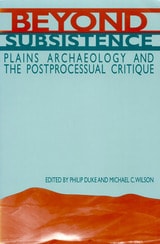
Beyond Subsistence
Plains Archaeology and the Postprocessual CritiqueEdited by Philip Duke and Michael C. Wilson
University of Alabama Press, 1995
A series of essays, written by Plains scholars of diverse research interests and backgrounds, that apply postprocessual approaches to the solution of current problems in Plains archaeology
Postprocessual archaeology is seen as a potential vehicle for integrating culture-historical, processual, and postmodernist approaches to solve specific archaeological problems.
The contributors address specific interpretive problems in all the major regions of the North American Plains, investigate different Plains societies (including hunter-gatherers and farmers and their associated archaeological records), and examine the political content of archaeology in such fields as gender studies and cultural resource management. They avoid a programmatic adherence to a single paradigm, arguing instead that a mature archaeology will use different theories, methods, and techniques to solve specific empirical problems. By avoiding excessive infatuation with the correct scientific method, this volume addresses questions that have often been categorized as beyond archaeological investigations.
Beyond Words
Discourse and Critical Agency in AfricaAndrew Apter
University of Chicago Press, 2007
Even within anthropology, a discipline that strives to overcome misrepresentations of peoples and cultures, colonialist depictions of the so-called Dark Continent run deep. The grand narratives, tribal tropes, distorted images, and “natural” histories that forged the foundations of discourse about Africa remain firmly entrenched. In Beyond Words, Andrew Apter explores how anthropology can come to terms with the “colonial library” and begin to develop an ethnographic practice that transcends the politics of Africa’s imperial past.
The way out of the colonial library, Apter argues, is by listening to critical discourses in Africa that reframe the social and political contexts in which they are embedded. Apter develops a model of critical agency, focusing on a variety of language genres in Africa situated in rituals that transform sociopolitical relations by self-consciously deploying the power of language itself. To break the cycle of Western illusions in discursive constructions of Africa, he shows, we must listen to African voices in ways that are culturally and locally informed. In doing so, Apter brings forth what promises to be a powerful and influential theory in contemporary anthropology.
Beyond the Monastery Walls
The Ascetic Revolution in Russian Orthodox Thought, 1814–1914Patrick Lally Michelson
University of Wisconsin Press, 2017
Patrick Lally Michelson's intellectual history of asceticism in Russian Orthodox thought traces the development of these competing arguments from the early nineteenth century to the early months of World War I. He demonstrates that this discourse was an imaginative interpretation of lived Orthodoxy, primarily meant to satisfy the ideological needs of Russian thinkers and Orthodox intellectuals as they responded to the socioeconomic, political, and cultural challenges of modernity.
Beyond the Public Sphere
Film and the Feminist ImaginaryMaría Pía Lara
Northwestern University Press, 2021
In Beyond the Public Sphere: Film and the Feminist Imaginary, the renowned philosopher and critical theorist María Pía Lara challenges the notion that the bourgeois public sphere is the most important informal institution between social and political actors and the state.
Drawing on a wide range of films—including The Milk of Sorrow, Ixcanul, Wadja, The Stone of Patience, Marnie, A Streetcar Named Desire, and Talk to Her—Lara dissects cinematic images of women’s struggles and their oppression. She builds on this analysis, developing a concept of the feminist social imaginary as a broader and more complex space that provides a way of thinking through the possibilities for emancipatory social transformation in response to forms of domination perpetuated by patriarchal capitalism.
Beyond the Sovereign Self
Aesthetic Autonomy from the Avant-Garde to Socially Engaged ArtGrant H. Kester
Duke University Press, 2024
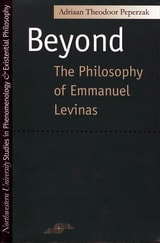
Beyond
The Philosophy of Emmanuel LevinasAdriaan Theodoor Peperzak
Northwestern University Press, 1997
Peperzak's examination begins with a general overview of Levinas's life and thought, and shows how issues of ethics, politics, and religion are intertwined in Levinas's philosophy. Peperzak also discusses the development of Levinas's relations with Husserl and Heidegger, demonstrating thematically the evolution of both Levinas's anti-Heideggerian view of technology and his critical attitude toward nature.
Biblical Religion and the Search for Ultimate Reality
Paul Tillich
University of Chicago Press, 1955
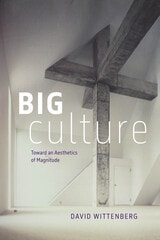
Big Culture
Toward an Aesthetics of MagnitudeDavid Wittenberg
University of Chicago Press, 2025
Big Culture asks a simple question: why do big things give us big feelings? Skyscrapers, disasters, and other large phenomena can elicit fear, attraction, and awe. David Wittenberg argues that these feelings cannot be explained through objects’ size alone. Instead, he contends that an encounter with bigness is a primal, even violent sensation like little else that we experience in our well-proportioned adult lives.
Drawing on examples as commonplace and as singular as atomic bombs, cinematic effects, pornographic “macrophilia,” monstrous creatures, and more, Wittenberg demonstrates how big things tap into our earliest experiences of the world, reigniting our most fundamental feelings about reality. In doing so, Wittenberg offers a new aesthetics of magnitude and of the special role that bigness plays in our everyday perception of objects and images.
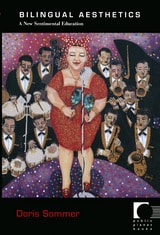
Bilingual Aesthetics
A New Sentimental EducationDoris Sommer
Duke University Press, 2004
Sommer encourages readers to entertain the creative possibilities inherent in multilingualism. With her characteristic wit and love of language, she focuses on humor—particularly bilingual jokes—as the place where tensions between and within cultures are played out. She draws on thinking about humor and language by a range of philosophers and others, including Sigmund Freud, Immanuel Kant, Ludwig Wittgenstein, Hannah Arendt, and Mikhail Bakhtin. In declaring the merits of allowing for crossed signals, Sommer sends a clear message: Making room for more than one language is about value added, not about remediation. It is an expression of love for a contingent and changing world.
Binding Words
Conscience and Rhetoric in Hobbes, Hegel, and HeideggerKaren Feldman
Northwestern University Press, 2006
Hobbes's Leviathan, Hegel's Phenomenology of Spirit, and Heidegger's Being and Time dramatize conscience's relation to language and knowledge, morality and duty, and ontology. Feldman investigates how, within these works, conscience is described as binding upon us while at the same time asking how texts themselves may be read as binding.
Bioaesthetics
Making Sense of Life in Science and the ArtsCarsten Strathausen
University of Minnesota Press, 2017
In recent years, bioaesthetics has used the latest discoveries in evolutionary studies and neuroscience to provide new ways of looking at art and aesthetics. Carsten Strathausen’s remarkable exploration of this emerging field is the first comprehensive account of its ideas, as well as a timely critique of its limitations.
Strathausen familiarizes readers with the basics of bioaesthetics, grounding them in its philosophical underpinnings while articulating its key components. Importantly, he delves into the longstanding problem of the “two cultures” that separate the arts and the sciences. Seeking to make bioaesthetics a more robust way of thinking, Strathausen then critiques it for failing to account for science’s historical and cultural assumptions. At its worst, he says, biologism reduces artworks to mere automatons that rubber-stamp pre-established scientific truths.
Written with a sensitive understanding of science’s strengths, and willing to refute its best arguments, Bioaesthetics helps readers separate the sensible from the specious. At a time when humanities departments are shrinking—and when STEM education is on the rise—Bioaesthetics makes vital points about the limitations of science, while lodging a robust defense of the importance of the humanities.