Results by title
1214 books match the query 'Subjects & Themes' and 69 start with b
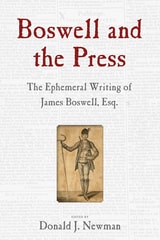
Boswell and the Press
Essays on the Ephemeral Writing of James BoswellDonald J. Newman
Bucknell University Press, 2021
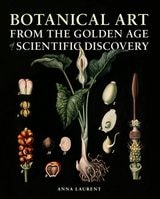
Botanical Art from the Golden Age of Scientific Discovery
Anna Laurent
University of Chicago Press, 2016
This beautifully illustrated oversized book gives the humble wall chart its due, reproducing more than two hundred of them in dazzling full color. Each wall chart is accompanied by captions that offer accessible information about the species featured, the scientists and botanical illustrators who created it, and any particularly interesting or innovative features the chart displays. And gardeners will be pleased to discover useful information about plant anatomy and morphology and species differences. We see lilies and tulips, gourds, aquatic plants, legumes, poisonous plants, and carnivorous plants, all presented in exquisite, larger-than-life detail.
A unique fusion of art, science, and education, the wall charts gathered here offer a glimpse into a wonderful scientific heritage and are sure to thrill naturalists, gardeners, and artists alike.
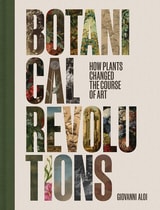
Botanical Revolutions
How Plants Changed the Course of ArtGiovanni Aloi
J. Paul Getty Trust, The, 2025
Desired for their aesthetic beauty, sought after for their medicinal properties, harvested for their scents and flavors, or grown as essential material resources, plants are indissolubly entwined with our existence. In art it is no different: plants have played a critical role. Yet despite their significant material and conceptual contributions, plants have been sidelined in the commentary of art historians and critics.
Botanical Revolutions presents a global history of plants in art, focusing on the crucial moments that signaled the formation of new movements and styles, as well as the creation of media that could not have occurred without the involvement of and interaction with the vegetal world. In this fascinating and beautifully illustrated book, author Giovanni Aloi delves deeply into the history and representation of plants in art, advocates for a change in our relationship with the botanical world, and presents an alternative history of art that foregrounds the truly indispensable contributions of plants.
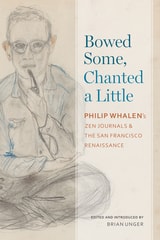
Bowed Some, Chanted a Little
Philip Whalen's Zen Journals and the San Francisco RenaissanceEdited and Introduced by Brian Unger
University of Alabama Press, 2023
The literary journals of a key figure in both the Beat and San Francisco Renaissance movements of the New American Poetry, and an ordained Zen Buddhist priest
Philip Whalen (1923–2002) authored twenty collections of verse, more than twenty broadsides, two novels, a huge assemblage of autobiographical literary journals, nine or ten experimental prose works, and dozens of critical essays, lectures, commentaries, introductions, prefaces, and interviews. But he came to regard his literary journals as his most important prose legacy.
Whalen’s literary work represents a significant turn in American letters, as he and his closest colleagues immersed themselves in East Asian literature and religion, reinvigorating strikingly new linguistic and aesthetic paths for North American writers and artists. However, until now Whalen’s forty-plus years of journals—sixty small eight-by-six-inch notebooks—have been largely inaccessible, archived in the rare book and manuscript library at the University of California, Berkeley, undigitized and unavailable online. Thus, the publication of a critical scholarly edition of Whalen’s journals and notebooks constitutes an important literary event and an invaluable resource for scholars, teachers, poets, and lay readers who follow twentieth-century North American poetry.

Boy
Tracy Youngblom
CavanKerry Press, 2023
The death of a youngest child. An alcoholic and distant father. A grief-stricken family. A tentative faith. These are the building blocks of Boy, a sequence of poems that explores how death and loss color memory and influence the ways family members relate to each other and to their shared history.
Inspired by the death of her own younger brother, Tracy Youngblom has written a poetry collection that serves as a companion to grief. This book is for those who love poetry and those who are intimidated by it, those interested in the way childhood experience shapes life, and those interested in the psychology of addiction.
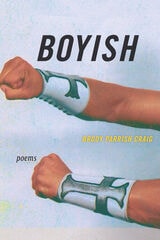
Boyish
PoemsBrody Parrish Craig
Omnidawn, 2021
Each page builds tension that then shatters, bringing us into the interior of a story. Brody Parrish Craig invites us to carve out a space and to find ourselves carried over the gravel along the creek. Moving through the subconscious and embodied desire, these poems are rich with formal play, twisting language in dense sonnets. Landscapes of the city’s dystopia meet the queer pastoral, where conservation often means knowing what must be burned down.
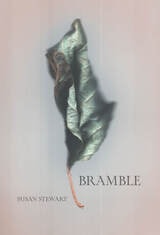
Bramble
Susan Stewart
University of Chicago Press, 2026
A finalist for the 2026 National Book Award for Poetry, this seventh collection by acclaimed poet Susan Stewart offers a meditation on difficulty and the powers of nature.
In the biblical book of Judges, the bramble is a figure of destructive leadership, thwarting the lives of trees. In ballads and fairy tales, roses grow “‘round the briar” in tragic contrast to heroines who are enveloped by the thorns. One of the oldest English words and an even older symbol, “bramble” reminds us of the entangled and unending struggle that comes with living in time and searching beyond appearances. The rough thicket presents impediments, yet it also bears fruit and delicate flowers.
With Bramble, Susan Stewart has composed a book of many forms, including satires, elegies, meditations, and songs. Bramble is also an exploration of the act of making such forms. The book’s three sections—“Mirror,” “Briar,” and “Channel”—link lyric time to our lives as they are situated in history and nature. Reflecting upon illness, grief, and change, the poems follow the progress of day and night, the movement of the seasons, and the path of water from springs to the sea.
Brave Humanism
Black Women Rewriting the Human in the Age of Jane CrowMollie Godfrey
The Ohio State University Press, 2025
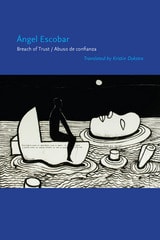
Breach of Trust/Abuso de confianza
Ángel Escobar with Translation by Kristin Dykstra
University of Alabama Press, 2016
The best-known work by acclaimed Cuban poet Ángel Escobar
Ángel Escobar’s Breach of Trust / Abuso de confianza is known by many as the most devastating book of his poetic generation. It is his first to be offered to an English-speaking audience. Merging personal and collective meditations, these twenty-three poems perform an indictment of violence. Escobar’s poetry delineates lacerations etched on bodies and minds by the sanguinary twentieth century, which unfolded out of a longer modernity spanning the Americas.
Breach of Trust / Abuso de confianza outlived its author, who took his own life in 1997. Brief and implicit appeals for justice and love offset the book’s abject theatricality. Escobar’s tragic masterpiece deftly interweaves themes into a striking synthesis offered in the spirit of survival.
Award-winning translator Kristin Dykstra introduces this collection with a comprehensive examination of Escobar’s life, work, and the times within which he wrote. Dykstra situates Escobar’s poetic abjection as his drive to confront thingification face to (non)face.

Breaking the Chains
Gender, Context, and the Politics of Writing in Modern ChinaDong Limin
Seagull Books, 2025
How has literature shaped gender politics in modern China? How has the concept of “woman” evolved within the shifting sociopolitical landscape? Old Chains and New delves into these questions by examining the dynamic interplay between literature, gender, and historical change. Drawing from literary studies, history, and sociology, this book reveals how women’s writing has not only reflected but also actively shaped cultural and national transformations.
From the late Qing era, when the “woman question” emerged as part of China’s response to imperialist pressures, to the ongoing evolution of feminist literary scholarship, this study argues that gender and literature are deeply interwoven. Women’s liberation in modern China was never solely about gender equality—it became a driving force for broader social change and national identity formation. Engaging with the complexities of women’s literature through a cultural-political lens, this book challenges static definitions and calls for a reevaluation of women’s literature not just as a literary category but as a key component in shaping China’s modern intellectual and cultural history.
By adopting the framework of “China as method,” Old Chains and New reimagines the role of literature in ideological and cultural shifts. It highlights women’s writing as a unique form of aesthetic politics—one with the power to intervene in and transform reality.
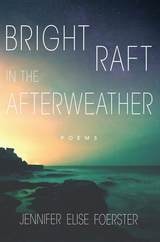
Bright Raft in the Afterweather
PoemsJennifer Elise Foerster
University of Arizona Press, 2018
Featuring recurring characters, settings, and motifs from her previous book, Leaving Tulsa, Foerster takes the reader on a solitary journey to the edges of the continents of mind and time to discover what makes us human. Along the way, the author surveys the intersection between natural landscapes and the urban world, baring parallels to the conflicts between Native American peoples and Western colonizers, and considering how imagination and representation can both destroy and remake our worlds.
Foerster’s captivating language and evocative imagery immerse the reader in a narrative of disorientation and reintegration. Each poem blends Foerster’s refined use of language with a mythic and environmental lyricism as she explores themes of destruction, spirituality, loss, and remembrance.
In a world wrought with ecological imbalance and grief, Foerster shows how from the devastated land of our alienation there is potential to reconnect to our origins and redefine the terms by which we inhabit humanity and the earth.

British Working-Class and Radical Writing Since 1700
Edited by John Goodridge and Adam Bridgen
University of London Press, 2025
At a time when working-class writing is gaining long-overdue recognition, British Working-Class and Radical Writing Since 1700 explores the intersection of class and literature over more than three centuries. This volume brings together leading scholars to examine the problems faced by working-class writers and the impact of class on themes such as feminism and anti-imperialism. Spanning from early laboring-class poets to contemporary memoirists, the collection revisits figures like John Clare and Ethel Carnie Holdsworth and also recovers overlooked voices and texts.
Covering poetry, fiction, drama, and political writing, the book investigates the relationship between class and literary production, offering fresh perspectives on how working-class and radical literature has shaped British cultural history. From the Romantic-era resistance of laboring poets to mid-century miners’ novels and the evolution of contemporary working-class memoirs, these essays reveal how literature has served as both a site of struggle and a tool of empowerment.
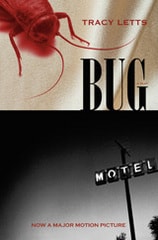
Bug
A PlayTracy Letts
Northwestern University Press, 2007
Tracy Letts's tale of love, paranoia, and government conspiracy is a thought-provoking psycho-thriller that mixes terror and laughter at a fever pitch.
This dark comedy takes place in a seedy motel room outside Oklahoma City, where Agnes, a drug-addled cocktail waitress, is hiding from her ex-con ex-husband. Her lesbian biker friend R.C. introduces her to Peter, a handsome drifter who might be an AWOL Gulf War veteran. They soon begin a relationship that takes place almost entirely within the increasingly claustrophobic confines of her motel room. Peter begins to rant about the war in Iraq, UFOs, the Oklahoma City bombings, cult suicides, and then secret government experiment on soldiers, of which he believes he is a victim. His delusions infect Agnes and the tension mounts as mysterious strangers appear at their door, past events haunt them at every turn and they are attacked by real bugs.
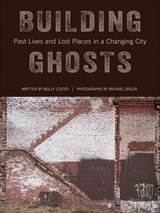
Building Ghosts
Past Lives and Lost Places in a Changing CityWritten by Molly Lester, Photographs by Michael Bixler
Temple University Press, 2024
Building Ghosts features more than 100 striking contemporary color photographs and a deeply researched narrative about Philadelphia’s buildings, neighborhoods, and the ghosts that reveal new truths and provocations about the changing city. The text and images in this lavish volume illuminate these lost buildings and found ghosts. Building Ghosts is an invitation to see the city differently, with the past clinging visibly to the present.
Building Taliesin
Frank Lloyd Wright’s Home of Love and LossRon McCrea
Wisconsin Historical Society Press, 2012
Burn Me Back
Peggy Robles-Alvarado
Four Way Books, 2025
Burnt Mountain
Emily Wilson
University of Iowa Press, 2025
Butterfly, the Bride
Essays on Law, Narrative, and the FamilyCarol Weisbrod
University of Michigan Press, 2004
Butterfly, the Bride looks at law from the outside, using narrative to provide a fresh perspective on the issues of law and social structure---and individual responses to law. This book thoroughly explores relationships between inner and public lives by examining what is ordinarily classified as the sphere of private life---the world of family relationships.
By Words Alone
The Holocaust in LiteratureSidra DeKoven Ezrahi
University of Chicago Press, 1980