Results by title
2194 books match the query 'Women's Studies' and 117 start with b
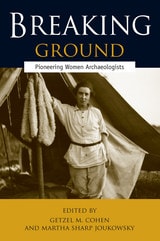
Breaking Ground
Pioneering Women ArchaeologistsGetzel M. Cohen and Martha Sharp Joukowsky, Editors
University of Michigan Press, 2004
-Claire Lyons, The Getty Museum
"Behind these pioneering women lie a wide range of fascinating and inspiring life stories. Though each of their tales is unique, they were all formidable scholars whose important contributions changed the field of archaeology. Kudos to the authors for making their stories and accomplishments known to us all!"
-Jodi Magness, University of North Carolina, Chapel Hill
This book presents twelve fascinating women whose contributions to the development and progress of Old World archaeology---in an area ranging from Italy to Mesopotamia---have been immeasurable. Each essay in this collection examines the life of a pioneer archaeologist in the early days of the discipline, tracing her path from education in the classics to travel and exploration and eventual international recognition in the field of archaeology. The lives of these women may serve as models both for those interested in gender studies and the history of archaeology because in fact, they broke ground both as women and as archaeologists.
The interest inherent in these biographies will reach well beyond defined disciplines and subdisciplines, for the life of each of these exciting and accomplished individuals is an adventure story in itself
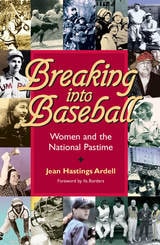
Breaking into Baseball
Women and the National PastimeJean Hastings Ardell. Foreword by Ila Borders
Southern Illinois University Press, 2005
While baseball is traditionally perceived as a game to be played, enjoyed, and reported from a masculine perspective, it has long been beloved among women—more so than any other spectator sport. Breaking into Baseball: Women and the National Pastime upends baseball’s accepted history to at last reveal just how involved women are, and have always been, in the American game.
Through provocative interviews and deft research, Jean Hastings Ardell devotes a detailed chapter to each of the seven ways women participate in the game—from the stands as fans, on the field as professionals or as amateur players, behind the plate as umpires, in the front office as executives, in the press box as sportswriters and reporters, or in the shadows as Baseball Annies. From these revelatory vantage points, Ardell invites overdue appreciation for the affinity and talent women bring to baseball at all levels and shows us our national game anew.
From its ancient origins in spring fertility rituals through contemporary marketing efforts geared toward an ever-increasing female fan base, baseball has always had a feminine side, and generations of women have sought—and been sought after—to participate in the sport, even when doing so meant challenging the cultural mores of their era. In that regard, women have been breaking into baseball from the very beginning. But recent decades have witnessed great strides in legitimizing women’s roles on the diamond as players and umpires as well as in vital management and media roles. In her thoughtfully organized and engagingly written survey, Ardell offers a chance for sports enthusiasts and historians of both genders to better appreciate the storied and complex relationship women have so long shared with the game and to glimpse the future of women in baseball.
Breaking into Baseball is augmented by twenty-four illustrations and a foreword from Ila Borders, the first woman to play more than three seasons of men’s professional baseball.

Breaking the Chains
Gender, Context, and the Politics of Writing in Modern ChinaDong Limin
Seagull Books, 2025
How has literature shaped gender politics in modern China? How has the concept of “woman” evolved within the shifting sociopolitical landscape? Old Chains and New delves into these questions by examining the dynamic interplay between literature, gender, and historical change. Drawing from literary studies, history, and sociology, this book reveals how women’s writing has not only reflected but also actively shaped cultural and national transformations.
From the late Qing era, when the “woman question” emerged as part of China’s response to imperialist pressures, to the ongoing evolution of feminist literary scholarship, this study argues that gender and literature are deeply interwoven. Women’s liberation in modern China was never solely about gender equality—it became a driving force for broader social change and national identity formation. Engaging with the complexities of women’s literature through a cultural-political lens, this book challenges static definitions and calls for a reevaluation of women’s literature not just as a literary category but as a key component in shaping China’s modern intellectual and cultural history.
By adopting the framework of “China as method,” Old Chains and New reimagines the role of literature in ideological and cultural shifts. It highlights women’s writing as a unique form of aesthetic politics—one with the power to intervene in and transform reality.
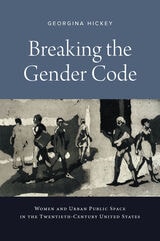
Breaking the Gender Code
Women and Urban Public Space in the Twentieth-Century United StatesGeorgina Hickey
University of Texas Press, 2023
A history of the activism that made public spaces in American cities more accessible to women.
From the closing years of the nineteenth century, women received subtle—and not so subtle—messages that they shouldn’t be in public. Or, if they were, that they were not safe. Breaking the Gender Code tells the story of both this danger narrative and the resistance to it.
Historian Georgina Hickey investigates challenges to the code of urban gender segregation in the twentieth century, focusing on organized advocacy to make the public spaces of American cities accessible to women. She traces waves of activism from the Progressive Era, with its calls for public restrooms, safe and accessible transportation, and public accommodations, through and beyond second-wave feminism, and its focus on the creation of alternative, women-only spaces and extensive anti-violence efforts. In doing so, Hickey explores how gender segregation intertwined with other systems of social control, as well as how class, race, and sexuality shaped activists' agendas and women's experiences of urban space. Drawing connections between the vulnerability of women in public spaces, real and presumed, and contemporary debates surrounding rape culture, bathroom bills, and domestic violence, Hickey unveils both the strikingly successful and the incomplete initiatives of activists who worked to open up public space to women.

Breast Cancer in the Academy
Solidarity in the Fight for Our LivesWendy K.Z. Anderson
Rutgers University Press, 2027
This edited collection is an interdisciplinary dialogue about how breast cancer diagnosis, treatment, and healing is experienced by academic women. The contributors fostered dialogue rooted in critical, qualitative, and autoethnographic traditions about how breast cancer diagnosis, treatment, and healing was experienced by a group with academic privileges, such as the ability to research and advocate for themselves. The book takes on a global perspective, incorporating pieces from medical doctors who became patients, BIPOC women, as well as scholars who identify as LBGTQIA, as they faced decisions about issues such as flat closures, fertility treatments, and being one-sided. These seventeen academic women navigated and resisted healthcare systems to develop a theory of coalitional survivorship.
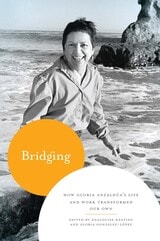
Bridging
How Gloria Anzaldúa's Life and Work Transformed Our OwnEdited by AnaLouise Keating and Gloria González-López
University of Texas Press, 2011
The inspirational writings of cultural theorist and social justice activist Gloria Anzaldúa have empowered generations of women and men throughout the world. Charting the multiplicity of Anzaldúa's impact within and beyond academic disciplines, community trenches, and international borders, Bridging presents more than thirty reflections on her work and her life, examining vibrant facets in surprising new ways and inviting readers to engage with these intimate, heartfelt contributions.
Bridging is divided into five sections: The New Mestizas: "transitions and transformations"; Exposing the Wounds: "You gave me permission to fly in the dark"; Border Crossings: Inner Struggles, Outer Change; Bridging Theories: Intellectual Activism with/in Borders; and "Todas somos nos/otras": Toward a "politics of openness." Contributors, who include Norma Elia Cantú, Elisa Facio, Shelley Fisher Fishkin, Aída Hurtado, Andrea Lunsford, Denise Segura, Gloria Steinem, and Mohammad Tamdgidi, represent a broad range of generations, professions, academic disciplines, and national backgrounds. Critically engaging with Anzaldúa's theories and building on her work, they use virtual diaries, transformational theory, poetry, empirical research, autobiographical narrative, and other genres to creatively explore and boldly enact future directions for Anzaldúan studies.
A book whose form and content reflect Anzaldúa's diverse audience, Bridging perpetuates Anzaldúa's spirit through groundbreaking praxis and visionary insights into culture, gender, sexuality, religion, aesthetics, and politics. This is a collection whose span is as broad and dazzling as Anzaldúa herself.
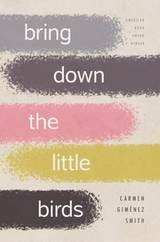
Bring Down the Little Birds
On Mothering, Art, Work, and Everything ElseCarmen Giménez Smith
University of Arizona Press, 2010
Writing in fragmented yet coherent sections, the author shares with us her interior monologue, affording the reader a uniquely honest, insightful, and deeply personal glimpse into a woman’s first and second journeys into motherhood. Giménez Smith begins Bring Down the Little Birds by detailing the relationship with her own mother, from whom her own concept of motherhood originated, a conception the author continually reevaluates and questions over the course of the book.
Combining fragments of thought, daydreams, entries from notebooks both real and imaginary, and real-life experiences, Giménez Smith interrogates everything involved in becoming and being a mother for both the first and second times. She wonders what her children will one day know about her own “secret life,” meditates on the physical effects of pregnancy, and questions the myths about, nostalgia for, and glorification of motherhood.
While Giménez Smith incorporates universal experiences of motherhood that other authors have detailed throughout literature, what separates her book from these many others is that her reflections are captured in a style that establishes an intimacy and immediacy between author and reader through which we come to know the secret life of a mother and are made to question our own conception of what motherhood really means.
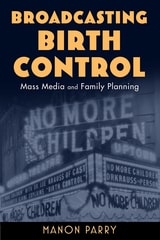
Broadcasting Birth Control
Mass Media and Family PlanningParry, Manon
Rutgers University Press, 2013
Mass media, Manon Parry contends, was critical to the birth control movement’s attempts to build support and later to publicize the idea of fertility control and the availability of contraceptive services in the United States and around the world. Though these public efforts in advertising and education were undertaken initially by leading advocates, including Margaret Sanger, increasingly a growing class of public communications experts took on the role, mimicking the efforts of commercial advertisers to promote health and contraception in short plays, cartoons, films, and soap operas. In this way, they made a private subject—fertility control—appropriate for public discussion.
Parry examines these trends to shed light on the contested nature of the motivations of birth control advocates. Acknowledging that supporters of contraception were not always motivated by the best interests of individual women, Parry concludes that family planning advocates were nonetheless convinced of women’s desire for contraception and highly aware of the ethical issues involved in the use of the media to inform and persuade.
Brokered Subjects
Sex, Trafficking, and the Politics of FreedomElizabeth Bernstein
University of Chicago Press, 2018
Buckeye Women
The History of Ohio’s DaughtersStephane Elise Booth
Ohio University Press, 2001
By the last two decades of the twentieth century, Ohio women had held positions as university presidents, chief executive officers, judges, superintendents of schools, and lieutenant governor. They had won Pulitzer Prizes and, in one case, the Nobel Prize for Literature.
But these women stood on the shoulders of those who came before: the pioneering women who helped tame the Ohio frontier, who filled the breach, who worked for reform, and who struggled for their own rights as citizens of one of the most prosperous states in the Union.
Buckeye Women is an accessible and comprehensive account of the role Ohio women have assumed in the history of the state and a narrative of their hardships and of the victories that have been won in the past two hundred years.
In this timely contribution to the Ohio Bicentennial Series, Professor Stephane Booth has written a rich and well-researched volume, providing for the first time a record of the vast and pivotal accomplishments shared by the women of Ohio over the last two centuries and documenting their contribution to the state’s remarkable heritage.
Building Domestic Liberty
Charlotte Perkins Gilman's Architectural FeminismPolly Wynn Allen
University of Massachusetts Press, 1988
Building Domestic Liberty offers a critical and admiring analysis of feminist philosopher Charlotte Perkins Gilman (1860–1935). Polly Allen examines Gilman's approach to architecture, landscape, and neighborhood design and discusses Gilman's case against prevailing household design and looks at her philosophy of world improvement.
Building Taliesin
Frank Lloyd Wright’s Home of Love and LossRon McCrea
Wisconsin Historical Society Press, 2012
Building Womanist Coalitions
Writing and Teaching in the Spirit of LoveEdited by Gary L. Lemons
University of Illinois Press, 2019
Built To Win
The Female Athlete As Cultural IconLeslie Heywood
University of Minnesota Press, 2003
A timely look at the rise of women in sports
The sculpted speed of Marion Jones. The grit and agility of Mia Hamm. The slam-dunk style of Lisa Leslie. The skill and finesse of these sports figures are widely admired, no longer causing the puzzlement and discomfort directed toward earlier generations of athletic women. Built to Win explores this relatively recent phenomenon—the confident, empowered female athletes found everywhere in American popular culture.
Leslie Heywood and Shari L. Dworkin examine the role of female athletes through interviews with elementary- and high school-age girls and boys; careful readings of ad campaigns by Nike, Reebok, and others; discussions of movies like Fight Club and Girlfight; and explorations of their own sports experiences. They ask: what, if any, dissonance is there between popular images and the actual experiences of these athletes? Do these images really “redefine femininity” and contribute to a greater inclusion of all women in sport? Are sexualized images of these women damaging their quest to be taken seriously? Do they inspire young boys to respect and admire female athletes, and will this ultimately make a difference in the ways gender and power are constructed and perceived?Proposing a paradigm shift from second- to third-wave feminism, Heywood and Dworkin argue that, in the years since the passage of Title IX, gender stereotypes have been destabilized in profound ways, and they assert that female athletes and their imagery are doing important cultural work to that end. Important, refreshing, and engrossing, Built to Win examines sport in all its complexity.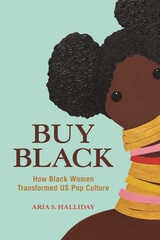
Buy Black
How Black Women Transformed US Pop CultureAria S. Halliday
University of Illinois Press, 2022
Far-ranging and bold, Buy Black reveals what attitudes inform a contemporary Black sensibility based in representation and consumerism. It also traces the parameters of Black symbolic power, mapping the sites where intraracial ideals of blackness, womanhood, beauty, play, and sexuality meet and mix in consumer and popular culture.
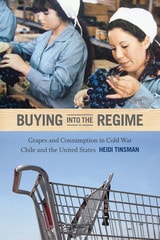
Buying into the Regime
Grapes and Consumption in Cold War Chile and the United StatesHeidi Tinsman
Duke University Press, 2014
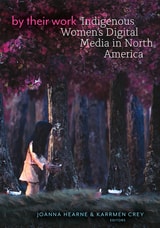
By Their Work
Indigenous Women's Digital Media in North AmericaJoanna Hearne
University of Minnesota Press, 2025
A first-of-its-kind collection to transform our understanding of digital media from Indigenous women creators
Indigenous women form a vital force in digital media production now and have over the past several decades—in fact, nearly three quarters of the projects at the 2017 imagineNATIVE Film and Media Arts Festival were created by women. By Their Work highlights the prismatic nature of Indigenous women’s digital media, connecting the digital arts with their creative labor and adaptive activism.
Joanna Hearne and Karrmen Crey bring together a collection of essays and interviews to highlight the voices of powerful and important media makers, from Indigenous video game creators to animators to social media influencers and from theorists of early Indigenous digital media to current practitioners, including trans and nonbinary creators often left out of public narratives about the digital. Creating a space to hear critical voices on Indigenous media history, theory, and production, the contributors share stories, genealogies, and practices behind Indigenous women’s power and presence in the digital world.
Focusing on the history of digital media as a whole, this collection presents a compelling case for Indigenous women’s crucial roles across the history of digital forms and platforms. In doing so, By Their Work transforms digital Indigenous studies in the twenty-first century.
Contributors: Nanobah Becker; Reilley Bishop-Stall, McGill U; Meagan Byrne; Tawny Trottier Cale; Dana Claxton; Crystal Harrison Collin; Elizabeth Day; Kristin L. Dowell, Florida State U; Miranda Due; Heid E. Erdrich; Marcella Ernest, U of New Mexico; Marisa Erven; David Gaertner, U of British Columbia; Carol Geddes; Faye Ginsburg, New York U; Patuk N. Glenn; Lisa Jackson; Jacqueline Land, William Jewell College; Jason Edward Lewis, Concordia University, Montreal; Joshua D. Miner, U of Kansas; Salma Monani, Gettysburg College; Jas M. Morgan, Simon Fraser U; Archer Pechawis, York U; Mikhel Proulx, Queen’s U Canada; Ryan Rice; Jolene Rickard, Cornell U; Channette Romero, U of Georgia; Wendi Sierra, Texas Christian U; Skawennati.