3785 books match the query 'Poetry' and 173 start with b
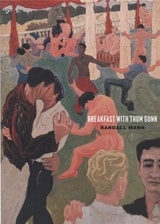
cover of Breakfast with Thom Gunn

Breakfast with Thom Gunn

Randall Mann

University of Chicago Press, 2009

Aubade

Those who lack a talent for love have come

to walk the long Pier 7. Here at the end

of the imagined world are three low-flying gulls

like lies on the surface; the slow red

of a pilot’s boat; the groan

of a fisherman hacking a small shark—

and our speech like the icy water, a poor

translation that will not carry us across.

What brought us west, anyway? A hunger.

But ours is no Donner Party, we who feed

only on scenery, the safest form

of obfuscation: see how the bay is a gray

deepening into gray, the color of heartbreak.


Randall Mann’s Breakfast with Thom Gunn is a work both direct and unsettling. Haunted by the afterlife of Thom Gunn (1929–2004), one of the most beloved gay literary icons of the twentieth century, the poems are moored in Florida and California, but the backdrop is “pitiless,” the trees “thin and bloodless,” the words “like the icy water” of the San Francisco Bay. Mann, fiercely intelligent, open yet elusive, draws on the “graceful erosion” of both landscape and the body, on the beauty that lies in unbeauty. With audacity, anxiety, and unbridled desire, this gifted lyric poet grapples with dilemmas of the gay self embroiled in—and aroused by—a glittering, unforgiving subculture. Breakfast with Thom Gunnis at once formal and free, forging a sublime integrity in the fire of wit, intensity, and betrayal.

Praise for Complaint in the Garden   

“We have before us a skillful, witty, passionate young poet. . . . Randall Mann is both attuned to and at odds with the natural world; he articulates the passions and predicaments of a self inside a massive, arousing, but sometimes brutal culture. And he accomplishes these things with buoyant lyric sensibilities and rejuvenating skills.”—Kenyon Review


[more]
cover of Breaking the Jaws of Silence: Sixty American Poets Speak to the World

Breaking the Jaws of Silence

Sixty American Poets Speak to the World

Sholeh Wolpé

University of Arkansas Press, 2013
Through the support of PEN Center USA, Iranian American poet and translator Sholeh Wolpé has brought together sixty American poets to address the world through poems that not only meditate on the principles of freedom, justice, and tolerance but also boldly and directly address specific countries. Natasha Trethewey, Robert Bly, Rita Dove, Yusef Komunyakaa, Galway Kinnell, Philip Levine, Carolyn Forché, Billy Collins, Jorie Graham, Naomi Shihab Nye, and Quincy Troupe are just some of the poets whose work is gathered in this powerful new collection. These poets speak out in the tradition of all poets who speak out in uprisings, seeking to change the landscape despite an environment of oppression, torture, and denial of basic human rights. All poems included were gifted to this anthology, which will benefit PEN Center USA's Freedom to Write program.
[more]
cover of Breathing Between the Lines: Poems

Breathing Between the Lines

Poems

Demetria Martínez

University of Arizona Press, 1997

Demetria Martínez has entered the public consciousness by way of the heart. In 1994, she captured a Western States Book Award with her first novel, Mother Tongue, which went on to win widespread national attention. Now, in Breathing between the Lines, the writer returns to poetry, her first love. Many of the poems in this book touch on the themes from Mother Tongue, about an American activist who falls in love with a Salvadoran political refugee.

Weaving together threads of love and family, social conviction and activism, loss and renewal, Breathing between the Lines carries the reader deep inside the head and heart of a talented Chicana writer. Page by page, the journey is an exhilarating one. What we find at the end is up to us.
[more]
cover of Brenda Is in the Room and Other Poems

Brenda Is in the Room and Other Poems

Craig Morgan Teicher

University Press of Colorado, 2007

Winner of the 2007 Colorado Prize for Poetry
Published by the Center for Literary Publishing at Colorado State University
[more]
cover of Brief Landing on the Earth's Surface

Brief Landing on the Earth's Surface

Juanita Brunk

University of Wisconsin Press, 1996

In Brief Landing on the Earth’s Surface, even the most ordinary moments are infused with an awareness of the lost past and a kind of prescience of the future. From one setting to another—Tidewater Virginia, rural Pennsylvania, Greece, New York City—these poems give voice to the human longing for permanence, home, and connection in the face of a constantly changing reality.
 

[more]
cover of Bright Raft in the Afterweather: Poems

Bright Raft in the Afterweather

Poems

Jennifer Elise Foerster

University of Arizona Press, 2018

In her dazzling new book, Jennifer Elise Foerster announces a frightening new truth: “the continent is dismantling.” Bright Raft in the Afterweather travels the spheres of the past, present, future, and eternal time, exploring the fault lines that signal the break of humanity’s consciousness from the earth.

Featuring recurring characters, settings, and motifs from her previous book, Leaving Tulsa, Foerster takes the reader on a solitary journey to the edges of the continents of mind and time to discover what makes us human. Along the way, the author surveys the intersection between natural landscapes and the urban world, baring parallels to the conflicts between Native American peoples and Western colonizers, and considering how imagination and representation can both destroy and remake our worlds.
Foerster’s captivating language and evocative imagery immerse the reader in a narrative of disorientation and reintegration. Each poem blends Foerster’s refined use of language with a mythic and environmental lyricism as she explores themes of destruction, spirituality, loss, and remembrance.

In a world wrought with ecological imbalance and grief, Foerster shows how from the devastated land of our alienation there is potential to reconnect to our origins and redefine the terms by which we inhabit humanity and the earth.
 
[more]
cover of Brodsky in English

Brodsky in English

Zakhar Ishov

Northwestern University Press, 2023

A deeply researched account of Joseph Brodsky’s evolution in English as a self-translator and a poet in translation

Joseph Brodsky’s translations of his own Russian-language poems into English “new originals” have been criticized for their “un-Englishness,” an appraisal based on a narrow understanding of translation itself. With this radical reassessment of the Nobel Prize winner’s self-translations, Zakhar Ishov proposes a fresh approach to poetry translation and challenges the assumption that poetic form is untranslatable. 

Brodsky in English draws on previously unexamined archival materials, including drafts and correspondence with translators and publishers, to trace the arc of Brodsky’s experience with the English language. Ishov shows how Brodsky’s belief in the intellectual continuity between his former life in the Soviet Union and his new career in the United States, including as Poet Laureate, anchored his insistence on maintaining the formal architecture of his poems in translation, locating the transmission of poetic meaning in the rhythms of language itself. This book highlights Brodsky’s place within the long history of the compromises translation must make between linguistic material and poetic process.
[more]
cover of Brother Bullet: Poems

Brother Bullet

Poems

Casandra López

University of Arizona Press, 2019

Speaking to both a personal and collective loss, in Brother Bullet Casandra López confronts her relationships with violence, grief, guilt, and ultimately, endurance. Revisiting the memory and lasting consequences of her brother’s murder, López traces the course of the bullet—its trajectory, impact, wreckage—in lyrical narrative poems that are haunting and raw with emotion, yet tender and alive in revelations of light.

Drawing on migratory experiences, López transports the reader to the Inland Empire, Baja California, New Mexico, and Arizona to create a frame for memory, filled with imagery, through the cyclical but changing essence of sorrow. This is paralleled with surrounding environments, our sense of belonging—on her family’s porch, or in her grandfather’s orange grove, or in the darkest desert. López’s landscapes are geographical markers and borders, connecting shared experiences and memories.

Brother Bullet tugs and pulls, drawing us into a consciousness—a story—we all bear.
[more]
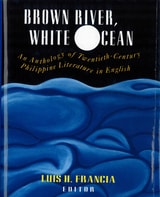
cover of Brown River, White Ocean: An Anthology of Twentieth-Century Philippine Literature in English

Brown River, White Ocean

An Anthology of Twentieth-Century Philippine Literature in English

Francia, Luis H

Rutgers University Press, 1993

English is often a primary literary language for Filipino writers--not only for those in the Philippines but for those resident in the US; both groups are included in this anthology of 31 stories and 108 poems documenting a tradition that began at the turn-of-the-century. Manila-born poet and writer Francia, an editor at the Village Voice, gathers and validates creative work that has had limited distribution not only here but in Asia. ``In the Philippine context, what is foreign and what is indigenous has always been a tricky and ultimately impossible subject,'' Francia writes in his introduction. ``Filipinos have unconsciously perfected the art of mixing the two up....'' Readers who expect Filipino English to have the unexpected inflections and inventiveness of Indian or Caribbean English will be disappointed: the Filipino writer uses standard American English as a native language, but spices it naturally with words form indigenous and adopted tongues: Tagalog, Spanish, Ilokano, etc. Stories look at unrequited passion (in which the sensual tropical ambiance is at odds with society's rules); village life; the different cultures that have settled in the archipelago--Chinese, Japanese, Spanish, Hindu Indian; and the consequences of military, colonial, and economic occupation. Both poems and stories consider the experience of Filipinos--some intellectual, some humble--in the US. Among the more familiar contributors: Carlos Bulosan, Jos‚ Garc¡a Villa, Jessica Hagedorn, and Ninotchka Rosca. While the prose selected here is more consistent in quality than the poetry, the poems seem more wide-ranging; like the fiction writers, the poets consider love, politics, and metaphysics but move as well into experimentation and the modernist realm. A satisfying and worthwhile project.
[more]
cover of Brownwood: Poems

Brownwood

Poems

Lawrence Bridges

Tupelo Press, 2016

Brownwood, like Berryman’s Henry, is a triad (I, He, You), an “other” character, con-structed within a real-life geography in an arsenal of time and place. Lawrence Bridges offers Polaroid graphics of his protagonist’s identity in the thick of our culture, amid the changing rules of fate and folly. As Elena Karina Byrne observes in her Foreword, “Brownwood is full of angst, wry humor, and sarcasm; he’s a lost twin, doppelganger, living in a melancholy place [and] this book’s poetic plot … arrives with cinematographic aplomb.” Bridges’s third volume of poems is like an autobiography of one stuck inside the vessel of who he is: “Feared as a monster, tame as a clown.”
[more]
cover of Buddha’s Dogs

Buddha’s Dogs

Susan Browne

Four Way Books, 2004
These poems are at once tender, vulnerable, biting, heartbreaking, and hilarious. One moment you are laughing, the next moment drying your eyes. Edward Hirsch, judge of the Four Way Books 2002 Intro Prize says of Buddha’s Dogs, "There’s a ruthless authenticity—a deep cherishing—in Buddha’s Dogs, a splendidly mature first book of poems that is filled with moments of Proustian recall, with the comedy and the anguish, the beauty and the burning of lived experience."
[more]
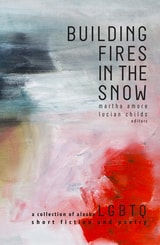
cover of Building Fires in the Snow: A Collection of Alaska LGBTQ Short Fiction and Poetry

Building Fires in the Snow

A Collection of Alaska LGBTQ Short Fiction and Poetry

Edited by Martha Amore and Lucian Childs

University of Alaska Press, 2016

Diversity has always been central to Alaska identity, as the state’s population consists of people with many different backgrounds, viewpoints, and life experiences. This book opens a window into these diverse lives, gathering stories and poems about lesbian, gay, bisexual, transgender, and queer life into a brilliant, path-breaking anthology.
            In these pages we see the panoply of LGBTQ life in Alaska today, from the quotidian urban adventures of a family—shopping, going out, working—to intimate encounters with Alaska’s breathtaking natural beauty. At a time of great change and major strides in LGBTQ civil rights, Building Fires in the Snow shows us an Alaska that shatters stereotypes and reveals a side of Alaska that’s been little seen until now.
 
[more]
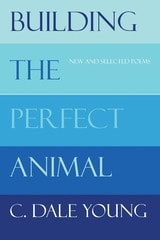
cover of Building the Perfect Animal: New and Selected Poems

Building the Perfect Animal

New and Selected Poems

C. Dale Young

Four Way Books, 2025

C. Dale Young, Winner of the 2017 Hanes Award in Poetry from The Fellowship of Southern Writers, brings together decades of work in Building the Perfect Animal: New and Selected Poems. These lyrics cut cleanly and exquisitely, performing a sacrifice at the altar of language. Remedying the inaccurate reports missionaries left in their “filthy journals,” “Memento” imagines instead the surgical precision Aztec priests must have used to “slice from the umbilicus up and through the diaphragm,” keeping the heart “while discarding the body, the feeble thing / tumbling down the steps of the pyramid.” As a tenured artist and veteran doctor, Young writes with a dual awareness of life’s fragility and the lyric’s endurance, presenting readers with new work that is entirely fresh even as it speaks to his broader legacy and dialogues with his preceding oeuvre. This book unfolds like the poet’s experience of time: “‘All my life.’ It sounds so odd to say that out loud. / But strange thing after strange thing transpired.” Representing the still-warm heart, what will one day be the only surviving memento of the outlasted body that bore them, these poems explore the author’s simultaneous embrace of mortality’s richness and resignation to death’s inevitable decay. Young surveys the perpetual ultimatum of his roles: as an oncologist, the patients (including his parents) he couldn’t save; as an artist, the self he intends to confront honestly as his body ages; and, as a mortal raised with stories of the Taino gods, the impossibility of building the perfect animal. When teaching bedside manner, how to break the news to a patient that their cancer will kill them, Young’s student “wants a guide, a checklist,” he says, “but nothing like that exists. It has never existed.” Building the Perfect Animal is a monument to that inconceivable instruction manual, honoring the ceaselessly unprecedented work and gift of being now alive.
 
[more]
cover of Bulgaria's Synagogue Poets: The Kastoreans

Bulgaria's Synagogue Poets

The Kastoreans

Edited by Leon J. Weinberger

University of Alabama Press, 1983

Critical Edition with introduction and commentary by Leon J. Weinberger

This is the first in-depth study of three 11th- to 12th-century poets from Balkan Byzantium. Included are all of the known works by Moses b. Hiyya, Joseph b. Jacob Qalai, and Isaac b. Judah, collected from rare manuscripts and printed editions and from Geniza collections at Oxford and Cambridge. These works provide the evidence that the Balkan synagogue poets favored distinctive literary forms even as they show the strong influence of the Hispanic-Hebrew writers. Completing the volume are indexes of rabbinic, Aramaic, and payyetanic usages and tables of metonymical terms.

Published by the Hebrew Union College Press, distributed by The University of Alabama Press.
[more]
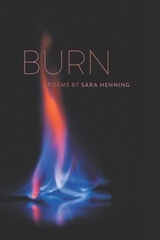
cover of Burn

Burn

Sara Henning

Southern Illinois University Press, 2024

A lyrical meditation on time, survival, and merciful moments of joy 

Sara Henning’s Burn draws readers deep into the moments that make us, focusing on instances of crisis and renewal to explore our relation to time and lived experience. In these poems, we follow a speaker as she works through the loss of young love, the death of her parents, marriage’s hardness and beauty, sexual assault, and the devastation of a pandemic—evolutions of trauma that fracture time and alter perception. Twinned with these extremes are shimmering manifestations of joy only an imperfect world can make possible.

Burn magnifies the way time leaves us both the victim and the victor of our realities. The blaze of her late-mother’s Tiffany lamps sends the speaker back to childhood, where she unearths mica from the schoolyard dirt. The devastation of an ecological crisis, the annihilating act of rape, and the unsolved disappearance of a caretaker all level the speaker’s world and upend her place in it, forcing her to reconstitute reality from what remains. In poems which summon the spirit of Stephen Hawking’s A Brief History of Time, this collection walks through the physics of temporality as refracted through love, loss, and grief, so we better understand its effect on our lives. Through this insight, Henning introduces a new way of being in the world.  

A work of advocacy and uplift, Burn shines with the vibrant possibilities of narrative lyric poetry as it forges a path from grief to hope.  
[more]
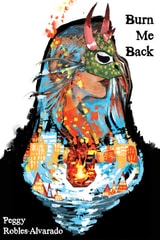
cover of Burn Me Back

Burn Me Back

Peggy Robles-Alvarado

Four Way Books, 2025
“My Spanglish,” Peggy Robles-Alvarado declares, “drops the -s and makes it ma’ o meno’,” replaces accent marks with side-eye, “has a Tía sin papeles,” and recognizes that “there is no other way to say— / Cónchole papi, you look good!” Igniting across tongues, cultures, and countries, the incendiary poems in Burn Me Back harness the incantatory power of language through hybrid forms, preserving a beloved father’s memory, enshrining the legacy of the Latino immigrant community in Washington Heights and the Bronx, reimagining the world we share, and speaking toward a hopeful multiplicity of possible futures. At the cross section of Puerto Rican and Dominican diasporas, rooted in ancestral narratives and infused with generational dislocation, this speaker refuses to abandon what resists translation, makes the space she needs, and transforms objects as she names them: “My Spanglish knows a fire escape is also a terrace.” Yes, the language here is a feat of engineering — a design shaped by the conditions of emergency, an architecture of survival, deliverance to open air. Like isolating the notes in a thunderous chord, Robles-Alvarado dexterously teases out each word’s many meanings, listening for the individual strains that created her as she archives family lore and fleshes out her personal history, writing against patriarchy while codifying working-class wisdom. She reconstructs a whole genealogy in “What They Mean by Papers,” reciting a negative litany of “papeles.” “Not the Daily News or El Diario La Prensa, / or the kind my mother read to me on Sunday / mornings,” her “throat full of / pelitos de mango,” “Not the kind Tía Weltina used to roll her tobacco with,” “conjuring / Taíno spirits she exhaled … as she tried to memorize the national anthem,” but the kind “Uncle Rito forged” while he “learned to curl the R in his name / as if writing sacred geometry,” “the kind that convinced four of my aunts to marry older / naturalized men in exchange for an acre of my grandfather’s campo” — the kind that required the rest of their lives as payment, “their bodies, / all their milk and honey, all their amber and caña dulce / sacrificed to the lust of viejos verdes, old bastards / who soured early on too much tabaco y ron and wanted to plant / their moldy seeds in supple girls who had never seen snow.” Robles-Alvarado orchestrates the fullness of her song by refusing to leave anyone out, by making room for a term’s contradictory definitions and playing through discordant combinations until the dissonance resolves. What began as an elegy composed by a daughter lost in mourning becomes an expansive arrangement sounding rupture and repair. This music travels between loss and recovery, addiction and sobriety, the cooling embers of lost childhood and the heat of the present, this very moment in which you could reach out to the people around you and ask them to be here with you for every scalding second, the warmth of your skin against theirs posing a burning question — an invitation to burn you back. 
[more]
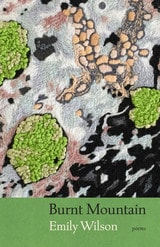
cover of Burnt Mountain

Burnt Mountain

Emily Wilson

University of Iowa Press, 2025
Since her first collection, The Keep, Emily Wilson has forged a singular voice in American poetry, one that traces and complicates the dynamic relationships between language and the natural, aesthetics and science, material forms and inwardness. Her new collection, Burnt Mountain, is set on the rugged slopes of an inauspicious mountain, densely wooded, long ago scoured by fire, and marked by generations of human presence. Fiercely attuned to the match and mismatch between mind and mountain—the ways in which the natural and the human construct and deconstruct each other in the contested realms of art, wilderness, history, devotion, and politics—Wilson’s poetics reckon with resistant forces of nature and with the human drive to subdue what eludes us. Above all, these poems encounter the flickering, flowing matrices of being—“that far-forged interior / Outlandish green and flaming cause unknown”—and give voice to the elemental question of what can and cannot be known or understood—and what can sustain us.
[more]
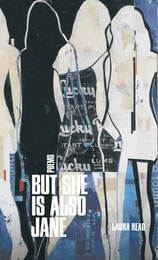
cover of But She Is Also Jane

But She Is Also Jane

Laura Read

University of Massachusetts Press, 2023

Conversational, irreverent, and disarmingly honest, the poems of But She Is Also Jane follow the everyday contours of women’s lives and the expectations they grapple with. As our speaker approaches middle age, she copes with the loss of loved ones, the realities of an emptying nest, the routine indignities of sexism, and nostalgia for the past. Laura Read’s third poetry collection balances discussions of Degas, Vermeer, and Marie Curie with reflections on Sammy Hagar, a troubling outing to a male revue, and memories of watching Mork and Mindy on the night of her mother’s hysterectomy.

[more]
cover of Butch Geography

Butch Geography

Stacey Waite

Tupelo Press, 2013

In her Los Angeles Review of Books essay “Who Is Who: Pronouns, Gender, and Merging Selves,” Dana Levin describes Stacey Waite’s fusion of gender identities: “Pseudonyms, heteronyms, personae, all the ventriloquizing literary arts; point of view and tonal shifts: these are tools for speakers and speaking. But the sentence too has a voice: ‘i will not be the kind of boy who can not bear the memory of her body’ … This is [Waite’s] genius … to take innocuous syntactical phrasing and change the players mid-sentence — to get around English’s pronominal either/or by creating a syntactical both/and…”
[more]
cover of Butterfly sleep

Butterfly sleep

Kim Kyung Ju

Tupelo Press, 2019
KIM KYUNG JU’s Butterfly Sleep is a historical drama based in the early period of the Joseon dynasty. He relies on a mixture of absurdism, magic realism, and dark humor in order to tell an existentialist allegory of Korea’s rapid development. In this sense, Butterfly Sleep is a story about the fractured soul of the nation. Even more so, it is a lesson in consolation. As Butterfly Sleep unfolds, we drift in and out of song, as music is made in order to comfort the characters in the play. With lyricism and grace, Kim suggests that the only way the ghosts of the nation can be consoled is through direct confrontation. Confront them first, then sing them a lullaby.
[more]
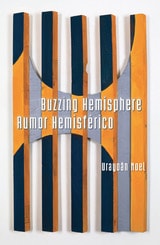
cover of Buzzing Hemisphere / Rumor Hemisférico

Buzzing Hemisphere / Rumor Hemisférico

Urayoán Noel

University of Arizona Press, 2015

Is poetry an alternative to or an extension of a globalized language? In Buzzing Hemisphere / Rumor Hemisférico, poet Urayoán Noel maps the spaces between and across languages, cities, and bodies, creating a hemispheric poetics that is both broadly geopolitical and intimately neurological.

In this expansive collection, we hear the noise of cities such as New York, San Juan, and São Paulo abuzz with flickering bodies and the rush of vernaculars as untranslatable as the murmur in the Spanish rumor. Oscillating between baroque textuality and vernacular performance, Noel’s bilingual poems experiment with eccentric self-translation, often blurring the line between original and translation as a way to question language hierarchies and allow for translingual experiences.

A number of the poems and self-translations here were composed on a smartphone, or else de- and re-composed with a variety of smartphone apps and tools, in an effort to investigate the promise and pitfalls of digital vernaculars. Noel’s poetics of performative self-translation operates not only across languages and cultures but also across forms: from the décima and the “staircase sonnet” to the collage, the abecedarian poem, and the performance poem.

In its playful and irreverent mash-up of voices and poetic traditions from across the Americas, Buzzing Hemisphere / Rumor Hemisférico imagines an alternative to the monolingualism of the U.S. literary and political landscape, and proposes a geo-neuro-political performance attuned to damaged or marginalized forms of knowledge, perception, and identity.
[more]
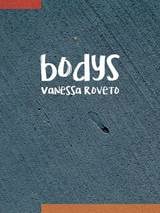
cover of bodys

bodys

Vanessa Roveto

University of Iowa Press, 2016

Vanessa Roveto’s debut collection, bodys, is a work of stunning strangeness, force, and audacity, generated by—and degenerating toward—the unanswerable question at the heart of poetic speech: What does it mean to be “a person?” A dizzying hybrid of poetry and prose, post-human analytics and ribaldry, spiritual autobiography, and grim satire, Roveto lends exacting voice to “a most complicated vocabulary of feeling-your-feelings.” Viscerally drawn to forbidden states and suspicious of its own desires, bodys is literature as high-risk, low-tech radiology, mapping the dim edges of identity and identification: “Brain scans indicated the moral center and the disgust center overlap on the mind field.”

Roveto’s sentences hurtle forward with withering disjunctive energy, laying down traps of wordplay, tacking toward and veering away from syntactical targets, trying-on and sloughing-off pronoun positions with abandon. Yet for all its postmodern bravado—and irreverence, and frequent scary hilarity—bodys remains abidingly attached to exploring the problem of a human speaker addressing itself to another, and colliding with its own otherness along the way. It is the same problem—articulation as disarticulation—that animates the great Renaissance sonnet sequences, from which bodys is affectionately, and perversely, descended. What is bodys—what are bodys—anyway? A dysfunction in the body’s ability to multiply itself? A dysmorphic take on the body’s sense of its reality? A dystopian vision of a world in which boundaries between selves and others have been overwhelmed by commerce, surveillance, medical technology, nihilistic agitprop? “Last night one of the girls asked about the relationship between a body and nobody,” Roveto writes. “It was the beautiful question.”
 
[more]
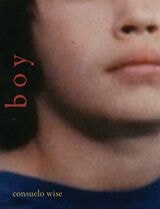
cover of boy

boy

Consuelo Wise

Omnidawn, 2024

A hybrid book-length poem in which the protagonist grapples with a great loss.
 
In this hybrid of lyric poetry and essay, Consuelo Wise utilizes repetition, fragmentation, and syntax to construct a form that repeatedly falls apart. Breaks in lines and fragmented stanzas are followed by accumulative rushes, slashes, brackets, and words pushed together.
 
Throughout this book-length poem, Wise composes a meditation and an investigation into loss and identity. Moving between sound and image, aggression and subtlety, b o y pries open memories that resist understanding but also refuse to be forgotten. Wise peels back layers of mourning, considering how it can be experienced as a personal, inherited, environmental, social, and historical phenomenon. Throughout, the protagonist in b o y reenvisions ways to process a great loss, listening closely and searching for words while “the earth is shaking and the silence pressing down.” 
[more]