Results by title
22279 books match the query 'Social Science' and 1147 start with b
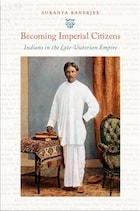
Becoming Imperial Citizens
Indians in the Late-Victorian EmpireSukanya Banerjee
Duke University Press, 2010
Interpreting autobiography, fiction, election speeches, economic analyses, parliamentary documents, and government correspondence, Banerjee foregrounds the narrative logic sustaining the unprecedented claims to citizenship advanced by racialized colonial subjects. She focuses on the writings of figures such as Dadabhai Naoroji, known as the first Asian to be elected to the British Parliament; Surendranath Banerjea, among the earliest Indians admitted into the Indian Civil Service; Cornelia Sorabji, the first woman to study law in Oxford and the first woman lawyer in India; and Mohandas K. Gandhi, who lived in South Africa for nearly twenty-one years prior to his involvement in Indian nationalist politics. In her analysis of the unexpected registers through which they carved out a language of formal equality, Banerjee draws extensively from discussions in both late-colonial India and Victorian Britain on political economy, indentured labor, female professionalism, and bureaucratic modernity. Signaling the centrality of these discussions to the formulations of citizenship, Becoming Imperial Citizens discloses a vibrant transnational space of political action and subjecthood, and it sheds new light on the complex mutations of the category of citizenship.
Becoming Israeli
National Ideals and Everyday Life in the 1950sAnat Helman
Brandeis University Press, 2014
Becoming Mapuche
Person and Ritual in Indigenous ChileMagnus Course
University of Illinois Press, 2011
Becoming Maya
Ethnicity and Social Inequality in Yucatán since 1500Wolfgang Gabbert
University of Arizona Press, 2004
Becoming Mead
The Social Process of Academic KnowledgeDaniel R. Huebner
University of Chicago Press, 2014
In Becoming Mead, Daniel R. Huebner traces the ways in which knowledge has been produced by and about the famed American philosopher. Instead of treating Mead’s problematic reputation as a separate topic of study from his intellectual biography, Huebner considers both biography and reputation as social processes of knowledge production. He uses Mead as a case study and provides fresh new answers to critical questions in the social sciences, such as how authors come to be considered canonical in particular disciplines, how academics understand and use others’ works in their research, and how claims to authority and knowledge are made in scholarship. Becoming Mead provides a novel take on the history of sociology, placing it in critical dialogue with cultural sociology and the sociology of knowledge and intellectuals.
Becoming Mexipino
Multiethnic Identities and Communities in San DiegoGuevarra, Rudy P
Rutgers University Press, 2012
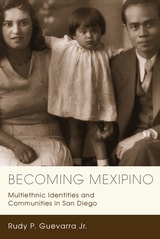
Through racially restrictive covenants and other forms of discrimination, both groups, regardless of their differences, were confined to segregated living spaces along with African Americans, other Asian groups, and a few European immigrant clusters. Within these urban multiracial spaces, Mexicans and Filipinos coalesced to build a world of their own through family and kin networks, shared cultural practices, social organizations, and music and other forms of entertainment. They occupied the same living spaces, attended the same Catholic churches, and worked together creating labor cultures that reinforced their ties, often fostering marriages. Mexipino children, living simultaneously in two cultures, have forged a new identity for themselves. Their lives are the lens through which these two communities are examined, revealing the ways in which Mexicans and Filipinos interacted over generations to produce this distinct and instructive multiethnic experience. Using archival sources, oral histories, newspapers, and personal collections and photographs, Guevarra defines the niche that this particular group carved out for itself.
Becoming Neighbors in a Mexican American Community
Power, Conflict, and SolidarityBy Gilda L. Ochoa
University of Texas Press, 2004
On the surface, Mexican Americans and Mexican immigrants to the United States seem to share a common cultural identity but often make uneasy neighbors. Discrimination and assimilationist policies have influenced generations of Mexican Americans so that some now fear that the status they have gained by assimilating into American society will be jeopardized by Spanish-speaking newcomers. Other Mexican Americans, however, adopt a position of group solidarity and work to better the social conditions and educational opportunities of Mexican immigrants.
Focusing on the Mexican-origin, working-class city of La Puente in Los Angeles County, California, this book examines Mexican Americans' everyday attitudes toward and interactions with Mexican immigrants—a topic that has so far received little serious study. Using in-depth interviews, participant observations, school board meeting minutes, and other historical documents, Gilda Ochoa investigates how Mexican Americans are negotiating their relationships with immigrants at an interpersonal level in the places where they shop, worship, learn, and raise their families. This research into daily lives highlights the centrality of women in the process of negotiating and building communities and sheds new light on identity formation and group mobilization in the U.S. and on educational issues, especially bilingual education. It also complements previous studies on the impact of immigration on the wages and employment opportunities of Mexican Americans.
Becoming New Yorkers
Ethnographies of the New Second GenerationPhilip Kasinitz
Russell Sage Foundation, 2004
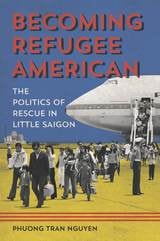
Becoming Refugee American
The Politics of Rescue in Little SaigonPhuong Nguyen
University of Illinois Press, 2017
Phuong Tran Nguyen examines the phenomenon of refugee nationalism among Vietnamese Americans in Southern California. Here, the residents of Little Saigon keep alive nostalgia for the old regime and, by extension, their claim to a lost statehood. Their refugee nationalism is less a refusal to assimilate than a mode of becoming, in essence, a distinct group of refugee Americans. Nguyen examines the factors that encouraged them to adopt this identity. His analysis also moves beyond the familiar rescue narrative to chart the intimate yet contentious relationship these Vietnamese Americans have with their adopted homeland. Nguyen sets their plight within the context of the Cold War, an era when Americans sought to atone for broken promises but also saw themselves as providing a sanctuary for people everywhere fleeing communism.
Becoming Rwandan
Education, Reconciliation, and the Making of a Post-Genocide CitizenS. Garnett Russell
Rutgers University Press, 2020
Becoming Somebody Else
Blackouts, Addiction, and Agency amongst London's HomelessJoshua Burraway
HAU, 2025
What does it mean to exist outside the normative temporality of life, of housed living, and, ultimately, of selfhood? Becoming Somebody Else takes up this question, offering a window into the fragmented and chaotic lives of people experiencing homelessness in urban London as they drink and drug themselves into blackout in post-austerity Britain. A state of being where time, body, agency, and self collapse into a memoryless abyss, the blackout is a prism into how human beings make and unmake their selfhood in the wake of social suffering and personal trauma. Attending to the words and histories of several individuals, Joshua Burraway knits together structural, psychological, and phenomenological approaches to understand the ways in which memory, agency, and selfhood are sites of struggle and belonging, and in doing so, suggests new ways of thinking about addiction, homelessness, and therapeutic possibility.
Becoming St. Louis
Family, Faith, and the Politics of Citizenship, 1820-1920Sharon Hartman Strom
University of Illinois Press, 2025
Becoming Transnational Youth Workers
Independent Mexican Teenage Migrants and Pathways of Survival and Social MobilityIsabel Martinez
Rutgers University Press, 2018
Becoming Trustworthy White Allies
Melanie S. Morrison
Duke University Press, 2025
Becoming Undone
Darwinian Reflections on Life, Politics, and ArtElizabeth Grosz
Duke University Press, 2011
Becoming Villagers
Comparing Early Village SocietiesEdited by Matthew S. Bandy and Jake R. Fox
University of Arizona Press, 2010
Based on a Society for American Archaeology symposium and subsequent Amerind Advanced Seminar in 2006, Becoming Villagers examines this transformation at various places and times across the globe by focusing not on the origins of agriculture and village life but rather on their consequences. The goal of the volume is to identify regularities in the ways that societies developed in the centuries and millennia following a transition to village life. Using cases that range from China to Bolivia and from the Near East to the American Southwest, leading archaeologists situate their specific areas of specialization in a broad comparative context.
They consider the forces acting to divide and fragment early villages and the social technologies and practices by which those obstacles were, in some cases, overcome. Finally, the volume examines the long-term historical trajectories of these early village societies.
This transformative collection makes a powerful case for a renewed and invigorated archaeological focus on large-scale comparative studies. It will be an essential read for anyone interested not only in early village societies but also in the ways in which archaeology relates to anthropology, other social sciences, and history.
CONTENTS:
- “Becoming Villagers: The Evolution of Early Village Societies,” Matthew S. Bandy and Jake R. Fox
- “Population Growth, Village Fissioning, and Alternative Early Village Trajectories,” Matthew S. Bandy
- “A Scale Model of Seven Hundred Years of Farming Settlements in Southwestern Colorado,” Timothy A. Kohler and Mark D. Varien
- “‘Great Expectations,’ or the Inevitable Collapse of the Early Neolithic in the Near East,” Nigel Goring-Morris and Anna Belfer-Cohen
- “‘Ritualization’ in Early Village Society: The Case of the Lake Titicaca Basin Formative,” Amanda B. Cohen
- “The Sacred and the Secular Revisited: The Essential Tensions of Early Village Society in the Southeastern United States,” Thomas Pluckhahn
- “Substantial Structures, Few People, and the Question of Early Villages in the Mimbres Region of the North American Southwest,” Patricia A. Gilman
- “Sea Changes in Stable Communities: What Do Small Changes in Practices at Catalhoyuk and Chiripa Imply about Community Making?” Christine A. Hastorf
- “The Emergence of Early Villages in the American Southwest: Cultural Issues and Historical Perspectives,” Richard H. Wilshusen and James M. Potter
- “A Persistent Early Village Settlement System on the Bolivian Southern Altiplano,” Jake R. Fox
- “First Towns in the Americas: Searching for Agriculture, Population Growth, and Other Enabling Conditions,” John E. Clark, Jon L. Gibson, and James Zeidler
- “The Evolution of Early Yangshao Period Village Organization in the Middle Reaches of Northern China's Yellow River Valley,” Christian E. Peterson and Gideon Shelach
Becoming White Clay
A History and Archaeology of Jicarilla Apache EnclavementB. Sunday Eiselt
University of Utah Press, 2012
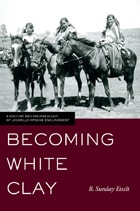
The story of one of the longest-lived and most successful nomadic enclaves in North America provides a rare glimpse into the material expressions of Apache self-determination and survival. For nearly 200 years the Jicarilla Apache of New Mexico thrived in the interstices of Pueblo and Spanish settlements following their expulsion from the Plains. Critical to their success was their ability to extend key aspects of Plains-Pueblo exchange to Indian and mixed-blood communities on the fringes of colonial rule. More than other nomadic tribes, the Jicarilla played an enormous role in holding together the social fabric of New Mexican villages after the fall of the Spanish Empire.
This comprehensive study by Sunday Eiselt begins with the great Athapaskan migration out of Canada during prehis-toric times and ends with the forced settlement of the Jicarilla on the Dulce reservation in the 1880s. Eiselt combines archaeological and ethnohistorical data in an examination of Jicarilla strategies for self-preservation. She reveals the ideological and political imperatives of “belonging” that shaped their interactions with local communities and the state and that enabled them to avoid reservation life well into the 1880s. Throughout their long history, Jicarilla identity remained intact, distinctive, and discernable even as life on the reservation disrupted the intimate connections that once existed with their Hispanic and Pueblo neighbors.
Becoming a Marihuana User
Howard S. Becker
University of Chicago Press, 2015
Becker doesn’t judge, but neither does he holler for legalization, tell you how to grow it in a hollowed-out dresser, or anything else like that for which there are plenty of other books you can buy. Instead, he looks at marijuana with a clear sociological lens—as a substance that some people enjoy, and that some others have decided none of us should. From there he asks: so how do people decide to get high, and what kind of experience do they have as a result of being part of the marijuana world? What he discovers will bother some, especially those who proselytize the irrefutably stunning effects of the latest strain: chemistry isn’t everything—the important thing about pot is how we interact with it. We learn to be high. We learn to like it. And from there, we teach others, passing the pipe in a circle that begins to resemble a bona fide community, defined by shared norms, values, and definitions just like any other community.
All throughout this book, you’ll see the intimate moments when this transformation takes place. You’ll see people doing it for the first time and those with considerable experience. You’ll see the early signs of the truths that have come to define the marijuana experience: that you probably won’t get high at first, that you have to hold the hit in, and that there are other people here who are going to smoke that, too.
Becoming a Marihuana User
Howard S. Becker
University of Chicago Press, 2015
OG Kush. Sour Diesel. Wax, shatter, and vapes. Marijuana has come a long way since its seedy days in the back parking lots of our culture. So has Howard S. Becker, the eminent sociologist, jazz musician, expert on “deviant” culture, and founding NORML board member. When he published Becoming a Marihuana User more than sixty years ago, hardly anyone paid attention—because few people smoked pot. Decades of Cheech and Chong films, Grateful Dead shows, and Cannabis Cups later, and it’s clear—marijuana isn’t just an established commodity, it’s an entire culture. And that’s just the thing—Becker totally called it: pot has everything to do with culture. It’s not a blight on culture, but a culture itself—in fact, you’ll see in this book the first use of the term “users,” rather than “abusers” or “addicts.” Come along on this short little study—now a famous timestamp in weed studies—and you will be astonished at how relevant it is to us today.
Becker doesn’t judge, but neither does he holler for legalization, tell you how to grow it in a hollowed-out dresser, or anything else like that for which there are plenty of other books you can buy. Instead, he looks at marijuana with a clear sociological lens—as a substance that some people enjoy, and that some others have decided none of us should. From there he asks: so how do people decide to get high, and what kind of experience do they have as a result of being part of the marijuana world? What he discovers will bother some, especially those who proselytize the irrefutably stunning effects of the latest strain: chemistry isn’t everything—the important thing about pot is how we interact with it. We learn to be high. We learn to like it. And from there, we teach others, passing the pipe in a circle that begins to resemble a bona fide community, defined by shared norms, values, and definitions just like any other community.
All throughout this book, you’ll see the intimate moments when this transformation takes place. You’ll see people doing it for the first time and those with considerable experience. You’ll see the early signs of the truths that have come to define the marijuana experience: that you probably won’t get high at first, that you have to hold the hit in, and that there are other people here who are going to smoke that, too.
Becoming a Mighty Voice
Daniel Cornfield
Russell Sage Foundation, 1989
Becoming a Place of Unrest
Environmental Crisis and Ecophenomenological PraxisRobert Booth
Ohio University Press, 2021

Becoming a Poet
Elizabeth Bishop with Marianne Moore and Robert LowellDavid Kalstone
University of Michigan Press, 2001
Becoming a Social Science Researcher
Quest and ContextBruce Parrott
University of Michigan Press, 2023
Becoming a Social Science Researcher is designed to help aspiring social scientists, including credentialed scholars, understand the formidable complexities of the research process. Instead of explaining specific research techniques, it concentrates on the philosophical, sociological, and psychological dimensions of social research. These dimensions have received little coverage in guides written for social science researchers, but they are arguably even more important than particular analytical techniques. Truly sophisticated social science scholarship requires that the researcher understand the intellectual and social contexts in which they collect and interpret information. While social science training in US graduate schools has become more systematic over the past two decades with numerous publications aimed at instruction, training and guidance still fall short in addressing the fundamental needs of this field.
Becoming a Visible Man
Second EditionJamison Green
Vanderbilt University Press, 2020
Since the first edition's publication, author Jamison Green's writings and advocacy among business and governmental organizations around the world have led to major changes in the fields of law, medicine, and social policy, and his (mostly invisible) work has had significant effects on trans people globally. This new edition captures the changes of the last two decades, while also imparting a message of self-acceptance and health.
With profoundly personal and eminently practical threads, Green clarifies transgender experience for transgender people and their families, friends, and coworkers. Medical and mental health care providers, educators, business leaders, and advocates seeking information about transgender concerns can all gain from Green's integrative approach to the topic. This book candidly addresses emotional relationships that are affected by a transition, and brings refined integrity to the struggle to self-define, whether one undergoes a transition or chooses not to.
Emphasizing the lives of transgender men—who are often overlooked—he elucidates the experience of masculinity in a way that is self-assured and inclusive of feminist values. Green's inspirational wisdom has informed and empowered thousands of readers. There is still no other book like Becoming a Visible Man in the transgender canon.
Becoming a Visible Man
Second EditionJamison Green
Vanderbilt University Press, 2020
Since the first edition's publication, author Jamison Green's writings and advocacy among business and governmental organizations around the world have led to major changes in the fields of law, medicine, and social policy, and his (mostly invisible) work has had significant effects on trans people globally. This new edition captures the changes of the last two decades, while also imparting a message of self-acceptance and health.
With profoundly personal and eminently practical threads, Green clarifies transgender experience for transgender people and their families, friends, and coworkers. Medical and mental health care providers, educators, business leaders, and advocates seeking information about transgender concerns can all gain from Green's integrative approach to the topic. This book candidly addresses emotional relationships that are affected by a transition, and brings refined integrity to the struggle to self-define, whether one undergoes a transition or chooses not to.
Emphasizing the lives of transgender men—who are often overlooked—he elucidates the experience of masculinity in a way that is self-assured and inclusive of feminist values. Green's inspirational wisdom has informed and empowered thousands of readers. There is still no other book like Becoming a Visible Man in the transgender canon.
Becoming an Ex
The Process of Role ExitHelen Rose Fuchs Ebaugh
University of Chicago Press, 1988
Ebaugh is herself an ex, having left the life of a Catholic nun to become a wife, mother, and professor of sociology. Drawing on interviews with 185 people, Ebaugh explores a wide range of role changes, including ex-convicts, ex-alcoholics, divorced people, mothers without custody of their children, ex-doctors, ex-cops, retirees, ex-nuns, and—perhaps most dramatically—transsexuals. As this diverse sample reveals, Ebaugh focuses on voluntary exits from significant roles. What emerges are common stages of the role exit process—from disillusionment with a particular identity, to searching for alternative roles, to turning points that trigger a final decision to exit, and finally to the creation of an identify as an ex.
Becoming an Ex is a challenging and influential study that will be of great interest to sociologists, mental health counselors, members of self-help groups such as Alcoholics Anonymous and Parents Without Partners, those in corporate settings where turnover has widespread implications for the organization, and for anyone struggling through a role exit who is trying to establish a new sense of self.
Becoming an Expert Caregiver
How Structural Flaws Shape Autism Carework and CommunityCara A. Chiaraluce
Rutgers University Press, 2025
Throughout the chapters in this book, the expert caregiver is one person who faces unbelievably daunting tasks of filling or reforming persistent institutional gaps, primarily in education and health care, and subverting ableist cultural norms. Without institutional support, answers to their questions, or pragmatic avenues to access resources, lay caregivers become the experts. Their trials and tribulations, especially when navigating the boundaries of professional/lay and private/public worlds, illuminate a type of carework that is increasingly relevant to a growing number of young families caring for neurodivergent, disabled, medically fragile, and/or chronically ill children. These stories offer a vivid picture of the often invisible complex challenges and structural forces that drive individuals to become expert caregivers in the first place.

Becoming an Interpreter
Rachel E. Herring
Gallaudet University Press, 2026
How does one become an interpreter, and what knowledge and skills are developed along the way? What does developing an identity as an interpreter involve? Becoming an Interpreter bridges the gap between theory and practice, weaving together personal narratives and research insights to explore questions like these.
Becoming an Interpreter is structured around five dimensions of becoming that connect foundational concepts to lived experience: community, social aspects, acquisition of interpreting skills, ethical reasoning and decision-making, and coping with emotion and stress. Together, these varied perspectives and experiences show that there is no one single breakthrough moment for becoming an interpreter; there are many. At the end of each chapter, there are interactive prompts that invite readers to pause and reflect.
Designed for students, developing interpreters, and individuals considering interpreting as a career, Becoming an Interpreter is an introduction to the field and an essential resource for professional reflection and growth.
Becoming and Remaining a People
Native American Religions on the Northern PlainsHoward L. Harrod
University of Arizona Press, 1995
This book offers a bold new interpretation of anthropological studies, demonstrating how religious traditions and ritual processes became sources of group and individual identity for many people. Harrod reconstructs the long religious development of two village peoples, the Mandans and the Hidatsas, describing how their oral traditions enabled them to reinterpret their experiences as circumstances changed. He then shows how these and other groups on the Northern Plains remained distinct peoples in the face of increased interactions with Euro-Americans, other Indians,.and the new religion of Christianity.
Harrod proposes that other interpretations of culture change may fail to come to terms with the role that religion plays in motivating both cultural conservatism and social change. For Northern Plains peoples, religion was at the heart of social identity and thus resisted change, but religion was also the source of creative reinterpretation, which produced culture change. Viewed from within the group, such change often seemed natural and was understood as an elaboration of traditions having roots in a deeper shared past. In addition to demonstrating religious continuity and change among the Mandans and the Hidatsas, he also describes instances of religious and social transformation among the peoples who became the Crows and the Cheyennes.
Becoming and Remaining a People adopts a challenging analytical approach that draws on the author's creative interpretations of rituals and oral traditions. By enabling us to understand the relation of religion both to the construction of social identity and to the interpretation of social change, it reveals the richness, depth, and cultural complexity of both past Native American people and their contemporary successors.
Becoming the Second City
Chicago's Mass News Media, 1833-1898Richard Junger
University of Illinois Press, 2010
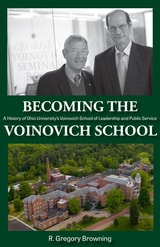
Becoming the Voinovich School
A History of Ohio University’s Voinovich School of Leadership and Public ServiceR. Gregory Browning, Ph.D.
Ohio University Press, 0
The evolution of a university-based public service model that integrates leadership, applied research, and regional engagement in Appalachian Ohio
Becoming the Voinovich School chronicles the evolution of Ohio University’s Voinovich School of Leadership and Public Service, a pioneering institution that blends academic rigor with hands-on public engagement. Founded on the vision of political scientist Mark Weinberg and inspired by the leadership philosophy of former US senator and Ohio governor George V. Voinovich, the school has become a national model for university-based public service.
From its modest beginnings in 1976—when Weinberg was hired to build a public administration program from scratch—the school has grown into a dynamic “do tank” serving the Appalachian Ohio region and beyond. Early initiatives like the Institute for Local Government Administration and Rural Development laid the groundwork for a new kind of academic center: one that connects faculty expertise with real-world problem-solving. Through applied research, GIS analysis, leadership training, and program evaluation, the school has become a trusted convener and catalyst for change.
The Voinovich School’s mission spans five key sectors: economic development, community development, education and child wellness, environmental restoration, and health and well-being. Its work is rooted in a commitment to empowering communities, especially those facing the economic and health challenges of postindustrial Appalachia. By pairing grant-funded projects with experiential education, the school has created opportunities for students to engage directly with pressing public issues while building leadership capacity across the region.
In 2007, the center was formally renamed the Voinovich School, reflecting its expanded scope and growing impact. Over the next decade, it launched new graduate programs, raised its national ranking, and became the educational partner for the Ohio Economic Development Institute. Today, the school continues to leverage state and federal funding, private-sector partnerships, and alumni networks to address complex challenges with innovative, community-driven solutions.
This book offers a compelling account of how one university unit transformed public service education—and how its legacy continues to shape leadership and policy in and beyond Ohio.
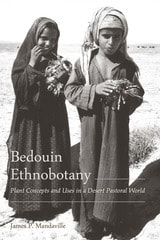
Bedouin Ethnobotany
Plant Concepts and Uses in a Desert Pastoral WorldJames P. Mandaville
University of Arizona Press, 2011
Bedouin Ethnobotany offers the first detailed study of plant uses among the Najdi Arabic–speaking tribal peoples of eastern Saudi Arabia. It also makes a major contribution to the larger project of ethnobotany by describing aspects of a nomadic peoples’ conceptual relationships with the plants of their homeland.
The modern theoretical basis for studies of the folk classification and nomenclature of plants was developed from accounts of peoples who were small-scale agriculturists and, to a lesser extent, hunter-gatherers. This book fills a major gap by extending such study into the world of the nomadic pastoralist and exploring the extent to which these patterns are valid for another major subsistence type. James P. Mandaville, an Arabic speaker who lived in Saudi Arabia for many years, focuses first on the role of plants in Bedouin life, explaining their uses for livestock forage, firewood, medicinals, food, and dyestuffs, and examining other practical purposes. He then explicates the conceptual and linguistic aspects of his subject, applying the theory developed by Brent Berlin and others to a previously unstudied population. Mandaville also looks at the long history of Bedouin plant nomenclature, finding that very little has changed among the names and classifications in nearly eleven centuries.
This volume includes a CD-ROM featuring more than 340 color images of the people, the terrain, and nearly all of the plants mentioned in the text as well as an audio file of a traditional Bedouin song and its translation and analysis.
An essential volume for anyone interested in the interaction between human culture and plant life, Bedouin Ethnobotany will stand as a definitive source for years to come.
Bedouin Life in the Egyptian Wilderness
By Joseph J. Hobbs
University of Texas Press, 1992
Between the Nile River and the Red Sea, in the northern half of Egypt's Eastern Desert, live the Bedouins of the Ma'aza tribe. Joseph Hobbs lived with the Khushmaan Ma'aza clan for almost two years, gathering information for a study of traditional Bedouin life and culture. The resulting work, Bedouin Life in the Egyptian Wilderness, is the first modern ethnographic portrait of the Ma'aza Bedouins.
Been a Heavy Life
Stories of Violent MenLois Presser
University of Illinois Press, 2007

Beep
Inside the Unseen World of Baseball for the BlindDavid Wanczyk
Ohio University Press, 2018
In Beep, David Wanczyk illuminates the sport of blind baseball to show us a remarkable version of America’s pastime. With balls tricked out to squeal three times per second, and with bases that buzz, this game of baseball for the blind is both innovative and intense. And when the best beep baseball team in America, the Austin Blackhawks, takes on its international rival, Taiwan Homerun, no one’s thinking about disability. What we find are athletes playing their hearts out for a championship.
Wanczyk follows teams around the world and even joins them on the field to produce a riveting inside narrative about the game and its players. Can Ethan Johnston, kidnapped and intentionally blinded as a child in Ethiopia, find a new home in beep baseball, and a spot on the all-star team? Will Taiwan’s rookie MVP Ching-kai Chen—whose superhuman feats on the field have left some veterans suspicious—keep up his incredible play? And can Austin’s Lupe Perez harness his competitive fire and lead his team to a long-awaited victory in the beep baseball world series?
Beep is the first book about blind baseball.
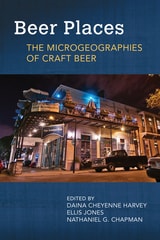
Beer Places
The Microgeographies of Craft BeerDaina Cheyenne Harvey
University of Arkansas Press, 2023
With insight from social scientists, beer bloggers, travel writers, and food entrepreneurs who recount their experiences of taprooms, breweries, and bottle shops from North Carolina to Zimbabwe, Beer Places reveals differences in the craft beer scene across multiple geographies. Situating craft beer as an emerging and important component of food studies, the essays in this volume attest to the singular power of craft beer to connect people and places.
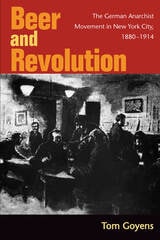
Beer and Revolution
The German Anarchist Movement in New York City, 1880-1914Tom Goyens
University of Illinois Press, 2007
Beer and Revolution examines the rollicking life and times of German immigrant anarchists in New York City from 1880 to 1914. Offering a new approach to an often misunderstood political movement, Tom Goyens puts a human face on anarchism and reveals a dedication less to bombs than to beer halls and saloons where political meetings, public lectures, discussion circles, fundraising events, and theater groups were held.
Goyens brings to life the fascinating relationship between social space and politics by examining how the intersection of political ideals, entertainment, and social activism embodied anarchism not as an abstract idea, but as a chosen lifestyle for thousands of women and men. He shows how anarchist social gatherings were themselves events of defiance and resistance that aimed at establishing anarchism as an alternative lifestyle through the combination of German working-class conviviality and a dedication to the principle that coercive authority was not only unnecessary, but actually damaging to full and free human development as well. Goyens also explores the broader circumstances in both the United States and Germany that served as catalysts for the emergence of anarchism in urban America and how anarchist activism was hampered by police surveillance, ethnic insularity, and a widening gulf between the anarchists' message and the majority of American workers.
Before Before
A Story of Discovery and Loss in Sierra LeoneBetsy Small
University of Michigan Press, 2025
2025 Foreword INDIES Finalist for Political and Social Sciences
- 2026 Nautilus Silver Book Award in World Cultures' Transformational Growth & Development
Sierra Leone is often sensationalized as a place of extreme violence and suffering—of blood diamonds, child soldiers, war amputations, and Ebola and now the highly addictive drug Kush. Before Before captures daily life in a different country, one Betsy Small first encountered as a Peace Corps worker between 1984–1987, and then rediscovered when she returned decades later with her daughter. Living in Tokpombu, a remote community of forty rice-farming families, the author faced struggles that changed her forever and witnessed the growing tensions in this rainforest village—between the young and old, between the traditions of oral history and honoring the ancestors valued by the elders and the siren call of the illicit diamond mines faced by the youth.
Before Before offers a rare portrait of everyday people, with particular focus on the lives of women and girls, before the brutal war of 1991 tore the country apart. Through Small’s account of immersion in another world as she witnessed injustice and was welcomed as a friend, readers are invited to explore the shared ground of our humanity.
Before Bemberg
Women Filmmakers in ArgentinaMatt Losada
Rutgers University Press, 2020
Watch some of the films discussed in the book with English subtitles (https://www.youtube.com/channel/UCF_6F4am5024rklIWwExUVA?view_as=subscriber).
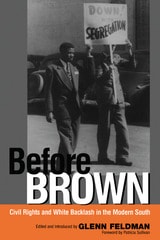
Before Brown
Civil Rights and White Backlash in the Modern SouthGlenn Feldman
University of Alabama Press, 2004
Details the ferment in civil rights that took place across the South before the momentous Brown vs. Board of Education decision in 1954
This collection refutes the notion that the movement began with the Supreme Court decision, and suggests, rather, that the movement originated in the 1930s and earlier, spurred by the Great Depression and, later, World War II—events that would radically shape the course of politics in the South and the nation into the next century.
This work explores the growth of the movement through its various manifestations—the activities of politicians, civil rights leaders, religious figures, labor unionists, and grass-roots activists—throughout the 1940s and 1950s. It discusses the critical leadership roles played by women and offers a new perspective on the relationship between the NAACP and the Communist Party.
Before Brown shows clearly that, as the drive toward racial equality advanced and national political attitudes shifted, the validity of white supremacy came increasingly into question. Institutionalized racism in the South had always offered white citizens material advantages by preserving their economic superiority and making them feel part of a privileged class. When these rewards were threatened by the civil rights movement, a white backlash occurred.
Before Brown
Heman Marion Sweatt, Thurgood Marshall, and the Long Road to JusticeBy Gary M. Lavergne
University of Texas Press, 2010
Winner, Coral Horton Tullis Memorial Prize for Best Book on Texas History, Texas State Historical Association, 2010
Carr P. Collins Award, Texas Institute of Letters, 2011
On February 26, 1946, an African American from Houston applied for admission to the University of Texas School of Law. Although he met all of the school's academic qualifications, Heman Marion Sweatt was denied admission because he was black. He challenged the university's decision in court, and the resulting case, Sweatt v. Painter, went to the U.S. Supreme Court, which ruled in Sweatt's favor. The Sweatt case paved the way for the landmark Brown v. Board of Education of Topeka rulings that finally opened the doors to higher education for all African Americans and desegregated public education in the United States.
In this engrossing, well-researched book, Gary M. Lavergne tells the fascinating story of Heman Sweatt's struggle for justice and how it became a milestone for the civil rights movement. He reveals that Sweatt was a central player in a master plan conceived by the National Association for the Advancement of Colored People (NAACP) for ending racial segregation in the United States. Lavergne masterfully describes how the NAACP used the Sweatt case to practically invalidate the "separate but equal" doctrine that had undergirded segregated education for decades. He also shows how the Sweatt case advanced the career of Thurgood Marshall, whose advocacy of Sweatt taught him valuable lessons that he used to win the Brown v. Board of Education case in 1954 and ultimately led to his becoming the first black Associate Justice of the Supreme Court.
Before Crips
Fussin', Cussin', and Discussin' among South Los Angeles Juvenile GangsJohn C. Quicker and Akil S. Batani-Khalfani
Temple University Press, 2022
This groundbreaking book opens the door on the missing record of South Los Angeles juvenile gangs. It is the result of the unique friendship that developed between John Quicker and Akil Batani-Khalfani, aka Bird, who collaborated to show how structural marginality transformed hang-out street groups of non-White juveniles into gangs, paving the way for the rise of the infamous Crips and Bloods. Before Crips uses a macro historical analysis to sort through political and economic factors to explain the nature of gang creation.
The authors mine a critical archive, using direct interviews with original gang members as well as theory and literature reviews, to contextualize gang life and gang formation. They discuss (and fuss and cuss about) topics ranging from the criminal economy and conceptions of masculinity to racial and gendered politics and views of violence. Their insider/outsider approach not only illuminates gang values and organization, but what they did and why, and how they grew in a backdrop of inequality and police brutality that came to a head with the 1965 Watts Rebellion.
Providing an essential understanding of early South Los Angeles gang life, Before Crips explains what has remained constant, what has changed, and the roots of the violence that continues.
Before Cultures
The Ethnographic Imagination in American Literature, 1865-1920Brad Evans
University of Chicago Press, 2005
In this work, Brad Evans weaves together the histories of American literature and anthropology. His study brings alive not only the regionalist and ethnographic fiction of the time but also revives a range of neglected materials, including the Zuni sketchbooks of anthropologist Frank Hamilton Cushing; popular magazines such as Century Illustrated Monthly, which published Cushing's articles alongside Henry James's; the debate between Joel Chandler Harris, author/collector of the Uncle Remus folktales, and John Wesley Powell, perhaps the most important American anthropologist of the time; and Du Bois's polemics against the culture concept as it was being developed in the early twentieth century.
Written with clarity and grace, Before Cultures will be of value to students of American literature, history, and anthropology alike.
Before Homosexuality in the Arab-Islamic World, 1500-1800
Khaled El-Rouayheb
University of Chicago Press, 2005
Attitudes toward homosexuality in the pre-modern Arab-Islamic world are commonly depicted as schizophrenic—visible and tolerated on one hand, prohibited by Islam on the other. Khaled El-Rouayheb argues that this apparent paradox is based on the anachronistic assumption that homosexuality is a timeless, self-evident fact to which a particular culture reacts with some degree of tolerance or intolerance. Drawing on poetry, biographical literature, medicine, dream interpretation, and Islamic texts, he shows that the culture of the period lacked the concept of homosexuality.
Before Kukulkán
Bioarchaeology of Maya Life, Death, and Identity at Classic Period YaxunáVera Tiesler, Andrea Cucina, Travis W. Stanton, and David A. Freidel; Foreword by Traci Ardren
University of Arizona Press, 2017
Using bioarchaeology, mortuary archaeology, and culturally sensitive mainstream archaeology, the authors create an in-depth regional understanding while also laying out broader ways of learning about the Maya past. Part 1 examines ancient lifeways among the Maya at Yaxuná, while part 2 explores different meanings of dying and cycling at the settlement and beyond: ancestral practices, royal entombment and desecration, and human sacrifice. The authors close with a discussion of the last years of occupation at Yaxuná and the role of Chichén Itzá in the abandonment of this urban center.
Before Kukulkán provides a cohesive synthesis of the evolving roles and collective identities of locals and foreigners at the settlement and their involvement in the region’s trajectory. Theoretically informed and contextualized discussions offer unique glimpses of everyday life and death in the socially fluid Maya city. These findings, in conjunction with other documented series of skeletal remains from this region, provide a nuanced picture of the social and biocultural dynamics that operated successfully for centuries before the arrival of the Itzá.
Before Lawrence v. Texas
The Making of a Queer Social MovementWesley G. Phelps
University of Texas Press, 2022
2024 Coral Horton Tullis Memorial Prize, Texas State Historical Association
2024 Award of Merit, The Philosophical Society of Texas Nonfiction Book Prize
The grassroots queer activism and legal challenges that led to a landmark Supreme Court decision in favor of gay and lesbian equality.
In 2003 the US Supreme Court overturned anti-sodomy laws across the country, ruling in Lawrence v. Texas that the Constitution protects private consensual sex between adults. To some, the decision seemed to come like lightning from above, altering the landscape of America’s sexual politics all at once. In actuality, many years of work and organizing led up to the legal case, and the landmark ruling might never have happened were it not for the passionate struggle of Texans who rejected their state’s discriminatory laws.
Before Lawrence v. Texas tells the story of the long, troubled, and ultimately hopeful road to constitutional change. Wesley G. Phelps describes the achievements, setbacks, and unlikely alliances along the way. Over the course of decades, and at great risk to themselves, gay and lesbian Texans and their supporters launched political campaigns and legal challenges, laying the groundwork for Lawrence. Phelps shares the personal experiences of the people and couples who contributed to the legal strategy that ultimately overturned the state’s discriminatory law. Even when their individual court cases were unsuccessful, justice seekers and activists collectively influenced public opinion by insisting that their voices be heard. Nine Supreme Court justices ruled, but it was grassroots politics that vindicated the ideal of equality under the law.
Before Norms
Institutions and Civic CultureRobert W. Jackman and Ross A. Miller
University of Michigan Press, 2005

Before Pictures
Douglas Crimp
University of Chicago Press, 2016
Before Pictures tells the story of Crimp’s life as a young gay man and art critic in New York City during the late 1960s through the turbulent 1970s. Crimp participated in all of what made the city so stimulating in that vibrant decade. The details of his professional and personal life are interwoven with this the particularly rich history of New York City at that time, producing a vivid portrait of both the critic and his adopted city. The book begins with his escape from his hometown in Idaho, and we quickly find Crimp writing criticism for ArtNews while working at the Guggenheim—where, as a young curatorial assistant, he was one of the few to see Daniel Buren’s Peinture-Sculpture before it was removed amid cries of institutional censorship. We also travel to the Chelsea Hotel (where Crimp helped the down-on-his-luck couturier Charles James organize his papers) through to his days as a cinephile and balletomane to the founding of the art journal October, where he remained a central figure for many years. As he was developing his reputation as a critic, he was also partaking of the New York night life, from drugs and late nights alongside the Warhol crowd at the Max’s Kansas City to discos, roller-skating, and casual sex with famous (and not-so-famous) men. As AIDS began to ravage the closely linked art and gay communities, Crimp eventually turned his attention to activism dedicated to rethinking AIDS.
Part biography and part cultural history, Before Pictures is a courageous account of an exceptional period in both Crimp’s life and the life of New York City. At the same time, it offers a deeply personal and engaging point of entry into important issues in contemporary art.
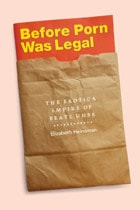
Before Porn Was Legal
The Erotica Empire of Beate UhseElizabeth Heineman
University of Chicago Press, 2011
Struggling to survive in post–World War II Germany, Beate Uhse (1919–2001)—a former Luftwaffe pilot, war widow, and young mother—turned to selling goods on the black market. A self-penned guide to the rhythm method found eager buyers and started Uhse on her path to becoming the world’s largest erotica entrepreneur. Battling restrictive legislation, powerful churches, and conservative social mores, she built a mail-order business in the 1950s that sold condoms, sex aids, self-help books, and more. The following decades brought the world’s first erotica shop, the legalization of pornography, the expansion of her business into eastern Germany, and web-based commerce.
Uhse was only one of many erotica entrepreneurs who played a role in the social and sexual revolution accompanying Germany’s transition from Nazism to liberal democracy. Tracing the activities of entrepreneurs, customers, government officials, and citizen-activists, Before Porn Was Legal brings to light the profound social, legal, and cultural changes that attended the growth of the erotica sector. Heineman’s innovative readings of governmental and industry records, oral histories, and the erotica industry’s products uncover the roots of today’s sexual marketplace and reveal the indelible ways in which sexual expression and consumption have become intertwined.
Before Their Time
Mary Stimming
Temple University Press, 1998
Each of these survivors faces the common difficulties associated with losing a loved one by suicide. They also experience difficulties specific to their status as both adult and child. Topics such as the impact of the parent's suicide on adult children's personal and professional choices, marriages and parenting, sibling and surviving parent relationships are explored with sensitivity and insight. Various coping skills, including humor, are described.
The writers describe feelings of regret and responsibility related to their parent's suicide. They express concern about other family members' vulnerability to suicide. They speak openly about the fears and stresses they face and how they cope with them.
The authors ranged in age from nineteen to thirty-six at the time of the parent's death. Between one and twenty-five years have passed since that tragedy.
In addition to the first-person narratives, the book includes a resource section with a national listing of suicide survivor support groups; an overview of existing research on survivors of suicide by John L. McIntosh, past president of the American Association of Suicidology; and an essay on elderly suicide by David C. Clark, secretary-general, International Association for Suicide, and editor-in-chief of Crisis. The book is introduced with a Foreword by Rev. Charles Rubey, founder and director of Loving Outreach to Survivors of Suicide.