Results by title
8642 books match the query '20th century' and 437 start with b
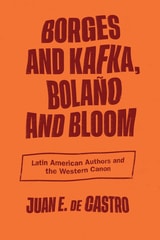
Borges and Kafka, Bolaño and Bloom
Latin American Authors and the Western CanonJuan E. De Castro
Vanderbilt University Press, 2022
Borges and Kafka, Bolaño and Bloom is a parsing not simply of these authors' reactions to a canon, but of the notion of canon writ large and the inequities and erasures therein. It concludes with a look at the testimonial and autobiographical writings of Rigoberta Menchú and Lurgio Gavilán, who arguably represent the trajectory of Indigenous testimonial and autobiographical writing during the last forty years, noting how their texts represent alternative ways of relating to national and, on occasion, Western cultures. This study is a new attempt to map writers' diverse ways of thinking about locality and universality from within and without what is known as the canon.
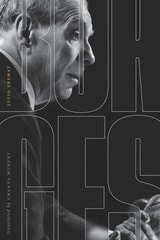
Borges
An IntroductionJulio Premat
Vanderbilt University Press, 2021
Originally published in French by an Argentine ex-pat living in Paris, Borges includes the Argentine specificities of Borges’s work—specificities that are often unrecognized or glossed over in Anglophone readings.
This book is a boon for university students of philosophy and literature, teachers and researchers in these fields who are looking to better understand this complex author, and anyone interested in the advanced study of literature. Somewhere between a guidebook and an exhaustive work of advanced research, Borges is the ultimate stepping-stone into the deeper Borgesian world.
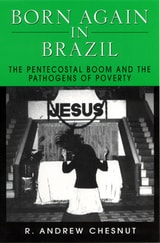
Born Again in Brazil
The Pentecostal Boom and the Pathogens of PovertyR. Andrew Chesnut
Rutgers University Press, 1997
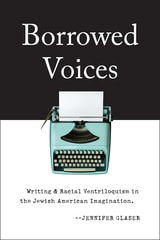
Borrowed Voices
Writing and Racial Ventriloquism in the Jewish American ImaginationGlaser, Jennifer
Rutgers University Press, 2016
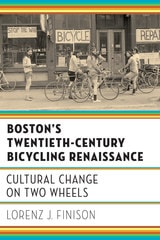
Boston's Twentieth-Century Bicycling Renaissance
Cultural Change on Two WheelsLorenz J. Finison
University of Massachusetts Press, 2019
Finison traces the city's cycling history, chronicling the activities of environmental and social justice activists, stories of women breaking into male-dominated professions by becoming bike messengers and mechanics, and challenges faced by African American cyclists. Making use of newspaper archives, newly discovered records of local biking organizations, and interviews with Boston-area bicyclists and bike builders, Boston's Twentieth-Century Bicycling Renaissance brings these voices and battles back to life.
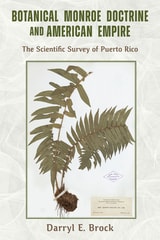
Botanical Monroe Doctrine and American Empire
The Scientific Survey of Puerto RicoDarryl E. Brock
University of Alabama Press, 2026
Explores how a US-led natural history survey of Puerto Rico served American Empire while yet catalyzing Boricua cultural nationalism
In Botanical Monroe Doctrine and American Empire, Darryl E. Brock examines the history, influence, and legacy of an ambitious effort to conduct a “physical and natural history survey of Porto [Puerto] Rico.” As founder of The New York Botanical Garden, Nathaniel Lord Britton advanced a botanical Monroe Doctrine that sought to counter British and European scientific influence in the Americas by establishing American authority over the naming and classification of species. Although initially aligned with imperial and “civilizing” aims, the Scientific Survey of Puerto Rico ultimately contributed to modernization, professionalization, and cultural preservation on the island. Its work in Taíno archaeology and jíbaro folklore helped lay the foundation for today’s Caguana Indigenous Ceremonial Park and reinforced currents of Boricua cultural nationalism. The survey also intersected with broader political and economic developments, influencing areas from bilingual education to New Deal administration in Puerto Rico.
Sponsored by the New York Academy of Sciences, the survey was conducted by The New York Botanical Garden in partnership with the American Museum of Natural History and the Yale Peabody Museum, with the final report issued in 1970. Puerto Rican scientists and intellectuals, including mycologist and future University of Puerto Rico chancellor Carlos Chardón, actively contributed to the project. Expanding to the Virgin Islands, the survey encompassed nearly two dozen expeditions, collected more than 10,000 plant specimens, and identified thirty-eight new species. Its nineteen published volumes remain among the most comprehensive multidisciplinary scientific studies of any tropical region. Brock’s groundbreaking work is essential reading for those interested in the history of science, Puerto Rico, and American empire.
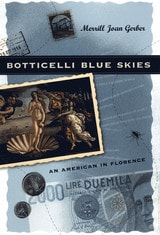
Botticelli Blue Skies
An American in FlorenceMerrill Joan Gerber
University of Wisconsin Press, 2002
When writer Merrill Joan Gerber is invited to join her husband, a history professor, as he takes a class of American college students to study in Florence, Italy, she feels terrified at the idea of leaving her comforts, her friends, and her aged mother in California. Her husband tries to assure her that her fear of Italy—and her lack of knowledge of the Italian language—will be offset by the discoveries of travel. "I can’t tell you exactly what will happen, but something will. And it will all be new and interesting." Botticelli Blue Skies is the tale of a woman who readily admits to fear of travel, a fear that many experience but are embarrassed to admit. When finally she plunges into the new adventure, she describes her experiences in Florence with wit, humor, and energy.
Instead of sticking to the conventional tourist path, Gerber follows her instincts. She makes discoveries without tour guides droning in her ear and reclaims the travel experience as her own, taking time to shop in a thrift shop, eat in a Chinese restaurant that serves "Dragon chips," make friends with her landlady who turns out to be a Countess, and visit the class of a professor at the university. She discovers a Florence that is not all museums and wine. With newfound patience and growing confidence, Gerber makes her way around Florence, Venice, and Rome. She visits famous places and discovers obscure ones—in the end embracing all that is Italian. Botticelli Blue Skies (accompanied by the author’s own photographs) is an honest, lyrical, touching account of the sometimes exhausting, often threatening, but always enriching physical and emotional challenge that is travel.
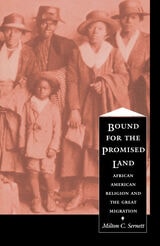
Bound For the Promised Land
African American Religion and the Great MigrationMilton C. Sernett
Duke University Press, 1997
Drawing on a range of sources—interviews, government documents, church periodicals, books, pamphlets, and articles—Sernett shows how the mass migration created an institutional crisis for black religious leaders. He describes the creative tensions that resulted when the southern migrants who saw their exodus as the Second Emancipation brought their religious beliefs and practices into northern cities such as Chicago, and traces the resulting emergence of the belief that black churches ought to be more than places for "praying and preaching." Explaining how this social gospel perspective came to dominate many of the classic studies of African American religion, Bound for the Promised Land sheds new light on various components of the development of black religion, including philanthropic endeavors to "modernize" the southern black rural church. In providing a balanced and holistic understanding of black religion in post–World War I America, Bound for the Promised Land serves to reveal the challenges presently confronting this vital component of America’s religious mosaic.

Bound Together
The Secularization of Turkey’s Literary Fields and the Western Promise of FreedomBaris Büyükokutan
University of Michigan Press, 2021
Bound Together takes a new look at twentieth-century Turkey, asking what it will take for Turkish women and men to regain their lost freedoms, and what the Turkish case means for the prospects of freedom and democracy elsewhere. Contrasting the country’s field of poetry, where secularization was the joint work of pious and nonpious people, with that of the novel, this book inquires into the nature of western-nonwestern difference.
Turkey’s poets were more fortunate than its novelists for two reasons. Poets were slightly better at developing the idea of the autonomy of art from politics. While piety was a marker of political identity everywhere, poets were better able than novelists to bracket political differences when assessing their peers as the country was bitterly polarized politically and as the century wore on. Second, and more important, poets of all stripes were more connected to each other than were novelists. Their greater ability to find and keep one another in coffeehouses and literary journals made it less likely for prospective cross-aisle partnerships to remain untested propositions.
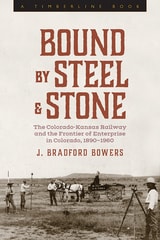
Bound by Steel and Stone
The Colorado-Kansas Railway and the Frontier of Enterprise in Colorado, 1890-1960J. Bradford Bowers
University Press of Colorado, 2022
Offering the Colorado-Kansas Railway as an example of how shortline railroads helped to integrate the rural landscape with the larger urban and economic world, Bowers reveals the constant adaptations driven by changing economic forces and conditions. He puts the railway in context of the wider environmental and political landscapes, the growing quarrying and mining business, the expansion of agriculture and irrigation, Progressive-era political reforms, and land development. In the new frontier of enterprise in the early twentieth-century American West, the railroad highlights the successes and failures of the men inspired to pursue these new opportunities as well as the story of one woman who held these fragile industries together well into the second half of the twentieth century.
Bound by Steel and Stone is an insightful addition to the history of industrialization and economic development in Colorado and the American West.
Bounding Biomedicine
Evidence and Rhetoric in the New Science of Alternative MedicineColleen Derkatch
University of Chicago Press, 2016
Bounding Biomedicine centers on this boundary-changing era, looking at how consumer demand shook the health care hierarchy. Drawing on scholarship in rhetoric and science and technology studies, the book examines how the medical profession scrambled to maintain its position of privilege and prestige, even as its foothold appeared to be crumbling. Colleen Derkatch analyzes CAM-themed medical journals and related discourse to illustrate how members of the medical establishment applied Western standards of evaluation and peer review to test health practices that did not fit easily (or at all) within standard frameworks of medical research. And she shows that, despite many practitioners’ efforts to eliminate the boundaries between “regular” and “alternative,” this research on CAM and the forms of communication that surrounded it ultimately ended up creating an even greater division between what counts as safe, effective health care and what does not.
At a time when debates over treatment choices have flared up again, Bounding Biomedicine gives us a possible blueprint for understanding how the medical establishment will react to this new era of therapeutic change.
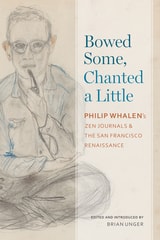
Bowed Some, Chanted a Little
Philip Whalen's Zen Journals and the San Francisco RenaissanceEdited and Introduced by Brian Unger
University of Alabama Press, 2023
The literary journals of a key figure in both the Beat and San Francisco Renaissance movements of the New American Poetry, and an ordained Zen Buddhist priest
Philip Whalen (1923–2002) authored twenty collections of verse, more than twenty broadsides, two novels, a huge assemblage of autobiographical literary journals, nine or ten experimental prose works, and dozens of critical essays, lectures, commentaries, introductions, prefaces, and interviews. But he came to regard his literary journals as his most important prose legacy.
Whalen’s literary work represents a significant turn in American letters, as he and his closest colleagues immersed themselves in East Asian literature and religion, reinvigorating strikingly new linguistic and aesthetic paths for North American writers and artists. However, until now Whalen’s forty-plus years of journals—sixty small eight-by-six-inch notebooks—have been largely inaccessible, archived in the rare book and manuscript library at the University of California, Berkeley, undigitized and unavailable online. Thus, the publication of a critical scholarly edition of Whalen’s journals and notebooks constitutes an important literary event and an invaluable resource for scholars, teachers, poets, and lay readers who follow twentieth-century North American poetry.
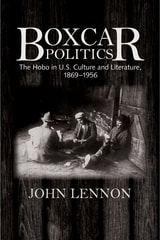
Boxcar Politics
The Hobo in U.S. Culture and Literature, 1869-1956John Lennon
University of Massachusetts Press, 2014
John Lennon maps the rise and demise of the political hobo from the nineteenth-century introduction of the transcontinental railroad to the Federal Aid Highway Act of 1956. Intertwining literary, historical, and theoretical representations of the hobo, he explores how riders and writers imagined alternative ways that working-class people could use mobility to create powerful dissenting voices outside of fixed hierarchal political organizations. Placing portrayals of hobos in the works of Jack London, Jim Tully, John Dos Passos, and Jack Kerouac alongside the lived reality of people hopping trains (including hobos of the IWW, the Scottsboro Boys, and those found in numerous long-forgotten memoirs), Lennon investigates how these marginalized individuals exerted collective political voices through subcultural practices.
Boycotts, Buses, and Passes
Black Women's Resistance in the U.S. South and South AfricaPamela E. Brooks
University of Massachusetts Press, 2008
In the mid-1950s, as many developing nations sought independence from colonial rule, black women in the American South and in South Africa launched parallel campaigns to end racial injustice within their respective communities. Just as the dignified obstinacy of Mrs. Rosa Parks sparked the Montgomery bus boycott in 1955, the 20,000 South African women who marched in Pretoria a year later to protest the pass laws signaled a new wave of resistance to the system of apartheid. In both places women who had previously been consigned to subordinate roles brought fresh leadership to the struggle for political freedom and social equality.
In this book, Pamela E. Brooks tells their story, documenting the extraordinary achievements of otherwise ordinary women. In comparing the experiences of black women activists in two different parts of the African diaspora, Brooks draws heavily on oral histories that provide clear, and often painful, insight into their backgrounds, their motives, their hopes, and their fears. We learn how black women from all walks of life—domestic and factory workers, householders, teachers, union organizers, churchwomen, clubwomen, rural and urban dwellers alike—had to overcome their class differences and work through the often difficult gender relations within their families and communities. Yet eventually they came together to forge their own political organizations, such as the Women's Political Council and the Federation of South African Women, or joined orga-nizations of women and men, such as the Montgomery Improvement Association and the African National Congress, to advance the common agenda of black liberation.By tracing the dual rise of political consciousness and activism among the black women of the U.S. South and South Africa, Brooks not only illuminates patterns that have long been overlooked but places that shared history within the context of a larger global struggle to bring an end to the vestiges of European colonialism.

Bradbury Beyond Apollo
Jonathan R. Eller
University of Illinois Press, 2020
Drawing on numerous interviews with Bradbury and privileged access to personal papers and private collections, Jonathan R. Eller examines the often-overlooked second half of Bradbury's working life. As Bradbury's dreams took him into a wider range of nonfiction writing and public lectures, the diminishing time that remained for creative pursuits went toward Hollywood productions like the award-winning series Ray Bradbury Theater. Bradbury developed the Spaceship Earth narration at Disney's EPCOT Center; appeared everywhere from public television to NASA events to comic conventions; published poetry; and mined past triumphs for stage productions that enjoyed mixed success. Distracted from storytelling as he became more famous, Bradbury nonetheless published innovative experiments in autobiography masked as detective novels, the well-received fantasy The Halloween Tree and the masterful time travel story "The Toynbee Convector." Yet his embrace of celebrity was often at odds with his passion for writing, and the resulting tension continuously pulled at his sense of self.
The revelatory conclusion to the acclaimed three-part biography, Bradbury Beyond Apollo tells the story of an inexhaustible creative force seeking new frontiers.
Brave Humanism
Black Women Rewriting the Human in the Age of Jane CrowMollie Godfrey
The Ohio State University Press, 2025
Brazilian Art under Dictatorship
Antonio Manuel, Artur Barrio, and Cildo MeirelesClaudia Calirman
Duke University Press, 2012

Bread and Work
The Experience of Unemployment 1918-39Matt Perry
Pluto Press, 2000
Looking beyond statistics and economic cycles, Perry investigates the human impact of unemployment. He uncovers the experience of being jobless from the perspective of those who lived through it, their employers and their communities. He uses oral history, memoirs, literary accounts, and newspaper articles to reveal the reality of unemployment.
Perry argues that the scale of the crisis has been minimised by historians who have tended to emphasise that prolonged unemployment was the problem of the distressed fringe.
Finally, Perry argues that the lessons of the 1930s have direct relevance today since the structural problems of industrial capitalism remain inherent.
Breadwinners and Citizens
Gender in the Making of the French Social ModelLaura Levine Frader
Duke University Press, 2008
Frader’s analysis moves between the everyday lives of ordinary working women and men and the actions of national policymakers, political parties, and political movements, including feminists, pro-natalists, and trade unionists. In the years following World War I, the many women and an increasing number of immigrant men in the labor force competed for employment and pay. Family policy was used not only to encourage reproduction but also to regulate wages and the size of the workforce. Policies to promote married women’s and immigrants’ departure from the labor force were more common when jobs were scarce, as they were during the Depression. Frader contends that gender and ethnicity exerted a powerful and unacknowledged influence on French social policy during the Depression era and for decades afterward.
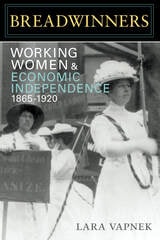
Breadwinners
Working Women and Economic Independence, 1865-1920Lara Vapnek
University of Illinois Press, 2009
Analyzing disjunctions between middle-class and working-class women's ideas of independence, Vapnek highlights the agendas for change advanced by leaders such as Jennie Collins, Leonora O'Reilly, and Helen Campbell and organizations such as the National Consumers' League, the Women's Educational and Industrial Union, and the Women's Trade Union League. Locating households as important sites of class conflict, Breadwinners recovers the class and gender politics behind the marginalization of domestic workers from labor reform while documenting the ways in which working-class women raised their voices on their own behalf.
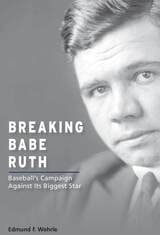
Breaking Babe Ruth
Baseball's Campaign Against Its Biggest StarEdmund F. Wehrle
University of Missouri Press, 2025
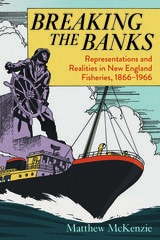
Breaking the Banks
Representations and Realities in New England Fisheries, 1866-1966Matthew McKenzie
University of Massachusetts Press, 2018
Books, films, and the media have long portrayed the Yankee fisherman's hard-scrabble existence, as he faced brutal weather on the open seas and unnecessary governmental restrictions. As McKenzie contends, this simplistic view has long betrayed commercial fisheries' sophisticated legislative campaigns in Washington, DC, as they sought federal subsidies and relief and, eventually, fewer constricting regulations. This clash between fisheries' representation and their reality still grips fishing communities today as they struggle to navigate age-old trends of fleet consolidation, stock decline, and intense competition.
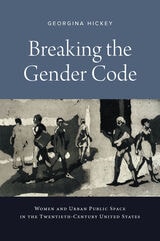
Breaking the Gender Code
Women and Urban Public Space in the Twentieth-Century United StatesGeorgina Hickey
University of Texas Press, 2023
A history of the activism that made public spaces in American cities more accessible to women.
From the closing years of the nineteenth century, women received subtle—and not so subtle—messages that they shouldn’t be in public. Or, if they were, that they were not safe. Breaking the Gender Code tells the story of both this danger narrative and the resistance to it.
Historian Georgina Hickey investigates challenges to the code of urban gender segregation in the twentieth century, focusing on organized advocacy to make the public spaces of American cities accessible to women. She traces waves of activism from the Progressive Era, with its calls for public restrooms, safe and accessible transportation, and public accommodations, through and beyond second-wave feminism, and its focus on the creation of alternative, women-only spaces and extensive anti-violence efforts. In doing so, Hickey explores how gender segregation intertwined with other systems of social control, as well as how class, race, and sexuality shaped activists' agendas and women's experiences of urban space. Drawing connections between the vulnerability of women in public spaces, real and presumed, and contemporary debates surrounding rape culture, bathroom bills, and domestic violence, Hickey unveils both the strikingly successful and the incomplete initiatives of activists who worked to open up public space to women.
Breaking the Jaws of Silence
Sixty American Poets Speak to the WorldSholeh Wolpé
University of Arkansas Press, 2013
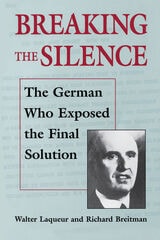
Breaking the Silence
The German Who Exposed the Final Solution.Walter Laqueur and Richard Breitman
Brandeis University Press, 1994
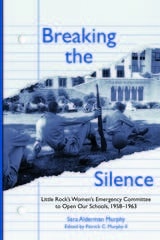
Breaking the Silence
The Little Rock Women's Emergency Committee to Open Our Schools, 1958–1963Sara Murphy
University of Arkansas Press, 1997
The Little Rock Central High School integration crisis did not end in1957 when President Eisenhower sent a portion of the first Airborne Division to protect nine black students. The turmoil was entering its second year in 1958 when Arkansas governor Orval Faubus invoked a hastily passed state law to close the high schools rather than obey the federal court orders that would integrate them.
A group of respectable, middle-class white women, faced with the prospect of no schools as well as the further loss of their city’s good name, turned militant. Led by Adolphine Fletcher Terry, a prominent, “old family” civic leader in her seventies, the women quickly put together the Women’s Emergency Committee to Open Our Schools (WEC), a highly effective organization that bombarded the city with ads, fliers, and statements challenging Faubus’s action. At peak membership, the WEC mustered two thousand to their cause. Largely inexperienced in politics when they joined the WEC, these women became articulate, confident promoters of public schools and helped others to understand that those schools must be fully integrated.
Forty years later, Sara Murphy, a key member of the WEC, recounts the rarely told sto1y of these courageous women who formed a resistance movement. With passion and sensitivity, she reconstructs the challenges and triumphs of that battle, which issued from the mutual link Southern white women shared with disfranchised African Americans in their common goal for full citizenship.
Breaking the South Slav Dream
The Rise and Fall of YugoslaviaKate Hudson
Pluto Press, 2003
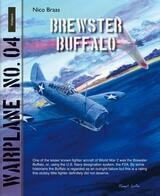
Brewster Buffalo
Nico Braas
Amsterdam University Press, 2023
This book presents an overview of the development and operational use of the Buffalo with many photos including a number not published before.
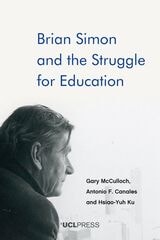
Brian Simon and the Struggle for Education
Gary McCulloch, Antonio Canales, and Hsiao-Yuh Ku
University College London, 2023
Using documentary sources that have only recently become publicly available, this book reveals the remarkably broad range of Brian Simon’s life as a student, soldier, schoolteacher, Communist Party activist, educational academic, campaigner, and reformer. In a sympathetic biography that retains critical distance, the authors analyze Simon’s contribution to Marxism and the Communist Party, explore the influence of both on his work as a historian of education, and trace the significance of his Marxist beliefs, political associations, and historical approaches to the cause of educational reform.
In so doing, they consider the full nature and limitations of Simon’s achievements in his struggle for education. Unlike many Marxist scholars, he remained loyal to the Communist Party in the 1950s, which damaged his reputation as a public intellectual. Nevertheless, his support for comprehensive education helped to promote egalitarian educational reforms in Britain, although he was later unable to provide sufficient resistance to the 1988 Education Reform Act and to a decline in the position of comprehensive schools.
In all this, the significance of Simon’s family, and especially his relationship with his wife Joan, is brought to the fore. Joan and Brian forged a formidable sixty-year partnership in politics and the Communist Party as well as in life, a partnership that lasted until Brian’s death in January 2002.
Brian W. Aldiss
Paul Kincaid
University of Illinois Press, 2022
Paul Kincaid explores the many contradictions that underlay the distinctive qualities of Aldiss’s writing. Wartime experiences in Asia and the alienation that arose upon his return to the cold austerity of postwar Britain inspired themes and imagery that Aldiss drew upon throughout his career. He wrote of prolific nature overwhelming humanity, believed war was madness even though it provided him with the happiest period of his life, and found parallels in the static lives of Indian peasants and hidebound English society. As Kincaid shows, contradictions created tensions that fueled the metaphorical underpinnings of Aldiss's work and shaped not only his long career but the evolution of postwar British science fiction.
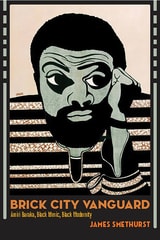
Brick City Vanguard
Amiri Baraka, Black Music, Black ModernityJames Smethurst
University of Massachusetts Press, 2020
Amiri Baraka is unquestionably the most recognized leader of the Black Arts Movement of the 1960s and 1970s, and one of the key literary and cultural figures of the postwar United States. While Baraka's political and aesthetic stances changed considerably over the course of his career, Brick City Vanguard demonstrates the continuity in his thinking about the meaning of black music in the material, psychic, and ideological development of black people. Drawing on primary texts, paratexts (including album liner notes), audio and visual recordings, and archival sources, James Smethurst takes a new look at how Baraka's writing on and performance of music envisioned the creation of an African American people or nation, as well as the growth and consolidation of a black working class within that nation, that resonates to this day. This vision also provides a way of understanding the encounter of black people with what has been called “the urban crisis” and a projection of a liberated black future beyond that crisis.
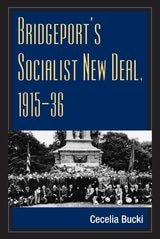
Bridgeport's Socialist New Deal, 1915-36
Cecelia Bucki
University of Illinois Press, 2001
In November 1933, the Socialist Party of Bridgeport, Connecticut put slate roofer Jasper McLevy in the mayor's seat and nearly won control of the city council. Cecelia Bucki explores how labor gained first a foothold and then a stronghold in local politics as broad debates pitted previously unengaged working-class citizens against local business leaders and traditional party elites.
In the heat of the Great Depression, the skilled union craftsmen who made up the bulk of the city's Socialist Party filled a political void created by the crumbling of mainstream parties, the disintegration of traditional modes of ethnic politics, and the city's acute fiscal crisis. In time, however, legislative measures and compromise politics blunted the progressive agenda. The local party split from the Socialist Party of America and became narrowly focused and reformist while still serving as the voice of the working class.
A portrait of a stunning moment in American politics, Bridgeport's Socialist New Deal, 1915-36 offers a fascinating look at the volatility of politics in the early years of the Great Depression.
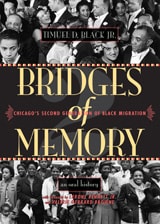
Bridges of Memory Volume 2
Chicago's Second Generation of Black MigrationTimuel Black
Northwestern University Press, 2008
In the second volume of Bridges of Memory, historian Timuel D. Black Jr. continues his conversations with African-Americans who migrated to Chicago from the South in search of economic, social, and cultural opportunities. With his trademark gift for interviewing, Black-himself the son of first-generation migrants to Chicago-guides these individual discussions with ease, resulting in first-person narratives that are informative and entertaining.
Picking up where the first book left off, volume 2 introduces the reader to more members of the first wave of migration and also members of the second generation, the children of those who came in the first wave. In telling their stories, the interviewees paint a vivid picture of the thriving and tight-knit Chicago community formerly known as the Black Belt—today's historic Bronzeville neighborhood. They bring to life the role of family, religion, business, music, and, most of all, the hopes, dreams, and perseverance that enabled a group of people to establish a successful community within a larger society that seemed determined to keep them from success. The experiences of these diverse and vivid personalities often illustrate the role that racial prejudice has played in shaping the specific arcs of their lives. But personal histories such as these are not just chronicles of frustration and despair; more important these narratives reveal an unwavering dedication to breaking the color line and a tireless pursuit of their right to the promise of America.
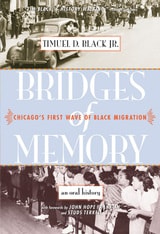
Bridges of Memory
Chicago's First Wave of Black MigrationTimuel D. Black Jr.
Northwestern University Press, 2005
Co-published with the DuSable Museum of African American History
Recipient of 2007 The Hyde Park Historical Society Paul Cornell Award
A collection of interviews with African Americans who came to Chicago from the South. In their first great migration to Chicago that began during World War I, African Americans came from the South seeking a better life--and fleeing a Jim Crow system of racial prejudice, discrimination, and segregation. What they found was much less than what they'd hoped for, but it was much better than what they'd come from--and in the process they set in motion vast changes not only in Chicago but also in the whole fabric of American society. This book, the first of three volumes, revisits this momentous chapter in American history with those who lived it.
Oral history of the first order, Bridges of Memory lets us hear the voices of those who left social, political, and economic oppression for political freedom and opportunity such as they'd never known--and for new forms of prejudice and segregation. These children and grandchildren of ex-slaves found work in the stockyards and steel mills of Chicago, settled and started small businesses in the "Black Belt" on the South Side, and brought forth the jazz, blues, and gospel music that the city is now known for. Historian Timuel D. Black, Jr., himself the son of first-generation migrants to Chicago, interviews a wide cross-section of African Americans whose remarks and reflections touch on issues ranging from fascism to Jim Crow segregation to the origin of the blues. Their recollections comprise a vivid record of a neighborhood, a city, a society, and a people undergoing dramatic and unprecedented changes.
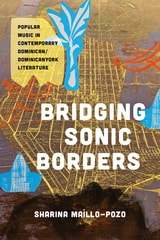
Bridging Sonic Borders
Popular Music in Contemporary Dominican/Dominicanyork LiteratureSharina Maíllo-Pozo
University of Texas Press, 2025
2026 Creative Research Medal, Office of Research at the University of Georgia
2026 Isis Duarte Book Prize, Haiti/Dominican Republic Section, Latin American Studies Association
How music depicted in literature shapes Dominican and Dominican New Yorkers’ identities and links the homeland to the diaspora.
Music has played a large role in recent Dominican literature, whether of the island or the diaspora. Bridging Sonic Borders explores this sonic connection linking the homeland and far-flung locales—especially New York, the center of Dominican cultural production in the United States. Sharina Maíllo-Pozo argues that literary representations of popular music delineate a shared aesthetic territory for US and Caribbean Dominicans, fostering an inclusive and transnational Dominicanidad.
Examining works written in Spanish, English, and Dominicanish, Maíllo-Pozo focuses on Dominican/Dominicanyork writings that have nurtured a borderless aesthetics through their shared investment in hip-hop, jazz, blues, pop, rock, and merengue. For Dominican writers, popular music has become a way of exploring memory and nostalgia and a means of centering people rejected from hegemonic identity formation—the working class, those of African descent, rural and queer people. For example, many works focused on the life of rocker Luis “Terror” Días have emphasized the in-between identity of being both Dominican and a New Yorker. Collectively, these writings have created a space in which boundaries of nation and diaspora are revealed for their fundamental porosity.
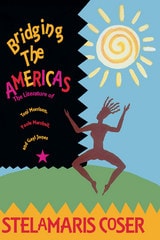
Bridging The Americas
The Literature of Paule Marshall, Toni Morrison, and Gayl JonesStelamaris Coser
Temple University Press, 1994
A literary study of three important black women writers, this book examines the "inter-American" characteristics in the work of Marshall, Morrison, and Jones, including detailed discussions of Morrison's Song of Solomon and Tar Baby, Jones's Corregidora and Song of Anninho, and Marshall's The Chose Place, The Timeless People.
Coser defines the inter-American characteristics in these authors' novels as a connection based on a common African heritage and a shared legacy of colonialism and racism. These three authors redefine the boundaries between the Americas, bridging the "extended Caribbean" that stretches from the U.S. Atlantic coast to Brazil. Their work reinterprets ethnic and sexual identity. Issues of race, class, and nationality overlap. History and identity are reinvented.
To explore the collective forms of resistance and cultural processes in Brazil, the Caribbean, and the United States, Coser also makes provocative connections between the visibility of black women writers and the popularity of male Latin American novelists like Carlos Fuentes and Gabriel Garcia Marquéz.

Brightening Glance
Art and LifePat Lipsky
University of Iowa Press, 2025
Brightening Glance offers a stunningly self-revealing portrait of the struggles and sacrifices, joys and excitement inherent in a modern painter’s life, and captures the evergreen allure of New York’s art world between 1970 and 2010. In stripped down, elegant prose, Lipsky summons a New York that no longer exists and ponders why we love (and hate) the art world. Ultimately, it’s a story of a contemporary woman, a mother, and a painter, who dares a career in a field where only a handful of women have succeeded.
Brilliance in Exile
The Diaspora of Hungarian Scientists from John von Neumann to Katalin KarikóIstván Hargittai
Central European University Press, 2023
By addressing the enigma of the exceptional success of Hungarian emigrant scientists and telling their life stories, Brilliance in Exile combines scholarly analysis with fascinating portrayals of uncommon personalities. István and Balazs Hargittai discuss the conditions that led to five different waves of emigration of scientists from the early twentieth century to the present. Although these exodes were driven by a broad variety of personal motivations, the attraction of an open society with inclusiveness, tolerance, and – needless to say – better circumstances for working and living, was the chief force drawing them abroad.
While emigration from East to West is a general phenomenon, this book explains why and how the emigration of Hungarian scientists is distinctive. The high number of Nobel Prizes among this group is only one indicator. Multicultural tolerance, a quickly emerging, considerably Jewish, urban middle class, and a very effective secondary school system were positive legacies of the Austro-Hungarian Monarchy. Multiple generations, shaped by these conditions, suffered from the increasingly exclusionist, intolerant, antisemitic, and economically stagnating environment, and chose to go elsewhere. “I would rather have roots than wings, but if I cannot have roots, I shall use wings," explained Leo Szilard, one of the fathers of the Atom Bomb.
Britain in Transition
The Twentieth CenturyAlfred F. Havighurst
University of Chicago Press, 1985
Britain, France and the Decolonization of Africa
Future Imperfect?Edited by Andrew W.M. Smith and Chris Jeppesen
University College London, 2017
British Women Writing Fiction
Abby H.P. Werlock
University of Alabama Press, 2000
British women in the second half of the 20th century have produced a body of work that is as diverse as it is entertaining. This book offers an informal, jargon-free introduction to the fiction of sixteen contemporary writers either brought up or now living in England, from Muriel Spark to Jeanette Winterson.
British Women Writing Fiction presents a balanced view comprising women writing since the 1950s and 1960s, those who attracted critical attention during the 1970s and 1980s, and those who have burst upon the literary scene more recently, including African-Caribbean and African women. The essays show how all of these writers treat British subjects and themes, sometimes from radically different perspectives, and how those who are daughters of immigrants see themselves as women writing on the margins of society.
Abby Werlock's introduction explores the historical and aesthetic factors that have contributed to the genre, showing how even those writers who began in a traditional vein have created experimental work. The contributors provide complete bibliographies of each writer's works and selected bibliographies of criticism. Exceptional both in its breadth of subjects covered and critical approaches taken, this book provides essential background that will enable readers to appreciate the singular merits of each writer. It offers an approach toward better understanding favorite authors and provides a way to become acquainted with new ones.

Broadcasting Hollywood
The Struggle over Feature Films on Early TVJennifer Porst
Rutgers University Press, 2021
Broadcasting Modernity
Cuban Commercial Television, 1950-1960Yeidy M. Rivero
Duke University Press, 2015
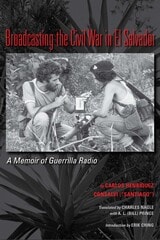
Broadcasting the Civil War in El Salvador
A Memoir of Guerrilla RadioBy Carlos Henriquez Consalvi ("Santiago")
University of Texas Press, 2010
During the 1980s war in El Salvador, Radio Venceremos was the main news outlet for the Frente Farabundo Martí para la Liberación Nacional (FMLN), the guerrilla organization that challenged the government. The broadcast provided a vital link between combatants in the mountains and the outside world, as well as an alternative to mainstream media reporting. In this first-person account, "Santiago," the legend behind Radio Venceremos, tells the story of the early years of that conflict, a rebellion of poor peasants against the Salvadoran government and its benefactor, the United States.
Originally published as La Terquedad del Izote, this memoir also addresses the broader story of a nationwide rebellion and its international context, particularly the intensifying Cold War and heavy U.S. involvement in it under President Reagan. By the war's end in 1992, more than 75,000 were dead and 350,000 wounded—in a country the size of Massachusetts. Although outnumbered and outfinanced, the rebels fought the Salvadoran Army to a draw and brought enough bargaining power to the negotiating table to achieve some of their key objectives, including democratic reforms and an overhaul of the security forces.
Broadcasting the Civil War in El Salvador is a riveting account from the rebels' point of view that lends immediacy to the Salvadoran conflict. It should appeal to all who are interested in historic memory and human rights, U.S. policy toward Central America, and the role the media can play in wartime.

Brodsky in English
Zakhar Ishov
Northwestern University Press, 2023
Joseph Brodsky’s translations of his own Russian-language poems into English “new originals” have been criticized for their “un-Englishness,” an appraisal based on a narrow understanding of translation itself. With this radical reassessment of the Nobel Prize winner’s self-translations, Zakhar Ishov proposes a fresh approach to poetry translation and challenges the assumption that poetic form is untranslatable.
Brodsky in English draws on previously unexamined archival materials, including drafts and correspondence with translators and publishers, to trace the arc of Brodsky’s experience with the English language. Ishov shows how Brodsky’s belief in the intellectual continuity between his former life in the Soviet Union and his new career in the United States, including as Poet Laureate, anchored his insistence on maintaining the formal architecture of his poems in translation, locating the transmission of poetic meaning in the rhythms of language itself. This book highlights Brodsky’s place within the long history of the compromises translation must make between linguistic material and poetic process.
Broken Brotherhood
The Rise and Fall of the National Afro-American CouncilBenjamin R. Justesen
Southern Illinois University Press, 2008
Broken Brotherhood: The Rise and Fall of the National Afro-American Council gives a comprehensive account of the National Afro-American Council, the first truly nationwide U.S. civil rights organization, which existed from 1898 to 1908. Based on exhaustive research, the volume chronicles the Council’s achievements and its annual meetings and provides portraits of its key leaders.
Led by four of the most notable African American leaders of the time—journalist T. Thomas Fortune, Bishop Alexander Walters, educator Booker T. Washington, and Congressman George Henry White—the Council persevered for a decade despite structural flaws and external pressures that eventually led to its demise in 1908.
Author Benjamin R. Justesen provides historical context for the Council’s development during an era of unprecedented growth in African American organizations. Justesen establishes the National Afro-American Council as the earliest national arena for discussions of critical social and political issues affecting African Americans and the single most important united voice lobbying for protection of the nation’s largest minority. In a period marked by racial segregation, widespread disfranchisement, and lynching violence, the nonpartisan council helped establish two more enduring successor organizations, providing core leadership for both the National Association for the Advancement of Colored People and the National Urban League.
Broken Brotherhood traces the history of the Council and the complicated relationships among key leaders from its creation in Rochester in 1898 to its last gathering in Baltimore in 1907, drawing on both private correspondence and contemporary journalism to create a balanced historical portrait. Enhanced by thirteen illustrations, the volume also provides intriguing details about the ten national gatherings, describes the Council’s unsuccessful attempt to challenge disfranchisement before the U.S. Supreme Court, and sheds light on the gradual breakdown of Republican solidarity among African American leaders in the first decade of the twentieth century.
Broken Masculinities
Solitude, Alienation, and Frustration in Turkish Literature after 1970Cimen Günay-Erkol
Central European University Press, 2016
Broken Masculinities portrays the post-dictatorial novel of the 1970s in all its complexity, and introduces the reader to a 1968-era Turkey, a period which challenges Turkey’s now reinforced Islamic image by portraying the quest for sexual liberation and critical student uprisings. Günay-Erkol argues that the literature written after the 1971 coup in Turkey constitutes a coherent sub-genre and needs to be considered together. These novels share a common ground which is rich in images of men and women craving for power: general isolation, sexual-emotional frustration, and a traumatic sense of solitude and alienation.
This book is an original and significant contribution to two major fields of study: (1) gender and sexuality with respect to formation of subjectivity through literature, and (2) modern literature and history through the study of Turkish literature. The chief concern in this book is not only literature’s response to a particular period in Turkey, but also the role of literature in bearing witness to trauma and drastic political acts of violence—and coming to terms with them.B
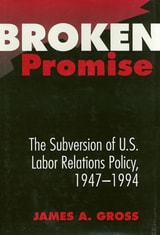
Broken Promise
The Subversion Of U.S. Labor RelationsJames A. Gross
Temple University Press, 2003
The Wagner Act of 1935 (later the Wagner-Taft-Hartley Act of 1947) was intended to democratize vast numbers of American workplaces: the federal government was to encourage worker organization and the substitution of collective bargaining for employers' unilateral determination of vital work-place matters. Yet this system of industrial democracy was never realized; the promise was "broken." In this rare inside look at the process of government regulation over the last forty-five years, James A. Gross analyzes why the promise of the policy was never fulfilled.
Gross looks at how the National Labor Relations Board's (NLRB) policy-making has been influenced by the President, the Congress, the Supreme Court, public opinion, resistance by organized employers, the political and economic strategies of organized labor, and the ideological dispositions of NLRB appointees. This book provides the historical perspective needed for a reevaluation of national labor policy. It delineates where we are now, how we got here, and what fundamental questions must be addressed if policy-makers are to make changes consistent with the underlying principles of democracy.
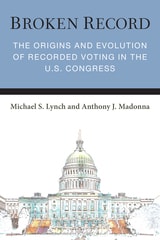
Broken Record
The Origins and Evolution of Recorded Voting in the U.S. CongressMichael S. Lynch & Anthony J. Madonna
University of Michigan Press, 2025
Consistent with the Founders’ skepticism of the impact of recorded voting in Congress, Broken Record shows that the contemporary roll call voting record includes far more meaningless position-taking and procedural roll call votes than it did during earlier congresses. The book argues that the removal of practical barriers to roll calls, internal changes to legislative procedures, and increased electoral competitiveness have led to more roll call votes on proposals sponsored by more extreme members. In addition to policy making being more difficult, increased roll call voting has played a substantial role in artificially increasing observed levels of polarization. This book argues that solving polarization requires a more nuanced set of solutions than simply replacing legislators; it will require increased public education about how Congress operates and specific procedural reforms.

Broken Silences
Interviews with Black and White Women WritersEdited by Shirley M Jordan
Rutgers University Press, 1993
In these 20 interviews with women writers of fiction, Jordan, who teaches at Hampton University in Virginia, attempts to plumb the relations between black and white women in fiction and in life, and to explore the creative process. Although the book suffers from lengthy discussions of somewhat obscure work, the interviewees, most of whom have portrayed female characters of a race other than their own, offer intriguing, often conflicting observations about the primacy of race, gender or class. Kaye Gibbons ( Ellen Foster ) suggests that rural locations offer commonality to black and white Southern women; Marita Golden ( Long Distance Life ) observes that white writers emphasize female beauty while black writers focus on character. This book may be a useful supplement to literature courses.
From Library Journal
The message derived from the candid and articulate women interviewed here is, as Belva Plain states, "you learn as you live together." Editor Jordan (Hampton Univ., Virginia) has opened a dialog on writing and race relations by publishing these interviews with 20 significant contemporary black and white women writers, from Alice Childress and Joyce Carol Oates to Mildred Pitts Walker. The substance of these writers' thoughts is that the commonality of women's experience informs the genuine portrayal of a character as much as does the writer's understanding of her blackness or whiteness. This special book, so different from others that examine the writing process, is likely to stimulate dialog among women and to provoke serious study of many excellent women writers working today. Recommended for all collections supporting the study of literature, women's studies, and race relations.