Results by title
8812 books match the query 'Political Science' and 358 start with b

Burma
The Curse of IndependenceShelby Tucker
Pluto Press, 2001

Burma’s Mass Lay Meditation Movement
Buddhism and the Cultural Construction of PowerIngrid Jordt
Ohio University Press, 2007
Burma's Mass Lay Meditation Movement: Buddhism and the Cultural Construction of Power describes a transformation in Buddhist practice in contemporary Burma. This revitalization movement has had real consequences for how the oppressive military junta, in power since the early 1960s, governs the country.
Drawing on more than ten years of extensive fieldwork in Burma, Ingrid Jordt explains how vipassanā meditation has brought about a change of worldview for millions of individuals, enabling them to think and act independently of the totalitarian regime. She addresses human rights as well as the relationship between politics and religion in a country in which neither the government nor the people clearly separates the two. Jordt explains how the movement has been successful in its challenge to the Burmese military dictatorship where democratically inspired resistance movements have failed.
Jordt's unsurpassed access to the centers of political and religious power in Burma becomes the reader's opportunity to witness the political workings of one of the world's most secretive and tyrannically ruled countries. Burma's Mass Lay Meditation Movement is a valuable contribution to Buddhist studies as well as anthropology, religious studies, and political science.

Burning Country
Syrians in Revolution and WarRobin Yassin-Kassab and Leila Al-Shami
Pluto Press, 2018
Burning Country explores the complicated reality of life in present-day Syria with unprecedented detail and sophistication, drawing on new firsthand testimonies from opposition fighters, exiles lost in an archipelago of refugee camps, and courageous human rights activists. Robin Yassin-Kassab and Leila Al-Shami expertly interweave these stories with an incisive analysis of the militarization of the uprising, the rise of the Islamists and sectarian warfare, and the role of Syria’s government in exacerbating the brutalization of the conflict. Through these accounts and a broad range of secondary source material, the authors persuasively argue that the international community has failed in its stated commitments to support the Syrian opposition movements.
This new edition brings the story up to the present, with a new chapter that covers the internationalization of the conflict, including interventions by the United States, Russia, and Iran; the rollback of ISIS; the fall of Daraya and Aleppo; the crushing of local democracy; sectarian cleansing; and the forced exile of millions of Syrians.
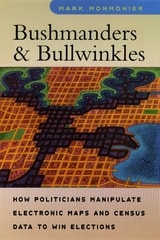
Bushmanders and Bullwinkles
How Politicians Manipulate Electronic Maps and Census Data to Win ElectionsMark Monmonier
University of Chicago Press, 2001
Written from the perspective of a cartographer rather than a political scientist, Bushmanders and Bullwinkles examines the political tales maps tell when votes and power are at stake. Monmonier shows how redistricting committees carve out favorable election districts for themselves and their allies; how disgruntled politicians use shape to challenge alleged racial gerrymanders; and how geographic information systems can make reapportionment a controversial process with outrageous products. He also explores controversies over the proper roles of natural boundaries, media maps, census enumeration, and ethnic identity. Raising important questions about Supreme Court decisions in regulating redistricting, Monmonier asks if the focus on form rather than function may be little more than a distraction from larger issues like election reform.
Characterized by the same wit and clarity as Monmonier's previous books, Bushmanders and Bullwinkles is essential background for understanding what might prove the most contentious political debate of the new decade.

Business Confronts Terrorism
Risks and ResponsesDean C. Alexander
University of Wisconsin Press, 2004
These scenarios could be part of a future Hollywood movie. Sadly, they are representative of previous terror attacks against industry and government interests worldwide. Moreover, they are harbingers of global terror threats.
Industry constitutes a prime target of contemporary terrorism. This timely book analyzes the threats companies face due to terrorism, industry responses to these dangers, and terrorism’s effects on conducting business in the post-9/11 environment. Dean C. Alexander details the conventional and unconventional terror capabilities facing industry. He describes the activities of terrorists in the economic system and the ways they finance their operations.
Alexander discusses how companies can reduce terrorist threats and that corporate security can minimize political violence. He outlines the dynamics of the public-private partnership against terrorism: government aiding industry, business supporting government, and tensions between the two. He also delineates terrorism’s effects—financial, physical, and emotional—on workers and employers. He highlights the negative financial and economic consequences of terrorism. He discusses the impact of terrorism on traditional business practices and concludes with an assessment of future trends.
Buying In or Selling Out?
The Commercialization of the American Research UniversityStein, Donald G.
Rutgers University Press, 2004
Universities were once ivory towers where scholarship and teaching reigned supreme, or so we tell ourselves. Whether they were ever as pure as we think, it is certainly the case that they are pure no longer. Administrators look to patents as they seek money by commercializing faculty discoveries; they pour money into sports with the expectation that these spectacles will somehow bring in revenue; they sign contracts with soda and fast-food companies, legitimizing the dominance of a single brand on campus; and they charge for distance learning courses that they market widely. In this volume, edited by Donald G. Stein, university presidents and others in higher education leadership positions comment on the many connections between business and scholarship when intellectual property and learning is treated as a marketable commodity. Some contributors write about the benefits of these connections in providing much needed resources. Others emphasize that the thirst for profits may bias the type of research that is carried out and the quality of that research. They fear for the future of basic research if faculty are in search of immediate payoffs.
The majority of the contributors acknowledge that commercialization is the current reality and has progressed too far to return to the “good old days.” They propose guidelines for students and professors to govern commercial activities. Such guidelines can increase the likelihood that quality, openness, and collegiality will remain core academic values.
Buying Power
A History of Consumer Activism in AmericaLawrence B. Glickman
University of Chicago Press, 2009
A definitive history of consumer activism, Buying Power traces the lineage of this political tradition back to our nation’s founding, revealing that Americans used purchasing power to support causes and punish enemies long before the word boycott even entered our lexicon. Taking the Boston Tea Party as his starting point, Lawrence Glickman argues that the rejection of British imports by revolutionary patriots inaugurated a continuous series of consumer boycotts, campaigns for safe and ethical consumption, and efforts to make goods more broadly accessible. He explores abolitionist-led efforts to eschew slave-made goods, African American consumer campaigns against Jim Crow, a 1930s refusal of silk from fascist Japan, and emerging contemporary movements like slow food. Uncovering previously unknown episodes and analyzing famous events from a fresh perspective, Glickman illuminates moments when consumer activism intersected with political and civil rights movements. He also sheds new light on activists’ relationship with the consumer movement, which gave rise to lobbies like the National Consumers League and Consumers Union as well as ill-fated legislation to create a federal Consumer Protection Agency.
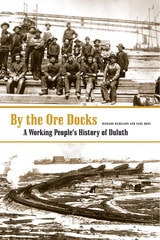
By The Ore Docks
A Working People’s History Of DuluthRichard Hudelson
University of Minnesota Press, 2006
In By the Ore Docks, Richard Hudelson and Carl Ross trace seventy years in the lives of Duluth’s multi-ethnic working class—Scandinavians, Finns, Italians, Poles, Irish, Jews, and African Americans—and chronicle, along with the events of the times, the city’s vibrant neighborhoods, religious traditions, and communities. But they also tell the dramatic story of how a populist worker’s coalition challenged the “legitimate American” business interests of the city, including the major corporation U.S. Steel.
From the Knights of Labor in the 1880s to the Industrial Workers of the World, the AFL and CIO, and the Democratic Farmer-Labor party, radical organizations and their immigrant visionaries put Duluth on the national map as a center in the fight for worker’s rights—a struggle inflamed by major strikes in the copper and iron mines.
By the Ore Docks is at once an important history of Duluth and a story of its working people, common laborers as well as union activists like Ernie Pearson, journalist Irene Paull, and Communist party gubernatorial candidate Sam Davis. Hudelson and Ross reveal tension between Duluth’s ethnic groups, while also highlighting the ability of the people to overcome those differences and shape the legacy of the city’s unsettled and remarkable past.
Richard Hudelson is professor of philosophy at the University of Wisconsin, Superior. He is the author of, among other works, Marxism and Philosophy in the Twentieth Century and The Rise and Fall of Communism.
Carl Ross (1913–2004) was a labor activist and the author of The Finn Factor in American Labor, Culture, and Society. He was director of the Twentieth-Century Radicalism in Minnesota Project of the Minnesota Historical Society.