Results by title
8642 books match the query '20th Century' and 437 start with b
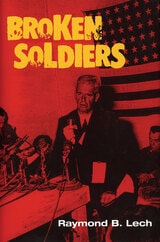
Broken Soldiers
Raymond B. Lech
University of Illinois Press, 2000
Drawing on some 60,000 pages of court-martial transcripts Lech secured through the Freedom of Information Act, Broken Soldiers documents the appalling treatment and the sophisticated propagandizing to which American POWs fell victim during the Korean conflict. Three thousand American soldiers perished in North Korean camps over the winter of 1950-51, most from starvation. Through the unsentimental testimony of survivors, Lech describes how these young men, filthy and lice-infested, lost an average of 40 percent of their body weight. Many also lost their powers of resistance and their grip on soldierly conduct.
After six months of starvation, the emaciated, disoriented prisoners were subjected to a relentless campaign to educate them to the virtues of communism. Bombarded with propaganda, the Americans were organized into study groups and forced to discuss and write about communism and Marxism, even to broadcast harangues against capitalist aggression and appeals for an end to the war.
Lech traces the spiral of debilitation and compromise, showing how parroting certain phrases came to seem a small price to pay for physical safety. Threatened with starvation and indefinite confinement in Korea, many POWs succumbed to pressure to mouth communist slogans and provide information far in excess of the regulation "name, rank, and service number."
Of the thousands of American soldiers who, while prisoners in North Korea, spoke and wrote favorably of communism and disparaged their country, a handful were charged with collaborating with the enemy. Why were so few singled out? Why did each branch of the armed services judge parallel circumstances differently, and why were American soldiers not realistically prepared for capture? A powerful indictment of justice miscarried, Broken Soldiers raises troubling questions that remain unanswered decades after the events.
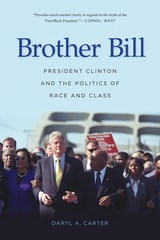
Brother Bill
President Clinton and the Politics of Race and ClassDaryl A Carter
University of Arkansas Press, 2016
“This book is a fascinating analysis of race and class in the age of President Bill Clinton. It provides much-needed clarity in regards to the myth of the ‘First Black President.’ It contributes much to our understanding of the history that informs our present moment!”
—Cornel West
As President Barack Obama was sworn into office on January 20, 2009, the United States was abuzz with talk of the first African American president. At this historic moment, one man standing on the inaugural platform, seemingly a relic of the past, had actually been called by the moniker the “first black president” for years.
President William Jefferson Clinton had long enjoyed the support of African Americans during his political career, but the man from Hope also had a complex and tenuous relationship with this faction of his political base. Clinton stood at the nexus of intense political battles between conservatives’ demands for a return to the past and African Americans’ demands for change and fuller equality. He also struggled with the class dynamics dividing the American electorate, especially African Americans. Those with financial means seized newfound opportunities to go to college, enter the professions, pursue entrepreneurial ambitions, and engage in mainstream politics, while those without financial means were essentially left behind. The former became key to Clinton’s political success as he skillfully negotiated the African American class structure while at the same time maintaining the support of white Americans. The results were tremendously positive for some African Americans. For others, the Clinton presidency was devastating.
Brother Bill examines President Clinton’s political relationship with African Americans and illuminates the nuances of race and class at the end of the twentieth century, an era of technological, political, and social upheaval.
Brother Is a Street Musician
Viewing the Landscape of Modernity Through Korean Popular MusicZhang Eujeong
Rutgers University Press, 2026
The history of the Korean popular music industry dates back a century before the beginnings of K-Pop, to when the Korean peninsula was still under Japanese rule. Though Koreans didn’t have an independent country, they were still able to use recorded music to assert a distinct cultural identity.
Brother Is a Street Musician chronicles the development of Korean popular music over the first half of the twentieth century, examining both industry trends and talented composers and performers like Nam Insu and Yi Nanyǒng. Drawing from rare archives of gramophone records and lyric books, musicologist Zhang Eujeong shows how Korean musicians drew from folk traditions to create totally new genres, ranging from comic songs to Western-influenced jazz records. She also includes English translations and detailed analyses of lyrics from some of the era’s most popular songs.
A landmark study of Korean music, now available in English for the first time, Brother Is a Street Musician tells the inspiring story of how a colonized people developed their own form of popular music, planting the seeds for an industry that would grow to export Korean culture around the world.
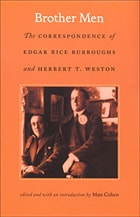
Brother Men
The Correspondence of Edgar Rice Burroughs and Herbert T. WestonEdgar Rice Burroughs and Herbert T. Weston
Duke University Press, 2005
The Burroughs-Weston letters trace a fascinating personal and business relationship that evolved as the two men and their wives embarked on joint capital ventures, traveled frequently, and navigated the difficult waters of child-rearing, divorce, and aging. Brother Men includes never-before-published images, annotations, and a critical introduction in which Cohen explores the significance of the sustained, emotional male friendship evident in the letters. Rich with insights related to visual culture and media technologies, consumerism, the history of the family, the history of authorship and readership, and the development of the West, these letters make it clear that Tarzan was only one small part of Edgar Rice Burroughs’s broad engagement with modern culture.
Brother Mine
The Correspondence of Jean Toomer and Waldo FrankEdited by Kathleen Pfeiffer
University of Illinois Press, 2010
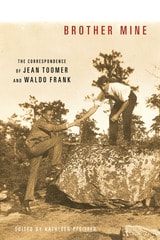
The friendship of Jean Toomer and Waldo Frank was one of the most emotionally intense, racially complicated, and aesthetically significant relationships in the history of American literary modernism. Waldo Frank was an established white writer who advised and assisted the younger African American Jean Toomer as he pursued a literary career. They met in 1920, began corresponding regularly in 1922, and were estranged by the end of 1923, the same year that Toomer published his ambitiously modernist debut novel, Cane.
While individual letters between Frank and Toomer have been published separately on occasion, they have always been presented out of context. This volume presents for the first time their entire correspondence in chronological order, comprising 121 letters ranging from 200 to 800 words each. Kathleen Pfeiffer annotates and introduces the letters, framing the correspondence and explaining the literary and historical allusions in the letters themselves.
Reading like an epistolary novel, Brother Mine captures the sheer emotional force of the story that unfolds in these letters: two men discover an extraordinary friendship, and their intellectual and emotional intimacy takes shape before our eyes. This unprecedented collection preserves the raw honesty of their exchanges, together with the developing drama of their ambition, their disappointments, their assessment of their world, and ultimately, the betrayal that ended the friendship.
Brown River, White Ocean
An Anthology of Twentieth-Century Philippine Literature in EnglishFrancia, Luis H
Rutgers University Press, 1993
Brown Skins, White Coats
Race Science in India, 1920–66Projit Bihari Mukharji
University of Chicago Press, 2022
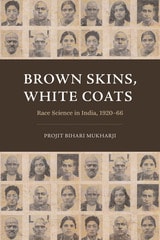
There has been a recent explosion in studies of race science in the twentieth and twenty-first centuries, but most have focused either on Europe or on North America and Australia. In this stirring history, Projit Bihari Mukharji illustrates how India appropriated and repurposed race science to its own ends and argues that these appropriations need to be understood within the national and regional contexts of postcolonial nation-making—not merely as footnotes to a Western history of “normal science.”
The book comprises seven factual chapters operating at distinct levels—conceptual, practical, and cosmological—and eight fictive interchapters, a series of epistolary exchanges between the Bengali author Hemendrakumar Ray (1888–1963) and the protagonist of his dystopian science fiction novel about race, race science, racial improvement, and dehumanization. In this way, Mukharji fills out the historical moment in which the factual narrative unfolded, vividly revealing its moral, affective, political, and intellectual fissures.
Brown in the Windy City
Mexicans and Puerto Ricans in Postwar ChicagoLilia Fernández
University of Chicago Press, 2012
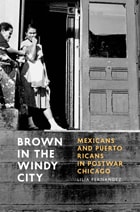
Brown in the Windy City is the first history to examine the migration and settlement of Mexicans and Puerto Ricans in postwar Chicago. Lilia Fernández reveals how the two populations arrived in Chicago in the midst of tremendous social and economic change and, in spite of declining industrial employment and massive urban renewal projects, managed to carve out a geographic and racial place in one of America’s great cities. Through their experiences in the city’s central neighborhoods over the course of these three decades, Fernández demonstrates how Mexicans and Puerto Ricans collectively articulated a distinct racial position in Chicago, one that was flexible and fluid, neither black nor white.

Brownie the War Dog
Veterans’ Best FriendKelly Nelson
Wisconsin Historical Society Press, 2024
During World War II, families all over the country volunteered their pet dogs to serve in the Dogs for Defense Program. This beautifully illustrated picture book tells the true story of a family and their beloved dog, Brownie, who served alongside the troops and returned home to become a companion to wounded vets.
At first Brownie's boy, Oren, isn’t sure he wants to send his boisterous best friend to war. But with the help of his parents, Oren decides that Brownie could do a lot of good. Brownie serves faithfully on the frontlines until an injury sends him home from the Pacific islands. His family welcomes him back with open arms. But Brownie is not content sitting around at home—he needs a job. He begins to accompany Oren's mother to the Veterans Home in King, Wisconsin, where she works. There, Brownie finds a way to serve his fellow veterans just as he served his fellow soldiers.
Lovingly illustrated by Aaron Boyd, this heartwarming story gives poignant new meaning to the phrase "man's best friend" and will be a favorite for children and their grownups.
Brutal Fantasies
Imagining North Korea in the Long Cold WarChristine Kim
Duke University Press, 2025

Budapest Blackout
A Holocaust Diaryby Máriá Mádi, edited by James W. Oberly
University of Wisconsin Press, 2023
Mádi’s family donated the entire collection of her diaries to the US Holocaust Memorial Museum. This edition transcribes a selection of Mádi’s writings focusing on the period of March 1944 to November 1945, from the Nazi invasion and occupation of Hungary, through the Battle of Budapest, to the ensuing Soviet occupation. While bearing witness to the catastrophe in Hungary, Mádi hid a Jewish family in her small flat from October 1944 to February 1945. She received a posthumous Righteous among Nations Medal from Yad Vashem, the World Holocaust Remembrance Center.
Editorial commentary by James W. Oberly situates Mádi’s observations, and a critical introduction by the Holocaust scholar András Lénárt outlines the wider sociopolitical context in which her diaries gain meaning.
Building Character in the American Boy
The Boy Scouts, YMCA, and Their Forerunners, 1870-1920David Macleod
University of Wisconsin Press, 2004
Back in print; First paperback edition.
Building Socialism
The Afterlife of East German Architecture in Urban VietnamChristina Schwenkel
Duke University Press, 2020
Building Taliesin
Frank Lloyd Wright’s Home of Love and LossRon McCrea
Wisconsin Historical Society Press, 2012
Building a Legislative-Centered Public Administration
Congress and the Administrative State, 1946-1999David Rosenbloom
University of Alabama Press, 2002
2001 Louis Brownlow Award from the National Academy of Public Administration
Reimagining public administration through the lens of constitutional governance and legislative intent.
Before 1946 the congressional role in public administration had been limited to authorization, funding, and review of federal administrative operations, which had grown rapidly as a result of the New Deal and the Second World War. But in passing the Administrative Procedure Act and the Legislative Reorganization Act that pivotal year, Congress self-consciously created for itself a comprehensive role in public administration. Reluctant to delegate legislative authority to federal agencies, Congress decided to treat the agencies as extensions of itself and established a framework for comprehensive regulation of the agencies' procedures. Additionally, Congress reorganized itself so it could provide continuous supervision of federal agencies.
Rosenbloom shows how these 1946 changes in the congressional role in public administration laid the groundwork for future major legislative acts, including the Freedom of Information Act (1966), Privacy Act (1974), Government in the Sunshine Act (1976), Paperwork Reduction Acts (1980, 1995), Chief Financial Officers Act (1990), and Small Business Regulatory Fairness Enforcement Act (1996). Each of these acts, and many others, has contributed to the legislative-centered public administration that Congress has formed over the past 50 years.
This first book-length study of the subject provides a comprehensive explanation of the institutional interests, values, and logic behind the contemporary role of Congress in federal administration and attempts to move the public administration field beyond condemning legislative "micromanagement" to understanding why Congress values it.
Building a Market
The Rise of the Home Improvement Industry, 1914-1960Richard Harris
University of Chicago Press, 2012
Building a New Educational State
Foundations, Schools, and the American SouthJoan Malczewski
University of Chicago Press, 2016
Malczewski presents foundation leaders as self-conscious state builders and policy entrepreneurs who aimed to promote national ideals through a public system of education—efforts they believed were especially critical in the South. Black education was an important component of this national agenda. Through extensive efforts to create a more centralized and standard system of public education aimed at bringing isolated and rural black schools into the public system, schools became important places for expanding the capacity of state and local governance. Schooling provided opportunities to reorganize local communities and augment black agency in the process. When foundations realized they could not unilaterally impose their educational vision on the South, particularly in black communities, they began to collaborate with locals, thereby opening political opportunity in rural areas. Unfortunately, while foundations were effective at developing the institutional configurations necessary for education reform, they were less successful at implementing local programs consistently due to each state’s distinctive political and institutional context.
Building a Social Contract
Modern Workers' Houses in Early-Twentieth Century DetroitMcCulloch, Michael
Temple University Press, 2023
Through oral histories, letters, photographs, and period fiction, McCulloch traces wage earners’ agency in negotiating a new implicit social contract, one that rewarded hard work with upward mobility in modern houses. This promise reflected workers’ increased bargaining power but, at the same time, left them increasingly vulnerable to layoffs.
Building a Social Contract focuses on Detroit, the quintessential city of the era, where migrant workers came and were Americanized, and real estate agents and the speculative housebuilding industry thrived. The Motor City epitomized the struggle of Black workers in this period, who sought better lives through industrial labor but struggled to translate their wages into housing security amid racist segregation and violence. When Depression-era unemployment created an eviction crisis, the social contract unraveled, and workers rose up—at the polls and in the streets—to create a labor movement that reshaped American capitalism for decades.
Today, the lessons McCulloch provides from early twentieth-century Detroit are a necessary reminder that wages are not enough, and only working-class political power can secure affordable housing.
Building on a Borrowed Past
Place and Identity in Pipestone, MinnesotaSally J. Southwick
Ohio University Press, 2005
Why is there a national monument near a small town on the Minnesota prairie? Why do the town’s residents dress as Indians each summer and perform a historical pageant based on a Victorian-era poem? To answer such questions, Building on a Borrowed Past: Place and Identity in Pipestone, Minnesota shows what happens when one culture absorbs the heritage of another for civic advantage.
Founded in 1874, Pipestone was named for the quarries where regional tribes excavated soft stone for making pipes. George Catlin and Henry Wadsworth Longfellow described the place and its tribal history. Promotion by white residents of the quarries as central to America’s Indian heritage helped Pipestone obtain a federal Indian boarding school in the 1890s and a national monument in the 1930s. The annual “Song of Hiawatha” pageant attracted tourists after World War II. Sally J. Southwick’s prizewinning study demonstrates how average, small–town citizens contributed to the generic image of “the Indian” in American culture.
Examining oral histories, memoirs, newspapers, federal documents, civic group records, and promotional literature, Southwick focuses on the role of middle–class individuals in establishing a historical, place–based identity. Building on a Borrowed Past reveals how identities are formed through adaptation of cultural, spiritual, racial, and historical symbols.
Building the Black Arts Movement
Hoyt Fuller and the Cultural Politics of the 1960sJonathan Fenderson
University of Illinois Press, 2019
Building the Cold War Consensus
The Political Economy of U.S. National Security Policy, 1949-51Benjamin O. Fordham
University of Michigan Press, 1998
Building the Metropolis
Architecture, Construction, and Labor in New York City, 1880–1935Alexander Wood
University of Chicago Press, 2025
Between the 1880s and the 1930s, New York City experienced explosive growth as nearly a million buildings, dozens of bridges and tunnels, hundreds of miles of subway lines, and thousands of miles of streets were erected to meet the needs of an ever-swelling population. This landscape—jagged with skyscrapers, rattling with the sound of mass transit, alive with people—made the city world-famous.
Building the Metropolis offers a revelatory look at this era of urban development by asking, “Who built New York, and how?” Focusing on the work of architects, builders, and construction workers, Alexander Wood chronicles the physical process of the city’s rapid expansion. New York’s towering buildings and busy thoroughfares aren’t just stylish or structural marvels, Wood shows, but the direct result of the many colorful personalities who worked in one of the city’s largest industries. This development boom drew on the resources of the whole community and required money, political will, creative vision, entrepreneurial drive, skilled workmanship, and hard physical labor. Wood shows this to be an even larger story as well. As cities became nodes in a regional, national, and global economy, the business of construction became an important motor of economic, political, and social development. While they held drastically different views on the course of urban growth, machine politicians, reformers, and radicals alike were all committed to city building on an epic scale.
Drawing on resources that include city archives and the records of architecture firms, construction companies, and labor unions, Building the Metropolis tells the story of New York in a way that’s epic, lively, and utterly original.
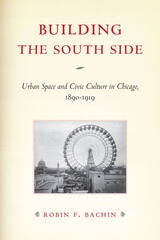
Building the South Side
Urban Space and Civic Culture in Chicago, 1890-1919Robin F. Bachin
University of Chicago Press, 2004
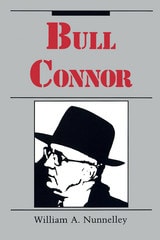
Bull Connor
William A. Nunnelley
University of Alabama Press, 1990
Nunnelley’s biography covers Connor’s early life as a sportscaster, his years as a nearly pathological police chief, and his reign as president of a corrupt public service commission.While providing the first published biographical study of Connor, Bull also traces the evolution of the civil rights movement in Birmingham. The book amplifies traditional one-dimensional accounts through the use of such primary sources a s Connor FBI files gained from a Freedom of Information request, Connor papers discovered in an old fire station about to be demolished, files from a law firm which represented Connor, interviews, and newspaper files. Connor’s racist image remains intact, but a more complete portrait of the controversial commissioner emerges.
Eugene “Bull” Connor gained infamy during the spring of 1963 as the heavy-handed Birmingham police commissioner who turned power hoses and police dogs on the black demonstrators led by Martin Luther King, Jr. Bull Connor and Birmingham symbolized hard-line Southern racism. Connor’s actions received national and international media coverage, which dramatized the plight of black people in segregated areas, giving the civil rights movement much-needed attention. After viewing television reports of the fire-hose and police-dogs episode, President John Kennedy said, “The civil rights movement should thank God for Bull Connor. He helped is as much as Abraham Lincoln.”
Bull Connor was an unlikely catalyst for the civil rights movement. Rather than forestalling integration, his response to the 1963 demonstrations hastened the demise of the dual society of which he became a symbol. Within weeks of King’s much-publicized Birmingham campaign, Congress took the first steps toward enacting the most sweeping civil rights legislation in American history. Birmingham was a turning point in the civil rights struggle, and Connor was the movement’s perfect adversary.
Bulldaggers, Pansies, and Chocolate Babies
Performance, Race, and Sexuality in the Harlem RenaissanceJames F. Wilson
University of Michigan Press, 2011
—David Krasner, author of A Beautiful Pageant: African American Theatre, Drama, and Performance in the Harlem Renaissance, 1910-1927
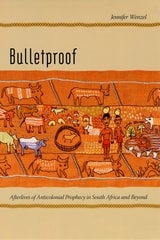
Bulletproof
Afterlives of Anticolonial Prophecy in South Africa and BeyondJennifer Wenzel
University of Chicago Press, 2009
In 1856 and 1857, in response to a prophet’s command, the Xhosa people of southern Africa killed their cattle and ceased planting crops; the resulting famine cost tens of thousands of lives. Much like other millenarian, anticolonial movements—such as the Ghost Dance in North America and the Birsa Munda uprising in India—these actions were meant to transform the world and liberate the Xhosa from oppression. Despite the movement’s momentous failure to achieve that goal, the event has continued to exert a powerful pull on the South African imagination ever since. It is these afterlives of the prophecy that Jennifer Wenzel explores in Bulletproof.
Wenzel examines literary and historical texts to show how writers have manipulated images and ideas associated with the cattle killing—harvest, sacrifice, rebirth, devastation—to speak to their contemporary predicaments. Widening her lens, Wenzel also looks at how past failure can both inspire and constrain movements for justice in the present, and her brilliant insights into the cultural implications of prophecy will fascinate readers across a wide variety of disciplines.
Bullets and Fire
Lynching and Authority in Arkansas, 1840-1950Guy Lancaster
University of Arkansas Press, 2017
Among the topics discussed are the lynching of slaves, the Arkansas Council of the Association of Southern Women for the Prevention of Lynching, the 1927 lynching of John Carter in Little Rock, and the state’s long opposition to a federal anti-lynching law.
Throughout, the work reveals how the phenomenon of lynching—as the means by which a system of white supremacy reified itself, with its perpetrators rarely punished and its defenders never condemned—served to construct authority in Arkansas. Bullets and Fire will add depth to the growing body of literature on American lynching and integrate a deeper understanding of this violence into Arkansas history.
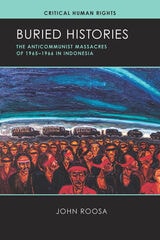
Buried Histories
The Anticommunist Massacres of 1965–1966 in IndonesiaJohn Roosa
University of Wisconsin Press, 2022
Drawing upon years of research and interviews with survivors, Buried Histories is an impressive contribution to the literature on genocide and mass atrocity, crucially addressing the topics of media, military organization, economic interests, and resistance.
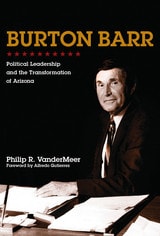
Burton Barr
Political Leadership and the Transformation of ArizonaPhilip R. VanderMeer, Foreword by Alfredo Gutierrez
University of Arizona Press, 2014
Considered perhaps the most influential person in Arizona’s political development, Burton Barr represented north central Phoenix in the Arizona House of Representatives for the twenty-two years from 1964 to 1986. As the Republican House Majority Leader for twenty of those years, he left his fingerprints on every major piece of legislation during those decades, covering such issues as air pollution, health care for indigents, school aid, the tax code, prison reform, child care, groundwater management, and freeway funding.
Burton Barr’s political life unfolded during the very time his state and region shifted from being outliers to trendsetters. His choices in policy making and his leadership style were both an outcome and a creator of his sociopolitical environment. Arizona politics in the 1960s and ’70s was a rich brew of key elements, a time when the economy was being transformed, the nature and distribution of populations shifted, partisan politics were in flux, and the very lifeblood of the West—water—was being contested under increasing pressures of usage and depletion.
How Barr successfully responded to those challenges is the story of Arizona’s development during those years. At the heart of it, Barr’s political life and personality are inextricably bound up with the life of the West.
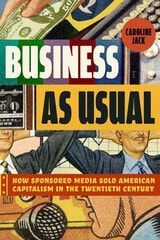
Business as Usual
How Sponsored Media Sold American Capitalism in the Twentieth CenturyCaroline Jack
University of Chicago Press, 2024
Business as Usual reveals how American capitalism has been promoted in the most ephemeral of materials: public service announcements, pamphlets, educational films, and games—what Caroline Jack calls “sponsored economic education media.” These items, which were funded by corporations and trade groups who aimed to “sell America to Americans,” found their way into communities, classrooms, and workplaces, and onto the airwaves, where they promoted ideals of “free enterprise” under the cloaks of public service and civic education. They offered an idealized vision of US industrial development as a source of patriotic optimism, framed business management imperatives as economic principles, and conflated the privileges granted to corporations by the law with foundational political rights held by individuals. This rhetoric remains dominant—a harbinger of the power of disinformation that so besets us today. Jack reveals the funding, production, and distribution that together entrenched a particular vision of corporate responsibility—and, in the process, shut out other hierarchies of value and common care.
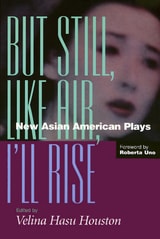
But Still Like Air
edited by Velina Hasu Houston, foreword by Roberta Uno
Temple University Press, 1997
What are Asian American plays about? Family conflicts, sexuality, social upheaval, betrayal ... the stuff of all drama. Whether the characters are a middle-aged Taiwanese woman who is married to an Irish American and who dreams of opening a Chinese restaurant, a Chinese American female bond trader trying to survive a corporate takeover, or an ABC (American Born Chinese) gay man whose lover has AIDS, their Asian-ness is only a part of their story.
As a playwright, Houston is keenly aware of the rigid formulas that often exclude writers of color and women women writers from mainstream theater. But Still, Like air, I'll Rise brings forth vibrant new work that challenges producers and audiences to broaden their expectations, to attend to the unfamiliar voices that expresses the universal and particular vision of Asian American playwrights.
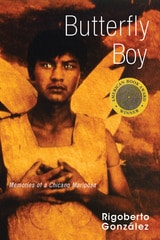
Butterfly Boy
Memories of a Chicano MariposaRigoberto Gonzalez
University of Wisconsin Press, 2011
Winner of the American Book Award
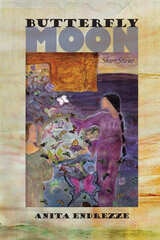
Butterfly Moon
Short StoriesAnita Endrezze
University of Arizona Press, 2012
Anita Endrezze has deep memories. Her father was a Yaqui Indian. Her mother traced her heritage to Slovenia, Germany, Romania, and Italy. And her stories seem to bubble up from this ancestral cauldron. Butterfly Moon is a collection of short stories based on folk tales from around the world. But its stories are set in the contemporary, everyday world. Or are they?
Endrezze tells these stories in a distinctive and poetic voice. Fantasy often intrudes into reality. Alternate “realities” and shifting perspectives lead us to question our own perceptions. Endrezze is especially interested in how humans hide feelings or repress thoughts by developing shadow selves. In “Raven’s Moon,” she introduces the shadow concept with a Black Moon, the “unseen reflection of the known.” (Of course the story is about a witch couple who seem very much in love.) The title character in “The Wife Who Lived on Wind” is an ogress who lives in a world somewhat similar to our own, but only somewhat. “The Vampire and the Moth Woman” reveals shape-shifters living among us.
Not surprisingly, Trickster appears in these tales. As in Native American stories, Trickster might be a fox or a coyote or a raven or a human—or something in between. “White Butterflies” and “Where the Bones Are” both deal with devastating diseases that swept through Yaqui country in the 1530s. Underneath their surfaces are old Yaqui folktales that feature the greatest Trickster of all: Death (and his little brother Fate).
Enjoyably disturbing, these stories linger—deep in our memory.
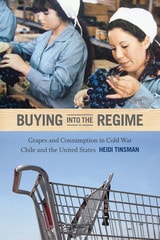
Buying into the Regime
Grapes and Consumption in Cold War Chile and the United StatesHeidi Tinsman
Duke University Press, 2014

Buying the Farm
Peace and War on a Sixties CommuneTom Fels
University of Massachusetts Press, 2012
With deft individual portraits, Fels reveals the social dynamics of the group and explores the ongoing difficulties faced by a commune that was founded in idealism and sought to operate on the model of a leaderless democracy. He draws on a large body of farm-family and 1960s-related writing and the notes of community members to present a variety of points of view. The result is an absorbing narrative that chronicles the positive aspects of Montague Farm while documenting the many challenges and disruptions that marked its history.

By Words Alone
The Holocaust in LiteratureSidra DeKoven Ezrahi
University of Chicago Press, 1980
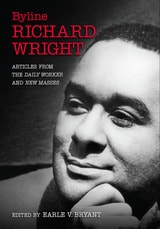
Byline, Richard Wright
Articles from the DAILY WORKER and NEW MASSESEdited by Earle V. Bryant
University of Missouri Press, 2015
A writer perhaps best known for the revolutionary works Black Boy and Native Son, Richard Wright also worked as a journalist during one of the most explosive periods of the 20th century. From 1937 to 1938, Wright turned out more than two hundred articles for the Daily Worker, the newspaper that served as the voice of the American Communist Party. Byline, Richard Wright assembles more than one hundred of those articles plus two of Wright’s essays from New Masses, revealing to readers the early work of an American icon.
As both reporter and Harlem bureau chief, Wright covered most of the major and minor events, personalities, and issues percolating through the local, national, and global scenes in the late 1930s. Because the Daily Worker wasn’t a mainstream paper, editors gave Wright free rein to cover the stories he wanted, and he tackled issues that no one else covered. Although his peers criticized his journalistic writing, these articles offer revealing portraits of Depression-era America rendered in solid, vivid prose.
Featuring Earle V. Bryant’s informative, detailed introduction and commentary contextualizing the compiled articles, Byline, Richard Wright provides insight into the man before he achieved fame as a novelist, short story writer, and internationally recognized voice of social protest. This collection opens new territory in Wright studies, and fans of Wright’s novels will delight in discovering the lost material of this literary great.