Results by title
342 books match the query '16th Century' and 20 start with c
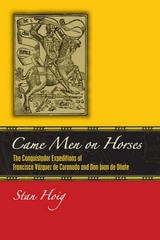
Came Men on Horses
The Conquistador Expeditions of Francisco Vázquez de Coronado and Don Juan de OñateStan Hoig
University Press of Colorado, 2013
Guided by myths of golden cities and worldly rewards, policy makers, conquistador leaders, and expeditionary aspirants alike came to the new world in the sixteenth century and left it a changed land. Came Men on Horses follows two conquistadors—Francisco Vázquez de Coronado and Don Juan de Oñate—on their journey across the southwest.
Driven by their search for gold and silver, both Coronado and Oñate committed atrocious acts of violence against the Native Americans, and fell out of favor with the Spanish monarchy. Examining the legacy of these two conquistadors Hoig attempts to balance their brutal acts and selfish motivations with the historical significance and personal sacrifice of their expeditions. Rich human details and superb story-telling make Came Men on Horses a captivating narrative scholars and general readers alike will appreciate.

Catalogue of Watermarks in Italian Printed Maps, ca. 1540-1600
David Woodward
University of Chicago Press, 1996
Fifteen years in the making, this catalogue will be an essential reference for bibliographers and archivists dealing with rare books and maps of the period, for map collectors, map librarians, and scholars and librarians working with early printed items and manuscripts.

Cervantes in Transit
Studies in Honor of Francisco Layna RanzPaul Michael Johnson
University of Delaware Press, 2027
Cervantes in Transit explores how Cervantes’s texts embody movement, transformation, and boundary-crossing across multiple dimensions. Theorizing Cervantes as a figure at once of transit and in transit, the volume argues that the diverse and often disparate array of Cervantine interpretations is not simply a byproduct of modernity, but an inherent component of the author’s own writing. Cervantes transgressed boundaries of all sorts—mixing genres, blurring fiction and reality, and moving characters into paratextual spaces. The concept of transit encompasses both physical movement between places and fundamental change or metamorphosis, reflecting how Cervantes’s writing has traveled through temporal, geographical, and conceptual spaces while continuously transforming. The volume’s thirteen chapters explore five thematic clusters: “Impressions” examines material book history and paratextual borders; “Identities” analyzes racial, religious, gender, and class transgressions; “Ironies” considers humor as a boundary-crossing mode; “Influences” traces Cervantes’s engagement with literary traditions; and “Itineraries” maps geographical circulation and global networks.
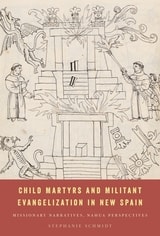
Child Martyrs and Militant Evangelization in New Spain
Missionary Narratives, Nahua PerspectivesStephanie Schmidt
University of Texas Press, 2025
Examines the many iterations of a story of child martyrdom in colonial Mexico.
A cornerstone of the evangelization of early New Spain was the conversion of Nahua boys, especially the children of elites. They were to be emissaries between Nahua society and foreign missionaries, hastening the transmission of the gospel. Under the tutelage of Franciscan friars, the boys also learned to act with militant zeal. They sermonized and smashed sacred objects. Some went so far as to kill a Nahua religious leader. For three boys from Tlaxcala, the reprisals were just as deadly.
In Child Martyrs and Militant Evangelization in New Spain, Stephanie Schmidt sheds light on a rare manuscript about Nahua child converts who were killed for acts of zealotry during the late 1520s. This is the Nahuatl version of an account by an early missionary-friar, Toribio de Benavente Motolinía. To this day, Catholics venerate the slain boys as Christian martyrs who suffered for their piety. Yet Franciscan accounts of the boys’ sacrifice were influenced by ulterior motives, as the friars sought to deflect attention from their missteps in New Spain. Illuminating Nahua perspectives on this story and period, Schmidt leaves no doubt as to who drove this violence as she dramatically expands the knowledgebase available to students of colonial Latin America.
Christian Humanism in Shakespeare
A Study in Religion and LiteratureLee Oser
Catholic University of America Press, 2022
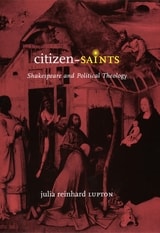
Citizen-Saints
Shakespeare and Political TheologyJulia Reinhard Lupton
University of Chicago Press, 2005
Among the many questions Julia Reinhard Lupton attempts to answer under the rubric of the citizen-saint are: how did states of emergency, acts of sovereign exception, and Messianic anticipations lead to new forms of religious and political law? What styles of universality were implied by the abject state of the pure creature, at sea in a creation abandoned by its creator? And how did circumcision operate as both a marker of ethnicity and a means of conversion and civic naturalization?
Written with clarity and grace, Citizen-Saints will be of enormous interest to students of English literature, religion, and early modern culture.
Classical Rhetoric in English Poetry
Brian Vickers
Southern Illinois University Press, 1989
Back in print after 17 years, this is a concise history of rhetoric as it relates to structure, genre, and style, with special reference to English literature and literary criticism from Ancient Greece to the end of the 18th century.
The core of the book is a quite original argument that the figures of rhetoric were not mere mechanical devices, were not, as many believed, a "nuisance, a quite sterile appendage to rhetoric to which (unaccountably) teachers, pupils, and writers all over the world devoted much labor for over 2,000 years." Rather, Vickers demonstrates, rhetoric was a stylized representation of language and human feelings.
Vickers supplements his argument through analyses of the rhetorical and emotional structure of four Renaissance poems. He also defines 16 of the most common figures of rhetoric, citing examples from the classics, the Bible, and major English poets from Chaucer to Pope.
Clean Hands and Rough Justice
An Investigating Magistrate in Renaissance ItalyDavid S. Chambers and Trevor Dean
University of Michigan Press, 1997
Clément Marot's Epistles
Clément Marot
Arizona Center for Medieval and Renaissance Studies, 2021
Clément Marot (1496–1544), a royal poet in Renaissance France who ushered in new verse forms and renewed existing ones, stands as one of the most important literary voices of the first half of the sixteenth century. Clément Marot’s Epistles represents a first attempt to offer a sustained English-language translation and critical edition of what is widely considered his most personal, historically relevant, and crowning verse form. Aiming for integrality and poetic precision, the volume translates and sets to verse all seventy-four of Marot’s epistles, employing the same meter and rhyme scheme used by the poet in the original compositions. Likewise focused on capturing Marot’s poetic voice, thus maintaining idiomatic and literary integrity, the resulting translation is an attempt to relate the playfulness and pathos of Marot’s verse, rendering it accessible to an anglophone public.
Beyond the more traditional verse epistles included in the primary base text, Marot’s authorized complete works from 1538, the volume also offers translations of the introductory prose epistles penned by Marot for his Adolescence clémentine of 1532 and the 1538 edition (Lyon, Dolet), as well as the coq-à-l’âne and other versified satirical epistles, the “artificial epistle” retelling of a popular medieval romance, and more. A robust critical apparatus includes ample footnotes, an extensive introduction, illustrations, a bibliography, a chronological table, and a concordance with the principal modern French-language editions of Marot’s epistles.
The book should appeal to English-speaking historians and literary scholars alike, as well as to poetry lovers, who will appreciate a new acquaintance with this distinctive voice from poetry’s past.
Colonial Cataclysms
Climate, Landscape, and Memory in Mexico’s Little Ice AgeBradley Skopyk
University of Arizona Press, 2020
The contiguous river basins that flowed in Tlaxcala and San Juan Teotihuacan formed part of the agricultural heart of central Mexico. As the colonial project rose to a crescendo in the sixteenth and seventeenth centuries, the Indigenous farmers of central Mexico faced long-term problems standard historical treatments had attributed to drought and soil degradation set off by Old World agriculture. Instead, Bradley Skopyk argues that a global climate event called the Little Ice Age brought cold temperatures and elevated rainfall to the watersheds of Tlaxcala and Teotihuacan. With the climatic shift came cataclysmic changes: great floods, human adaptations to these deluges, and then silted wetlands and massive soil erosion.
This book chases water and soil across the colonial Mexican landscape, through the fields and towns of New Spain’s Native subjects, and in and out of some of the strongest climate anomalies of the last thousand or more years. The pursuit identifies and explains the making of two unique ecological crises, the product of the interplay between climatic and anthropogenic processes. It charts how Native farmers responded to the challenges posed by these ecological rifts with creative use of plants and animals from the Old and New Worlds, environmental engineering, and conflict within and beyond the courts. With a new reading of the colonial climate and by paying close attention to land, water, and agrarian ecologies forged by farmers, Skopyk argues that colonial cataclysms—forged during a critical conjuncture of truly unprecedented proportions, a crucible of human and natural forces—unhinged the customary ways in which humans organized, thought about, and used the Mexican environment.
This book inserts climate, earth, water, and ecology as significant forces shaping colonial affairs and challenges us to rethink both the environmental consequences of Spanish imperialism and the role of Indigenous peoples in shaping them.
Coloniality, Religion, and the Law in the Early Iberian World
Santa Arias
Vanderbilt University Press, 2013
Hispanic Issues Series
Nicholas Spadaccini, Editor-in-Chief
Hispanic Issues Online
hispanicissues.umn.edu/online_main.html
Commerce with the Classics
Ancient Books and Renaissance ReadersAnthony Grafton
University of Michigan Press, 1997
Common Prayer
The Language of Public Devotion in Early Modern EnglandRamie Targoff
University of Chicago Press, 2001
Through readings of William Shakespeare's Hamlet, Richard Hooker's Lawes of Ecclesiastical Politie, Philip Sidney's Apology for Poetry and his translations of the Psalms, John Donne's sermons and poems, and George Herbert's The Temple, Targoff uncovers the period's pervasive and often surprising interest in cultivating public and formalized models of worship. At the heart of this study lies an original and daring approach to understanding the origins of devotional poetry; Targoff shows how the projects of composing eloquent verse and improving liturgical worship come to be deeply intertwined. New literary practices, then, became a powerful means of forging common prayer, or controlling private and otherwise unmanageable expressions of faith.
Common Understandings, Poetic Confusion
Playhouses and Playgoers in Elizabethan EnglandWilliam N. West
University of Chicago Press, 2021
What if going to a play in Elizabethan England was more like attending a football match than a Broadway show—or playing in one? In Common Understandings, Poetic Confusion, William N. West proposes a new account of the kind of participatory entertainment expected by the actors and the audience during the careers of Shakespeare and his contemporaries. West finds surprising descriptions of these theatrical experiences in the figurative language of early modern players and playgoers—including understanding, confusion, occupation, eating, and fighting. Such words and ways of speaking are still in use today, but their earlier meanings, like that of theater itself, are subtly, importantly different from our own. Playing was not confined to the actors on the stage but filled the playhouse, embracing audiences and performers in collaborative experiences that did not belong to any one alone but to the assembled, various crowd. What emerged in playing was a kind of thinking and feeling distributed across persons and times that were otherwise distinct. Thrown apples, smashed bottles of beer, and lumbering bears—these and more gave verbal shape to the physical interactions between players and playgoers, creating circuits of exchange, production, and consumption.
Contested Canonizations
The Last Medieval Saints, 1482-1523Ronald C. Finucane
Catholic University of America Press, 2011
Convents and the Body Politic in Late Renaissance Venice
Jutta Gisela Sperling
University of Chicago Press, 2000
Sperling explains how women were not allowed to marry beneath their social status while men could, especially if their brides were wealthy. Faced with a shortage of suitable partners, patrician women were forced to offer themselves as "a gift not only to God, but to their fatherland," as Patriarch Giovanni Tiepolo told the Senate of Venice in 1619. Noting the declining birth rate among patrician women, Sperling explores the paradox of a marriage system that preserved the nobility at the price of its physical extinction. And on a more individual level, she tells the fascinating stories of these women. Some became scholars or advocates of women's rights, some took lovers, and others escaped only to survive as servants, prostitutes, or thieves.
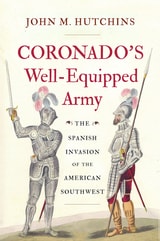
Coronado's Well-Equipped Army
The Spanish Invasion of the American SouthwestJohn M. Hutchins
Westholme Publishing, 2023
Winner of Two Colorado Book Awards
The historic 1540–1542 expedition of Captain-General Francisco Vasquez de Coronado is popularly remembered as a luckless party of exploration which wandered the American Southwest and then blundered onto the central Great Plains of Texas, Oklahoma, and Kansas. The expedition, as historian John M. Hutchins relates in Coronado’s Well-Equipped Army: The Spanish Invasion of the American Southwest, was a military force of about 1,500 individuals, made up of Spanish soldiers, Indian warrior allies, and camp followers. Despite the hopes for a peaceful conquest of new lands—including those of a legendary kingdom of Cibola—the expedition was obliged to fight a series of battles with the natives in present-day Sonora, California, Arizona, and New Mexico. The final phase of the invasion was less warlike, as the members of the expedition searched the Great Plains in vain for a wealthy civilization called Quivira.While much has been written about the march of Coronado and his men, this is the first book to address the endeavor as a military campaign of potential conquest like those conducted by other conquistadors. This helps to explain many of the previously misunderstood activities of the expedition. In addition, new light is cast on the non-Spanish participants, including Mexican Indian allies and African retainers, as well as the important roles of women.
Courtly Song in Late Sixteenth-Century France
Jeanice Brooks
University of Chicago Press, 2001
Brooks concentrates on a period in which the court's importance in projecting the symbolic centrality of monarchy was growing rapidly and considers the role of the air in defining patronage hierarchies at court and in enhancing courtly visions of masculine and feminine virtue. Her study illuminates the court's relationship to the world beyond its own confines, represented first by Italy, then by the countryside. In addition to the 40 editions of airs de cour printed between 1559 and 1589, Brooks draws on memoirs, literary works, and iconographic evidence to present a rounded vision of French Renaissance culture.
The first book-length examination of the history of air de cour, this work also sheds important new light on a formative moment in French history.
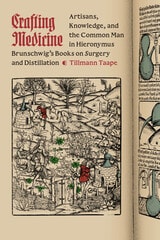
Crafting Medicine
Artisans, Knowledge, and the Common Man in Hieronymus Brunschwig's Books on Surgery and DistillationTillmann Taape
University of Chicago Press, 2025
Between 1497 and 1512, Hieronymus Brunschwig (ca. 1450–ca. 1530), an obscure craftsman from Strasbourg, wrote books on surgery and pharmacy that transformed medical expertise, how it was codified in print, and how it was communicated to new audiences. Brunschwig was an unlikely author. He apprenticed as a surgeon in the local guild and dispensed medicines from his own shop. But he was remarkably well-read in surgery, alchemy, and medical theory, even if he lacked a university education. His unique authorial voice spoke to the healing practices of craftsmen and common people in a down-to-earth German dialect.
Crafting Medicine, by Tillmann Taape, is the first in-depth study of Brunschwig and his works. In it, Taape argues that Brunschwig’s writings shaped a nascent tradition of vernacular medicine. Brunschwig’s books represent a key moment in the history of medical print, for they conveyed medical expertise to a new readership of nonacademic practitioners, who became a key audience for a flood of vernacular medical publications during the sixteenth century. Using Brunschwig’s books as a unique window into the past, Crafting Medicine beautifully reconstructs the world of science inhabited by Brunschwig, his fellow craftsmen, his translators, and his readers.
Cultural Aesthetics
Renaissance Literature and the Practice of Social OrnamentPatricia Fumerton
University of Chicago Press, 1991