Results by title
805 books match the query '18th Century' and 41 start with c
Canaletto's Camera
Philip Steadman
University College London, 2025
Canaletto’s Camera provides a revelatory look at how the Venetian master Antonio Canaletto (1697–1768) used the camera obscura, a precursor to the modern camera, to create his meticulous cityscapes. Drawing on new research, Steadman examines Canaletto’s connections to contemporary scientists and his reliance on measured architectural drawings, discovering previously unrecognized techniques that shaped his iconic views of Venice and London.
By analyzing Canaletto’s sketches and reconstructing an 18th-century camera obscura, Steadman and his colleagues have recreated the artist’s process, demonstrating how he traced real scenes, altered them in his finished works, and even engaged in a form of early photomontage. Through digital overlays and side-by-side comparisons with contemporary photographs, the book challenges assumptions about Canaletto’s realism and artistic manipulation.
Lavishly illustrated and deeply engaging, Canaletto’s Camera is a compelling read for art historians, scholars of optical devices, and those fascinated by the intersection of art and science.
Capitalism and the Emergence of Civic Equality in Eighteenth-Century France
William H. Sewell Jr.
University of Chicago Press, 2021
William H. Sewell Jr. argues that the flourishing of commercial capitalism in eighteenth-century France introduced a new independence, flexibility, and anonymity to French social life. By entering the interstices of this otherwise rigidly hierarchical society, expanded commodity exchange colored everyday experience in ways that made civic equality thinkable, possible, even desirable, when the crisis of the French Revolution arrived. Sewell ties together masterful analyses of a multitude of interrelated topics: the rise of commerce, the emergence of urban publics, the careers of the philosophes, commercial publishing, patronage, political economy, trade, and state finance. Capitalism and the Emergence of Civic Equality in Eighteenth-Century France offers an original interpretation of one of history’s pivotal moments.
Captain Paul Cuffe, Yeoman
A BiographyJeffrey A. Fortin
University of Massachusetts Press, 2024
Paul Cuffe is best understood as a member of the Black founding fathers—a group of pre-eminent African Americans who built institutions and movements during the first decades of the United States. While he is known amongst scholars, his astounding life story deserves a much wider audience. Jeffrey A. Fortin has crafted a beautiful, moving portrait of this important maritime figure that will appeal to anyone interested in early American history and who loves great story telling.
Born on Cuttyhunk Island, Massachusetts in 1759 to a formerly enslaved African father and a Wampanoag Indian mother, Cuffe emerged from anonymity to become the most celebrated African-American sea captain during the Age of Sail. An abolitionist, veteran, and community activist, celebrity followed Cuffe as he built a shipping empire that traded both in American coastal waters and across the wider Atlantic Ocean. Cuffe and his Black crews shook the foundations of systemic racism, challenging norms by sailing into Charleston and other ports where slavery was legal, and thus demonstrating that business and profits were more powerful than social limitations. He founded America’s first racially integrated school in Westport, Massachusetts, and is considered the leader of the nation’s first back-to-Africa movement. Newspapers in England, the United States, and the Caribbean reported his whereabouts and adventures, and abolitionists hailed him for his Quaker beliefs, sobriety, and commitment to advancing opportunities for persons of African descent.
Drawing on pamphlets, letters, and other documents, and painstakingly reconstructing his genealogy, Fortin vividly describes Cuffe’s experiences and places them within the broader history of the Early Republic to help reveal the central role of African Americans in the founding of the United States. Unlike previous biographies, Fortin situates Cuffe within an Atlantic world where race and identity were fluid, and Africans and African Americans sought to build and govern a free Black nation in West Africa.

Captains of Charity
The Writing and Wages of Postrevolutionary Atlantic BenevolenceMary Kathleen Eyring
University of New Hampshire Press, 2017
According to Eyring, the men and women who most successfully wrote about and engaged in benevolent work strategically connected their work with the affluence generated by maritime commerce. The water trades supported the growth of the American publishing industry, but they also generated both vast inequities in wealth and physically and economically hazardous conditions that, in the absence of a welfare state, required the intervention of benevolent societies. Laborers in Atlantic port cities barred from lucrative professions by gender, race, physical ability, or social status found a way to make a living wage by conjoining the literary with the charitable—and attaching both to a profit structure. In so doing, they transformed the nature of American benevolence and gave rise to the nonprofit sector, which has since its inception provided discontented laborers with a forum in which to express their critique of for-profit American enterprise, by imitating it.
In Captains of Charity, Eyring looks at writers who overcame their marginalized status by bringing together the strands of maritime industry, publishing, and benevolence. These include Richard Allen and Absalom Jones, two black clergymen who managed a massive relief effort when refugees fleeing revolution in Haiti transported the yellow fever virus to Philadelphia in 1793; Nancy Prince, a free woman of color who sought her livelihood in the Protestant missions of Jamaica in the years immediately following Britain's emancipation of laborers in its Caribbean colonies; Sarah Josepha Hale, who parlayed the social influence she had gained as the founder of a seaman's aid society in Boston into a role as editor of the hugely popular periodical Godey's Lady's Book; and Sarah Pogson Smith, who donated the proceeds of her writing to such prominent charitable causes as the New York Institution for the Instruction of the Deaf and Dumb and then capitalized on the goodwill this charity work generated among her wealthy friends in New York City, Philadelphia, and Charleston.
Hardcover is un-jacketed.
Captors and Captives
The 1704 French and Indian Raid on DeerfieldEvan Haefeli
University of Massachusetts Press, 2003
Haefeli and Sweeney reconstruct events from multiple points of view, through the stories of a variety of individuals involved. These stories begin in the Native, French, and English communities of the colonial Northeast, then converge in the February 29 raid, as a force of more than two hundred Frenchmen, Abenakis, Hurons, Kahnawake Mohawks, Pennacooks, and Iroquois of the Mountain overran the northwesternmost village of the New England frontier. Although the inhabitants put up more of a fight than earlier accounts of the so-called Deerfield Massacre have suggested, the attackers took 112 men, women, and children captive. The book follows the raiders and their prisoners on the harsh three-hundred-mile trek back to Canada and into French and Native communities. Along the way the authors examine how captives and captors negotiated cultural boundaries and responded to the claims of competing faiths and empires—all against a backdrop of continuing warfare.
By giving equal weight to all participants, Haefeli and Sweeney range across the fields of social, political, literary, religious, and military history, and reveal connections between cultures and histories usually seen as separate.
Carrying All before Her
Celebrity Pregnancy and the London Stage, 1689-1800Chelsea Phillips
University of Delaware Press, 2022
The rise of celebrity stage actresses in the long eighteenth century created a class of women who worked in the public sphere while facing considerable scrutiny about their offstage lives. Such powerful celebrity women used the cultural and affective significance of their reproductive bodies to leverage audience support and interest to advance their careers, and eighteenth-century London patent theatres even capitalized on their pregnancies. Carrying All Before Her uses the reproductive histories of six celebrity women (Susanna Mountfort Verbruggen, Anne Oldfield, Susannah Cibber, George Anne Bellamy, Sarah Siddons, and Dorothy Jordan) to demonstrate that pregnancy affected celebrity identity, impacted audience reception and interpretation of performance, changed company repertory and altered company hierarchy, influenced the development and performance of new plays, and had substantial economic consequences for both women and the companies for which they worked. Deepening the fields of celebrity, theatre, and women's studies, as well as social and medical histories, Phillips reveals an untapped history whose relevance and impact persists today.
Casanova's Lottery
The History of a Revolutionary Game of ChanceStephen M. Stigler
University of Chicago Press, 2022
In the 1750s, at the urging of famed adventurer Giacomo Casanova, the French state began to embrace risk in adopting a new Loterie. The prize amounts paid varied, depending on the number of tickets bought and the amount of the bet, as determined by each individual bettor. The state could lose money on any individual Loterie drawing while being statistically guaranteed to come out on top in the long run. In adopting this framework, the French state took on risk in a way no other has, before or after. At each drawing the state was at risk of losing a large amount; what is more, that risk was precisely calculable, generally well understood, and yet taken on by the state with little more than a mathematical theory to protect it.
Stephen M. Stigler follows the Loterie from its curious inception through its hiatus during the French Revolution, its renewal and expansion in 1797, and finally to its suppression in 1836, examining throughout the wider question of how members of the public came to trust in new financial technologies and believe in their value. Drawing from an extensive collection of rare ephemera, Stigler pieces together the Loterie’s remarkable inner workings, as well as its implications for the nature of risk and the role of lotteries in social life over the period 1700–1950.
Both a fun read and fodder for many fields, Casanova's Lottery shines new light on the conscious introduction of risk into the management of a nation-state and the rationality of playing unfair games.

Catching Nature in the Act
Réaumur and the Practice of Natural History in the Eighteenth CenturyMary Terrall
University of Chicago Press, 2014
At the center of Terrall’s study is René-Antoine Ferchault de Réaumur (1683–1757)—the definitive authority on natural history in the middle decades of the eighteenth century—and his many correspondents, assistants, and collaborators. Through a close examination of Réaumur’s publications, papers, and letters, Terrall reconstructs the working relationships among these naturalists and shows how observing, collecting, and experimenting fit into their daily lives. Essential reading for historians of science and early modern Europe, Catching Nature in the Act defines and excavates a dynamic field of francophone natural history that has been inadequately mined and understood to date.
Cato's Tears and the Making of Anglo-American Emotion
Julie Ellison
University of Chicago Press, 1999
Early popular dramas of this time, Ellison shows, linked male stoicism with sentimentality through portrayals of stoic figures whose civic sacrifices bring other men to tears. Later works develop a different model of sensibility, drawing their objects of sympathy from other races and classes—Native Americans, African slaves, servants. Only by examining these texts in light of the complex masculine tradition of stoic sentimentality, Ellison argues, can one interpret women's roles in the culture of sensibility.
In her conclusion, Ellison offers "a short history of liberal guilt," exploring the enduring link between male stoicism and male sensibility in political and cultural life from the late seventeenth century to today.
Cayman's 1794 Wreck of the Ten Sail
Peace, War, and Peril in the CaribbeanMargaret E. Leshikar-Denton
University of Alabama Press, 2020
The story has been passed through generations for more than two centuries. Details vary depending on who is doing the telling, but all refer to this momentous maritime event as the Wreck of the Ten Sail. Sometimes misunderstood as the loss of a single ship, it was in fact the wreck of ten vessels at once, comprising one of the most dramatic maritime disasters in all of Caribbean naval history. Surviving historical documents and the remains of the wrecked ships in the sea confirm that the narrative is more than folklore. It is a legend based on a historical event in which HMS Convert, formerly L’Inconstante, a recent prize from the French, and 9 of her 58-ship merchant convoy sailing from Jamaica to Britain, wrecked on the jagged eastern reefs of Grand Cayman in 1794.
The incident has historical significance far beyond the boundaries of the Cayman Islands. It is tied to British and French history during the French Revolution, when these and other European nations were competing for military and commercial dominance around the globe. The Wreck of the Ten Sail attests to the worldwide distribution of European war and trade at the close of the eighteenth century.
In Cayman’s 1794 Wreck of the Ten Sail: Peace, War, and Peril in the Caribbean, Margaret E. Leshikar-Denton focuses on the ships, the people, and the wreck itself to define their place in Caymanian, Caribbean, and European history. This well-researched volume weaves together rich oral folklore accounts, invaluable supporting documents found in archives in the United Kingdom, Jamaica, and France, and tangible evidence of the disaster from archaeological sites on the reefs of the East End.

Chamfort
A BiographyClaude Arnaud
University of Chicago Press, 1992
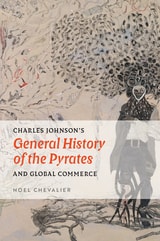
Charles Johnson's "General History of the Pyrates" and Global Commerce
Noel Chevalier
Bucknell University Press, 2025
This study explores how General History of the Pyrates was at the heart of early eighteenth-century British debates about commerce, colonialism, and law. Examining how pirates are depicted as both monsters and Great Men, Noel Chevalier untangles the contradictions within a Britain emerging as a colonial superpower, where ruthlessness and ambition were both feared and praised. Traveling the high seas to plunder treasure from foreign lands, pirates were not so different from the British capitalists who built fortunes from resource extraction, the plantation economy, and the transatlantic slave trade. Connecting the work to later books like Gulliver’s Travels and The Beggar’s Opera that satirized the era and its power-hungry prime minister Robert Walpole, Chevalier shows how the pirate became an iconic figure in 1720s Britain, a time of cold-hearted capitalism and rapacious colonial expansion.
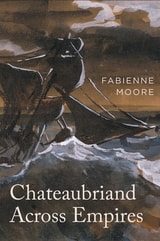
Chateaubriand Across Empires
Fabienne Moore
Bucknell University Press, 0
What happens when the liberty of ancient nobility collides with the revolutionary ideals of equality? This groundbreaking study explores how the American, French, Haitian, and Greek Revolutions redefined freedom—and how French Romantic figure Chateaubriand grappled with that transformation. Tracing his travels across England, North America, and the Mediterranean, this book uncovers Chateaubriand’s seductive visions of “paradises lost,” which were taken up, challenged, and reimagined by Anglophone and Hispanic writers.
From Charlotte Brontë to Harriet Beecher Stowe, from Byron to Bolaño authors found in Chateaubriand a conflicted but powerful voice at the crossroads of liberty, race, religion, and empire. This is the first comprehensive study to situate Chateaubriand within the histories of colonialism and global revolution, revealing a literary legacy that remains startlingly relevant in today’s struggles over equality.
Published by Bucknell University Press. Distributed worldwide by Rutgers University Press.
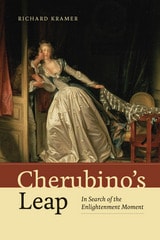
Cherubino's Leap
In Search of the Enlightenment MomentRichard Kramer
University of Chicago Press, 2016
In Cherubino’s Leap, Richard Kramer unmasks such prismatic moments in iconic music from the Enlightenment, from the “chromatic” moment—the single tone that disturbs the thrust of a diatonic musical discourse—and its deployment in seminal instrumental works by Emanuel Bach, Haydn, and Mozart; on to the poetic moment, taking the odes of Klopstock, in their finely wrought prosody, as a challenge to the problem of strophic song; and finally to the grand stage of opera, to the intense moment of recognition in Gluck’s Iphigénie en Tauride and the exquisitely introverted phrase that complicates Cherubino’s daring moment of escape in Mozart’s Figaro. Finally, the tears of the disconsolate Konstanze in Mozart’s Die Entführung aus dem Serail provoke a reflection on the tragic aspect of Mozart’s operatic women. Throughout, other players from literature and the arts—Diderot, Goethe, Lessing among them—enrich the landscape of this bold journey through the Enlightenment imagination.

Citoyennes
Women and the Ideal of Citizenship in Eighteenth-Century FranceAnnie K. Smart
University of Delaware Press, 2012
Did women have a civic identity in eighteenth-century France? In Citoyennes: Women and the Ideal of Citizenship in Eighteenth-Century France, Annie Smart contends that they did. While previous scholarship has emphasized the ideal of domestic motherhood or the image of the republican mother, Smart argues persuasively that many pre-revolutionary and revolutionary texts created another ideal for women–the ideal of civic motherhood. Smart asserts that women were portrayed as possessing civic virtue, and as promoting the values and ideals of the public sphere.
Contemporary critics have theorized that the eighteenth-century ideal of the Republic intentionally excluded women from the public sphere. According to this perspective, a discourse of “Rousseauean” domestic motherhood stripped women of an active civic identity, and limited their role to breastfeeding and childcare. Eighteenth-century France marked thus the division between a male public sphere of political action and a female private sphere of the home.
Citoyennes challenges this position and offers an alternative model of female identity. This interdisciplinary study brings together a variety of genres to demonstrate convincingly that women were portrayed as civic individuals. Using foundational texts such as Jean-Jacques Rousseau’s Emile, or on Education (1762), revolutionary gouaches of Lesueur, and vaudeville plays of Year II of the Republic (1793/1794), this study brilliantly shows that in text and image, women were represented as devoted to both the public good and their families.
In addition, Citoyennes offers an innovative interpretation of the home. Through re-examining sphere theory, this study challenges the tendency to equate the home with private concerns, and shows that the home can function as a site for both private life and civic identity.
Citoyennes breaks new ground, for it both rectifies the ideal of domestic Rousseauean motherhood, and brings a fuller understanding to how female civic identity operated in important French texts and images.
Published by University of Delaware Press. Distributed worldwide by Rutgers University Press.
Civic Charity in a Golden Age
ORPHAN CARE IN EARLY MODERN AMSTERDAMAnne E. C. McCants
University of Illinois Press, 1997
can see the start of profound social and economic changes in early modern
Amsterdam, Civic Charity in a Golden Age explores the connections
between the developing capitalist economy, the functioning of the government,
and the provision of charitable services to orphans in Amsterdam during
the seventeenth and eighteenth centuries, the period of the city's greatest
prosperity and subsequent decline.
Anne McCants skillfully interprets details of the orphanage's expenditures,
especially for food; its population; the work records of those who were
reared there; and the careers of the regents who oversaw it. The establishment
of the orphanage itself was called for by the changing economic needs
of rapidly expanding commercial centers and the potential instability
of a government that depended on taxes from a large, politically powerless
segment of the population.
Class Politics and the Creation of the American State
James Parisot
University of Michigan Press, 2026
Why does the American federal government seem to prioritize elite capitalist interests over those of other groups? Class Politics and the Creation of the American State draws on a wide range of sources—personal letters, official government documents, private notes, and newspaper articles—to reveal that the federal government was built to give the emerging capitalist elite a way to consolidate and institutionalize their power. Challenging both liberal and conservative interpretations about what the US Constitution means, this book tells a new story about how the American state took shape.
The framers of the Constitution constructed an image of the state, enshrined in the Constitution, that presented their power as universal: a system meant to serve all Americans equally. This image helped legitimize the new order, even if the rising capitalist class stood to benefit most of all. Since the United States of the late 1780s was not yet a fully capitalist society, the state that was built opened space for less capitalistically incorporated social classes, including some artisans and yeoman farmers, to have limited representation. Class Politics and the Creation of the American State shows how the structure of the early American state worked primarily to advance capitalist interests, while incorporating other groups enough to maintain a sense of broad representation and inclusion.
Climate and the Making of Worlds
Toward a Geohistorical PoeticsTobias Menely
University of Chicago Press, 2021
In this book, Tobias Menely develops a materialist ecocriticism, tracking the imprint of the planetary across a long literary history of poetic rewritings and critical readings which continually engage with the climate as a condition of human world making. Menely’s central archive is English poetry written between John Milton’s Paradise Lost (1667) and Charlotte Smith’s “Beachy Head” (1807)—a momentous century and a half during which Britain, emerging from a crisis intensified by the Little Ice Age, established the largest empire in world history and instigated the Industrial Revolution. Incorporating new sciences into ancient literary genres, these ambitious poems aspired to encompass what the eighteenth-century author James Thomson called the “system . . . entire.” Thus they offer a unique record of geohistory, Britain’s epochal transition from an agrarian society, buffeted by climate shocks, to a modern coal-powered nation. Climate and the Making of Worlds is a bracing and sophisticated contribution to ecocriticism, the energy humanities, and the prehistory of the Anthropocene.
Colonial Fantasies
Conquest, Family, and Nation in Precolonial Germany, 1770-1870Susanne Zantop
Duke University Press, 1997
From as early as the sixteenth century, Germans preoccupied themselves with an imaginary drive for colonial conquest and possession that eventually grew into a collective obsession. Zantop illustrates the gendered character of Germany’s colonial imagination through critical readings of popular novels, plays, and travel literature that imagine sexual conquest and surrender in colonial territory—or love and blissful domestic relations between colonizer and colonized. She looks at scientific articles, philosophical essays, and political pamphlets that helped create a racist colonial discourse and demonstrates that from its earliest manifestations, the German colonial imagination contained ideas about a specifically German national identity, different from, if not superior to, most others.
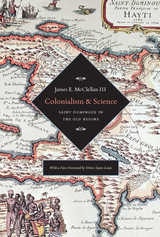
Colonialism and Science
Saint Domingue and the Old RegimeJames E. McClellan III
University of Chicago Press, 2010
How was the character of science shaped by the colonial experience? In turn, how might we make sense of how science contributed to colonialism? Saint Domingue (now Haiti) was the world’s richest colony in the eighteenth century and home to an active society of science—one of only three in the world, at that time. In this deeply researched and pathbreaking study of the colony, James E. McClellan III first raised his incisive questions about the relationship between science and society that historians of the colonial experience are still grappling with today. Long considered rare, the book is now back in print in an English-language edition, accompanied by a new foreword by Vertus Saint-Louis, a native of Haiti and a widely-acknowledged expert on colonialism. Frequently cited as the crucial starting point in understanding the Haitian revolution, Colonialism and Science will be welcomed by students and scholars alike.
“By deftly weaving together imperialism and science in the story of French colonialism, [McClellan] . . . brings to light the history of an almost forgotten colony.”—Journal of Modern History
“McClellan has produced an impressive case study offering excellent surveys of Saint Domingue’s colonial history and its history of science.”—Isis
Community and Solitude
New Essays on Johnson’s CircleLee, Anthony W
Bucknell University Press, 2019
Contributors: Christopher Catanese, James Caudle, Marilyn Francus, Christine Jackson-Holzberg, Claudia Thomas Kairoff, Elizabeth Lambert, Anthony W. Lee, James E. May, John Radner, and Lance Wilcox.
Published by Bucknell University Press. Distributed worldwide by Rutgers University Press.
Community without Consent
New Perspectives on the Stamp ActEdited by Zachary McLeod Hutchins
Dartmouth College Press, 2016
Connected by the Ear
The Media, Pedagogy, and Politics of the Romantic LectureSean Franzel
Northwestern University Press, 2013
In this innovative new study, Sean Franzel charts the concurrent emergence of German Romantic pedagogy, the modern research university, and modern visions of the politically engaged scholar. At the heart of the pedagogy of Immanuel Kant, Johann Gottlieb Fichte, K. P. Moritz, A. W. Schlegel, Adam Müller, and others was the lecture, with its ability to attract listeners and to model an ideal discursive community, reflecting an era of revolution, reform, and literary, philosophical, and scientific innovation.
Along with exploring the striking preoccupation of Romantic thinkers with the lecture and with its reverberations in print, Franzel argues that accounts of scholarly speech from this period have had a lasting impact on how the pedagogy, institutions, and medial manifestations of modern scholarship continue to be understood.
"Sean Franzel’s archaeology illuminates both the bourgeois public sphere and discourse network 1800 by showing the romantic lecture to be the key cultural form in a pivotal moment of German intellectual history, a history long obsessed with the mediation of oral discourse and written text."—John Durham Peters, author of Speaking into the Air
Conquering the American Wilderness
The Triumph of European Warfare in the Colonial NortheastGuy Chet
University of Massachusetts Press, 2003
A study of military tactics and strategy before the War of Independence, this book reexamines the conquest of the North American wilderness and its native peoples by colonial settlers. Historians have long believed that the peculiar conditions of the New World, coupled with the success of Indians tactics, forced the colonists to abandon traditional European methods of warfare and to develop a new “American” style of combat. By combining firearms with guerrilla-like native tactics, colonial commanders were able not only to subdue their Indian adversaries but eventually to prevail against more conventionally trained British forces during the American Revolution. Yet upon closer scrutiny, this common understanding of early American warfare turns out to be more myth than reality.
As Guy Chet reveals, clashes between colonial and Indian forces during the seventeenth and eighteenth centuries did not lead to a reevaluation and transformation of conventional military doctrine. On the contrary, the poor performance of the settlers during King Philip's War (1675–76) and King William's War (1689–1697) prompted colonial magistrates to address the shortcomings of their military forces through a greater reliance on British troops and imperial administrators. Thus, as the eighteenth century wore on, growing military success in the New England colonies reflected an increasing degree of British planning, administration, participation, and command. The colonies' military and political leadership, Chet argues, never rejected the time-tested principles of European warfare, and even during the American War of Independence, the republic's military leadership looked to Europe for guidance in the art of combat.
Conservatism and Southern Intellectuals, 1789-1861
Liberty, Tradition, and the Good SocietyAdam L. Tate
University of Missouri Press, 2005
Constructing European Historical Narratives in the Early Modern World
Edited by Hilary J. Bernstein, Fabien Montcher, and Megan Armstrong
Iter Press, 2025
Exploring the art of crafting historical narratives during the early modern period, Constructing European Historical Narratives in the Early Modern World reflects on the social and political implications of the diversification of research methods and writing practices associated with historical writing. It does so by considering the global and local situatedness of historical narratives from the perspective of both their makers and publics while interrogating the extent of the hegemony that a composite European world acquired over the elaboration of historical narratives.
The contributions to this volume take into account historical texts ranging from those most concerned with the self—revealing questions of personal or familial agency and identity—to those in which groups of writers collaborated to produce engaged narratives, to those focused on broader, disembodied concepts, such as language development and geographical features, using a significant mixture of textual references and personal experience. This volume deliberately mixes studies from numerous parts of Europe and its colonial outposts and juxtaposes writings by published scholars with the manuscript testimonies of occasional memorialists.

Consuming Anxieties
Alcohol, Tobacco, and Trade in British Satire, 1660-1751Dayne C. Riley
Bucknell University Press, 2024

Contested Boundaries
Itinerancy and the Reshaping of the Colonial American Religious WorldTimothy D. Hall
Duke University Press, 1994
This book expands our understanding of evangelical itinerancy in the 1740s by viewing it within the context of Britain’s expanding commercial empire. As pro- and anti-revivalists tried to shape a burgeoning transatlantic consumer society, the itinerancy of the Great Awakening appears here as a forceful challenge to contemporary assumptions about the place of individuals within their social world and the role of educated leaders as regulators of communication, order, and change. The most celebrated of these itinerants was George Whitefield, an English minister who made unprecedented tours through the colonies. According to Hall, the activities of the itinerants, including Whitefield, encouraged in the colonists an openness beyond local boundaries to an expanding array of choices for belief and behavior in an increasingly mobile and pluralistic society. In the process, it forged a new model of the church and its social world.
As a response to and a source of dynamic social change, itinerancy in Hall’s powerful account provides a prism for viewing anew the worldly and otherworldly transformations of colonial society. Contested Boundaries will be of interest to students and scholars of colonial American history, religious studies, and cultural and social anthropology.

Control and Order in French Colonial Louisbourg, 1713-1758
A.J.B. Johnston
Michigan State University Press, 2001
Control and Order in French Colonial Louisbourg, 1713-1758 is the culmination of nearly a quarter century of research and writing on 18th-century Louisbourg by A. J. B. Johnston. The author uses a multitude of primary archival sources-official correspondence, court records, parish registries, military records, and hundreds of maps and plans-to put together a detailed analysis of a distinctive colonial society. Located on Cape Breton Island (then known as Île Royale), the seaport and stronghold of Louisbourg emerged as one of the most populous and important settlements in all of New France. Its economy was based on fishing and trade, and the society that developed there had little or nothing to do with the fur trade, or the seigneurial regime that characterized the Canadian interior. Johnston traces the evolution of a broad range of controlling measures that were introduced and adapted to achieve an ordered civil and military society at Louisbourg. Town planning, public celebrations, diversity in the population, use of punishments, excessive alcohol consumption, the criminal justice system, and sexual abuse are some of the windows that reveal attempts to control and regulate society. A. J. B. Johnston's Control and Order in French Colonial Louisbourg offers both a broad overview of the colony's evolution across its half-century of existence, and insightful analyses of the ways in which control was integrated into the mechanisms of everyday life.

Copying Machines
Taking Notes for the AutomatonCatherine Liu
University of Minnesota Press, 2000
Explores literary theory’s fear of and fascination with the mechanical.
Anxieties about fixing the absolute difference between the human being and the mechanical replica, the automaton, are as old as the first appearance of the machine itself. Exploring these anxieties and the efforts they prompted, this book opens a window on one of the most significant, if subtle, ideological battles waged on behalf of the human against the machine since the Enlightenment—one that continues in the wake of technological and conceptual progress today.
A sustained examination of the automaton as early modern machine and as a curious ancestor of the twentieth-century robot, Copying Machines offers extended readings of mechanistic images in the eighteenth century through the prism of twentieth-century commentary. In readings of texts by Lafayette, Molière, Laclos, and La Bruyère—and in a chapter on the eighteenth-century inventor of automatons, Jacques Vaucanson—Catherine Liu provides a fascinating account of ways in which the automaton and the preindustrial machine haunt the imagination of ancien régime France and structure key moments of the canonical literature and criticism of the period.
Cosmopolis
The Hidden Agenda of ModernityStephen Toulmin
University of Chicago Press, 1992
In the seventeenth century, a vision arose which was to captivate the Western imagination for the next three hundred years: the vision of Cosmopolis, a society as rationally ordered as the Newtonian view of nature. While fueling extraordinary advances in all fields of human endeavor, this vision perpetuated a hidden yet persistent agenda: the delusion that human nature and society could be fitted into precise and manageable rational categories. Stephen Toulmin confronts that agenda—its illusions and its consequences for our present and future world.
Creating the Creole Island
Slavery in Eighteenth-Century MauritiusMegan Vaughan
Duke University Press, 2005
Combining archival research with an engaging literary style, Vaughan juxtaposes extensive analysis of court records with examinations of the logs of slave ships and of colonial correspondence and travel accounts. The result is a close reading of life on the island, power relations, colonialism, and the process of cultural creolization. Vaughan brings to light complexities of language, sexuality, and reproduction as well as the impact of the French Revolution. Illuminating a crucial period in the history of Mauritius, Creating the Creole Island is a major contribution to the historiography of slavery, colonialism, and creolization across the Indian Ocean.
Credit, Fashion, Sex
Economies of Regard in Old Regime FranceClare Haru Crowston
Duke University Press, 2013
Credit economies constituted "economies of regard" in which reputation depended on embodied performances of credibility. Crowston explores the role of fashionable appearances and sexual desire in leveraging credit and reconstructs women's vigorous participation in its gray markets. The scandalous relationship between Queen Marie Antoinette and fashion merchant Rose Bertin epitomizes the vertical loyalties and deep social divides of the credit regime and its increasingly urgent political stakes.
Cruelty and Laughter
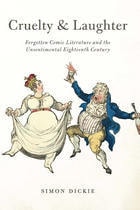
Forgotten Comic Literature and the Unsentimental Eighteenth CenturySimon Dickie
University of Chicago Press, 2011
Eighteenth-century British culture is often seen as polite and sentimental—the creation of an emerging middle class. Simon Dickie disputes these assumptions in Cruelty and Laughter, a wildly enjoyable but shocking plunge into the forgotten comic literature of the age. Beneath the surface of Enlightenment civility, Dickie uncovers a rich vein of cruel humor that forces us to recognize just how slowly ordinary human sufferings became worthy of sympathy.
Delving into an enormous archive of comic novels, jestbooks, farces, variety shows, and cartoons, Dickie finds a vast repository of jokes about cripples, blind men, rape, and wife-beating. Epigrams about syphilis and scurvy sit alongside one-act comedies about hunchbacks in love. He shows us that everyone—rich and poor, women as well as men—laughed along. In the process, Dickie also expands our understanding of many of the century’s major authors, including Samuel Richardson, Lady Mary Wortley Montagu, Tobias Smollett, Frances Burney, and Jane Austen. He devotes particular attention to Henry Fielding’s Joseph Andrews, a novel that reflects repeatedly on the limits of compassion and the ethical problems of laughter. Cruelty and Laughter is an engaging, far-reaching study of the other side of culture in eighteenth-century Britain.
Cul de Sac
Patrimony, Capitalism, and Slavery in French Saint-DominguePaul Cheney
University of Chicago Press, 2017
Focusing on correspondence between the Ferronnayses and their plantation managers, Cul de Sac proposes that the Caribbean plantation system, with its reliance on factory-like production processes and highly integrated markets, was a particularly modern expression of eighteenth-century capitalism. But it rested on a foundation of economic and political traditionalism that stymied growth and adaptation. The result was a system heading toward collapse as planters, facing a series of larger crises in the French empire, vainly attempted to rein in the inherent violence and instability of the slave society they had built. In recovering the lost world of the French Antillean plantation, Cul de Sac ultimately reveals how the capitalism of the plantation complex persisted not as a dynamic source of progress, but from the inertia of a degenerate system headed down an economic and ideological dead end.

Cultivating Peace
The Virgilian Georgic in English, 1650-1750Schoenberger, Melissa
Bucknell University Press, 2019
Published by Bucknell University Press. Distributed worldwide by Rutgers University Press.
Culture and Language at Crossed Purposes
The Unsettled Records of American SettlementJerome McGann
University of Chicago Press, 2022
Classic American literature, Jerome McGann argues, is haunted by the betrayal of seventeenth- and eighteenth-century Indian treaties—“a stunned memory preserved in the negative spaces of the treaty records.” A noted scholar of the “textual conditions” of literature, McGann investigates canonical works from the colonial period, including the Arbella sermon and key writings of William Bradford, John Winthrop, Anne Bradstreet, Cotton Mather’s Magnalia, Benjamin Franklin’s celebrated treaty folios and Autobiography, and Thomas Jefferson’s Notes on the State of Virginia. These are highly practical, purpose-driven works—the record of Enlightenment dreams put to the severe test of dangerous conditions. McGann suggests that the treaty-makers never doubted the unsettled character of what they were prosecuting, and a similar conflicted ethos pervades these works. Like the treaty records, they deliberately test themselves against stringent measures of truth and accomplishment and show a distinctive consciousness of their limits and failures. McGann’s book is ultimately a reminder of the public importance of truth and memory—the vocational commitments of humanist scholars and educators.
Cultures of Print
Essays in the History of the BookDavid D. Hall
University of Massachusetts Press, 1996
David D. Hall examines the interchange between popular and learned cultures and the practices of reading and writing. His writings deal with change and continuity, exploring the possibility of a reading revolution and arguing for the long duration of a Protestant vernacular tradition. A newly written essay on book culture in the early Chesapeake describes a system of scribal publication. The pieces reflect Hall's belief that the better we understand the production and consumption of books, the closer we come to a social history of culture.
Curators and Culture
The Museum Movement in America, 1740-1870Joel J. Orosz
University of Alabama Press, 1990
Tracing the birth of American museums and the curators who shaped a nation’s cultural identity.
As they formed their pioneer museums, these men were guided not so much by European examples, but rather by the imperatives of the American democratic culture, including the Enlightenment, the simultaneous decline of the respectability and rise of the middle classes, the Age of Egalitarianism, and the advent of professionalism in the sciences. Thus the pre-1870 American museum was neither the frivolous sideshow some critics have imagined, nor the enclave for elitists that others have charged. Instead, the proprietors displayed serious motives and egalitarian aspirations.
The conflicting demands for popular education on the one hand and professionalism on the other were a continuing source of tension in American museums after about 1835, but by 1870 the two claims had synthesized into a rough parity. This synthesis, the "American Compromise," has remained the basic model of museums in America down to the present. Thus, by 1870, the form of the modern American museum as an institution which simultaneously provides popular education and promotes scholarly research was completely developed.
Curiosity
A Cultural History of Early Modern InquiryBarbara M. Benedict
University of Chicago Press, 2001
In this striking social history, Barbara M. Benedict draws on the texts of the early modern period to discover the era's attitudes toward curiosity, a trait we learn was often depicted as an unsavory form of transgression or cultural ambition.
Curtain Calls
British and American Women and the Theater, 1660–1820Mary A. Schofield
Ohio University Press, 1991
“I here and there o’heard a Coxcomb cry,
Ah, rot—’tis a Woman’s Comedy.”
Thus Aphra Behn ushers in a new era for women in the British Theatre (Sir Patient Fancy, 1678). In the hundred years that were to follow—and exactly those years that Curtain Calls examines—women truly took the theater world by storm.
For each woman who chose a career in the theater world of the eighteenth century, there is a unique tale of struggle, insult, success, good or bad fortune, disaster, seduction, or fame. Whether acting, writing, reviewing, or stage managing, women played a major, if frequently unacknowledged, role in the history of the theater from the late seventeenth through the early nineteenth centuries. From Alpha Behn’s earliest plays through the glorious celebrity of Sara Siddons, women molded the taste of the age and carved out in the theater one of the few available opportunities for independence and renown.
Not all the women who tried succeeded, of course, and even the best faced opposition as they challenged the male stronghold of playwriting and theater managing. Curtain Calls maps the new territory as these pioneering women staked it for their own; it chronicles their lives, their triumphs, and their losses.
We begin with Aphra Behn, whose first play was staged in 1670, and conclude in the early decades of the nineteenth century with Inchbald and Siddons. The one hundred and fifty years encompassed by their lives contain the careers of dozens of lesser–known women, a network, as Dr. Johnson would have it, encompassing both talent and tribulation.
Contributors include: Edward Langhans, Linda R. Payne, Pat Rogers, Maureen e. Mulvihill, Deborah Payne, Betty Rizzo, Ellen Donkin, Frances M. Kavenik, Jessica Munns, nancy Cotton, Edna L. Steevs, Doreen Saar, Jean B. Kern, Katherine M. Rogers, Constance Clark, William J. Burling, Judith Phillips Stanton, Douglas Butler, Rose Zimbardo, and the editors.