Results by title
51 books match the query '1941-' and 4 start with c
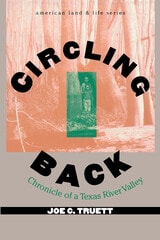
Circling Back
Chronicle of a Texas River ValleyJoe C. Truett
University of Iowa Press, 1996
“There was so much space.” These words epitomize ecologist Joe Truett's boyhood memories of the Angelina River valley in East Texas. Years and miles later, back home for the funeral of his grandfather, Truett began a long meditation on the world Corbett Graham had known and he himself had glimpsed, a now-vanished world where wild hogs and countless other animals rustled through the leaves, cows ate pinewoods grass instead of corn, oaks and hickories and longleaf pines were untouched by the corporate ax, and the river flowed freely. Truett's meditation resulted in this clear-sighted portrait of a place over time, its layers revealed by his love and care and curiosity.Truett celebrates his family's heritage and the unspoiled natural world of the Piney Woods without nostalgia. He recreates an older, simpler, more worthy age, but he knows that we have lost touch with it because we wanted to: he laments the loss but understands it. What makes his prose so moving and so redeeming is this precise combination of honesty and sorrow, overlaid by a quiet passion for both the natural and the human worlds.
Confessions of Joan the Tall
Joan Cusack Handler
CavanKerry Press, 2012
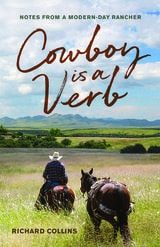
Cowboy is a Verb
Notes from a Modern-day RancherRichard Collins
University of Nevada Press, 2019
A born storyteller with a flair for words, Collins breathes life into the geology, history, and interdependency of land, water, and native and introduced plants and animals. He conjures indelible portraits of the hardworking, dedicated people he comes to know. With both humor and humility, he recounts the day-to-day challenges of ranch life such as how to build a productive herd, distribute your cattle evenly across a rough and rocky landscape, and establish a grazing system that allows pastures enough time to recover. He also intimately recounts a battle over the endangered Gila topminnow and how he and his neighbors worked with university range scientists, forest service conservationists, and funding agencies to improve their ranches as well as the ecological health of the Redrock Canyon watershed.
Ranchers who want to stay in the game don’t dominate the landscape; instead, they have to continually study the land and the animals it supports. Collins is a keen observer of both. He demonstrates that patience, resilience, and a common-sense approach to conservation and range management are what counts, combined with an enduring affection for nature, its animals, and the land. Cowboy is a Verb is not a romanticized story of cowboy life on the range, rather it is a complex story of the complicated work involved with being a rancher in the twenty-first-century West.
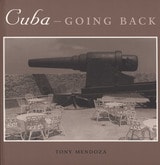
Cuba--Going Back
By Tony Mendoza
University of Texas Press, 1999
Imagine being unable to return to your homeland for thirty-six years. What would you do if you finally got a chance to go back?
In 1996, after travel restrictions between the United States and Cuba were relaxed, Cuban exile Tony Mendoza answered that question. Taking his cameras, notebooks, and an unquenchable curiosity, he returned for his first visit to Cuba since summer of 1960, when he emigrated with his family at age eighteen. In this book he presents over eighty evocative photographs accompanied by a beautifully written text that mingles the voices of many Cubans with his own to offer a compelling portrait of a resilient people awaiting the inevitable passing of the socialist system that has failed them.
His photographs and interviews bear striking witness to the hardships and inequalities that exist in this workers' "paradise," where the daily struggle to make ends meet on an average income of eight dollars a month has created a longing for change even in formerly ardent revolutionaries. At the same time, Cuba—Going Back is an eloquent record of a personal journey back in time and memory that will resonate with viewers and readers both within and beyond the Cuban American community. It belongs on the shelves of anyone who values excellent photography and well-crafted prose.