Results by title
193 books match the query '1945-' and 15 start with c

Categorically Unequal
The American Stratification SystemDouglas S. Massey
Russell Sage Foundation, 2007
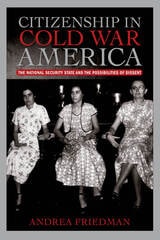
Citizenship in Cold War America
The National Security State and the Possibilities of DissentAndrea Friedman
University of Massachusetts Press, 2014
The stories told here capture a wide-ranging debate about the workings of the national security state and the meaning of American citizenship. Some of the participants in this debate—women like war bride Ellen Knauff and Pentagon employee Annie Lee Moss—were able to make their own experiences compelling examples of the threats posed by the national security regime. Others, such as Ruth Reynolds and Lolita Lebrón, who advocated an end to American empire in Puerto Rico, or the psychiatrist Fredric Wertham, who sought to change the very definition of national security, were less successful. Together, however, they exposed the gap between democratic ideals and government policies.
Friedman traverses immigration law and loyalty boards, popular culture and theoretical treatises, U.S. court-rooms and Puerto Rican jails, to demonstrate how Cold War repression made visible in new ways the unevenness and limitations of American citizenship. Highlighting the ways that race and gender shaped critiques and defenses of the national security regime, she offers new insight into the contradictions of Cold War political culture.
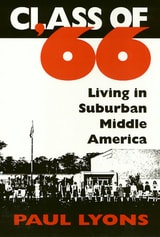
Class Of '66
Living in Suburban Middle AmericaPaul Lyons
Temple University Press, 1994
Paul Lyons interviewed 47 members of the class of 1966, recording recollections of their school days, politics, work, family life, community, and expectations for future careers and family. Each chapter is complemented by personal profiles of individual "Coasters." Removed from both the urban experience and that of the elite suburbs, these teenagers disprove popular cultural assumptions that all baby boomers, with few exceptions, went to Woodstock, protested against the Vietnam War, engaged in drug experimentation, or joined the hippie counter-culture. Instead, Lyons' study explores how their then relative ambivalence to political and cultural rebellion did not preclude many "Coasters" from indirectly incorporating over the years certain core Sixties values on issues of race, gender, mobility, and patriotism.
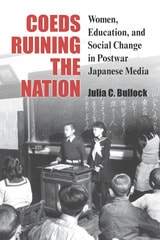
Coeds Ruining the Nation
Women, Education, and Social Change in Postwar Japanese MediaJulia C. Bullock
University of Michigan Press, 2019
This is the first book in English to explore the arguments for and against coeducation as presented in newspaper and magazine articles, cartoons, student-authored school newsletters, and roundtable discussions published in the Japanese press as these reforms were being implemented. It complicates the notion of the postwar years as a moment of rupture, highlighting prewar experiments with coeducation that belied objections that the practice was a foreign imposition and therefore “unnatural” for Japanese culture. It also illustrates a remarkable degree of continuity between prewar and postwar models of femininity, arguing that Occupation-era guarantees of equal educational opportunity were ultimately repurposed toward a gendered division of labor that underwrote the postwar project of economic recovery. Finally, it excavates discourses of gender and sexuality underlying the moral panic surrounding coeducation to demonstrate that claims of rampant sexual deviance and other concerns were employed as disciplinary mechanisms to reinforce an ideology of harmonious gender complementarity and to dissuade women from pursuing conventionally masculine prerogatives.
Cold War Anthropology
The CIA, the Pentagon, and the Growth of Dual Use AnthropologyDavid H. Price
Duke University Press, 2016
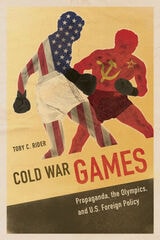
Cold War Games
Propaganda, the Olympics, and U.S. Foreign PolicyToby C Rider
University of Illinois Press, 2016
Drawing on newly declassified materials and archives, Toby C. Rider chronicles how the U.S. government used the Olympics to promote democracy and its own policy aims during the tense early phase of the Cold War. Rider shows how the government, though constrained by traditions against interference in the Games, eluded detection by cooperating with private groups, including secretly funded émigré organizations bent on liberating their home countries from Soviet control. At the same time, the United States utilized Olympic host cities as launching pads for hyping the American economic and political system. Behind the scenes, meanwhile, the government attempted clandestine manipulation of the International Olympic Committee. Rider also details the campaigns that sent propaganda materials around the globe as the United States mobilized culture in general, and sports in particular, to fight the communist threat.
Deeply researched and boldly argued, Cold War Games recovers an essential chapter in Olympic and postwar history.
Commoning with George Caffentzis and Silvia Federic
Camille Barbagallo, Nicholas Beuret and David Harvie
Pluto Press, 2019
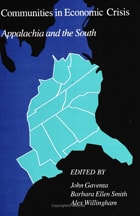
Communities In Economic Crisis
edited by John Gaventa, Barbara Ellen Smith and Alex Willingham
Temple University Press, 1990
Hard times are no stranger to the people of Appalachia and the South. Earlier books have documented the low wages of the textile industry, boom-and-bust cycles of coal mining, and debt peonage of Southern agriculture that have established a heritage of poverty that endures. This book is a unique collection of essays by people who are actively involved in the efforts to challenge economic injustice in these regions and to empower the residents to build democratic alternatives.
In the series Labor and Social Change, edited by Paula Rayman and Carmen Sirianni.
Confession of a Serial Killer
The Untold Story of Dennis Rader, the BTK KillerKatherine Ramsland
University Press of New England, 2017
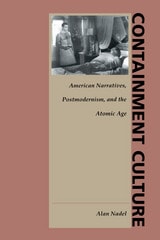
Containment Culture
American Narratives, Postmodernism, and the Atomic AgeAlan Nadel
Duke University Press, 1995
Examining a broad sweep of American culture, from the work of George Kennan to Playboy Magazine, from the movies of Doris Day and Walt Disney to those of Cecil B. DeMille and Alfred Hitchcock, from James Bond to Holden Caulfield, Nadel discloses the remarkable pervasiveness of the containment narrative. Drawing subtly on insights provided by contemporary theorists, including Baudrillard, Foucault, Jameson, Sedgwick, Certeau, and Hayden White, he situates the rhetoric of the Cold War within a gendered narrative powered by the unspoken potency of the atom. He then traces the breakdown of this discourse of containment through such events as the Bay of Pigs invasion and the Free Speech Movement at Berkeley, and ties its collapse to the onset of American postmodernism, typified by works such as Catch–22 and The Man Who Shot Liberty Valence.
An important work of cultural criticism, Containment Culture links atomic power with postmodernism and postwar politics, and shows how a multifarious national policy can become part of a nation’s cultural agenda and a source of meaning for its citizenry.
Crabgrass Catholicism
How Suburbanization Transformed Faith and Politics in Postwar AmericaStephen M. Koeth
University of Chicago Press, 2025
The 1960s in America were a time of revolt against the stifling conformism embodied in the sprawling, uniform suburbs of the 1950s. Typically, the reforms of the Catholic Church’s Second Vatican Council, which aimed to make the Church more modern and accessible, are seen as one result of that broader cultural liberalization. Yet in Crabgrass Catholicism, Stephen M. Koeth demonstrates that the liberalization of the Church was instead the product of the mass suburbanization that began some fifteen years earlier. Koeth argues that postwar suburbanization revolutionized the Catholic parish, the relationship between clergy and laity, conceptions of parochial education, and Catholic participation in US politics, and thereby was a significant factor in the religious disaffiliation that only accelerated in subsequent decades.
A novel exploration of the role of Catholics in postwar suburbanization, Crabgrass Catholicism will be of particular interest to urban historians, scholars of American Catholicism and religious studies, and Catholic clergy and laity.
Cults, Martyrs and Good Samaritans
Religion in Contemporary English Political DiscourseJames Crossley
Pluto Press, 2018
From the paternalistic Christianity used to justify ever-intensifying neoliberalism, to the ethnonationalist and protectionist Christianity of Theresa May and Brexit, to the socialist constructions of Christianity by Jeremy Corbyn and Momentum, Crossley guides us through the love affair between politics and Christianity.. Drawing on interviews with politicians, activists, revolutionaries, and voters on either side of Brexit, Crossley reveals how religion is linked to positions on issues of class, capitalism, and foreign policy, and how it can can often challenge dominant class interests, obfuscate potential causes of unrest, and even justify military intervention.
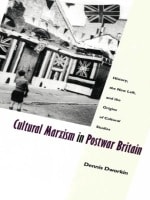
Cultural Marxism in Postwar Britain
History, the New Left, and the Origins of Cultural StudiesDennis Dworkin
Duke University Press, 1997
Limited to neither a single discipline nor a particular intellectual figure, this book comprehensively views British cultural Marxism in terms of the dialogue between historians and the originators of cultural studies and in its relationship to the new left and feminist movements. From the contributions of Eric Hobsbawm, Christopher Hill, Rodney Hilton, Sheila Rowbotham, Catherine Hall, and E. P. Thompson to those of Perry Anderson, Barbara Taylor, Raymond Williams, Dick Hebdige, and Stuart Hall, Dworkin examines the debates over issues of culture and society, structure and agency, experience and ideology, and theory and practice. The rise, demise, and reorganization of journals such as The Reasoner, The New Reasoner, Universities and Left Review, New Left Review, Past and Present, are also part of the history told in this volume. In every instance, the focus of Dworkin’s attention is the intellectual work seen in its political context. Cultural Marxism in Postwar Britain captures the excitement and commitment that more than one generation of historians, literary critics, art historians, philosophers, and cultural theorists have felt about an unorthodox and critical tradition of Marxist theory.
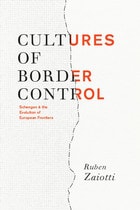
Cultures of Border Control
Schengen and the Evolution of European FrontiersRuben Zaiotti
University of Chicago Press, 2011
In recent years, a number of European countries abolished national border controls in favor of Europe’s external frontiers. In doing so, they challenged long-established conceptions of sovereignty, territoriality, and security in world affairs.
Setting forth a new analytic framework informed by constructivism and pragmatism, Ruben Zaiotti traces the transformation of underlying assumptions and cultural practices guiding European policymakers and postnational Europe, shedding light on current trends characterizing its politics and relations with others. The book also includes a fascinating comparison to developments in North America, where the United States has pursued more restrictive border control strategies since 9/11. As a broad survey of the origins, evolution, and implications of this remarkable development in European integration, Cultures of Border Control will be of interest to students and scholars of international relations and political geography.
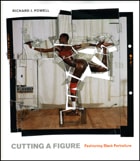
Cutting a Figure
Fashioning Black PortraitureRichard J. Powell
University of Chicago Press, 2009
Powell forcefully supports this argument with evidence drawn from a survey of nineteenth-century portraits, in-depth case studies of the postwar fashion model Donyale Luna and the contemporary portraitist Barkley L. Hendricks, and insightful analyses of images created since the late 1970s. Along the way, he discusses major artists—such as Frédéric Bazille, John Singer Sargent, James Van Der Zee, and David Hammons—alongside such overlooked producers of black visual culture as the Tonka and Nike corporations. Combining previously unpublished images with scrupulous archival research, Cutting a Figure illuminates the ideological nature of the genre and the centrality of race and cultural identity in understanding modern and contemporary portraiture.