Results by title
1713 books match the query '21St Century' and 129 start with c
COVID Diagnosed the System
Lessons from the Pandemic in Massachusetts PrisonsBridget Conley
Rutgers University Press, 0
The American criminal justice system was in flux in 2020, a clash of possibilities for reform, retrenchment, and radical change—nowhere more so than in Massachusetts, which had just passed major criminal justice reform. The COVID-19 pandemic interrupted the moment with life-threatening force, ravaging people held in prisons and jails across the country. However, it did not so much create new deprivations and suffering as it exposed prisons as sites of physical, institutional, and psychological violence that do not make communities safer. At the same time, advocates for people in prisons—including many incarcerated and formerly incarcerated people—seized on the pandemic’s disruptions to demand change. Detailing the first year of the pandemic inside the Massachusetts state prison system, this book argues that the history of the pandemic inside prisons exposed both the cruelties of incarceration and the power of change when it is led by directly affected people.
COVID and...
How to Do Rhetoric in a PandemicEmily Winderman
Michigan State University Press, 2023
Cacaphonies
The Excremental Canon of French LiteratureAnnabel L. Kim
University of Minnesota Press, 2022
Exploring why there is so much fecal matter in literary works that matter
Cacaphonies takes fecal matter and its place in literature seriously. Readers and critics have too long overlooked excrement’s vital role in the twentieth- and twenty-first-century French canon. In a stark challenge to the tendency to view this literature through sanitizing abstractions, Annabel L. Kim undertakes close readings of key authors to argue for feces as a figure of radical equality, both a literary object and a reflection on literature itself, without which literary studies is impoverished and sterile.
Following the fecal through line in works by Céline, Beckett, Genet, Sartre, Duras, and Gary and the contemporary authors Anne Garréta and Daniel Pennac, Kim shows that shit, far from vanishing from the canon after the early modern period, remains present in the modern and contemporary French literature that follows. She argues that all the shit in the canon expresses a call to democratize literature, making literature for all, just as shit is for (or of) all. She attends to its presence in this prized element of French identity, treating it as a continually uttered desire to manifest the universality France aspires to—as encapsulated by the slogan Liberté, égalité, fraternité—but fails to realize. In shit there is a concrete universalism that traverses bodies with disregard for embodied differences.
Cacaphonies reminds us that literature, and the ideas to be found therein, cannot be separated from the corporeal envelopes that create and receive them. In so doing, it reveals the aesthetic, political, and ethical potential of shit and its capacity to transform literature and life.
Cairo Pop
Youth Music in Contemporary EgyptDaniel J. Gilman
University of Minnesota Press, 2014
Cairo Pop is the first book to examine the dominant popular music of Egypt, shababiyya. Scorned or ignored by scholars and older Egyptians alike, shababiyya plays incessantly in Cairo, even while Egyptian youth joined in mass protests against their government, which eventually helped oust longtime Egyptian president Hosni Mubarak in early 2011. Living in Cairo at the time of the revolution, Daniel Gilman saw, and more importantly heard, the impact that popular music can have on culture and politics. Here he contributes a richly ethnographic analysis of the relationship between mass-mediated popular music, modernity, and nationalism in the Arab world.
Before Cairo Pop, most scholarship on the popular music of Egypt focused on musiqa al-ṭarab. Immensely popular in the 1950s and ’60s and even into the ’70s, musiqa al-ṭarab adheres to Arabic musical theory, with non-Western scales based on tunings of the strings of the ‘ud—the lute that features prominently, nearly ubiquitously, in Arabic music. However, today one in five Egyptians is between the ages of 15 and 24; half the population is under the age of 25. And shababiyya is their music of choice. By speaking informally with dozens of everyday young people in Cairo, Gilman comes to understand shababiyya as more than just a musical genre: sometimes it is for dancing or seduction, other times it propels social activism, at others it is simply sonic junk food.
In addition to providing a clear Egyptian musical history as well as a succinct modern political history of the nation, Cairo Pop elevates the aural and visual aesthetic of shababiyya—and its role in the lives of a nation’s youth.
Cairo
City of SandMaria Golia
Reaktion Books, 2004
Cairo steps inside the interactions between Cairenes, examining the roles of family, tradition and bureaucracy in everyday life. The book explores Cairo's relationship with its "others", from the French and British occupations to modern influences like tourism and consumerism. Cairo also discusses characteristic styles of communication, and linguistic mêmes, including slang, grandiloquence, curses and jokes.
Cairo exists by virtue of these interactions, synergies of necessity, creativity and the presence or absence of power. Cairo: City of Sand reveals a peerless balancing act, and transmits the city's overriding message: the breadth of the human capacity for loss, astonishment and delight.
Campaign Inc.
How Leadership and Organization Propelled Barack Obama to the White HouseHenry F. De Sio., Jr.
University of Iowa Press, 2014
De Sio shows readers that Obama himself was direct about his vision for the campaign when he instructed his staff to “run it like a business.” Thus, this is less the story of Barack Obama, candidate, and more the story of Barack Obama, CEO. Because campaigns are launched from scratch during every election cycle, they are the ultimate entrepreneurial experience. In the course of the election, the Obama campaign scaled up from a scrappy start-up to a nearly $1 billion operation, becoming a hothouse environment on which the glare of the media spotlight was permanently trained.
Campaign Inc. allows readers to peek behind the curtain at the underdog organization that brought down the Clinton campaign and later went on to defeat the Republican machine, while offering lessons in leadership and organization to innovators, executives, and entrepreneurs.
Cancel Wars
How Universities Can Foster Free Speech, Promote Inclusion, and Renew DemocracySigal R. Ben-Porath
University of Chicago Press, 2023
College campuses have become flashpoints of the current culture war and, consequently, much ink has been spilled over the relationship between universities and the cultivation or coddling of young American minds. Philosopher Sigal R. Ben-Porath takes head-on arguments that infantilize students who speak out against violent and racist discourse on campus or rehash interpretations of the First Amendment. Ben-Porath sets out to demonstrate the role of the university in American society and, specifically, how it can model free speech in ways that promote democratic ideals.
In Cancel Wars, she argues that the escalating struggles over “cancel culture,” “safe spaces,” and free speech on campus are a manifestation of broader democratic erosion in the United States. At the same time, she takes a nuanced approach to the legitimate claims of harm put forward by those who are targeted by hate speech. Ben-Porath’s focus on the boundaries of acceptable speech (and on the disproportional impact that hate speech has on marginalized groups) sheds light on the responsibility of institutions to respond to extreme speech in ways that proactively establish conversations across difference. Establishing these conversations has profound implications for political discourse beyond the boundaries of collegiate institutions. If we can draw on the truth, expertise, and reliable sources of information that are within the work of academic institutions, we might harness the shared construction of knowledge that takes place at schools, colleges, and universities against truth decay. Of interest to teachers and school leaders, this book shows that by expanding and disseminating knowledge, universities can help rekindle the civic trust that is necessary for revitalizing democracy.

Cannibal Translation
Literary Reciprocity in Contemporary Latin AmericaIsabel C. Gómez
Northwestern University Press, 2023
Winner of the 2024 ACLA Harry Levin Prize • Honorable Mention MLA Katherine Singer Kovacs Prize
A bold comparative study illustrating the creative potential of translations that embrace mutuality and resist assimilation
Cannibal translators digest, recombine, transform, and trouble their source materials. Isabel C. Gómez makes the case for this model of literary production by excavating a network of translation projects in Latin America that includes canonical writers of the twentieth century, such as Haroldo and Augusto de Campos, Rosario Castellanos, Clarice Lispector, José Emilio Pacheco, Octavio Paz, and Ángel Rama. Building on the avant-garde reclaiming of cannibalism as an Indigenous practice meant to honorably incorporate the other into the self, these authors took up Brazilian theories of translation in Spanish to fashion a distinctly Latin American literary exchange, one that rejected normative and Anglocentric approaches to translation and developed collaborative techniques to bring about a new understanding of world literature.
By shedding new light on the political and aesthetic pathways of translation movements beyond the Global North, Gómez offers an alternative conception of the theoretical and ethical challenges posed by this artistic practice. Cannibal Translation: Literary Reciprocity in Contemporary Latin America mobilizes a capacious archive of personal letters, publishers’ records, newspapers, and new media to illuminate inventive strategies of collectivity and process, such as untranslation, transcreation, intersectional autobiographical translation, and transpeaking. The book invites readers to find fresh meaning in other translational histories and question the practices that mediate literary circulation.
Capitalism in the 21st Century
Through the Prism of ValueMichael Roberts
Pluto Press, 2022
Contemporary capitalism is always evolving. From digital technologies to cryptocurrencies, current trends in political economy are much discussed, but often little understood. So where can we turn for clarity? As Michael Roberts and Guglielmo Carchedi argue, new trends don't necessarily call for a new theory.
In Capitalism in the 21st Century, the authors show how Marx's law of value explains numerous issues in our modern world. In both advanced economies and the periphery, value theory provides a piercing analytical framework through which we can approach topics as varied as labor, profitability, technology, the environment, the role of China, imperialism, and the state.
An ambitious work that will appeal to both heterodox economists and labor movement activists alike, as it demonstrates the ongoing contemporary relevance of Marxist theory to current trends in political economy.

Capitalism's Other Times
Fiction, Speculation, and FuturityGreg Forter
Northwestern University Press, 2027
Reorienting critical theory and literary criticism to consider how the present contains seeds of a future beyond capitalism
Critical theorists have long held to the axiom that it is easier to imagine the end of the world than the end of capitalism. Greg Forter starts this wide-ranging study of contemporary literature by suggesting that this position is increasingly hard to maintain. In the wake of the 2008 financial crisis, the global rise of the New Right, and the mass disruptions and despair wrought by COVID-19, the story that capital had built about itself has begun to reveal cracks in its foundations. Capitalism has not succeeded in fully flattening or homogenizing time. Developing in combined and uneven fashion, it has retained the residues of pasts that suggest other futures are possible. Forter assembles a corpus of novels that theorize this insight. He names these fictions speculative realism to highlight how they map the closures of our present while opening that present onto other, more speculative orders of time. In the face of ongoing, overlapping crises, Forter posits, these fictions locate flickering intimations of a utopian somewhen; they illuminate a present charged with precipitates of a transfigured but now imaginable future.
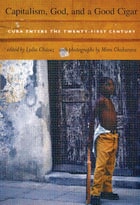
Capitalism, God, and a Good Cigar
Cuba Enters the Twenty-first CenturyLydia Chávez, ed.
Duke University Press, 2005
Based on reporting by journalists, writers, and documentary filmmakers since 2001, each of the essays collected here covers a particular dimension of contemporary Cuban society, revealing what it is like to have lived, for more than a decade, suspended between communism and capitalism. There are pieces on hip hop musicians, fiction writing and censorship, the state of ballet and the performing arts, and the role of computers and the Internet. Other essays address the shrinking yet still sizeable numbers of true believers in the promise of socialist revolution, the legendary cigar industry, the changing state of religion, the significance of the recent influx of money and people from Spain, and the tensions between recent Cuban emigrants and previous generations of exiles. Including more than seventy striking documentary photographs of Cuba’s people, countryside, and city streets, this richly illustrated collection offers keen, even-handed insights into the abundant ironies of life in Cuba today.
Contributors. Juliana Barbassa, Ana Campoy, Mimi Chakarova, Lydia Chávez, John Coté, Julian Foley, Angel González, Megan Lardner, Ezequiel Minaya, Daniela Mohor, Archana Pyati, Alicia Roca, Olga R. Rodríguez, Bret Sigler, Annelise Wunderlich

Capitalism’s Tomorrows
Imagining the Future of BusinessGavin Benke
University of Chicago Press, 0
The institutional evolution of “corporate futurism” and its influence on our view of the role of private enterprise in society.
While the bright capitalist future that the power elite of postwar America dreamed of hasn’t come to pass, its influence and repercussions continue to resonate. Gavin Benke shows that the cultural, intellectual, and political rise of neoliberalism was not inevitable. Instead, beginning in the early 1960s, a group that he dubs “corporate futurists” imagined a differently shaped and community-minded version of capitalism. Most interestingly, Benke goes beyond the once-big names in the field (such as Alvin Toffler and Daniel Bell) to show how deep-seated and granular the engagement with futurism was.
Using an incredible array of futurists’ reports, conference proceedings, and internal deliberations at places like the infamous RAND Corporation, Capitalism’s Tomorrows uncovers a moment of genuine introspection about capitalism’s development and shows how it is subject to our imaginative capacity and ability to shape how these systems work.
Captivating Technology
Race, Carceral Technoscience, and Liberatory Imagination in Everyday LifeRuha Benjamin, editor
Duke University Press, 2019
Carceral Liberalism
Feminist Voices against State ViolenceEdited by Shreerekha Pillai. Foreword by Demita Frazier
University of Illinois Press, 2023
One of Ms. Magazine's Most Anticipated Books of 2023
Carceral liberalism emerges from the confluence of neoliberalism, carcerality, and patriarchy to construct a powerful ruse disguised as freedom. It waves the feminist flag while keeping most women still at the margins. It speaks of a post-race society while one in three Black men remain incarcerated. It sings the praises of capital while the dispossessed remain mired in debt.
Shreerekha Pillai edits essays on carceral liberalism that continue the trajectory of the Combahee River Collective and the many people inspired by its vision of feminist solidarity and radical liberation. Academics, activists, writers, and a formerly incarcerated social worker look at feminist resurgence and resistance within, at the threshold of, and outside state violence; observe and record direct and indirect forms of carcerality sponsored by the state and shaped by state structures, traditions, and actors; and critique carcerality. Acclaimed poets like Honorée Fanonne Jeffers and Solmaz Sharif amplify the volume’s themes in works that bookend each section.
Cutting-edge yet historically grounded, Carceral Liberalism examines an American ideological creation that advances imperialism, anti-blackness, capitalism, and patriarchy.
Contributors: Maria F. Curtis, Joanna Eleftheriou, Autumn Elizabeth and Zarinah Agnew and D Coulombe, Jeremy Eugene, Demita Frazier, Honorée Fanonne Jeffers, Alka Kurian, Cassandra D. Little, Beth Matusoff Merfish, Francisco Argüelles Paz y Puente, Shreerekha Pillai, Marta Romero-Delgado, Ravi Shankar, Solmaz Sharif, Shailza Sharma, Tria Blu Wakpa and Jennifer Musial, Javier Zamora
Caribes 2.0
New Media, Globalization, and the Afterlives of DisasterJossianna Arroyo
Rutgers University Press, 2023
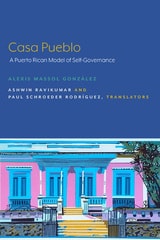
Casa Pueblo
A Puerto Rican Model of Self-GovernanceAlexis Massol González, Translated by Ashwin Ravikumar and Paul Schroeder Rodríguez
Lever Press, 2022
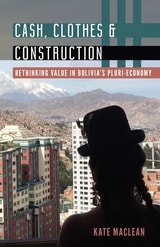
Cash, Clothes, and Construction
Rethinking Value in Bolivia's Pluri-economyKate Maclean
University of Minnesota Press, 2023
A groundbreaking feminist perspective on Movimiento al Socialismo (MAS) rule in Bolivia and the country’s radical transformation under Evo Morales
The presidency of Evo Morales in Bolivia (2006–2019) has produced considerable academic scholarship, much of it focused on indigenous social movements or extractivism, and often triumphalist about the successes of Morales’s Movimiento al Socialismo (MAS). Turning a new lens on the movement, Cash, Clothes, and Construction presents the first gender-based analysis of “pluri-economy,” a central pillar of Bolivia’s program under Morales, evaluating the potential of this vision of “an economy where all economies fit” to embrace feminist critiques of capitalism and economic diversity.
Based on more than twelve years of empirical research exploring the remarkable transformations in Bolivia since 2006, this book focuses on three sectors—finance, clothing, and construction—in which indigenous women have defied gendered expectations. Kate Maclean presents detailed case studies of women selling secondhand high street clothes from the United States in the vast, peri-urban markets of Bolivian cities; Aymaran designers of new pollera (traditional Andean dress) fashions, one of whom exhibited her collection in New York City; and the powerful and rich chola paceña, whose real estate investments have transformed the cultural maps of La Paz and El Alto.
Cash, Clothes, and Construction offers a gendered analysis of the mission of MAS to dismantle neoliberalism and decolonize politics and economy from the perspective of the Indigenous women who have radically transformed Bolivia’s economy from the ground up.
Cassian's Prayer for the 21st Century
John Levko
University of Scranton Press, 2000

Celebrating 100 Years of the Texas Folklore Society, 1909-2009
Kenneth L. Untiedt
University of North Texas Press, 2009
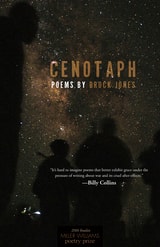
Cenotaph
PoemsBrock Jones
University of Arkansas Press, 2016
Finalist, 2016 Miller Williams Poetry Prize, edited by Billy Collins
Out of the contradiction, paradox, loss, and strange beauty of contemporary warfare, Brock Jones brings us Cenotaph, a collection of poems that have as their genesis Jones’s deployments to Iraq in 2002 and 2005, when he was in the US Army.
These are war poems, but also love poems and hate poems, poems about dying and living, poems about hope and hopelessness. These are poems that beautifully reflect Jones’s resignation to and rejection of the impossibility of saying anything definitive or honest about war.
These are poems that strive to do what poet Bruce Weigl described as the poet’s job: to find “some kind of miraculous way th at if you work hard enough to get the words right, that which you call horrific and wrong is defeated.”
Cenotaph is a poet doing the poet’s work: trying, hoping to get the words right.
Central American Migrations in the Twenty-First Century
Edited by Mauricio Espinoza, Miroslava Arely Rosales Vásquez, and Ignacio Sarmiento
University of Arizona Press, 2023
Central American Migrations in the Twenty-First Century tackles head-on the way Central America has been portrayed as a region profoundly marked by the migration of its people. Through an intersectional approach, this volume demonstrates how the migration experience is complex and affected by gender, age, language, ethnicity, social class, migratory status, and other variables. Contributors carefully examine a broad range of topics, including forced migration, deportation and outsourcing, intraregional displacements, the role of social media, and the representations of human mobility in performance, film, and literature. The volume establishes a productive dialogue between humanities and social sciences scholars, and it paves the way for fruitful future discussions on the region’s complex migratory processes.
Contributors
Guillermo Acuña
Andrew Bentley
Fiore Bran-Aragón
Tiffanie Clark
Mauricio Espinoza
Hilary Goodfriend
Leda Carolina Lozier
Judith Martínez
Alicia V. Nuñez
Miroslava Arely Rosales Vásquez
Manuel Sánchez Cabrera
Ignacio Sarmiento
Gracia Silva
Carolina Simbaña González
María Victoria Véliz
Challenging the Black Atlantic
The New World Novels of Zapata Olivella and GonçalvesJohn T. Maddox IV
Bucknell University Press, 2021
Published by Bucknell University Press. Distributed worldwide by Rutgers University Press.
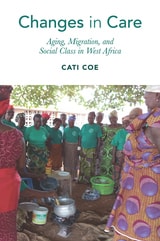
Changes in Care
Aging, Migration, and Social Class in West AfricaCati Coe
Rutgers University Press, 2022
There is a short film that accompanies the book, “Making Happiness: Older People Organize Themselves” (2020), an 11-minute film by Cati Coe. Available at: https://doi.org/doi:10.7282/t3-thke-hp15

Changing Minds or Changing Channels?
Partisan News in an Age of ChoiceKevin Arceneaux and Martin Johnson
University of Chicago Press, 2013
Changing Their Minds?
Donald Trump and Presidential LeadershipGeorge C. Edwards III
University of Chicago Press, 2021
Donald Trump has been a distinctive president, and his arrival in the Oval Office brought new questions. Could someone with his decades of experience as a self-promoter connect with the public and win its support? Could a president who is an experienced negotiator obtain the support in Congress needed to pass his legislative programs? Would we need to adjust the theory of presidential leadership to accommodate a president with unique persuasive skills?
Building on decades of research and employing extensive new data, George C. Edwards III addresses these questions. He finds that President Trump has been no different than other presidents in being constrained by his environment. He moved neither the public nor Congress. Even for an experienced salesman and dealmaker, presidential power is still not the power to persuade. Equally important was the fact that, as Edwards shows, Trump was not able to exploit the opportunities he had. In fact, we learn here that the patterns of the president’s rhetoric and communications and his approach to dealing with Congress ultimately lessened his chances of success. President Trump, it turns out, was often his own agenda’s undoing.
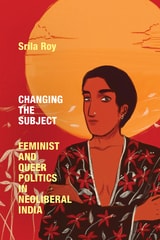
Changing the Subject
Feminist and Queer Politics in Neoliberal IndiaSrila Roy
Duke University Press, 2022
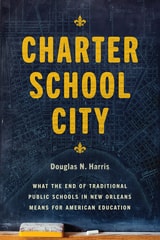
Charter School City
What the End of Traditional Public Schools in New Orleans Means for American EducationDouglas N. Harris
University of Chicago Press, 2020
New Orleans became the first US city ever to adopt a school system based on the principles of markets and economics. When the state took over all of the city’s public schools, it turned them over to non-profit charter school managers accountable under performance-based contracts. Students were no longer obligated to attend a specific school based upon their address, allowing families to act like consumers and choose schools in any neighborhood. The teacher union contract, tenure, and certification rules were eliminated, giving schools autonomy and control to hire and fire as they pleased.
In Charter School City, Douglas N. Harris provides an inside look at how and why these reform decisions were made and offers many surprising findings from one of the most extensive and rigorous evaluations of a district school reform ever conducted. Through close examination of the results, Harris finds that this unprecedented experiment was a noteworthy success on almost every measurable student outcome. But, as Harris shows, New Orleans was uniquely situated for these reforms to work well and that this market-based reform still required some specific and active roles for government. Letting free markets rule on their own without government involvement will not generate the kinds of changes their advocates suggest.
Combining the evidence from New Orleans with that from other cities, Harris draws out the broader lessons of this unprecedented reform effort. At a time when charter school debates are more based on ideology than data, this book is a powerful, evidence-based, and in-depth look at how we can rethink the roles for governments, markets, and nonprofit organizations in education to ensure that America’s schools fulfill their potential for all students.
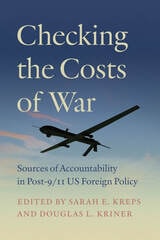
Checking the Costs of War
Sources of Accountability in Post-9/11 US Foreign PolicyEdited by Sarah E. Kreps and Douglas L. Kriner
University of Chicago Press, 2025
A thorough reassessment of how domestic factors do and do not constrain the use of American military force abroad in the early twenty-first century.
More than two decades have passed since the September 11th terrorist attacks resuscitated debates about the “imperial presidency” within the United States. During that same time, the United States has fought costly and inconclusive wars in Iraq and Afghanistan, pivoted to the Pacific to counter China, and pulled its gaze back to Europe and the Middle East in response to wars in Ukraine and Gaza. Moreover, new technologies and ways of funding and staffing wars have made the costs of war less visible to the public while polarization has increased and a new legal doctrine of presidential power has gained force.
Against this backdrop, Checking the Costs of War reassesses how domestic factors have both constrained and failed to constrain the use of military power across different contexts and over time. Richly empirical chapters explore the varying effects of different kinds of potential checks: legislative, public opinion, and bureaucratic. Collectively, chapters offer new insight into the prospects for war and peace today.
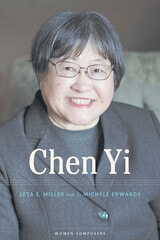
Chen Yi
Leta E. Miller and J. Michele Edwards
University of Illinois Press, 2020
Winner of the Leila Webster Memorial Music Award for the International Alliance for Women in Music of the 2022 Pauline Alderman Awards for Outstanding Scholarship on Women in Music
Chen Yi is the most prominent woman among the renowned group of new wave composers who came to the US from mainland China in the early 1980s. Known for her creative output and a distinctive merging of Chinese and Western influences, Chen built a musical language that references a breathtaking range of sources and crisscrosses geographical and musical borders without eradicating them.
Leta E. Miller and J. Michele Edwards provide an accessible guide to the composer's background and her more than 150 works. Extensive interviews with Chen complement in-depth analyses of selected pieces from Chen's solos for Western or Chinese instruments, chamber works, choral and vocal pieces, and compositions scored for wind ensemble, chamber orchestra, or full orchestra. The authors highlight Chen's compositional strategies, her artistic elaborations, and the voice that links her earliest and most recent music. A concluding discussion addresses questions related to Chen's music and issues such as gender, ethnicity and nationality, transnationalism, border crossing, diaspora, exoticism, and identity.
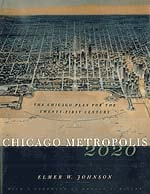
Chicago Metropolis 2020
The Chicago Plan for the Twenty-First CenturyElmer W. Johnson
University of Chicago Press, 2001
Nearly a century later, Chicago, like all cities, faces similar dilemmas: how to reconcile privatism with public control, growth with restraint, wealth with poverty, and beauty with industry. And as it did a hundred years ago with the Burnham Plan, the Commercial Club has sponsored a wholly contemporary plan for the city's future development. Written by Elmer W. Johnson, a lawyer and civic leader, Chicago Metropolis 2020 is a guide for those in all spheres of influence who are working to make cities economically and socially vigorous while addressing the greatest problems modern metropolises face. While Burnham's plan primarily addressed architecture and spatial planning, Chicago Metropolis 2020 addresses all facets of urban life, from public education to suburban sprawl, from transportation to social and economic segregation, with the expressed goal of continuing Chicago's tradition of renewal and foresight.
Chicago Metropolis 2020 is an ambitious and necessary plan for a major city at the turn of the century. In scope and execution, it aims at nothing less than economic vibrancy, quality of life, and equity of opportunity.
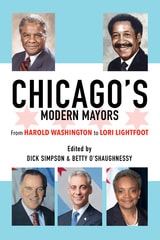
Chicago’s Modern Mayors
From Harold Washington to Lori LightfootEdited by Dick Simpson and Betty O'Shaughnessy
University of Illinois Press, 2024
Chicago’s transformation into a global city began at City Hall. Dick Simpson and Betty O’Shaughnessy edit in-depth analyses of the five mayors that guided the city through this transition beginning with Harold Washington’s 1983 election: Washington, Eugene Sawyer, Richard M. Daley, Rahm Emmanuel, and Lori Lightfoot. Though the respected political science, sociologist, and journalist contributors approach their subjects from distinct perspectives, each essay addresses three essential issues: how and why each mayor won the office; whether the City Council of their time acted as a rubber stamp or independent body; and the ways the unique qualities of each mayor’s administration and accomplishments influenced their legacy.
Filled with expert analysis and valuable insights, Chicago’s Modern Mayors illuminates a time of transition and change and considers the politicians who--for better and worse--shaped the Chicago of today.
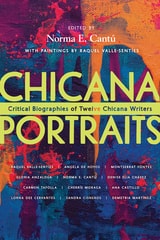
Chicana Portraits
Critical Biographies of Twelve Chicana WritersEdited by Norma E. Cantú; With paintings by Raquel Valle-Sentíes
University of Arizona Press, 2023
Artist Raquel Valle-Sentíes’s portraits bring visual dimension, while essays delve deeply into the authors’ lives for details that inform their literary, artistic, feminist, and political trajectories and sensibilities. The collection brilliantly intersects artistic visual and literary cultural productions, allowing complex themes to emerge, such as the fragility of life, sexism and misogyny, Chicana agency and forging one’s own path, the struggles of becoming a writer and battling self-doubt, economic instability, and political engagement and activism.
Arranged chronologically by birth order of the authors, the book can be read cover to cover for a genealogical overview, or scholars and general readers can easily jump in at any point and read about an individual author, regardless of the chronology.
Biographies included in this work include Raquel Valle-Sentíes, Angela de Hoyos, Montserrat Fontes, Gloria E. Anzaldúa, Norma E. Cantú, Denise Elia Chávez, Carmen Tafolla, Cherríe Moraga, Ana Castillo, Lorna Dee Cervantes, Sandra Cisneros, and Demetria Martínez.
Contributors
Cordelia E. Barrera
Mary Pat Brady
Norma E. Cantú
María Jesus Castro Dopacio
Carlos Nicolás Flores
Myrriah Gómez
Maria Magdalena Guerra de Charur
Gabriella Gutiérrez y Muhs
Georgina Guzmán
Cristina Herrera
María Esther Quintana
Eliza Rodríguez y Gibson
Meagan Solomon
Lourdes Torres
Raquel Valle-Sentíes
Jen Yáñez-Alaniz
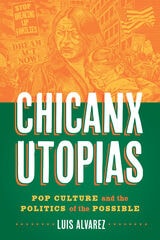
Chicanx Utopias
Pop Culture and the Politics of the PossibleLuis Alvarez
University of Texas Press, 2022
2023 Honorable Mention Best History Book, International Latino Book Awards
Broad and encompassing examination of Chicanx popular culture since World War II and the utopian visions it articulated
Amid the rise of neoliberalism, globalization, and movements for civil rights and global justice in the post–World War II era, Chicanxs in film, music, television, and art weaponized culture to combat often oppressive economic and political conditions. They envisioned utopias that, even if never fully realized, reimagined the world and linked seemingly disparate people and places. In the latter half of the twentieth century, Chicanx popular culture forged a politics of the possible and gave rise to utopian dreams that sprang from everyday experiences.
In Chicanx Utopias, Luis Alvarez offers a broad study of these utopian visions from the 1950s to the 2000s. Probing the film Salt of the Earth, brown-eyed soul music, sitcoms, poster art, and borderlands reggae music, he examines how Chicanx pop culture, capable of both liberation and exploitation, fostered interracial and transnational identities, engaged social movements, and produced varied utopian visions with divergent possibilities and limits. Grounded in the theoretical frameworks of Walter Benjamin, Stuart Hall, and the Zapatista movement, this book reveals how Chicanxs articulated pop cultural utopias to make sense of, challenge, and improve the worlds they inhabited.
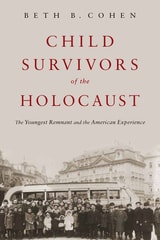
Child Survivors of the Holocaust
The Youngest Remnant and the American ExperienceCohen, Beth B
Rutgers University Press, 2018
The majority of European Jewish children alive in 1939 were murdered during the Holocaust. Of 1.5 million children, only an estimated 150,000 survived. In the aftermath of the Shoah, efforts by American Jews brought several thousand of these child survivors to the United States. In Child Survivors of the Holocaust, historian Beth B. Cohen weaves together survivor testimonies and archival documents to bring their story to light. She reveals that even as child survivors were resettled and “saved,” they struggled to adapt to new lives as members of adoptive families, previously unknown American Jewish kin networks, or their own survivor relatives. Nonetheless, the youngsters moved ahead. As Cohen demonstrates, the experiences both during and after the war shadowed their lives and relationships through adulthood, yet an identity as “survivors” eluded them for decades. Now, as the last living link to the Holocaust, the voices of Child Survivors are finally being heard.

Children Crossing Borders
Latin American Migrant ChildhoodsEdited by Alejandra J. Josiowicz and Irasema Coronado
University of Arizona Press, 2022
Unified in their common interest in the well-being of children, the contributors bring an unrivaled breadth of experience and research to offer a transnational, multidimensional, and multilayered look at migrant childhoods in Latin America. Organized around three main themes—educational experiences; literature, art and culture, and media depictions; and the principle of the “best interest of the child”—this work offers both theoretical and practical approaches to the complexity of migrant childhood. The essays discuss family and school lives, children’s experience as wage laborers, and the legislation and policies that affect migrants.
This volume draws much-needed attention to the plight of migrant children and their families, illuminating the human and emotional toll that children experience as they crisscross the Americas. Exploring the connections between education, policy, cultural studies, and anthropology, the essays in this volume navigate a space of transnational children’s rights central to Latin American life in the twentieth and twenty-first centuries.
Contributors
Marissa Bejarano-Fernbaugh
Nancie Bouchard
Lina M. Caswell
Irasema Coronado
Valentina Glockner
Alejandra J. Josiowicz
Patrícia Nabuco Martuscelli
María Inés Pacecca
Martha Rodríguez-Cruz
Emily Ruehs-Navarro
Kathleen Tacelosky
Élisabeth Vallet
China and the Internet
Using New Media for Development and Social ChangeSong Shi
Rutgers University Press, 2024
China as Number One?
The Emerging Values of a Rising PowerYang Zhong and Ronald F. Inglehart
University of Michigan Press, 2024
One of the most significant global events in the last forty years has been the rise of China— economically, technologically, politically, and militarily. The question on people's minds for decades has been whether China will replace the United States as a superpower in the near future. But for China, this power must be comprehensive — having strong economic and militant forces are only two pieces of the puzzle. China must also possess soft power, such as attractive ideologies, values, and culture.
China as Number One? explores China’s soft powers through the eyes of Chinese citizens. Utilizing data from the World Values Survey, the contributors to this collection analyze the potential soft power of a rising China by examining its residents' social values. A comprehensive study of changes and continuities in the political and social values of Chinese citizens, the book examines findings in the context of evolutionary modernization theory and cross-national comparison.
China in the World
Culture, Politics, and World VisionBan Wang
Duke University Press, 2022
China’s Challenges and International Order Transition
Beyond “Thucydides's Trap”Edited by Huiyun Feng and Kai He
University of Michigan Press, 2020
China’s Challenges and International Order Transition introduces an integrated conceptual framework of “international order” categorized by three levels (power, rules, and norms) and three issue-areas (security, political, and economic). Each contributor engages one or more of these analytical dimensions to examine two questions: (1) Has China already challenged this dimension of international order? (2) How will China challenge this dimension of international order in the future?
The contested views and perspectives in this volume suggest it is too simple to assume an inevitable conflict between China and the outside world. With different strategies to challenge or reform the many dimensions of international order, China’s role is not a one-way street. It is an interactive process in which the world may change China as much as China may change the world.
The aim of the book is to broaden the debate beyond the “Thucydides Trap” perspective currently popular in the West. Rather than offering a single argument, this volume offers a platform for scholars, especially Chinese scholars vs. Western scholars, to exchange and debate their different views and perspectives on China and the potential transition of international order.
Chinese Marriages in Transition
From Patriarchy to New FamilismXiaoling Shu
Rutgers University Press, 2023
This book is freely available in an open access edition thanks to TOME (Toward an Open Monograph Ecosystem)— a collaboration of the Association of American Universities, the Association of University Presses, and the Association of Research Libraries—and the generous support of the University of California, Davis. Learn more at the TOME website, available at: openmonographs.org.
Download the open access book here.
Chinese Netizens' Opinions on Death Sentences
An Empirical ExaminationBin Liang and Jianhong Liu
University of Michigan Press, 2021
Few social issues have received more public attention and scholarly debate than the death penalty. While the abolitionist movement has made a successful stride in recent decades, a small number of countries remain committed to the death penalty and impose it with a relatively high frequency. In this regard, the People’s Republic of China no doubt leads the world in both numbers of death sentences and executions. Despite being the largest user of the death penalty, China has never conducted a national poll on citizens’ opinions toward capital punishment, while claiming “overwhelming public support” as a major justification for its retention and use.
Chinese Netizens’ Opinions on Death Sentences: An Empirical Examination uses a forum of public comments to explore and examine Chinese netizens’ opinions on the death penalty. Based on a content analysis of 38,512 comments collected from 63 cases in 2015, this study examines the diversity and rationales of netizens’ opinions, netizens’ interactions, and their evaluation of China’s criminal justice system. In addition, the book discusses China’s social, systemic, and structural problems and critically examines the rationality of netizens’ opinions based on Habermas’s communicative rationality framework. Readers will be able to contextualize Chinese netizens’ discussions and draw conclusions about commonalities and uniqueness of China’s death penalty practice.
Chinese Surplus
Biopolitical Aesthetics and the Medically Commodified BodyAri Larissa Heinrich
Duke University Press, 2018

Chinese Whispers
Toward a Transpacific PoeticsYunte Huang
University of Chicago Press, 2022
In this new book, the noted critic and best-selling author Yunte Huang explores the dynamics of poetry and poetics in the age of globalization, particularly questions of translatability, universality, and risk in the transpacific context. “Chinese whispers” refers to an American children’s game dating to the years of the Cold War, a period in which everything Chinese, or even Chinese sounding, was suspect. Taking up various manifestations of the phrase in the twentieth and twenty-first centuries, Huang investigates how poetry, always to a significant degree untranslatable, complicates the transpacific production of meanings and values.
The book opens with the efforts of I. A. Richards, arguably the founder of Anglo-American academic literary criticism, to promote Basic English in China in the early twentieth century. It culminates by resituating Ernest Fenollosa’s famous essay “The Chinese Written Character as a Medium for Poetry,” exploring the ways in which Chinese has historically enriched but also entrapped the Western conception of language.
Choosing to Lead
Understanding Congressional Foreign Policy EntrepreneursRalph G. Carter and James M. Scott
Duke University Press, 2009
Carter and Scott combine extensive quantitative analysis, interviews with members of Congress and their staff, and case studies of key foreign policy entrepreneurs, including Frank Church, William Fulbright, Jesse Helms, Edward Kennedy, Pat McCarran, and Curt Weldon. Drawing on their empirical data, the authors identify the key variables in foreign policy entrepreneurship, including membership in the Senate or House, seniority and committee assignments, majority or minority party status, choice of foreign policy issues, and the means used to influence policy. By illuminating the roles and impact of individual members of Congress, Carter and Scott contribute to a more nuanced understanding of the broader U.S. foreign policy-making process.
Chosen Peoples
Christianity and Political Imagination in South SudanChristopher Tounsel
Duke University Press, 2021
Christian America and the Kingdom of God
Richard T. Hughes
University of Illinois Press, 2012

Chromatic Algorithms
Synthetic Color, Computer Art, and Aesthetics after CodeCarolyn L. Kane
University of Chicago Press, 2014
Chromatic Algorithms reveals the fascinating history behind digital color, tracing it from the work of a few brilliant computer scientists and experimentally minded artists in the late 1960s and early ‘70s through to its appearance in commercial software in the early 1990s. Mixing philosophy of technology, aesthetics, and media analysis, Carolyn Kane shows how revolutionary the earliest computer-generated colors were—built with the massive postwar number-crunching machines, these first examples of “computer art” were so fantastic that artists and computer scientists regarded them as psychedelic, even revolutionary, harbingers of a better future for humans and machines. But, Kane shows, the explosive growth of personal computing and its accompanying need for off-the-shelf software led to standardization and the gradual closing of the experimental field in which computer artists had thrived.
Even so, the gap between the bright, bold presence of color onscreen and the increasing abstraction of its underlying code continues to lure artists and designers from a wide range of fields, and Kane draws on their work to pose fascinating questions about the relationships among art, code, science, and media in the twenty-first century.
Cinema of Crushing Motherhood
A New Feminist CinemaOlivia Landry
University of Illinois Press, 2025
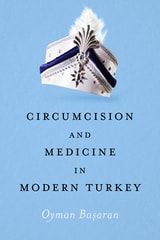
Circumcision and Medicine in Modern Turkey
Oyman Basaran
University of Texas Press, 2023
An investigation of how the expansion of modern medicine in Turkey transformed young boys’ experiences of circumcision.
In Turkey, circumcision is viewed as both a religious obligation and a rite of passage for young boys, as communities celebrate the ritual through gatherings, gifts, and special outfits. Yet the procedure is a potentially painful and traumatic ordeal. With the expansion of modern medicine, the social position of sünnetçi (male circumcisers) became subject to the institutional arrangements of Turkey’s evolving health care and welfare system. In the transition from traditional itinerant circumcisers to low-ranking health officers in the 1960s and hospital doctors in the 1990s, the medicalization of male circumcision has become entangled with state formation, market fetishism, and class inequalities.
Based on Oyman Başaran’s extensive ethnographic and historical research, Circumcision and Medicine in Modern Turkey is a close examination of the socioreligious practice of circumcision in twenty-five cities and their outlying towns and villages in Turkey. By analyzing the changing subjectivity of medical actors who seek to alleviate suffering in male circumcision, Başaran offers a psychoanalytically informed alternate approach to the standard sociological arguments surrounding medicalization and male circumcision.
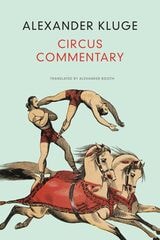
Circus Commentary
Alexander Kluge
Seagull Books, 2024
The circus has fascinated Alexander Kluge ever since he was a child, and his devotion to it has been preserved throughout his cinematic output and his most recent literary work. In the circus, he finds both the shadow image of work and the epitome of human excellence, from love to war to revolution. As surfaces onto which utopias are projected, these elaborate performances offer a tangible representation of developments within civilization, with its nearly infinite possibilities and sometimes inevitable crashes—from the excited roar of the crowd to death on the floor of the ring.
In Circus Commentary, Kluge’s montage of modernities moves back and forth through time and space, expressing his unique mix of fictional and non-fictional reports, histories, and stories through semantic fields, images, and film sequences inserted in the book via QR codes. We encounter a broad panorama of perplexed artists and sophisticated surgeons cavorting alongside fighter pilots, sans-culottes drunk with dreams of omnipotence, and, most importantly, animals—to whose superhuman performances, this book creates a lasting memorial.