Results by title
313 books match the query 'Administration' and 16 start with c
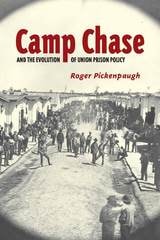
Camp Chase and the Evolution of Union Prison Policy
Roger Pickenpaugh
University of Alabama Press, 2007
Camp Chase was a major Union POW camp and also served at various times as a Union military training facility and as quarters for Union soldiers who had been taken prisoner by the Confederacy and released on parole or exchanged. As such, this careful, thorough, and objective examination of the history and administration of the camp will be of true significance in the literature on the Civil War.
Campus with Purpose
Building a Mission-Driven CampusStephen Lehmkuhle
Rutgers University Press, 2021
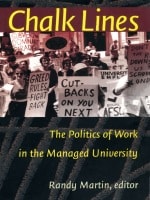
Chalk Lines
The Politics of Work in the Managed UniversityRandy Martin, ed.
Duke University Press, 1999
While tracing the socioeconomic conditions that have led to the present labor situation on campuses, the contributors consider such topics as the political implications of managerialism and the conceptual status of academic labor.
They examine the trend toward restructuring and downsizing, the particular plight of the adjunct professor, the growing emphasis on vocational training in the classroom, and union organizing among university faculty, staff, and graduate students. Placing such issues within the context of the history of labor movements as well as governmental initiatives to train a workforce capable of competing in the global economy, Chalk Lines explores how universities have attempted to remake themselves in the image of the corporate sector. Originally published as an issue of Social Text, this expanded volume, which includes four new essays, offers a broad view of academic labor in the United States.
With its important, timely contribution to debates concerning the future of higher education, Chalk Lines will interest a wide array of academics, administrators, policymakers, and others invested in the state—and fate—of academia.
Contributors. Stanley Aronowitz, Jan Currie, Zelda F. Gamson, Emily Hacker, Stefano Harney, Randy Martin, Bart Meyers, David Montgomery, Frederick Moten, Christopher Newfield, Gary Rhoades, Sheila Slaughter, Jeremy Smith, Vincent Tirelli, William Vaughn, Lesley Vidovich, Ira Yankwitt

Change and Harmonization in European Education
Robert Beck
University of Minnesota Press, 1971

Children Crossing Borders
Immigrant Parent and Teacher Perspectives on Preschool for Children of ImmigrantsJoseph Tobin
Russell Sage Foundation, 2013

Chocolate Islands
Cocoa, Slavery, and Colonial AfricaCatherine Higgs
Ohio University Press, 2012
In Chocolate Islands: Cocoa, Slavery, and Colonial Africa, Catherine Higgs traces the early-twentieth-century journey of the Englishman Joseph Burtt to the Portuguese colony of São Tomé and Príncipe—the chocolate islands—through Angola and Mozambique, and finally to British Southern Africa. Burtt had been hired by the chocolate firm Cadbury Brothers Limited to determine if the cocoa it was buying from the islands had been harvested by slave laborers forcibly recruited from Angola, an allegation that became one of the grand scandals of the early colonial era. Burtt spent six months on São Tomé and Príncipe and a year in Angola. His five-month march across Angola in 1906 took him from innocence and credulity to outrage and activism and ultimately helped change labor recruiting practices in colonial Africa.
This beautifully written and engaging travel narrative draws on collections in Portugal, the United Kingdom, and Africa to explore British and Portuguese attitudes toward work, slavery, race, and imperialism. In a story still familiar a century after Burtt’s sojourn, Chocolate Islands reveals the idealism, naivety, and racism that shaped attitudes toward Africa, even among those who sought to improve the conditions of its workers.
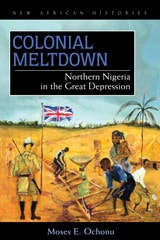
Colonial Meltdown
Northern Nigeria in the Great DepressionMoses E. Ochonu
Ohio University Press, 2009
Historians of colonial Africa have largely regarded the decade of the Great Depression as a period of intense exploitation and colonial inactivity. In Colonial Meltdown, Moses E. Ochonu challenges this conventional interpretation by mapping the determined, at times violent, yet instructive responses of Northern Nigeria’s chiefs, farmers, laborers, artisans, women, traders, and embryonic elites to the British colonial mismanagement of the Great Depression. Colonial Meltdown explores the unraveling of British colonial power at a moment of global economic crisis.
Ochonu shows that the economic downturn made colonial exploitation all but impossible and that this dearth of profits and surpluses frustrated the colonial administration which then authorized a brutal regime of grassroots exactions and invasive intrusions. The outcomes were as harsh for Northern Nigerians as those of colonial exploitation in boom years.
Northern Nigerians confronted colonial economic recovery measures and their agents with a variety of strategies. Colonial Meltdown analyzes how farmers, women, laborers, laid-off tin miners, and NorthernNigeria’s emergent elite challenged and rebelled against colonial economic recovery schemes with evasive trickery, defiance, strategic acts of revenge, and criminal self-help and, in the process, exposed the weak underbelly of the colonial system.
Combined with the economic and political paralysis of colonial bureaucrats in the face of crisis, these African responses underlined the fundamental weakness of the colonial state, the brittleness of its economicmission, and the limits of colonial coercion and violence. This atmosphere of colonial collapse emboldened critics of colonial policies who went on to craft the rhetorical terms on which the anticolonial struggle of the post–World War II period was fought out.
In the current climate of global economic anxieties, Ochonu’s analysis will enrich discussions on the transnational ramifications of economic downturns. It will also challenge the pervasive narrative of imperial economic success.
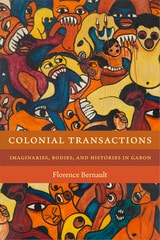
Colonial Transactions
Imaginaries, Bodies, and Histories in GabonFlorence Bernault
Duke University Press, 2019

Colonialism, Antisemitism, and Germans of Jewish Descent in Imperial Germany
Christian S. Davis
University of Michigan Press, 2012
Colonialism, Antisemitism, and Germans of Jewish Descent in Imperial Germany examines the relationship between the colonial and antisemitic movements of modern Germany from 1871 to 1918, examining the complicated ways in which German antisemitism and colonialism fed off of and into each other in the decades before the First World War. Author Christian S. Davis studies the significant involvement with and investment in German colonialism by the major antisemitic political parties and extra-parliamentary organizations of the day, while also investigating the prominent participation in the colonial movement of Jews and Germans of Jewish descent and their tense relationship with procolonial antisemites.
Working from the premise that the rise and propagation of racial antisemitism in late-nineteenth-century Germany cannot be separated from the context of colonial empire, Colonialism, Antisemitism, and Germans of Jewish Descent in Imperial Germany is the first work to study the dynamic and evolving interrelationship of the colonial and antisemitic movements of the Kaiserreich era. It shows how individuals and organizations who originated what would later become the ideological core of National Socialism---racial antisemitism---both influenced and perceived the development of a German colonial empire predicated on racial subjugation. It also examines how colonialism affected the contemporaneous German antisemitic movement, dividing it over whether participation in the nationalist project of empire building could furnish patriotic credentials to even Germans of Jewish descent. The book builds upon the recent upsurge of interest among historians of modern Germany in the domestic impact and character of German colonialism, and on the continuing fascination with the racialization of the German sense of self that became so important to German history in the twentieth century.
Completing College
Rethinking Institutional ActionVincent Tinto
University of Chicago Press, 2012
Even as the number of students attending college has more than doubled in the past forty years, it is still the case that nearly half of all college students in the United States will not complete their degree within six years. It is clear that much remains to be done toward improving student success. For more than twenty years, Vincent Tinto’s pathbreaking book Leaving College has been recognized as the definitive resource on student retention in higher education. Now, with Completing College, Tinto offers administrators a coherent framework with which to develop and implement programs to promote completion.
Deftly distilling an enormous amount of research, Tinto identifies the essential conditions enabling students to succeed and continue on within institutions. Especially during the early years, he shows that students thrive in settings that pair high expectations for success with structured academic, social, and financial support, provide frequent feedback and assessments of their performance, and promote their active involvement with other students and faculty. And while these conditions may be worked on and met at different institutional levels, Tinto points to the classroom as the center of student education and life, and therefore the primary target for institutional action.
Improving retention rates continues to be among the most widely studied fields in higher education, and Completing College carefully synthesizes the latest research and, most importantly, translates it into practical steps that administrators can take to enhance student success.
Composition and Rhetoric in Contentious Times
Rachel McCabe
Utah State University Press, 2023
Editors Rachel McCabe and Jennifer Juszkiewicz consider how educators can respond to multiple current crises relating to composition and rhetoric with generosity and cautious optimism; in the process, they address the current concerns about the longevity of the humanities. By engaging with social constructivist, critical race, socioeconomic, and activist pedagogies, each chapter provides an answer to the question, How can our courses help students become stronger writers while contending with current social, environmental, and ethical questions posed by the world around them? The contributors consider this question from numerous perspectives, recognizing the important ways that power and privilege affect our varying means of addressing this question.
Relying on both theory and practice, Composition and Rhetoric in Contentious Times engages the future of composition and rhetoric as a discipline shaped by recent and current global events. This text appeals to early-career writing program administrators, writing center directors, and professional specialists, as well as Advanced Placement high school instructors, graduate students, and faculty teaching graduate-level pedagogy courses.

CounterStories from the Writing Center
Frankie Condon
Utah State University Press, 2021
Practicing what Derrick Bell has termed “creative truth telling,” these writers are not concerned with individual white women in writing centres but with the social, political, and cultural capital that is the historical birthright of white, straight, cis-gendered women, particularly in writing centre studies. The essays collected in this volume test, defy, and overflow the bounds of traditional academic discourse in the service of powerful testimony, witness, and counterstory.
CounterStories from the Writing Center is a must-read for writing centre directors, scholars, and tutors who are committed to antiracist pedagogy and offers a robust intersectional analysis to those who seek to understand the relationship between the work of writing centres and the problem of racism. Accessible and usable for both graduate and undergraduate students of writing centre theory and practice, this work troubles the field’s commonplaces and offers a rich envisioning of what writing centres materially committed to inclusion and equity might be and do.
Contributors: Dianna Baldwin, Nicole Caswell, Mitzi Ceballos, Romeo Garcia, Neisha-Anne Green, Doug Kern, T. Haltiwanger Morrison, Bernice Olivas, Moira Ozias, Trixie Smith, Willow Trevino
Creating Culture through Health Leadership
Edited by Lina Svedin
University of Minnesota Press, 2020
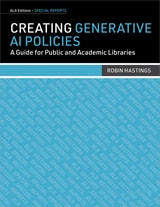
Creating Generative AI Policies
A Guide for Public and Academic LibrariesRobin Hastings
American Library Association, 2026
Though it’s challenging to set policies for a technology that is so young and still in flux, the need is urgent. Because usage of AI presents both opportunities and risks, libraries must be proactive. The WEF (World Economic Forum) predicts that while there may be a loss of 92 million jobs to various AI tools, they see 170 million new jobs and roles emerging from the use of this new technology. Whether or not this proves correct, there are already digital literacy skills, including a basic understanding of the technology around AI, that libraries can help their patrons master; and because of data privacy, security, and ethics issues, library workers require clear AI policies too. Technology expert Hastings highlights the first attempts of libraries across the country to set up policies for the use of AI in their organizations, as well as policies created by cities and other similar institutions, to guide stakeholders in creating their own smart, forward-thinking course of action. Succinct and pragmatic, this timely resource
- provides a short overview of Generative AI history, basic technical knowledge, and the key arguments put forth by those in favor and those opposed to this technology;
- offers advice on discovering how library staff encounter AI in their day-to-day work, both in their own usage and by patrons, to inform what policies the library needs and which policies to consider adjusting for particular use cases;
- includes separate chapters focusing on staff-side policy and patron/public-facing policy, delving into essential considerations like staff training, privacy and data protection, security, AI usage for reference, patron education and AI literacy, and setting limits and boundaries on patron AI use;
- suggests useful approaches to ensure that AI policies are easy to follow and understand by library workers, patrons, and the wider community;
- discusses how to craft flexible procedures that can be updated as AI continues to change, drawing on technology management best practices; and
- offers links to additional resources like sample policy documents and a curated reading list for understanding the environment around AI.
Crisis Leadership in Higher Education
Theory and PracticeRalph A. Gigliotti
Rutgers University Press, 2020
Cultured Force
Makers and Defenders of the French Colonial EmpireBarnett Singer and John Langdon
University of Wisconsin Press, 2008