138 books match the query 'Appreciation' and 8 start with c
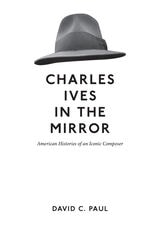
cover of Charles Ives in the Mirror: American Histories of an Iconic Composer

Charles Ives in the Mirror

American Histories of an Iconic Composer

David C. Paul

University of Illinois Press, 2013

American composer Charles Ives (1874–1954) has gone from being a virtual unknown to become one of the most respected and lauded composers in American music. In this sweeping survey of intellectual and musical history, David C. Paul tells the new story of how Ives's music was shaped by shifting conceptions of American identity within and outside of musical culture, charting the changes in the reception of Ives across the twentieth century and into the twenty-first century. Paul focuses on the critics, composers, performers, and scholars whose contributions were most influential in shaping the critical discourse on Ives, many of them marquee names of American musical culture themselves, including Henry Cowell, Aaron Copland, Elliott Carter, and Leonard Bernstein.

Paul explores both how Ives positioned his music amid changing philosophical and aesthetic currents and how others interpreted his contributions to American music. Although Ives's initial efforts to find a public in the early twenties attracted a few devotees, the resurgence of interest in the American literary past during the thirties made a concert staple of his "Concord" Sonata, a work dedicated to nineteenth-century transcendentalist writers. Paul shows how Ives was subsequently deployed as an icon of American freedom during the early Cold War period and how he came to be instigated at the head of a line of "American maverick" composers. Paul also examines why a recent cadre of scholars has beset the composer with Gilded Age social anxieties.

By embedding Ives' reception within the changing developments of a wide range of fields including intellectual history, American studies, literature, musicology, and American politics and society in general, Charles Ives in the Mirror: American Histories of an Iconic Composer greatly advances our understanding of Ives and his influence on nearly a century of American culture.

[more]
cover of Chinese Whispers: Toward a Transpacific Poetics

Chinese Whispers

Toward a Transpacific Poetics

Yunte Huang

University of Chicago Press, 2022

Chinese Whispers examines multiple contact zones between the Anglophone and Sinophone worlds, investigating how poetry both enables and complicates the transpacific production of meaning.
 
In this new book, the noted critic and best-selling author Yunte Huang explores the dynamics of poetry and poetics in the age of globalization, particularly questions of translatability, universality, and risk in the transpacific context. “Chinese whispers” refers to an American children’s game dating to the years of the Cold War, a period in which everything Chinese, or even Chinese sounding, was suspect. Taking up various manifestations of the phrase in the twentieth and twenty-first centuries, Huang investigates how poetry, always to a significant degree untranslatable, complicates the transpacific production of meanings and values.

The book opens with the efforts of I. A. Richards, arguably the founder of Anglo-American academic literary criticism, to promote Basic English in China in the early twentieth century. It culminates by resituating Ernest Fenollosa’s famous essay “The Chinese Written Character as a Medium for Poetry,” exploring the ways in which Chinese has historically enriched but also entrapped the Western conception of language.
 
[more]
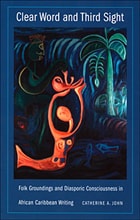
cover of Clear Word and Third Sight: Folk Groundings and Diasporic Consciousness in African Caribbean Writing

Clear Word and Third Sight

Folk Groundings and Diasporic Consciousness in African Caribbean Writing

Catherine A. John

Duke University Press, 2003

Clear Word and Third Sight examines the strands of a collective African diasporic consciousness represented in the work of a number of Black Caribbean writers. Catherine A. John shows how a shared consciousness, or “third sight,” is rooted in both pre- and postcolonial cultural practices and disseminated through a rich oral tradition. This consciousness has served diasporic communities by creating an alternate philosophical “worldsense” linking those of African descent across space and time.

Contesting popular discourses about what constitutes culture and maintaining that neglected strains in negritude discourse provide a crucial philosophical perspective on the connections between folk practices, cultural memory, and collective consciousness, John examines the diasporic principles in the work of the negritude writers Léon Damas, Aimé Césaire, and Léopold Senghor. She traces the manifestations and reworkings of their ideas in Afro-Caribbean writing from the eastern and French Caribbean, as well as the Caribbean diaspora in the United States. The authors she discusses include Jamaica Kincaid, Earl Lovelace, Simone Schwarz-Bart, Audre Lorde, Paule Marshall, and Edouard Glissant, among others. John argues that by incorporating what she calls folk groundings—such as poems, folktales, proverbs, and songs—into their work, Afro-Caribbean writers invoke a psychospiritual consciousness which combines old and new strategies for addressing the ongoing postcolonial struggle.
[more]
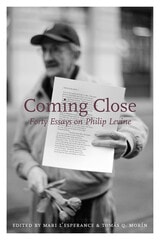
cover of Coming Close: Forty Essays on Philip Levine

Coming Close

Forty Essays on Philip Levine

Mari L'Esperance and Tomas Morin

University of Iowa Press, 2013
This collection of essays pays tribute to Philip Levine as teacher and mentor. Throughout his fifty-year teaching career, the Pulitzer Prize–winning Levine taught scores of younger poets, many of whom went on to become famous in their own right. These forty essays honor and celebrate one of our most vivid and gifted poets.
           
Whether in Fresno, New York, Boston, Detroit, or any of the other cities where Levine taught, his students benefited from his sharp, humorous honesty in the classroom. In these personal essays, poets spanning a number of generations reveal how their lives and work were forever altered by studying with Levine. The heartfelt tributes illuminate how one dedicated teacher’s intangible gifts can make a vast difference in the life of a developing poet, as well as providing insight into the changing tenor of the poetry workshop in the American university setting.
Here, poets as diverse as Nick Flynn and David St. John, Sharon Olds and Larry Levis, Ada Limon and Mark Levine, Malena Morling and Lawson Fusao Inada are united in their deep regard for Philip Levine. The voices echo and reverberate as each strikes its own honoring tone. 

Contributors: Aaron Belz, Ciaran Berry, Paula Bohince, Shane Book, B. H. Boston, Xochiquetzal Candelaria, Colin Cheney, Michael Clifton, Michael Collier, Nicole Cooley, Kate Daniels, Blas Manuel De Luna, Kathy Fagan, Andrew Feld, Nick Flynn, Edward Hirsch, Sandra Hoben, Ishion Hutchinson, Lawson Fusao Inada, Dorianne Laux, Joseph O. Legaspi, Mark Levine, Larry Levis, Ada Limón, Elline Lipkin, Jane Mead, Dante Micheaux, Malena Mörling, John Murillo, Daniel Nester, Sharon Olds, January Gill O’Neil, Greg Pape, Kathleen Peirce, Sam Pereira, Jeffrey Skinner, Tom Sleigh, David St. John, Brian Turner, Robert Wrigley 
[more]
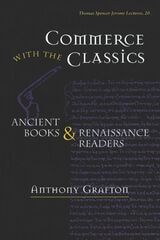
cover of Commerce with the Classics: Ancient Books and Renaissance Readers

Commerce with the Classics

Ancient Books and Renaissance Readers

Anthony Grafton

University of Michigan Press, 1997
The style of reading in Renaissance Europe, as seen in the margins of books and in the texts of Renaissance intellectuals themselves, is deftly charted in this welcome volume from Anthony Grafton. Growing out of the Thomas Spencer Jerome Lectures that Anthony Grafton gave at the University of Michigan in 1992, this book describes the interaction between books and readers in the Renaissance, as seen in four major case studies.Humanists Alberti, Pico, Budé, and Kepler, all major figures of their time and now major figures in intellectual history, are examined in the light of their distinctive ways of reading. Investigating a period of two centuries, Grafton vividly portrays the ways in which book/scholar interactions--and the established traditions that were reflected in these interactions--were part of and helped shape the subjects' Humanistic philosophy. The book also indicates how these traditions have implications for the modern literary scene.Commerce with the Classics: Ancient Books and Renaissance Readers illustrates the immense variety of the humanist readers of the Renaissance. Grafton describes life in the Renaissance library, how the act of reading was shaped by the physical environment, and various styles of reading during the time. A strong sense of what skilled reading was like in the past is built up through anecdotes, philological analysis, and documents from a wide variety of sources, many of them unpublished.This volume will be of special interest to Renaissance and intellectual historians, students of Renaissance literature, and classicists who concern themselves with the afterlife of their texts.Anthony Grafton is Henry Putnam University Professor of History, Princeton University.
[more]
cover of Congenial Souls: Reading Chaucer from Medieval to Postmodern

Congenial Souls

Reading Chaucer from Medieval to Postmodern

Stephanie Trigg

University of Minnesota Press, 2001
[more]
cover of Constructing German Walt Whitman

Constructing German Walt Whitman

Walter Grunzweig

University of Iowa Press, 1994
In this first comprehensive study in English of Walt Whitman's reception in the German-speaking countries, Walter Grünzweig posits a very broadly based notion of culture, embodying a wide variety of elements such as high literature, politics, youth movements, sexuality, and other subcultures.
[more]
cover of Crossings: Nietzsche and the Space of Tragedy

Crossings

Nietzsche and the Space of Tragedy

John Sallis

University of Chicago Press, 1991

Boldly contesting recent scholarship, Sallis argues that
The Birth of Tragedy is a rethinking of art at the
limit of metaphysics. His close reading focuses on the
complexity of the Apollinian/Dionysian dyad and on the
crossing of these basic art impulses in tragedy.

"Sallis effectively calls into question some commonly
accepted and simplistic ideas about Nietzsche's early
thinking and its debt to Schopenhauer, and proposes
alternatives that are worth considering."—Richard
Schacht, Times Literary Supplement
[more]