Results by title
95 books match the query 'Arab-Israeli conflict' and 5 start with c
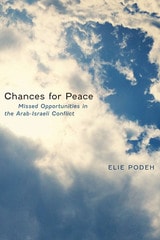
Chances for Peace
Missed Opportunities in the Arab-Israeli ConflictBy Elie Podeh
University of Texas Press, 2015
Drawing on a newly developed theoretical definition of “missed opportunity,” Chances for Peace uses extensive sources in English, Hebrew, and Arabic to systematically measure the potentiality levels of opportunity across some ninety years of attempted negotiations in the Arab-Israeli conflict. With enlightening revelations that defy conventional wisdom, this study provides a balanced account of the most significant attempts to forge peace, initiated by the world’s superpowers, the Arabs (including the Palestinians), and Israel. From Arab-Zionist negotiations at the end of World War I to the subsequent partition, the aftermath of the 1967 War and the Sadat Initiative, and numerous agreements throughout the 1980s and 1990s, concluding with the Annapolis Conference in 2007 and the Abu Mazen-Olmert talks in 2008, pioneering scholar Elie Podeh uses empirical criteria and diverse secondary sources to assess the protagonists’ roles at more than two dozen key junctures.
A resource that brings together historiography, political science, and the practice of peace negotiation, Podeh’s insightful exploration also showcases opportunities that were not missed. Three agreements in particular (Israeli-Egyptian, 1979; Israeli-Lebanese, 1983; and Israeli-Jordanian, 1994) illuminate important variables for forging new paths to successful negotiation. By applying his framework to a broad range of power brokers and time periods, Podeh also sheds light on numerous incidents that contradict official narratives. This unique approach is poised to reshape the realm of conflict resolution.
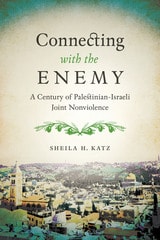
Connecting with the Enemy
A Century of Palestinian-Israeli Joint NonviolenceBy Sheila H. Katz
University of Texas Press, 2016
Thousands of ordinary people in Israel and Palestine have engaged in a dazzling array of daring and visionary joint nonviolent initiatives for more than a century. They have endured despite condemnation by their own societies, repetitive failures of diplomacy, harsh inequalities, and endemic cycles of violence.
Connecting with the Enemy presents the first comprehensive history of unprecedented grassroots efforts to forge nonviolent alternatives to the lethal collision of the two national movements. Bringing to light the work of over five hundred groups, Sheila H. Katz describes how Arabs and Jews, children and elders, artists and activists, educators and students, garage mechanics and physicists, and lawyers and prisoners have spoken truth to power, protected the environment, demonstrated peacefully, mourned together, stood in resistance and solidarity, and advocated for justice and security. She also critiques and assesses the significance of their work and explores why these good-will efforts have not yet managed to end the conflict or occupation. This previously untold story of Palestinian-Israeli joint nonviolence will challenge the mainstream narratives of terror and despair, monsters and heroes, that help to perpetuate the conflict. It will also inspire and encourage anyone grappling with social change, peace and war, oppression and inequality, and grassroots activism anywhere in the world.
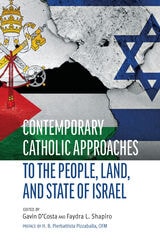
Contemporary Catholic Approaches to the People, State, and Land of Israel
Gavin D'Costa
Catholic University of America Press, 2021

Corporate Complicity in Israel's Occupation
Evidence from the London Session of the Russell Tribunal on PalestineEdited by Asa Winstanley and Frank Barat
Pluto Press, 2011
The Russell Tribunal on Palestine is a people’s tribunal in the spirit of the Tribunal on Vietnam that was set up by Bertrand Russell in the 1960s. This book contains a selection of the most vital evidence and testimonies presented at the London session. It includes the papers submitted to the tribunal, written by expert witnesses, based on their detailed research into the companies that prop-up Israeli occupation.
Examining the involvement of corporations in the illegal occupation of Palestinian land by Israel, the tribunal of 2010 generated widespread media coverage. The book identifies companies and corporations participating in such illegality and possibilities for legal action against them are discussed.
Released to coincide with the South Africa session at the end of 2011, Corporate Complicity in Israel's Occupation is a vital resource to lawyers, journalists and activists hoping to take informed action against Israeli war crimes and occupation.
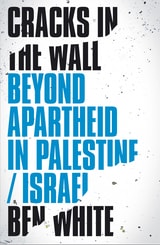
Cracks in the Wall
Beyond Apartheid in Palestine/IsraelBen White
Pluto Press, 2018
But while the situation on the ground is bleak, Ben White argues that there are widening cracks in Israel's traditional pillars of support. Opposition to Israeli policies and even critiques of Zionism are growing in Jewish communities, as well as amongst Western progressives. The election of Donald Trump has served as a catalyst for these processes, including the transformation of Israel from a partisan issue into one that divides the US establishment. Meanwhile, the Palestinian-led boycott campaign is gathering momentum, prompting a desperate backlash by Israel and its allies.
With sharp analysis, Ben White says now is the time to plot a course that avoids the mistakes of the past - a way forward beyond apartheid in Palestine. The solution is not partition and ethnic separation, but equality and self-determination - for all.