Results by title
299 books match the query 'Arizona' and 17 start with c
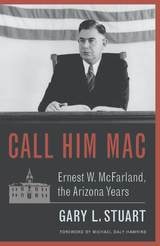
Call Him Mac
Ernest W. McFarland, the Arizona YearsGary L. Stuart; Foreword by Michael Daly Hawkins
University of Arizona Press, 2018
In Call Him Mac, Gary L. Stuart renders a nuanced portrait of a young, ambitious, restless, and smiling man on the verge of becoming a political force headed for the highest levels of governance in Arizona and America. Stuart reveals how Mac became an expert on water law and a visionary in Arizona’s agricultural future. Using interviews with friends and family and extensive primary source research, Stuart spotlights Mac’s unerring focus as a loving husband, father, and grandfather, even in times of great personal tragedy. Mac’s commitments to his family mirrored his sense of fiduciary duty in public life. His enormous political successes were answers to how he dealt with threats to his own life in 1919, the loss of his first wife and three children in the 1930s, and a political loss in 1952 that no one saw coming.
Stuart writes the little-known story of how Arizona’s culture and citizens shaped this energetic, determined, likable lawyer. The fame Mac created was not for himself but for those he served in Arizona and beyond. Mac’s unparalleled political success was fermented during his early Arizona years, the bridge that brought him to his future as an approachable and likable elder statesman of Arizona politics.
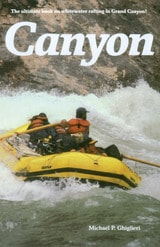
Canyon
Michael P. Ghiglieri
University of Arizona Press, 1992
From Lee's Ferry to Diamond Creek, Ghiglieri leads you down 226 miles of wild river and through some of the most breathtaking scenery on earth. Along the way, he navigates the Colorado River's dozens of notorious rapids—many of which drop fifteen feet or more—and shares the excitement of waves and boulders, thunder and foam. Recounting a real journey through this geological wonder, Canyon interweaves heart-pounding adventure with factual insights into the world of Grand Canyon. Between the rapids, Ghiglieri relates tales of river runners past and present, lessons in geology and wildlife, observations on the impact of Glen Canyon Dam, and stories of Native inhabitants, from Anasazi ancestors to Havasupai Rastafarians. This trip also offers more than its share of human drama for the passengers aboard, leaving them with tales of their own to tell.
"Running the Colorado River in the Grand Canyon is to me the most impressive journey on our planet," writes Ghiglieri, "an adventure that leaves no traveler unchanged." For anyone who has ever shared or contemplated that adventure, Canyon recreates an unforgettable ride.
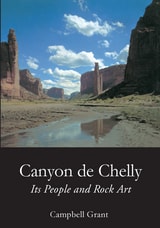
Canyon de Chelly
Its People and Rock ArtCampbell Grant
University of Arizona Press, 1978
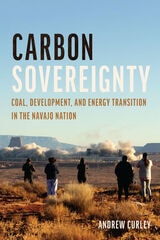
Carbon Sovereignty
Coal, Development, and Energy Transition in the Navajo NationAndrew Curley
University of Arizona Press, 2023
This comprehensive new work offers a deep dive into the complex inner workings of energy shift in the Navajo Nation. Geographer Andrew Curley, a member of the Navajo Nation, examines the history of coal development within the Navajo Nation, including why some Diné supported coal and the consequences of doing so. He explains the Navajo Nation’s strategic choices to use the coal industry to support its sovereignty as a path forward in the face of ongoing colonialism. Carbon Sovereignty demonstrates the mechanism of capitalism through colonialism and the construction of resource sovereignty, in both the Navajo Nation’s embrace and its rejection of a coal economy.
For the people of the Navajo Nation, energy sovereignty is dire and personal. Thanks to on-the-ground interviews with Diné coal workers, environmental activists, and politicians, Curley documents the real consequences of change as they happened. While some Navajo actors have doubled down for coal, others have moved toward transition. Curley argues that political struggles ultimately shape how we should understand coal, capitalism, and climate change. The rise and fall of coal magnify the nuance and complexity of change. Historical and contemporary issues intermingle in everyday life with lasting consequences.
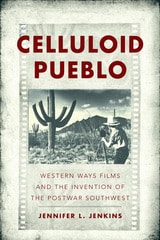
Celluloid Pueblo
Western Ways Films and the Invention of the Postwar SouthwestJennifer L. Jenkins
University of Arizona Press, 2016
Celluloid Pueblo tells the story of Western Ways Features and its role in the invention of the Southwest of the imagination. Active during a thirty-year period of profound growth and transformation, the Herberts created a dynamic visual record of the region, and their archival films now serve as a time capsule of the Sunbelt in the mid-twentieth century. Drawing upon a ten-year career with Fox, Western Ways owner-operator Charles Herbert brought a newshound’s sensibility and acute skill at in-camera editing to his southwestern subjects. The Western Ways films provided counternarratives to Hollywood representations of the West and established the regional identity of Tucson and the borderlands.
Jennifer L. Jenkins’s broad-sweeping book examines the Herberts’ work on some of the first sound films in the Arizona borderlands and their ongoing promotion of the Southwest. The book covers the filmic representation of Native and Mexican lifeways, Anglo ranching and leisure, Mexican missions and tourism, and postwar borderlands prosperity and progressivism. The story of Western Ways closely follows the boom-and-bust arc of the midcentury Southwest and the constantly evolving representations of an exotic—but safe and domesticated—frontier.
Centuries of Decline during the Hohokam Classic Period at Pueblo Grande
Edited by David R. Abbott
University of Arizona Press, 2003
New data from major excavations in Phoenix, however, suggest that little was "classic" about the Classic period at Pueblo Grande. These findings challenge views of Hohokam society that prevailed for most of the twentieth century, suggesting that for Pueblo Grande it was a time of decline rather than prosperity, a time marked by overpopulation, environmental degradation, resource shortage, poor health, and social disintegration. During this period, the Hohokam in the lower Salt River Valley began a precipitous slide toward the eventual abandonment of a homeland that they had occupied for more than one thousand years.
This volume is a long-awaited summary of one of the most important data-recovery projects in Southwest archaeology, synthesizing thousands of pages of data and text published in seven volumes of contract reports. The authors—all leading authorities in Hohokam archaeology who played primary roles in this revolution of understanding—here craft a compelling argument for the eventual collapse of Hohokam society in the late fourteenth century as seen from one of the largest and seemingly most influential irrigation communities along the lower Salt River.
Drawing on extremely large and well-preserved collections, the book reveals startling evidence of a society in decline as reflected in catchment analysis, archaeofaunal assemblage composition, skeletal studies, burial assemblages, artifact exchange, and ceramic production. The volume also includes a valuable new summary of the archival reconstruction of the architectural sequence for the Pueblo Grande platform mound.
With its wealth of data, interpretation, and synthesis, Centuries of Decline represents a milestone in our understanding of Hohokam culture. It is a key reference for Southwest archaeologists who seek to understand the Hohokam collapse and a benchmark for anyone interested in the prehistory of Arizona.
Ceramic Commodities and Common Containers
The Production and Distribution of White Mountain Red Ware in the Grasshopper Region, ArizonaDaniela Triadan
University of Arizona Press, 1997
Relying primarily on stylistic analyses and the relative abundance of this ceramic ware in site assemblages, most scholars have assumed that it was manufactured within a restricted area on the southeastern edge of the Colorado Plateau and distributed via trade and exchange networks that may have involved controlled access to these ceramics.
This monograph critically evaluates these traditional interpretations, utilizing large-scale compositional and petrographic analyses that established multiple production zones for White Mountain Red Ware—including one in the Grasshopper region—during Pueblo IV times. The compositional data combined with settlement data and an analysis of archaeological contexts demonstrates that White Mountain Red Ware vessels were readily accessible and widely used household goods, and that migration and subsequent local production in the destinaton areas were important factors in their wide distribution during the 14th century.
Ceramic Commodities and Common Containers provides new insights into the organization of ceramic production and distribution in the northern Southwest and into the processes of social reorganization that characterized the late 13th and 14th century Western Pueblo world. As one of the few studies that integrate materials analysis into archaeological research, Triadan's monograph marks a crucial contribution to the reconstruction of these prehistoric societies.
Ceramics and Community Organization among the Hohokam
David R. Abbott
University of Arizona Press, 2000
Through ceramic analyses from Classic period sites such as Pueblo Grande, Abbott shows that ceramic production sources and exchange networks can be determined from the composition, surface treatment attributes, and size and shape of clay containers. The distribution networks revealed by these analyses provide evidence for community boundaries and the web of social ties within them.
Abbott's meticulous research documents formerly unrecognized horizontal cohesiveness in Hohokam organizational structure and suggests how irrigation was woven into the fabric of their social evolution. By demonstrating the contribution that ceramic research can make toward resolving issues about community organization, this work expands the breadth and depth of pottery studies in the American Southwest.
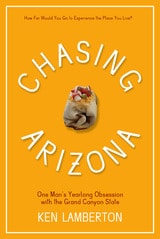
Chasing Arizona
One Man’s Yearlong Obsession with the Grand Canyon StateKen Lamberton
University of Arizona Press, 2015
Lamberton chases the four corners of Arizona, attempts every county, every reservation, and every national monument and state park, from the smallest community to the largest city. He drives his Kia Rio through the longest tunnels and across the highest suspension bridges, hikes the hottest deserts, and climbs the tallest mountain, all while visiting the people, places, and treasures that make Arizona great.
In the vivid, lyrical, often humorous prose the author is known for, each destination weaves together stories of history, nature, and people, along with entertaining side adventures and excursions. Maps and forty-four of the author’s detailed pencil drawings illustrate the journey.
Chasing Arizona is unlike any book of its kind. It is an adventure story, a tale of Arizona, a road-warrior narrative. It is a quest to see and experience as much of Arizona as possible. Through intimate portrayals of people and place, readers deeply experience the Grand Canyon State and at the same time celebrate what makes Arizona a wonderful place to visit and live.
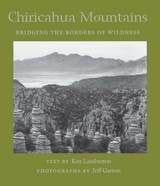
Chiricahua Mountains
Bridging the Borders of WildnessText by Ken Lamberton; Photographs by Jeff Garton
University of Arizona Press, 2003
Lamberton shares insights about the geology, habitats, and diversity of wildlife in a place of such isolation that species must either adapt or become extinct. The Chiricahuas are one link in a chain of mountains connecting the Rockies to the Sierra Madre Occidental in Mexico, and some Madrean species reach the northernmost extension of their ranges here: birds like sulphur-bellied flycatchers, mammals like jaguarundis, and trees like the Apache pine. But this is not an untraveled wilderness. We learn why the Chiricahuas are so popular with birders, who flock to these mountains from around the world in the hopes of spotting some of the nearly four hundred avian species found here. We also learn something of the Chiricahua's rich human culture, from Apache warriors to European settlers.
Gracing the text are more than a dozen black-and-white photographs by Jeff Garton that offer views of the Chiricahuas different from those usually found in tourist brochures: landscapes and riparian settings, rock formations and plant studies that give readers a lasting impression of the beauty and tranquility of this wilderness. Together words and images convey an intimate view of one of the Southwest's most exotic locations—stronghold, paradise, and everlasting island in the vast and rolling desert.
Chronological Analysis of Tsegi Phase Sites in Northeastern Arizona
Jeffrey S. Dean
University of Arizona Press, 1970
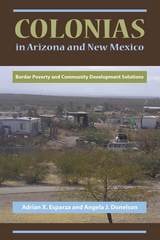
Colonias in Arizona and New Mexico
Border Poverty and Community Development SolutionsAdrian X. Esparza and Angela J. Donelson
University of Arizona Press, 2008
Beginning with an examination of the origins of border region settlement and the emergence of colonias in southern Arizona and New Mexico in the late 1800s, the book then turns to an assessment of current social, economic, and housing conditions. The authors also examine how Mexico’s recent economic crises and U.S. immigration and border security policies have shaped the quality of life in colonias, and they evaluate recent community development initiatives. By examining the challenges and successes of these recent efforts, the authors are able to provide a generalized plan for community development. Balancing analyses of these communities with a review of the positive steps taken to improve the quality of life of their inhabitants, Colonias in Arizona and New Mexico is an indispensable tool for anyone interested in public policy or immigration issues.
Connected Communities
Networks, Identity, and Social Change in the Ancient Cibola WorldMatthew A. Peeples
University of Arizona Press, 2018
In Connected Communities, Matthew A. Peeples examines a period of dramatic social and political transformation in the ancient Cibola region (ca. A.D. 1150–1325). He analyzes archaeological data generated during a century of research through the lens of new and original social theories and methods focused on exploring identity, social networks, and social transformation. In so doing, he demonstrates the value of comparative, synthetic analysis.
The book addresses some of the oldest enduring questions in archaeology: How do large-scale social identities form? How do they change? How can we study such processes using material remains? Peeples approaches these questions using a new set of methods and models from the broader comparative social sciences (relational sociology and social networks) to track the trajectories of social groups in terms of both networks of interactions (relations) and expressions of similarity or difference (categories). He argues that archaeological research has too often conflated these different kinds of social identity and that this has hindered efforts to understand the drivers of social change.
In his strikingly original approach, Peeples combines massive amounts of new data and comparative explorations of contemporary social movements to provide new insights into how social identities formed and changed during this key period.
Coronado National Memorial
A History of Montezuma Canyon and the Southern HuachucasJoseph P. Sánchez
University of Nevada Press, 2017
Sánchez is the foremost historian of the area, and he shifts through and decodes a number of key Spanish and English language documents from different archives that tell the story of an historical drama of epic proportions. He combines the regional and the global, starting with the prehistory of the area. He covers Spanish colonial contact, settlement missions, the Mexican Territorial period, land grants, and the ultimate formation of the international border that set the stage for the creation of the Coronado National Memorial in 1952.
Much has been written about southwestern Arizona and northeastern Sonora, and in many ways this book complements those efforts and delivers details about the region’s colorful past.
Cowboy is a Verb
Notes from a Modern-day RancherRichard Collins
University of Nevada Press, 2019
A born storyteller with a flair for words, Collins breathes life into the geology, history, and interdependency of land, water, and native and introduced plants and animals. He conjures indelible portraits of the hardworking, dedicated people he comes to know. With both humor and humility, he recounts the day-to-day challenges of ranch life such as how to build a productive herd, distribute your cattle evenly across a rough and rocky landscape, and establish a grazing system that allows pastures enough time to recover. He also intimately recounts a battle over the endangered Gila topminnow and how he and his neighbors worked with university range scientists, forest service conservationists, and funding agencies to improve their ranches as well as the ecological health of the Redrock Canyon watershed.
Ranchers who want to stay in the game don’t dominate the landscape; instead, they have to continually study the land and the animals it supports. Collins is a keen observer of both. He demonstrates that patience, resilience, and a common-sense approach to conservation and range management are what counts, combined with an enduring affection for nature, its animals, and the land. Cowboy is a Verb is not a romanticized story of cowboy life on the range, rather it is a complex story of the complicated work involved with being a rancher in the twenty-first-century West.
Crossing the Yard
Thirty Years as a Prison VolunteerRichard Shelton
University of Arizona Press, 2007
Richard Shelton was a young English professor in 1970 when a convict named Charles Schmid—a serial killer dubbed the “Pied Piper of Tucson” in national magazines—shared his brooding verse. But for Shelton, the novelty of meeting a death-row monster became a thirty-year commitment to helping prisoners express themselves. Shelton began organizing creative writing workshops behind bars, and in this gritty memoir he offers up a chronicle of reaching out to forgotten men and women—and of creativity blossoming in a repressive environment. He tells of published students such as Paul Ashley, Greg Forker, Ken Lamberton, and Jimmy Santiago Baca who have made names for themselves through their writing instead of their crimes. Shelton also recounts the bittersweet triumph of seeing work published by men who later met with agonizing deaths, and the despair of seeing the creative strides of inmates broken by politically motivated transfers to private prisons. And his memoir bristles with hard-edged experiences, ranging from inside knowledge of prison breaks to a workshop conducted while a riot raged outside a barricaded door. Reflecting on his decision to tutor Schmid, Shelton sees that the choice “has led me through bloody tragedies and terrible disappointments to a better understanding of what it means to be human.”
Crossing the Yard is a rare story of professional fulfillment—and a testament to the transformative power of writing.
Cultural and Environmental History of Cienega Valley, Southeastern Arizona
Frank W. Eddy and Maurice E. Cooley
University of Arizona Press, 1983