Results by title
69 books match the query 'Art, American' and 4 start with c
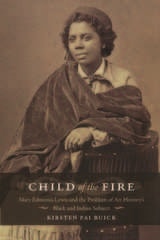
Child of the Fire
Mary Edmonia Lewis and the Problem of Art History's Black and Indian SubjectKirsten Pai Buick
Duke University Press, 2010
Buick considers the institutions and people that supported Lewis’s career—including Oberlin College, abolitionists in Boston, and American expatriates in Italy—and she explores how their agendas affected the way they perceived and described the artist. Analyzing four of Lewis’s most popular sculptures, each created between 1866 and 1876, Buick discusses interpretations of Hiawatha in terms of the cultural impact of Henry Wadsworth Longfellow’s epic poem The Song of Hiawatha; Forever Free and Hagar in the Wilderness in light of art historians’ assumptions that artworks created by African American artists necessarily reflect African American themes; and The Death of Cleopatra in relation to broader problems of reading art as a reflection of identity.
Circulation
Edited by François Brunet
Terra Foundation for American Art, 2017
The third volume in the Terra Foundation Essays series, Circulation brings together an international and interdisciplinary team of scholars, including Thierry Gervais, Tom Gunning, J. M. Mancini, Frank Mehring, and Hélène Valance, who map the multiple planes where artistic meaning has been produced by the circulation of art from the eighteenth century to the present. The book looks at both broad historical trends and the successes and failures of particular works of art from a wide variety of artists and styles. Together, the contributions significantly expand the conceptual and methodological terrain of scholarship on American art.
Collecting the Now
On the Financial Side of Postwar Art HistoryMichael Maizels
University of Michigan Press, 2022
Collecting the Now offers a new, in-depth look at the economic forces and institutional actors that have shaped the outlines of postwar art history, with a particular focus on American art, 1960–1990. Working through four case studies, Michael Maizels illuminates how a set of dealers and patrons conditioned the iconic developments of this period: the profusions of pop art, the quixotic impossibility of land art, the dissemination of new media, and the speculation-fueled neo-expressionist painting of the 1980s.
This book addresses a question of pivotal importance to a swath of art history that has already received substantial scholarly investigation. We now have a clear, nuanced understanding of why certain evolutions took place: why pop artists exploded the delimited parameters of aesthetic modernism, why land artists further strove against the object form itself, and why artists returned to (neo-)traditional painting in the 1980s. But remarkably elided by extant scholarship has been the question of how. How did conditions coalesce around pop so that its artists entered into museum collections, and scholarly analyses, at pace unprecedented in the prior history of art? How, when seeking to transcend the delimited gallery object, were land artists able to create monumental (and by extension, monumentally expensive), interventions in the extreme wilds of the Western deserts? And how did the esoteric objects of media art come eventually to scholarly attention in the sustained absence of academic interest or a private market? The answers to these questions lie in an exploration of the financial conditions and funding mechanisms through which these works were created, advertised, distributed, and preserved.
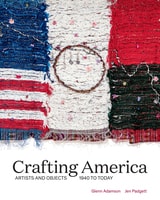
Crafting America
Artists and Objects, 1940 to TodayJen Padgett
University of Arkansas Press, 2020
Craft is a diverse, democratic art form practiced by Americans of every gender, age, ethnicity, and class. Crafting America traces this expansive range of skilled making in a variety of forms, from ceramics and wood to performance costume and community-based practice. In exploring the intertwining of craft and American experience, this volume reveals how artists leverage their craft to realize the values of life, liberty, and the pursuit of happiness.
Accompanying an exhibition of the same title organized by Crystal Bridges Museum of American Art, Crafting America features contributions from scholars that illuminate craft’s relationship to ritual and memory, personal independence, abstraction, and Native American histories. The richly illustrated catalog section—with more than a hundred color images accompanied by lively commentary—presents a vivid picture of American craft over the past eight decades, offering fresh insights on the relationships between objects.
Building upon recent advances in craft scholarship and encouraging more inclusive narratives, Crafting America presents a bold statement on the vital role of craft within the broader context of American art and identity.