Results by title
133 books match the query 'Artists' and 10 start with c

Ceramic Figures
A Directory of ArtistsFlynn, Michael
Rutgers University Press, 2002
Figurative ceramics is one of the most exciting and innovative areas of art today. Though ceramics has been unfashionable in the past, the last twenty-five years have seen a worldwide resurgence of interest in this art form among artists, galleries, and the public.
In this book, Michael Flynn looks back at the last twenty-five years and selects over one hundred of the most important artists working with ceramic figures. He also includes ceramicists from earlier in the century whose work has had an influence on the subject. The work ranges from porcelain to raku and from the small to the monumental.
Ceramic Figures is arranged alphabetically by last name, giving a thumbnail sketch of the artist and showing a variety of the artist’s work. Major galleries and collections where the pieces appear are also included. The result is a spectacular international survey of this most captivating of subjects.
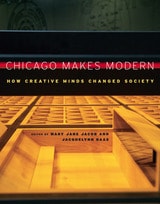
Chicago Makes Modern
How Creative Minds Changed SocietyEdited by Mary Jane Jacob and Jacquelynn Baas
University of Chicago Press, 2012
Chicago is a city dedicated to the modern—from the skyscrapers that punctuate its skyline to the spirited style that inflects many of its dwellings and institutions, from the New Bauhaus to Hull-House. Despite this, the city has long been overlooked as a locus for modernism in the arts, its rich tradition of architecture, design, and education disregarded. Still the modern in Chicago continues to thrive, as new generations of artists incorporate its legacy into fresh visions for the future. Chicago Makes Modern boldly remaps twentieth-century modernism from our new-century perspective by asking an imperative question: How did the modern mind—deeply reflective, yet simultaneously directed—help to dramatically alter our perspectives on the world and make it new?
Returning the city to its rightful position at the heart of a multidimensional movement that changed the face of the twentieth century, Chicago Makes Modern applies the missions of a brilliant group of innovators to our own time. From the radical social and artistic perspectives implemented by Jane Addams, John Dewey, and Buckminster Fuller to the avant-garde designs of László Moholy-Nagy and Mies van der Rohe, the prodigious offerings of Chicago's modern minds left an indelible legacy for future generations. Staging the city as a laboratory for some of our most heralded cultural experiments, Chicago Makes Modern reimagines the modern as a space of self-realization and social progress—where individual visions triggered profound change. Featuring contributions from an acclaimed roster of contemporary artists, critics, and scholars, this book demonstrates how and why the Windy City continues to drive the modern world.
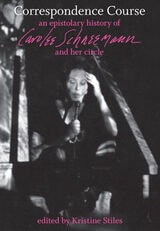
Correspondence Course
An Epistolary History of Carolee Schneemann and Her CircleKristine Stiles, ed.
Duke University Press, 2010
Kristine Stiles selected, edited, annotated, and wrote the introduction to the letters, assembling them so that readers can follow the development of Schneemann’s art, thought, and private and public relationships. The correspondence chronicles a history of energy and invention, joy and sorrow, and charged personal and artistic struggles. It sheds light on the internecine aesthetic politics and mundane activities that constitute the exasperating vicissitudes of making art, building an artistic reputation, and negotiating an industry as unpredictable and demanding as the art world in the mid- to late twentieth century.
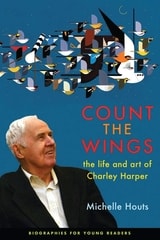
Count the Wings
The Life and Art of Charley HarperMichelle Houts
Ohio University Press, 2018
When you look at a bird, do you see feathers and a beak? Or do you see circles and triangles? Artist Charley Harper spent his life reducing subjects to their simplest forms, their basic lines and shapes. This resulted in what he called minimal realism and the style that would become easily recognized as Charley Harper’s. Art fans and nature lovers around the world fell in love with Harper’s paintings, which often featured bright colors and intriguing nature subjects.
Harper’s love of painting and drawing led him from the hills of West Virginia to the bombed-out villages of Europe, to the streets of New York City, and to the halls of the Art Academy of Cincinnati. How did the farm boy who didn’t know a single artist become one of America’s most recognized midcentury modern painters? The answer is simple. He did it by counting the wings.
Count the Wings is the first book for middle-grade readers about Harper’s life and work. Author Michelle Houts worked closely with the Harper estate to include full-color illustrations, plentiful supplemental materials, and discussion questions that will intrigue and engage young readers. Count the Wings is part of our acclaimed Biographies for Young Readers series, which brings smart, expertly researched books about often overlooked but exceptional individuals to school-age readers.
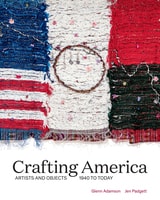
Crafting America
Artists and Objects, 1940 to TodayJen Padgett
University of Arkansas Press, 2020
Craft is a diverse, democratic art form practiced by Americans of every gender, age, ethnicity, and class. Crafting America traces this expansive range of skilled making in a variety of forms, from ceramics and wood to performance costume and community-based practice. In exploring the intertwining of craft and American experience, this volume reveals how artists leverage their craft to realize the values of life, liberty, and the pursuit of happiness.
Accompanying an exhibition of the same title organized by Crystal Bridges Museum of American Art, Crafting America features contributions from scholars that illuminate craft’s relationship to ritual and memory, personal independence, abstraction, and Native American histories. The richly illustrated catalog section—with more than a hundred color images accompanied by lively commentary—presents a vivid picture of American craft over the past eight decades, offering fresh insights on the relationships between objects.
Building upon recent advances in craft scholarship and encouraging more inclusive narratives, Crafting America presents a bold statement on the vital role of craft within the broader context of American art and identity.
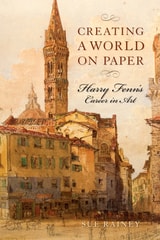
Creating a World on Paper
Harry Fenn's Career in ArtSue Rainey
University of Massachusetts Press, 2013
Arriving in New York from London in 1857 as a young wood engraver, Fenn soon forged a career in illustration. His tiny black-and-white wood engravings for Whittier's Snow-Bound (1868) surprised critics with their power, and his bold, innovative compositions for Picturesque America (1872–74) were enormously popular and expanded the field for illustrators and publishers. In the 1880s and '90s, his illustrations appeared in many of the finest magazines and newspapers, depicting the places and events that interested the public—from post–Civil War national reconciliation to the World's Columbian Exposition in 1893 to the beginnings of imperialism in the Spanish-American War.
This handsomely designed volume documents Fenn's prolific career from the 1860s until his death in 1911. Sue Rainey also recounts his adventurous sketching trips in the western United States, Europe, and the Middle East, which enhanced his reputation for depicting far-flung places at a time when the nation was taking a more prominent role on the world stage.
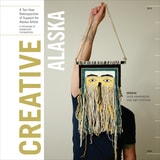
Creative Alaska
A Ten-Year Retrospective of Support for Alaska Artists, 2004-2013Edited by Sven Haakanson and Amy Steffian
University of Alaska Press, 2016
Creative Alaska profiles the award winners from 2004 to 2013 in three categories: Distinguished Artists, Fellowships, and Project Awards. Richly illustrated accounts of each of the artists and their work illuminate the challenges and opportunities of the artistic life in Alaska and the powerful impact of the Rasmuson Foundation’s support.

Creative Infrastructures
Artists, Money and Entrepreneurial ActionLinda Essig
Intellect Books, 2022
As in sports, business, and other sectors, the top 1% of artists have disproportionately influenced public expectations for what it means to be successful. In Creative Infrastructures, Linda Essig takes an unconventional approach and looks at the quotidian artist—and at what they do, not what they make. All too often, artists who are attentive to the business side of their creative practice are accused of selling out. But for many working artists, that attention to business is what enables them not just to survive but to thrive. When artists follow their mission, Essig contends that they don’t sell out, they spiral up by keeping mission at the forefront. Through illustrative case studies from culturally and racially diverse communities, Essig examines the relationships between art, innovation, entrepreneurship, and money while offering a theory for arts entrepreneurship that places more emphasis on means than ends.
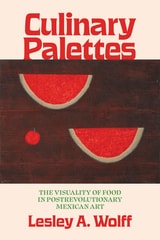
Culinary Palettes
The Visuality of Food in Postrevolutionary Mexican ArtLesley A. Wolff
University of Texas Press, 2025
2026 Mejor libro Humanidades, Mexico Section of the Latin American Studies Association
2026 Honorable Mention, First Book Prize, Cultural Studies Association
2025 Excellence in Scholarly Research and Publication Award, SECAC (formerly the Southeastern College Art Conference)
How the visual culture of food, cookery, and consumption played a central role in the making of postrevolutionary Mexico.
Postrevolutionary Mexico City was a site of anxious nation-building, as rampant modernization converged and clashed with the nation’s growing nostalgia for its pre-Columbian heritage. During this volatile period, food became a meaningful symbol for a Mexican citizenry seeking new modes of national participation.
Culinary Palettes explores how the artistic invocation of food cultures became an arena in which to negotiate the political entanglements of postrevolutionary Mexico. Lesley Wolff casts a nuanced eye on the work of visual artists such as Tina Modotti, Carlos González, and Rufino Tamayo, who nurtured the symbolic and performative power of iconic foods such as pulque, mole poblano, and watermelon. Through analysis of a wide array of visual evidence, including paintings, architecture, vintage postcards, menus, and cookbooks, Culinary Palettes demonstrates how these artists positioned their work within a broad visual landscape that relied upon the power of Mexican foodways in the urban and national imagination. In the studios of modernists, Wolff argues, artistic production, foodways, and Indigeneity proved to be mutually constitutive—and at times weaponized—agents in articulating competing claims to a new nationhood.
Culture Incorporated
Museums, Artists, And Corporate SponsorshipsMark W. Rectanus
University of Minnesota Press, 2002
An exposé of the hidden costs of corporate funding of the arts
Photographer Annie Leibowitz collaborates with American Express on a portrait exhibition. Absolut Vodka engages artists for their advertisements. Philip Morris mounts an "Arts Against Hunger" campaign in partnership with prominent museums. Is it art or PR, and where is the line that separates the artistic from the corporate? According to Mark Rectanus, that line has blurred. These mergers of art, business, and museums, he argues, are examples of the worldwide privatization of cultural funding.
In Culture Incorporated, Rectanus calls for full disclosure of corporate involvement in cultural events and examines how corporations, art institutions, and foundations are reshaping the cultural terrain. In turn, he also shows how that ground is destabilized by artists subverting these same institutions to create a heightened awareness of critical alternatives. Rectanus exposes how sponsorship helps maintain social legitimation in a time when corporations are the target of significant criticism. He provides wide-ranging examples of artists and institutions grappling with corporate sponsorship, including artists’s collaboration with sponsors, corporate sponsorship of museum exhibitions, festivals, and rock concerts, and cybersponsoring. Throughout, Rectanus analyzes the convergence of cultural institutions with global corporate politics and its influence on our culture and our communities.